IMDb RATING
7.4/10
3.3K
YOUR RATING


Join a voyage through aquatic realms where humans have rarely dared to go. Waddle with playful penguins, dart with lightning speed through schools of sharks, ride over stormy waves with mass... Read allJoin a voyage through aquatic realms where humans have rarely dared to go. Waddle with playful penguins, dart with lightning speed through schools of sharks, ride over stormy waves with massive whales and view rare alien-like creatures.Join a voyage through aquatic realms where humans have rarely dared to go. Waddle with playful penguins, dart with lightning speed through schools of sharks, ride over stormy waves with massive whales and view rare alien-like creatures.
- Directors
- Writers
- Stars

Pierce Brosnan
- Self - Narrator
- (voice: English version)


Frank Glaubrecht
- Self - Narrator
- (voice: German version)


Dalik Wollinitz
- Self - Narrator (voice: Hebrew version)
- (as Dalik Volonitz)
- Directors
- Writers
- All cast & crew
- Production, box office & more at IMDbPro
7.43.2K
1
2
3
4
5
6
7
8
9
10
Featured reviews
Surprise!
We watched this film in school the other day. I thought that it would have just been some half-hour National Geographic special on the ocean, but it was actually a real movie. They showed us creatures at the bottom of the ocean, and more. The cinematography was excellent, and the music score was also well-done. It always fit with what was going on. It wasn't just some footage from Jaws 4 and an Australian-voiced cartoon character making shark jokes. It was a very well done film, and it was narrated by Pierce Brosnan of James Bond fame. I suggest renting it or something. Hope this review was helpful and all. I give Deep Blue an 8/10.
Astounding.
I studied marine biology for a couple years in college, and this movie has some of the most amazing underwater footage I've ever seen. It's a fascinating journey into the ocean, particularly the parts that most of us will never see, like the arctic regions and the deepest reaches of the deep ocean. Some of the shots themselves are incredible just in the way the camera crew were able to immerse themselves in the biological communities that they were filming, especially the feeding scenes. Anyone with even a passing interest in the ocean and the mysteries of life on this planet should definitely not miss this. This movie is an explanation for why so many people believe that our planet should be called Oceanus rather than Earth.
Despite the lack of detail this is a natural visual feast
Water makes up most of the Earth and, unlike the surface ecosystems, it is the hardest for man to explore, inhabit or bulldoze. It is the closest thing to having a different planet, except right here on Earth. As such I was looking forward to watching this film because of the excellent footage of the many amazing creatures and ecosystems that ever improving technology allow us to get closer to. I'm not really one for nature programmes so maybe that is why I was extra impressed by the film because such stuff has not become "ordinary" to me. At the start of the film I must admit that I was watching the "ordinary"; whales, crabs and seals fitted into that category to me but once the camera went deeper into the oceans it only became more and more fascinating with such weird and wonderful creatures on display.
This goes for the shallower depths as well, as fish, whales, sharks etc are all very well presented and gorgeous to watch. Indeed that is the strength of the film the beauty of it. It is fascinating to watch and the expertise in filming shines through from start to finish. However it is the appreciation of the view where the film is weak. Gambon's narration is sparse and even but it only occasionally gives out nuggets of information. I didn't expect detail like David Attenborough would give but it could have done with something more to compliment the visuals. The music covers the lack of narration and generally the score is well pitched to support the air of wonder or pace to the film.
Overall this is a great visual treat, even if it is mostly going to be seen on the small screen. It all looks impressive and is fascinating but a bit more narration and detail would have been useful. Best viewed as a visual experience or as an entry into the wider genre of nature programmes.
This goes for the shallower depths as well, as fish, whales, sharks etc are all very well presented and gorgeous to watch. Indeed that is the strength of the film the beauty of it. It is fascinating to watch and the expertise in filming shines through from start to finish. However it is the appreciation of the view where the film is weak. Gambon's narration is sparse and even but it only occasionally gives out nuggets of information. I didn't expect detail like David Attenborough would give but it could have done with something more to compliment the visuals. The music covers the lack of narration and generally the score is well pitched to support the air of wonder or pace to the film.
Overall this is a great visual treat, even if it is mostly going to be seen on the small screen. It all looks impressive and is fascinating but a bit more narration and detail would have been useful. Best viewed as a visual experience or as an entry into the wider genre of nature programmes.
Visually Arresting Snapshot of Oceanic Life
I had the opportunity to watch this movie during the Seattle International Film Festival, and I was amazed. I haven't seen the documentary series "Deep Blue Sea" on which it was based, so I cannot comment on how the film compares to that series. What I can say is for any of you who are interested in animal behavior above and below the ocean's surface, you will be amazed. This film has few interruptions between wonderfully paced and edited clips of animal behavior. While I had seen almost all of the animals and plant life that appear in this movie before, this gave me a new and thrilling opportunity to see their lives as the animals themselves do. You hear their voices and experience their emotions. The soundtrack kept me emotionally captivated for the entire 90 minute run time. The filmmakers don't try to narrate the behavior, but let you experience it first hand, to a thrilling effect.
However, this movie is not for the faint of heart. The filmmakers spare no detail in showing close up the threats posed to smaller sea life by larger and more voracious variations of life. With that in mind, I recommend keeping young children away from this movie. The children sitting a few rows in front of me in the theater gasped and held onto their parents during the violent scenes in the film.
If you do see this movie, make a point to do it on the biggest screen you can find, and sit as close as you can.
However, this movie is not for the faint of heart. The filmmakers spare no detail in showing close up the threats posed to smaller sea life by larger and more voracious variations of life. With that in mind, I recommend keeping young children away from this movie. The children sitting a few rows in front of me in the theater gasped and held onto their parents during the violent scenes in the film.
If you do see this movie, make a point to do it on the biggest screen you can find, and sit as close as you can.
Dazzling Visual Images of Ocean Life
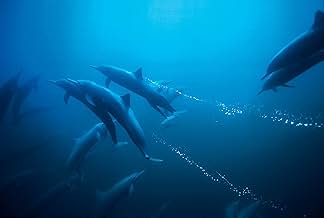
The beginning of this documentary is devoid of credits. We see dolphins swimming and leaping in the open water and sea birds diving directly into the ocean to snatch a fish. The narrator (Pierce Brosnan) says, "This is a world of constant jeopardy, an endless cycle of birth, death, and renewal." Powerful waves crash into the rocky coast, where the sea lions return to give birth, but unwary seals become prey to predators (the black and white colored killer whales) in the shallows at high tide. Then again, the whales themselves risk being stranded there.
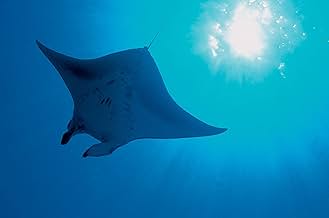
More marine life is seen before the view shifts to the coral reefs, "a narrow band of sun-fed life only found in the shallows of the tropical seas." The skeletons of coral polyps – the smallest and most fragile of organisms – form the reef. The darkness is feeding time for some; the night-feeders with built-in sensors have no need of light. Fascinating and colorful sea creatures abound further below the ocean surface, but unfortunately most are not identified. There are poisonous jellyfish and manta rays. Just before the halfway mark of the film the scene moves to the Arctic (polar bears) and also Antarctic (penguins). In the Antarctic the temperature is seventy degrees below zero (-70°F) and the winds exceed one hundred miles per hour. The penguins gather speed in the cold waters before jumping out and landing on sheet ice. Meanwhile in the far north the polar bears search for nesting seals hidden in ice caves situated just below the surface. Thirty-ton gray whales travel six thousand miles to feed in the polar seas. After six hours of jostling, killer whales separate one unfortunate gray calf from its mother and move in when it is thoroughly exhausted.
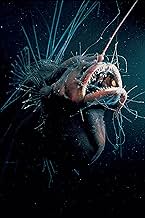
From the surface of the ocean we next enter a subterranean world, the deepest underwater area on the planet and where surface light does not penetrate. Seven miles deep (the Marianas Trench), it is a mystery world of perpetual night. It is a sparsely explored netherworld of odd life forms (again unidentified). The only light emanates from the undersea creatures themselves. Light is used as a lure to attract prey or as a decoy to confuse them. Poisonous hydrogen sulfide gas and boiling water spew forth in some areas. Yet, even near those settings some life forms exist. At film's end we hear that there are only a few thousand blue whales left on earth. The blue whales are earth's largest creatures by far.
The narration is limited and the orchestral music appropriate. If you like nature documentaries, you will enjoy this one, although there are several lulls.
More marine life is seen before the view shifts to the coral reefs, "a narrow band of sun-fed life only found in the shallows of the tropical seas." The skeletons of coral polyps – the smallest and most fragile of organisms – form the reef. The darkness is feeding time for some; the night-feeders with built-in sensors have no need of light. Fascinating and colorful sea creatures abound further below the ocean surface, but unfortunately most are not identified. There are poisonous jellyfish and manta rays. Just before the halfway mark of the film the scene moves to the Arctic (polar bears) and also Antarctic (penguins). In the Antarctic the temperature is seventy degrees below zero (-70°F) and the winds exceed one hundred miles per hour. The penguins gather speed in the cold waters before jumping out and landing on sheet ice. Meanwhile in the far north the polar bears search for nesting seals hidden in ice caves situated just below the surface. Thirty-ton gray whales travel six thousand miles to feed in the polar seas. After six hours of jostling, killer whales separate one unfortunate gray calf from its mother and move in when it is thoroughly exhausted.
From the surface of the ocean we next enter a subterranean world, the deepest underwater area on the planet and where surface light does not penetrate. Seven miles deep (the Marianas Trench), it is a mystery world of perpetual night. It is a sparsely explored netherworld of odd life forms (again unidentified). The only light emanates from the undersea creatures themselves. Light is used as a lure to attract prey or as a decoy to confuse them. Poisonous hydrogen sulfide gas and boiling water spew forth in some areas. Yet, even near those settings some life forms exist. At film's end we hear that there are only a few thousand blue whales left on earth. The blue whales are earth's largest creatures by far.
The narration is limited and the orchestral music appropriate. If you like nature documentaries, you will enjoy this one, although there are several lulls.


Did you know
- ConnectionsEdited from The Blue Planet (2001)
- How long is Deep Blue?Powered by Alexa
Details
- Release date
- Countries of origin
- Official site
- Language
- Also known as
- Đại Dương Xanh Thẳm
- Filming locations
- Production companies
- See more company credits at IMDbPro
Box office
- Budget
- $5,000,000 (estimated)
- Gross US & Canada
- $132,261
- Opening weekend US & Canada
- $8,373
- Jun 5, 2005
- Gross worldwide
- $19,292,539
- Runtime
- 1h 23m(83 min)
- Color
- Sound mix
- Aspect ratio
- 1.85 : 1
Contribute to this page
Suggest an edit or add missing content