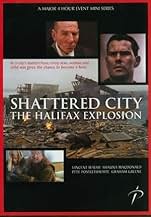
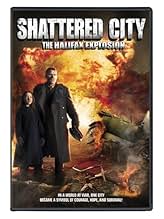
A true story about the tragic explosion at Halifax Harbour, Canada, in the early hours of December 6, 1917.A true story about the tragic explosion at Halifax Harbour, Canada, in the early hours of December 6, 1917.A true story about the tragic explosion at Halifax Harbour, Canada, in the early hours of December 6, 1917.
- Awards
- 8 wins & 6 nominations total
Browse episodes
Featured reviews
Shattered City is a highly enjoyable retelling of an almost forgotten event in Canadian history. I am from Halifax, and for me, the sight of the ships exploding in the harbour was a visceral experience. The blast, which occurred in December, 1917, was the largest man-made explosion before Hiroshima, killed 2000 people instantly and vaporized two square miles of the city of Halifax.
I could have done without some of the more soap opera-like elements of it, but in all, I was engaged by the characters and moved by their horrendous plight. Although plagued by a low budget($10 million), the show did an excellent job of recreating wartime Halifax and the harbour, and the people felt authentic as they went about their daily lives.
This film is highly recommended for anyone who enjoys a good story of human courage and drama, and is a must-see for any fan of Canadian history.
Postscript: I now live in northern Canada, and watched the show with a group of westerners and northerners. None of them had heard of the Halifax Explosion. What a sad commentary on our woefully provincial education systems and on our ability to tell our own stories.
I could have done without some of the more soap opera-like elements of it, but in all, I was engaged by the characters and moved by their horrendous plight. Although plagued by a low budget($10 million), the show did an excellent job of recreating wartime Halifax and the harbour, and the people felt authentic as they went about their daily lives.
This film is highly recommended for anyone who enjoys a good story of human courage and drama, and is a must-see for any fan of Canadian history.
Postscript: I now live in northern Canada, and watched the show with a group of westerners and northerners. None of them had heard of the Halifax Explosion. What a sad commentary on our woefully provincial education systems and on our ability to tell our own stories.
I really liked Vincent Walsh as the lead. He was very convincing in both the family-oriented scenes and the action stuff. The impending tragedy and the mundane actions that led to it were well-played and very gripping. It was nice to see a number of veteran Canadian actors like Lynne Griffin and Graham Green in large and small roles. I also thought the subplot about German saboteurs was both nicely diverting and added to the suspense. While Canadian productions can never hope to compete with Hollywood for budget and special effects, they can provide a Canadian "feel" to a project and "Shattered City" does that very well.
CBC is doing what it is supposed to do and it's hard to fault them for that. This story of the Halifax Explosion of 1917 is good but it could be much better. It's also plagued by small errors. (A CNR logo in 1917? WW2 style posters in WW1. A 1930's folding camera with a flash? I don't think so. I spotted these in the first episode. I'm sure there were others.) The characters in the stories woven through the tragedy are both predictable and one dimensional. However the drama leading up to the explosion is well executed and the recreation of Halifax harbour full of old ships is effective. It's good but falls far short of being great.
While this movie, and The Perfect Storm, and many others about war, ships and whatever else may be BASED on true stories and events...they are NOT true stories.
As there was NOT always somebody in every location at every second to document the event and the speeches and actions that people did, much of this story is fiction.
I found the movie interesting, that's for sure.
I found it a good insight to the event with a basic understanding to the incident...but it is still partially fiction.
What did impress me very much was that a film of this magnitude, a huge cast, a huge set, special effects and locations can be filmed for only 10 million dollars while a movie which takes place in very few locations with very few actors, few effects, few sets and much less than this film had will be shot for three or 4 times the budget.
Whoever worked the finances on this movie should be in public office to deal with the finances the Canadian and Provincial Governments budget problems.
They obviously know how to control the spending of money to the extreme.
Make-up, set design, acting and everything else was great too.
I am just overly impress with the people behind the cash flow...they really know how to spend the money, so that every cent is made to work.
As there was NOT always somebody in every location at every second to document the event and the speeches and actions that people did, much of this story is fiction.
I found the movie interesting, that's for sure.
I found it a good insight to the event with a basic understanding to the incident...but it is still partially fiction.
What did impress me very much was that a film of this magnitude, a huge cast, a huge set, special effects and locations can be filmed for only 10 million dollars while a movie which takes place in very few locations with very few actors, few effects, few sets and much less than this film had will be shot for three or 4 times the budget.
Whoever worked the finances on this movie should be in public office to deal with the finances the Canadian and Provincial Governments budget problems.
They obviously know how to control the spending of money to the extreme.
Make-up, set design, acting and everything else was great too.
I am just overly impress with the people behind the cash flow...they really know how to spend the money, so that every cent is made to work.
My commentary: First and foremost, while the emphasis was on human error in the movie, the fact is war is a very fertile breeding ground for accidents on top of the deliberate carnage. "Saving Private Ryan" noted this with the mention of the glider that was fitted with armor plating - but no one thought to tell the pilot. So it crashes and six soldiers are killed needlessly. Accounts of war proliferate in tragic incidents such as that one. The Halifax Explosion must be the biggest war-related accident in history.
The Great War featured incomprehensibly vast usage of artillery shells, and artillery shells need TNT and other explosives. A lot of this had to be imported from the U.S., and by ships. Ships had to be gathered in ports. Ports will then see a lot of ships coming and going, and harbor masters are going to be pressed to keep all this traffic moving. The odds were considerable something like the incident of Dec. 6th, 1917 would happen someplace in Allied ports sooner or later.
Captain Le Medec probably wasn't the greatest or bravest mariner of all time. But how many ship captains who have seniority or pull are going to agree to captain a massive floating bomb at the height of the U-boat menace? Second, did anyone notice that the movie exonerates harbor pilot Mackie while making Le Medec and the Belgian captain look like total dolts at the helm; and has Mackie trying to avert disaster while the Frenchman funks off with his crew? Considering it is a Canadian and not a French production, what a surprise.
Then there is the almost defeatist speech Capt. Collins gives to the war rally in the church. Excuse me, an *officer* in HM forces blurting out like that? It simply wouldn't have happened at the time. Contrary to what he later tells Barbara, Germans weren't close to suing for peace at the time, and the war wasn't kept going only because the Allies wanted another year of war profits. Indeed, with the Western Front stalemated and Russia close to surrender, Ludendorff et al were convinced victory for Germany was just around the corner. And a lot of people on the Allied side feared the same thing.
On the plus side, I was impressed by what the production did with a limited CBC budget.
The Great War featured incomprehensibly vast usage of artillery shells, and artillery shells need TNT and other explosives. A lot of this had to be imported from the U.S., and by ships. Ships had to be gathered in ports. Ports will then see a lot of ships coming and going, and harbor masters are going to be pressed to keep all this traffic moving. The odds were considerable something like the incident of Dec. 6th, 1917 would happen someplace in Allied ports sooner or later.
Captain Le Medec probably wasn't the greatest or bravest mariner of all time. But how many ship captains who have seniority or pull are going to agree to captain a massive floating bomb at the height of the U-boat menace? Second, did anyone notice that the movie exonerates harbor pilot Mackie while making Le Medec and the Belgian captain look like total dolts at the helm; and has Mackie trying to avert disaster while the Frenchman funks off with his crew? Considering it is a Canadian and not a French production, what a surprise.
Then there is the almost defeatist speech Capt. Collins gives to the war rally in the church. Excuse me, an *officer* in HM forces blurting out like that? It simply wouldn't have happened at the time. Contrary to what he later tells Barbara, Germans weren't close to suing for peace at the time, and the war wasn't kept going only because the Allies wanted another year of war profits. Indeed, with the Western Front stalemated and Russia close to surrender, Ludendorff et al were convinced victory for Germany was just around the corner. And a lot of people on the Allied side feared the same thing.
On the plus side, I was impressed by what the production did with a limited CBC budget.
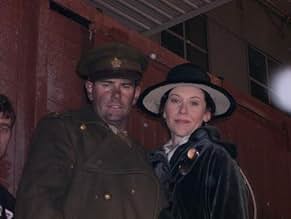
Did you know
- Trivia1,951 people were killed
- GoofsThere is a scene at the railway station in which a rail car carries the old CNR logo (A maple leaf with a box inside it containing the words "Canadian National Railways"). The CNR was formed in 1923.
- Crazy creditsThis film is dedicated to the spirit and the memory of Constance "Connie" Bond Young August 9, 1911 - February 22, 2003
- ConnectionsFollowed by City of Ruins: The Halifax Explosion (2003)
Details
- Release date
- Country of origin
- Official site
- Language
- Also known as
- La explosión de Halifax
- Filming locations
- Production companies
- See more company credits at IMDbPro
- Runtime
- 2h 55m(175 min)
- Color
- Sound mix
- Aspect ratio
- 1.78 : 1
Contribute to this page
Suggest an edit or add missing content