

In 16th century Venice, when a merchant must default on a large loan from an abused Jewish moneylender for a friend with romantic ambitions, the bitterly vengeful creditor demands a gruesome... Read allIn 16th century Venice, when a merchant must default on a large loan from an abused Jewish moneylender for a friend with romantic ambitions, the bitterly vengeful creditor demands a gruesome payment instead.In 16th century Venice, when a merchant must default on a large loan from an abused Jewish moneylender for a friend with romantic ambitions, the bitterly vengeful creditor demands a gruesome payment instead.
- Director
- Writers
- Stars
- Nominated for 1 BAFTA Award
- 2 wins & 7 nominations total






- Aragon
- (as Antonio Gil-Martinez)

- Director
- Writers
- All cast & crew
- Production, box office & more at IMDbPro
Featured reviews
A Gold Casket
The situations and characters that result are extremely rich, and those are the things we notice and remember. They are rich because of the massive talent in how the small turns of phrase support the larger containing notions.
When the plays were performed in the form Shakespeare understood, there were essentially no sets or props and the actors' priorities were to convey the language. He knew nothing of the modern notion of acting where actors create characters, characters drive situations and situations define or illuminate a larger context. That's all backwards from his magical tradition.
So putting on a Shakespearian play today is a challenge of high order, at least doing it in such a way that the genius of the thing shines through. Otherwise, you have something of which we have hundreds of thousands of examples from lesser talents. It is made ever harder because actors believe Shakespeare was created for them, and actors together with other trades who appreciate their perspective control many creative decisions today.
Matters are much worse when conveying Shakespeare to film. The "language" is different bigger including a growing vocabulary of visual language. And the actors are even more unavoidable.
In "Merchant," Shakespeare's big notions had to do with deviation from law in as many forms as he could fit into the play. Foremost among these was the "law" of the dramatic form; this play famously mixes tragedy and comedy. In tragedy, the characters accidentally fall into the machinery of the universe and get ground up, often accelerated by what they "must" do. (In film that would be "noir.")
In Shakespeare's comedies, the characters understand the rules and are able to play with them without hazard for their amusement. (A film equivalent would be screwball.) So one large notion of dealing with law is the very construction of the play: two different notions of law, one within and the other without. Lynch in "Blue Velvet" would similarly have two genres as conflicting characters.
Shakespeare of course piles dozens of other problems with laws, rules and norms into his story: the Venetian legal system, religious prescriptions, and on and on, even down to the duties of a daughter in carrying out her father's eccentric will.
The magic isn't in any of this, impressive as it is. The magic comes in how he constructs the language and metaphors that dart in and out of the various issues and perspectives. Sometimes a metaphor is captured by itself. Sometimes it stands outside itself. Sometimes it even mocks or annotates itself. Its as if he created molecules that have the same lives as the galaxies and then let all the stuff in the middle (people, cities, religions) just emerge but with rich commentary on the laws of emergence.
We do have very good film adaptations of Shakespeare. "Prospero's Books" is a terrifically deep understanding of the spoken and cinematic languages and the self-reference of explicitly portraying the playwright. Branaugh's "Hamlet" appropriately subordinated images and actors (both excellent in his case) to the narrative in the language. Godard's "Lear" is also good, completely translating and discarding the language. Luhrmann's "Romeo and Juliet" takes the kinds of risks with cinematic poetry and magic the source does with language.
Now this. Much has been made of the anti-Semitism, and some about the overt homosexuality. Both are social constructions much younger than this play. For London audiences, no people they knew could be more cartoonish than Italians: foppish, superficial and lacking introspection. This play is anchored on two characters: the aging gay merchant of the title and a rich, ripe orphan virgin. Both end up in differing intrigues over love for the same pretty boy. Both intrigues involve rules, law and money and the writer has them interact.
The Jew and his daughter are secondary, no more important than the contents of the boxes and portrayed no more ruthlessly than the Italians around him. His engagement is more a device to introduce religious law outside that known to the audience. We add the anti-Semitism here, something the adapter decided to accentuate.
This is a nice movie. Everything about it is pretty. Even the modern constructions of characters by Pacino and Irons have a prettiness to them, As an ordinary movie (like say, "Amadeus") it is a reasonable filler of time if your life is lacking in prettiness.
But the source has something far richer to feed us with, the ability to be in a story and think about that story: to break our narrative eye into dozens of fairies, some of which dance outside the engagement and some that are swept along. None of that conveys here. We are instead locked into a single narrative thread, despite many cinematic techniques from others that would have allowed otherwise.
Radford chooses the gold box. We have the sex, not the love. Our ships are lost.
Ted's Evaluation -- 2 of 3: Has some interesting elements.
Excellent and well set rendition about Shakespeare ¨pound of flesh¨ story
This very enjoyable film is a balance of both, tragedy and comedy. As is both delightful, disturbing and dramatically marvellous. Al Pacino delivers a wonderfully complex and dark performance. His portrayal is pretty watchable and absolutely memorable, he's a Shakespeare expert , like he proved in ¨Looking for King Richard III¨ which he starred and and directed. I found particularly nice the way the film handled the court rivalry , the antagonism between them and final result. The movie packs an evocative musical score by Jocelyn Pock(Eye wide shut) and colorful cinematography by Benoit Delhomme, director's usual cameraman. The motion picture is well directed by Michael Radford. Another adaptation about this known book are mostly made for TV, these are the following : 1973 with Laurence Olivier, Joan Plowright and Jeremy Brett ; 1980 by Jack Gold with Warren Mitchell and John Rhys Davies ; 2001 by Trevor Nunn with Henry Goodman. And by Orson Welles with Oja Kodar but was scrapped and pretended to release with other of his unfinished movies, though never completed when the negatives were mysteriously lost. I would recommend this picture to anybody interested by Shakespeare.
Heavy Editing Brings Mixed Results
But Radford makes these scenes much weaker than necessary. For example, he allows the suitors to overact laughably and also cuts their dialog in a way that limits their complexity -- especially with the Duke, who appears stuck-up but smart in the full text, merely stupidly foppish in the movie. In short, Radford wipes out any hope for either comedy or pathos -- both of which can be found in better productions.
In contrast to the cheesy heterosexuality, the clearly homosexual love of Antonio for Bassanio is quite moving, in large part because it's subtly played by an excellent Jeremy Irons. For that matter, Lynn Collins is much better at portraying Portia in drag than Portia the beautiful, expectant young maiden.
Meanwhile, the Shylock plot is compelling as always and benefits from an excellent performance by Pacino. However, a whole strand of Shylock's character has been more or less eliminated. In the full text, Shylock repeatedly makes it clear that he does *not* merely want revenge for mistreatment -- rather he wants to kill Antonio because Antonio is cutting into his business and bringing down interest rates by lending for free:
"I hate him for he is a Christian; but more for that in low simplicity he lends out money gratis, and brings down the rate of usance here with us in Venice."
That's also why Shylock refuses Bassanio's offer of many times more than Antonio owes -- Shylock knows that it still won't equal what he can make in higher interest if Antonio is dead:
"I will have the heart of him, if he forfeit; for, were he out of Venice, I can make what merchandise I will."
To make Shylock more sympathetic, such cold-hearted calculation is excised almost entirely from this screen version.
Still, by making Shylock less an outright villain, the director arguably improves on the original -- Pacino can appear more intriguingly human, less like the Jewish Snidely Whiplash that Shakespeare frequently gives us.
In all, I felt that about two-thirds of this Merchant was excellent drama, and one third was tedious romantic "comedy."
A great British movie
From the director of the film version of 1984, Michael Radford has created a masterpiece for everyone to enjoy time and time again.
With an outstanding cast that includes Al Pacino, (Shylock) Joseph Fiennes, (Bassanio) Jeremy Irons, (Antonio) Kris Marshall (Gratiano) and Lynn Collins, (Portia); this beautiful movie is a must see for every Shakespeare enthusiast.
The story is set in 15th century Britain when many Jews were sadly persecuted in the streets for no apparent reason. Bassanio with the help of Antonio visit a wealthy Jewish loan shark called Shylock and ask if they may borrow some money so Bassanio can visit his love, Portia. Shylock agrees but demands a pound of flesh from Antonio if he can not meet his strict payment demands.
A while later Antonio can not pay the loan and Shylock demands his pound of flesh. A ferocious court battle then takes place between the two men as Antonio's friends and family gather round to await his verdict.
This is a remarkable cinematic experience with the passionate Al Pacino at his best. Also look out for the rising young star, Kris Marshall from the hit, Love Actually. He played the part of Gratiano which such emotion and dignity.
This film, which will most certainly be up for Oscars, clearly demonstrates that Shakespeare can still entertain crowds centuries from his death.
The Merchant has been reinvented - with a deft hand
The text is quite stripped down with many passages cut. But, I only noticed one line which was cut at the moment when I expected to hear it - and it was replaced by a look that said it all. This economy and judicious editing has given us a gripping movie - not just a film of the play.
And at last, there is a rationale as to why Antonio is so loyal and generous to the undeserving/unrelated Bassanio - you can almost feel Antonio's pulse start to race when he catches glimpse of Bassanio passing by in a gondola, or arriving for a visit. But it is as subtle as that - no more. I was spellbound.
There were many other highlights. I felt the arguments during the trial to be heartbreaking. And, the suitors' trials are hilarious.
Add all that to glorious cinematography and costumes that resonated with the times, and you'll understand why I can't wait to see it again. And again.


Did you know
- TriviaCate Blanchett was set to play Portia, but had to drop out at the last minute after discovering she was pregnant.
- GoofsApproximately 0:02:50 into the film, camera equipment and a man with a black baseball cap w/white logo are seen on the left hand side of the frame. It's a very quick cutaway scene after a couple shots of the white balcony.
- Quotes
Shylock: I am a Jew! Hath not a Jew eyes? hath not a Jew hands, organs, dimensions, senses, affections, passions? Fed with the same food, hurt with the same weapons, subject to the same diseases, healed by the same means, warmed and cooled by the same winter and summer, as a Christian is? If you prick us, do we not bleed? if you tickle us, do we not laugh? if you poison us, do we not die? And if you wrong us, shall we not revenge? If we are like you in the rest, we will resemble you in that. If a Jew wrong a Christian, what is his humility? Revenge. If a Christian wrong a Jew, what should his sufferance be - by Christian example? Why, revenge. The villany you teach me, I will execute, and it shall go hard - but I will better the instruction.
- Crazy creditsPROLOGUE: "Intolerance of the Jews was a fact of 16th century life even in Venice, the most powerful and liberal city state in Europe."
"By law the Jews were forced to live in the old walled foundry or 'Geto' area of the city. After sundown the gate was locked and guarded by Christians."
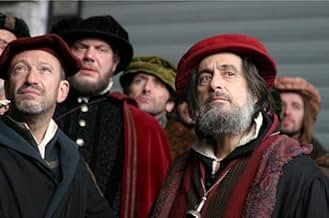
"In the daytime any man leaving the ghetto had to wear a red hat to mark him as a Jew."
"The Jews were forbidden to own property. Thus, they practiced usury, the practice of lending money at interest. This was against Christian law."
"The sophisticated Venetians would turn a blind eye to it but for the religious fanatics, who hated the Jews, it was another matter . . . "
- ConnectionsFeatured in 'Merchant of Venice': Shakespeare Through the Lens (2005)
- SoundtracksWith Wand'ring Steps
Composed by Jocelyn Pook, Lyrics by John Milton
Arranged by Jocelyn Pook
Performed by Baroque Strings Quartet Ensemble, featuring solo vocals by Andreas Scholl
Harp: Siobhan Armstrong
Psaltery: Harvey Brough
Lute: Elizabeth Kenny
Published by Shylock Ltd / EMI Music Publishing Ltd
© 2004 Decca Music Group Limited
(p) Jocelyn Pook Ltd. /2004 Decca Music Group Limited
Details
- Release date
- Countries of origin
- Languages
- Also known as
- William Shakespeare's The Merchant of Venice
- Filming locations
- Esch-sur-Alzette, Luxembourg(only Venice film set)
- Production companies
- See more company credits at IMDbPro
Box office
- Budget
- $30,000,000 (estimated)
- Gross US & Canada
- $3,765,585
- Opening weekend US & Canada
- $69,868
- Jan 2, 2005
- Gross worldwide
- $21,560,182
- Runtime
- 2h 11m(131 min)
- Color
- Sound mix
- Aspect ratio
- 2.35 : 1