

A teenage boy comes of age in the 1970's, sent by his neurotic, pretentious mother to live with a jolly, vulgar psychiatrist and his eccentric extended family.A teenage boy comes of age in the 1970's, sent by his neurotic, pretentious mother to live with a jolly, vulgar psychiatrist and his eccentric extended family.A teenage boy comes of age in the 1970's, sent by his neurotic, pretentious mother to live with a jolly, vulgar psychiatrist and his eccentric extended family.
- Awards
- 3 wins & 7 nominations total





- Director
- Writers
- All cast & crew
- Production, box office & more at IMDbPro
6.123.6K
1
2
3
4
5
6
7
8
9
10
Featured reviews
Love, Pain And Hair
Irritating at times but only at times when the writer, director, producer puts himself in front of the camera and all we see it's him. But, most of the time this is a surprising, smart comedy of pains with a sensational Annette Bening - her best performance without a doubt - her disintegration is, apart from everything else, shattering and absurdly entertaining. She descends her psychic road wrecking havoc wherever she wants to do "the best thing for you". Under the effects of the medication and the advise of her con-shrink she slides away, brilliantly. Alec Baldwin has three little moments that he manages to wrap with so much truth that his character lingers in my mind. Well, there you are, I'm talking about the performances because that's what makes this movie really fly. Jill Claybourgh, Joseph Finnes, Brian Cox, Gwynneth Paltrow, Evan Rachel Wood and Joseph Cross with his literary future and his thing for hair, they all transform this stranger than fiction real life tale into something memorable, yes, memorable. I don't quite understand why this film was so mistreated by critic and public alike. I found more rewarding elements here than in most of what 2006 had to offer at the movies. Give it a try.
Running with Scissors is strange and psychotically contagious
Running with Scissors reviewed by Sam Osborn
I've become all too wary of memoirs lately. Not because of the James Frey debacle, but because they've become the literary equivalent of the biopic at the movies. Just as I've grown tired of seeing the rise and inevitable fall of infamous icons during Oscar season, I've grown tired of plowing through the literary lives of men and women compelled to account their abusive childhoods, sexual deviancy, problems with drugs and alcohol, and, the real must, their harebrained families. The books sell well because readers love gossip, scandal, and melodrama. Running with Scissors has no shortage of such pulpy details, as its hero, Augusten Burroughs, has all the makings of memoir sentimentality. He was born into a selfish, dysfunctional family, adopted by his mother's psychiatrist, attempted suicide, turned out to be gay, and was exposed to sex at a young age under the hands of a man much past his age. His life was, if nothing else, screwed up enough to put into a book. But while I'm a pessimist to the genre, Running with Scissors is strange and psychotically contagious.
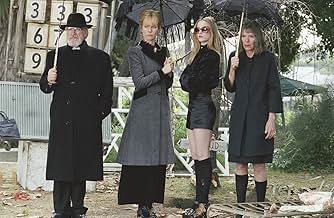
To oversimplify the matter, the film is a collection of people dealing with their issues. Heading up the Burroughs family is Norman Burroughs (Alec Baldwin), a business man with the sedated lick of alcoholism whose only wish seems to be to sidestep his wife's raging narcissism. Dierdre (Annete Bening), his wife, is a selfish would-be writing starlet whose lack of talent is constantly at odds with the confidence that she deserves a Nobel Prize. Her failure she blames on the supposed acts of sabotage by Norman, of which she confides in her only son Augusten. The family begins counseling with Doctor Finch (Brian Cox), the man who eventually adopts Augusten when Norman walks out and Dierdre begins popping Valium like prescription Skittles. The Finch family seems to be no upgrade though, as Agnes (Jill Clayburgh), the mother, is first seen munching on dog kibble, Hope (Gwyneth Paltrow), the favored daughter, is known to talk to her cat Freud, and Natalie (Evan Rachel Wood), the second daughter, tries to open Augusten up by using electro-shock therapy. Their home is an old-money palace painted blazing pink, with various lawn furniture, cobbled windows, and a Christmas tree that's been erect for over two years.
My Mother happens to be mildly obsessed with Augusten Burroughs. She speaks of his stories and literary adventures as though they're the loopy reveries of a second son she birthed into paperback. So several months ago I took her to our hometown bookshop, The Boulder Bookstore, to see Mr. Burroughs speak on his most recent book, Magical Thinking. I'd read a few of his stories at my Mom's urgent requests and flipped through a couple chapters of his first memoir (the film's source), Running with Scissors, in preparation. I knew enough, I felt, to hold my own in a book signing. But as the first hand was raised during the Q&A segment of the presentation, a woman asked how Augusten's dog was doing, how his partner was holding up, if they'd purchased that house he mentioned, and if those shoes were still in mint condition. I was obviously behind the curve. Mr. Burroughs has entrusted so much of his intimate life with his writing. It's organic and swelling with humor drawn from a frank self-awareness that doesn't embarrass him or his readers. His audience isn't a third-party to his life, they're all his closest friends; quite a job for rookie feature Writer/Director Ryan Murphy.
Murphy approaches the material very cinematically, using every magic trick offered to him by his technicians. This is no shaky, documentary-style memoir that shreds cinema to the tatters of the broken characters on screen. Murphy's characters are heightened to hyperbolic altitude, but are anchored to a reality only gotten from the pages of non-fiction accounting. His film is tightly-knit, too, with every line of dialogue truly used and with characters' stories intertwined into a family of glowing psychosis. It makes for a film constructed from quirk and color, but Murphy's characters can't seem to escape from being so human. They deal with their issues, but like humans, rarely manage to solve them. It can be appalling and sometimes painful, but Burroughs and Murphy's stories are just too lovely to turn your back to.
Rating: 3.5 out of 4
Sam Osborn
I've become all too wary of memoirs lately. Not because of the James Frey debacle, but because they've become the literary equivalent of the biopic at the movies. Just as I've grown tired of seeing the rise and inevitable fall of infamous icons during Oscar season, I've grown tired of plowing through the literary lives of men and women compelled to account their abusive childhoods, sexual deviancy, problems with drugs and alcohol, and, the real must, their harebrained families. The books sell well because readers love gossip, scandal, and melodrama. Running with Scissors has no shortage of such pulpy details, as its hero, Augusten Burroughs, has all the makings of memoir sentimentality. He was born into a selfish, dysfunctional family, adopted by his mother's psychiatrist, attempted suicide, turned out to be gay, and was exposed to sex at a young age under the hands of a man much past his age. His life was, if nothing else, screwed up enough to put into a book. But while I'm a pessimist to the genre, Running with Scissors is strange and psychotically contagious.
To oversimplify the matter, the film is a collection of people dealing with their issues. Heading up the Burroughs family is Norman Burroughs (Alec Baldwin), a business man with the sedated lick of alcoholism whose only wish seems to be to sidestep his wife's raging narcissism. Dierdre (Annete Bening), his wife, is a selfish would-be writing starlet whose lack of talent is constantly at odds with the confidence that she deserves a Nobel Prize. Her failure she blames on the supposed acts of sabotage by Norman, of which she confides in her only son Augusten. The family begins counseling with Doctor Finch (Brian Cox), the man who eventually adopts Augusten when Norman walks out and Dierdre begins popping Valium like prescription Skittles. The Finch family seems to be no upgrade though, as Agnes (Jill Clayburgh), the mother, is first seen munching on dog kibble, Hope (Gwyneth Paltrow), the favored daughter, is known to talk to her cat Freud, and Natalie (Evan Rachel Wood), the second daughter, tries to open Augusten up by using electro-shock therapy. Their home is an old-money palace painted blazing pink, with various lawn furniture, cobbled windows, and a Christmas tree that's been erect for over two years.
My Mother happens to be mildly obsessed with Augusten Burroughs. She speaks of his stories and literary adventures as though they're the loopy reveries of a second son she birthed into paperback. So several months ago I took her to our hometown bookshop, The Boulder Bookstore, to see Mr. Burroughs speak on his most recent book, Magical Thinking. I'd read a few of his stories at my Mom's urgent requests and flipped through a couple chapters of his first memoir (the film's source), Running with Scissors, in preparation. I knew enough, I felt, to hold my own in a book signing. But as the first hand was raised during the Q&A segment of the presentation, a woman asked how Augusten's dog was doing, how his partner was holding up, if they'd purchased that house he mentioned, and if those shoes were still in mint condition. I was obviously behind the curve. Mr. Burroughs has entrusted so much of his intimate life with his writing. It's organic and swelling with humor drawn from a frank self-awareness that doesn't embarrass him or his readers. His audience isn't a third-party to his life, they're all his closest friends; quite a job for rookie feature Writer/Director Ryan Murphy.
Murphy approaches the material very cinematically, using every magic trick offered to him by his technicians. This is no shaky, documentary-style memoir that shreds cinema to the tatters of the broken characters on screen. Murphy's characters are heightened to hyperbolic altitude, but are anchored to a reality only gotten from the pages of non-fiction accounting. His film is tightly-knit, too, with every line of dialogue truly used and with characters' stories intertwined into a family of glowing psychosis. It makes for a film constructed from quirk and color, but Murphy's characters can't seem to escape from being so human. They deal with their issues, but like humans, rarely manage to solve them. It can be appalling and sometimes painful, but Burroughs and Murphy's stories are just too lovely to turn your back to.
Rating: 3.5 out of 4
Sam Osborn
Horrifically Hilarious
Black comedies can be very subjective to an audience. Running With Scissors isn't for everyone. The humor comes from the often shocking dysfunction the characters struggle with. Annette Bening plays a woman so selfish, egotistical and full of anger that she would destroy her family to satisfy her needs. Ms. Bening's performance is raw and spontaneous. Brian Cox plays the doctor she turns to who may or may not be an out and out quack, another stellar performance. Natalie Rachel Ward stands out as the doctors younger daughter while Gweneth Paltrow seems lost amongst the fine acting surrounding her, and although it is always good to see Jill Clayburgh in anything, I was not as impressed with her as I have been in the past. Alec Baldwins turn as Bening's husband is small, but he holds his own. In the midst of all the over the top, almost Gothic insanity is Bening and Baldwin's son, based on the author, subtly played by Joseph Cross. Joseph Fiennes has a difficult time with a difficult character, another victim of the doctor's "treatment".
I would agree with another commenter who stated that the director Ryan Murphy uses every trick in the book when it comes to film making and then some. I fully expected a musical number or a dream sequence. As evidenced in Nip Tuck, Murphy relies on music to enhance a mood. The art direction and costumes capture the seventies and all it's weirdness. As others have said RWS also reminded me of American Beauty in it's anti-American dream nature. This movie covers dark territory, doesn't have obvious comedy and doesn't follow any typical scenario although it did suffer from "sappy" moments. I can guarantee that you'll walk out of the theater happy that you aren't anyone in the film.
I would agree with another commenter who stated that the director Ryan Murphy uses every trick in the book when it comes to film making and then some. I fully expected a musical number or a dream sequence. As evidenced in Nip Tuck, Murphy relies on music to enhance a mood. The art direction and costumes capture the seventies and all it's weirdness. As others have said RWS also reminded me of American Beauty in it's anti-American dream nature. This movie covers dark territory, doesn't have obvious comedy and doesn't follow any typical scenario although it did suffer from "sappy" moments. I can guarantee that you'll walk out of the theater happy that you aren't anyone in the film.
Contains some moments of brilliance amongst a pedestrian treatment
Well, one thing you can't say about this film is that it doesn't try to be different, even if it ultimately resembles a number of independent US 'dysfunctional family' movies. The trouble is it sometimes comes across as being too clever and, for all its quirky characters - who should be drawing you into their world and lives - the film stubbornly holds the audience at arm's length. This is a major weakness, because it leaves you feeling like you're watching animals in a zoo or specimens under a microscope rather than real people with real emotions.
The immediate suspicion about memoirs is that they are the memories (real or manufactured - but that's an entirely different can of worms) of just one person in the story, and that the other characters have no opportunity to provide their side of that story. The real-life Finch family brought legal action against Augusten Burroughs for the way they were portrayed and the case was settled out of court by Burrough's publishers. This could have been because they didn't want to get involved in a potentially damaging and expensive court case, or it might have been because the Finches had a strong case - either way the fact of the settlement is bound to cast some doubt over the truth of Burrough's tale.
With regards to the film itself, it's something of a trudge for the most part. This is despite the fact that every single part is played to perfection by an eclectic cast. Brian Cox, whose career appears to become more successful the older he gets, is especially good as the crackpot psychiatrist who adopts the 15-year-old Burroughs (Joseph Cross), welcoming him into an eccentric and disturbed family. Annette Bening also gives a terrific performance, even though her character becomes increasingly annoying as the film goes on (only Jill Clayburgh and Alec Baldwin's characters emerge with any kind of dignity). Although the film tends to drag at times, when it shines it really shines, especially with the use of some well-chosen songs from the 70s. The sequence played out to Al Stewart's Year of the Cat is particularly memorable, and it's a shame that these moments are distributed so sparingly amongst the more pedestrian material.
The immediate suspicion about memoirs is that they are the memories (real or manufactured - but that's an entirely different can of worms) of just one person in the story, and that the other characters have no opportunity to provide their side of that story. The real-life Finch family brought legal action against Augusten Burroughs for the way they were portrayed and the case was settled out of court by Burrough's publishers. This could have been because they didn't want to get involved in a potentially damaging and expensive court case, or it might have been because the Finches had a strong case - either way the fact of the settlement is bound to cast some doubt over the truth of Burrough's tale.
With regards to the film itself, it's something of a trudge for the most part. This is despite the fact that every single part is played to perfection by an eclectic cast. Brian Cox, whose career appears to become more successful the older he gets, is especially good as the crackpot psychiatrist who adopts the 15-year-old Burroughs (Joseph Cross), welcoming him into an eccentric and disturbed family. Annette Bening also gives a terrific performance, even though her character becomes increasingly annoying as the film goes on (only Jill Clayburgh and Alec Baldwin's characters emerge with any kind of dignity). Although the film tends to drag at times, when it shines it really shines, especially with the use of some well-chosen songs from the 70s. The sequence played out to Al Stewart's Year of the Cat is particularly memorable, and it's a shame that these moments are distributed so sparingly amongst the more pedestrian material.
Worth seeing for the performances, and it is often amusing, and even touching occasionally
Amusing but unsatisfying adaptation of Augusten Burrough's autobiography. Burrough's mother (played by Annette Bening) fancied herself a poet. After constant fighting with her husband (Alec Baldwin) she becomes entangled with a quack psychologist (Brian Cox), who drugs her up and convinces her to give custody of her son over to him. Augusten (Joseph Cross) lives between his mother and the psychologist, along with his quirky family (Jill Clayburgh, Gwyneth Paltrow and Evan Rachel Wood). He also becomes romantically involved with the doctor's other adopted son (Joseph Fiennes, whom I didn't recognize at all). The film has a hard time deciding whether it's a comedy or a drama. I imagine Augosten Burroughs had a hard time deciding which category his life fit into, as well, if this is how it all went down! The doctor and his family are endlessly quirky. The man graduated from Yale, but lives in a hell-hole where nothing is clean, Christmas decorations are kept up all year around, and the doctor's wife eats dog food while watching Dark Shadows. Oh, and the guy interprets his stool to tell his fortune. But then, this is supposed to have really happened, so it certainly has a tragic angle to it all. The doctor doped Burrough's mother into oblivion and stole all her money, and the child support his father sent. The movie is often very funny, especially near the beginning, before we realize the tragic aspects of it. It does also contain one of the funniest lines of the year, concerning the doctor's private room, which he refers to as his "masturbatorium", read with aplomb by Brian Cox. The movie starts falling apart when the drama and comedy don't mix. Several scenes don't work well at all, especially a completely nonsensical montage mixing three disparate events together, at least one of which doesn't fit into the movie whatsoever. The pop music score is especially amateurish, even worse than the one in The Departed. The movie is far from great, but it's worth seeing for the performances. Everyone is very good here. Wait for video, though.


Did you know
- TriviaJulianne Moore was originally attached to play Deirdre Burroughs.
- GoofsIn the last scene after Augusten has said goodbye to his mother, the suitcase he had is no longer with him while he waits for his departing bus.
- How long is Running with Scissors?Powered by Alexa
Details
- Release date
- Country of origin
- Official site
- Language
- Also known as
- Recortes de mi vida
- Filming locations
- Milbank & McFie House - 3340 Country Club Drive, Midtown, Los Angeles, California, USA(Interiors of Dr. Finch's house)
- Production companies
- See more company credits at IMDbPro
Box office
- Budget
- $12,000,000 (estimated)
- Gross US & Canada
- $7,022,827
- Opening weekend US & Canada
- $226,108
- Oct 22, 2006
- Gross worldwide
- $7,460,797
- Runtime
- 1h 56m(116 min)
- Color
- Sound mix
- Aspect ratio
- 2.35 : 1
Contribute to this page
Suggest an edit or add missing content