Triggers in Leash
- Episode aired Oct 16, 1955
- TV-14
- 30m

A cook tries everything she can think of to end a dispute between two gunmen who have sworn to kill each other.A cook tries everything she can think of to end a dispute between two gunmen who have sworn to kill each other.A cook tries everything she can think of to end a dispute between two gunmen who have sworn to kill each other.
- Director
- Writers
- Stars


- Director
- Writers
- All cast & crew
- Production, box office & more at IMDbPro
Featured reviews
Distilled suspense
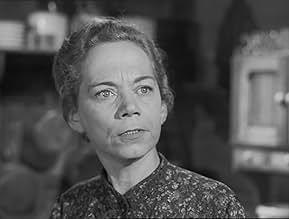
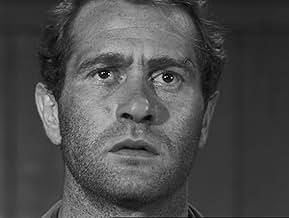
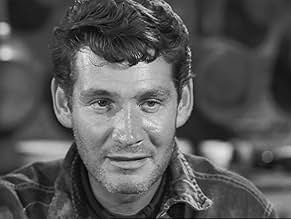
TV favorites Gene Barry and Darren McGavin square off as gunslingers intent on killing each other in a gunfight after a dispute over a poker game. Neither one will step down, but Ellen Corby as a cafe lady preparing them breakfast dominates the show, cleverly outwitting them and saving the day.
A character actress of the first order, Corby makes her character utterly believable, no hint of acting at all, but forceful all the same, and seeing the future "Bat Masterson" versus evilly smiling McGavin in this Mexican standoff is memorable.
Unleash the triggers already
The basic plot: a men enters Maggie's establishment, which looks like a little cabin but apparently feeds random stragglers. The man refuses to remove his gun belt. Why becomes clear when a second man enters. It seems there was a poker game the night before and it devolved into an argument. The first man let the second live, and now the second is looking for revenge. Their showdown over ham and eggs lasts 20 minutes. 20. Minutes. "You draw first." "You draw first." "Even if you draw first, I'll outdraw ya." "Even if you draw first, I'll outdraw ya." Lather, rinse, repeat. For 20 minutes.
In between, Maggie implores both men to think before they shoot. The twist ending I hoped for involved Maggie and a pistol hidden in her apron, but alas, it was not to be. Not one of the show's better offerings, in my opinion.
Possible influence on Sergio Leone?
Also, since the men were supposed to draw when a cuckoo clock chimed, I was reminded of For A Few Dollars More, when a gunfight was supposed to start when a musical watch stopped its song.
Anyway, I can't know for sure, but I feel almost certain that the maestro must have caught this episode and liked it, and found things he wanted to use. Watch the climactic duel from The Good The Bad and the Ugly, and then watch this episode. I think you'll see what I mean.
Well-Crafted Drama, & One of the Best of the Early Episodes
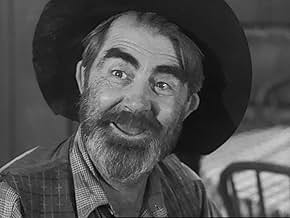
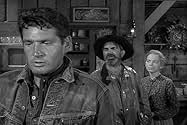
Ellen Corby, Gene Barry, and Darren McGavin are the stars, with Casey McGregor playing the only other on-screen character. Corby's character runs an out-of-the-way lunch counter, in which the characters played by Barry and McGavin confront each other with deadly intentions. Corby's character tries everything she can think of to cool off the two hotheads, even getting them to eat something while keeping one hand ready to draw at all times.
Although Hitchcock neither wrote nor directed the episode personally, it's well worthy of him, with a memorable situation, some very good dramatic touches, plus some psychology added in. Director Don Medford did a fine job of building up the tension, and the cast members are all in very good form. It's all resolved in a clever way that also would be worthy of Hitchcock's dry sense of humor.
Practically all of the episodes in the series were at least interesting, and many of them were memorable in one way or another. This one, though, is a particularly good example of an ideal usage of the half-hour format, and among the early episodes, it is very possibly the most efficient and effective.
you draw and i shoot
Here we have an interesting idea. To build (and hold!) a tension based on nothing. A single set, to prevent distractions, and a dispute that will make us follow the two cowboys, and want to know who of them (if any) will break and draw first. The fact that they use a single space is already important, because it notes already an intention to be tense (and intense). Because this is a 25 minute episode (plus Hitch's interventions) they don't have to establish any shots outside the space to allow spectators to breathe. We can be 25 minutes inside the same room.
The interesting thing is to check the narrative devices and modes they choose to build on the tension, or ease on it when needed, and the cleverness of the unfolding. So, tension increases depending on the placement of the cowboys in the space and, more important, Maggie's position in relation to them. So it's a very spatial positioning of the characters which i enjoy, and which the camera helps. We fear for Maggie, when she is just behind Del, and we fear for her when she's in the middle. Comedy; this is a comedy, in the end, and we have a very curious balance between the eminent shooting and the goofiness of having, for example, two fellows who can't eat properly because they won't stop starring at each other. Comedy here happens not because they act to be funny, but because the situation implies that. It's a great type of comedy. And of course, the final twist, when we thought we'd seen something, we are told we've being as deceived as the cowboys.
Hitch's interventions, specially at the end, is again priceless, here enhanced by the really funny nonsense twist. The value of it is that it's not a mere annotation on what we saw, it's a continuation of the narrative, after the end of the episode.
My opinion: 4/5
http://www.7eyes.wordpress.com


Did you know
- TriviaIn an Italian magazine from the 1960s, director Sergio Leone admits to liking this episode so much that he borrowed many things from it and included them in his westerns.
- GoofsMaggie grabs the handles of hot items such as the skillet and coffee pot with no insulation to protect her from burns.
- Quotes
[first lines]
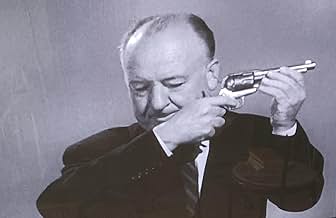
Himself - Host: [Alfred Hitchcock loads one bullet into a revolver and spins the cylinder. He aims the gun off stage left while holding it up to his ear and pulls the trigger - click. He spins the barrel again, and pulls the trigger - click. He shrugs] That's precisely why I don't care for Russian roulette. I never seem to win. There are two revolvers, such as this, which play a part in tonight's story. It is what you might call a Western, although there isn't a horse to be seen. We intended to get horses, but they couldn't remember the lines. So you'll be seeing people instead. The cast is a very small one and threatens to become smaller with every passing moment. You see, two of the characters have threatened to eliminate each other on sight. Now, I am sure there are some of you who don't want to see them do that. So, I suggest instead that you listen to our sponsor's message.
- SoundtracksFuneral March of a Marionette
Written by Charles Gounod
Details
- Runtime
- 30m
- Color
- Aspect ratio
- 1.33 : 1