
In the aftermath of a heist, Tony manages crew tensions as he and Carmela consider military school for A.J., while Meadow questions the world she's grown up in.In the aftermath of a heist, Tony manages crew tensions as he and Carmela consider military school for A.J., while Meadow questions the world she's grown up in.In the aftermath of a heist, Tony manages crew tensions as he and Carmela consider military school for A.J., while Meadow questions the world she's grown up in.
- Director
- Writers
- Stars




- Charmaine Bucco
- (as Katherine Narducci)

- Bobby 'Bacala' Baccalieri
- (as Steven R. Schirripa)


- Director
- Writers
- All cast & crew
- Production, box office & more at IMDbPro
Featured reviews
Episode 3 season 3
On the other hand, for the first time I saw Tony's weakness, I saw how the problem of his family Iaffected his Authority.
I hope he get back to his strength in the next episodes.
Didn't he almost drown in 3 inches of water?
This is a powerful and reflective episode with some exceptionally good performances.
It cleverly focuses on the situation involving Jackie and how it impacts Tony's attitude towards his own son. The varying outlooks on how AJ should be brought up are contrasted and portrayed in a number of emotive clashes involving Tony, Carmela, and AJ. These are intelligently written and wonderfully performed.
There is plenty of dark humour and irony. The scenes at Hudson, particularly those with Tobin Bell, are superb. Little touches such as when he talks about discipline, substance abuse and simultaneously lights up a cigarette are excellent.
Another well presented theme is the duality and hypocrisy of people who present a loving, communal face within society but in reality are cold and self serving. This is evident in one great scene involving Meadow that is incredibly well made and superbly acted by Jamie-Lynn Sigler.
Some of the issues are laid on quite thick, but it doesn't take you out of the narrative.
Season 3 is a bleak and compelling experience to put it mildly. We have seen a brutal rape, cold blooded murders, continual lies, parents pushing their children away, scenes of great ambiguity and bland "regularness". In the midst of it have been little rays of hope from characters who see the world for what it is make sound observations and strong ethical decisions. This episode just caps off a fairly cynical take on life by the writers.
For me it's a 9.5/10 but I round upwards.
The episode focuses heavily on the reverberations of Jackie Jr.'s death, examining the impact on his family,
The episode focuses heavily on the reverberations of Jackie Jr.'s death, examining the impact on his family, Tony Soprano, and the wider crew. Tony's cold pragmatism contrasts with Meadow's emotional outburst, as family members confront the brutal consequences of their lifestyles. AJ's sudden panic attack during the funeral signals the inherited pressures and psychological fallout within the Soprano family, prompting Tony to assert a tough-love approach to parenting. Parallel to these family dynamics is the FBI's increased pressure on the crew, highlighted by a raid during the Super Bowl weekend that results in various arrests, including Christopher and Silvio, while Paulie narrowly escapes. The episode's closing features a highly symbolic and experimental sequence that juxtaposes Uncle Junior's singing with the voices of foreign singers, underscoring themes of cultural insularity and existential contemplation.
John Patterson's direction maintains a commanding balance between intimate family moments and the tense realities of criminal life. His visual storytelling leverages stark lighting contrasts and careful framing to capture the shifting moods, from somber funerals and domestic vulnerability to sudden bursts of violence and chaos. Patterson's pacing is deliberate, enhancing the episode's emotional rhythms and amplifying suspense without sacrificing thematic depth. The symbolic final scene exemplifies the episode's artistic ambition, blending diegetic and non-diegetic sound in a moment of cultural and existential uncertainty.
Cinematographically, the episode employs a muted and somber color palette consistent with the episode's mood, utilizing shadow and darkness to emphasize the themes of loss and moral ambiguity. The editing skillfully weaves between multiple narrative threads, sustaining clarity and emotional engagement. Sound design is integral to the episode's atmosphere, with the contrasting sounds of mourning, celebration, and the uncanny final musical sequence highlighting the complex emotional and cultural tapestry.
The performances are exemplary, with James Gandolfini reprising his role as Tony with a potent mix of authority, grief, and paternal concern. Jamie-Lynn Sigler's Meadow provides a powerful counterpoint through her raw emotional response, while Robert Iler's portrayal of AJ's vulnerability adds depth to the familial narrative. The supporting cast enhances the layered storytelling through nuanced portrayals of sorrow, frustration, and conflicted loyalties.
Thematically, "Army of One" interrogates cycles of violence and the burdens of legacy within the Soprano family and mafia culture. It addresses the paradoxes of power and vulnerability, illustrating how personal loss intertwines with social obligation and survival. The episode also explores issues of cultural identity and existential introspection, particularly through its ambiguous, multi-layered ending that invites various interpretations about fate, community, and the erosion of traditional boundaries.
The episode reflects on Italian-American heritage and the insular codes of organized crime, juxtaposed against the broader societal forces embodied by the diverse voices in the closing sequence. This contrast serves as a critique of isolated subcultures and a meditation on the challenges of change and adaptation in an evolving social landscape.
While the episode's symbolic complexity and emotionally intense focus might challenge viewers seeking straightforward resolution, these elements elevate its status as a sophisticated and memorable televisual work. "Army of One" exemplifies The Sopranos' commitment to blending genre storytelling with rich thematic and cultural inquiry.
Spectacular
First things first: the fate of Jackie Jr. With his safety completely linked to Ralphie's decision, the poor kid's hours are numbered, and ten minutes into the episode Vito Spatafore (Joseph R. Gannascoli) sticks a bullet in his brains. The murder causes great sorrow, especially when it comes to Meadow, who starts drinking and being rude to everyone. As if that weren't enough, Tony also has to deal with his other heir: A.J. has been expelled from school for stealing a test, and is punished by being sent to a military academy.
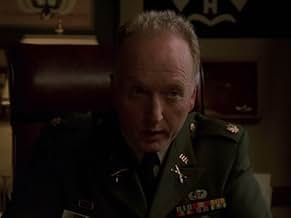
Whereas the previous series ended with a major death (Pussy), Army of One gets that detail out of the way immediately, so that it can focus on the effect Jackie's premature demise has on those surrounding him: the funniest scene is arguably the one where Jackie's sister proves a lot smarter than the grown-ups by not believing the drug deal story and insisting her brother was clipped by "some fat f*ck in see-through socks" (pretty much Vito's profile). There is also (unintentional) humor in Anthony's face-to-face with Major Zwingli (Tobin "Jigsaw" Bell), head of the military academy, although the laughs actually make the scene more tense.
The show's biggest victory, however, lies in the perfectly structured final scene: for once (barring the series finale) it looks like one of the seasons ends on a cheerier note than usual (without giving away anything: Dominic Chianese's singing voice is beautiful), while in reality the almost lyrical atmosphere conceals a heap of silent despair. Bravo.


Did you know
- TriviaDominic Chianese, who plays Junior Soprano, sings near the end of the episode. Chianese is an accomplished tenor and musician, having released a CD titled Hits in 2000, on which he sings American and Italian songs. He performed Salvatore Cardillo's sentimental classic "Core 'ngrato" ("Ungrateful Heart").
- GoofsMajor Zwingli is wearing two ribbons in the wrong order of precedence. The Army Overseas Service Ribbon (bottom row, middle) should be in the place of the Army Service Ribbon (bottom row, left) and vice versa. His uniform also lacks a sleeve unit patch, which would be the military school patch.
- Quotes
Anthony 'Tony' Soprano Sr.: I work hard all day to pay for this six thousand-square foot house, big-screen TVs, food on the table, video games, all kinds of scooters and bicycles, Columbia University, and for what? To come home to this?
A.J. Soprano: Sucks to be you.
[slaps AJ]
Carmela Soprano: [gasps] My God, Tony!
Anthony 'Tony' Soprano Sr.: There's more where that came from! We're starting a new regime around here!
- Alternate versionsFairuza Balk appeared in the original airing of this episode as Agent Deborah Ciccerone. However, Balk was unable to return to the role for the following season due to scheduling conflicts. Lola Glaudini was cast in the role for the following season. Balk's scenes were reshot with Glaudini in the role. Glaudini appears in all subsequent rebroadcasts of the episode and in the DVD release
- ConnectionsReferences The Phil Silvers Show (1955)
Details
- Runtime
- 1h(60 min)
- Color
- Sound mix
- Aspect ratio
- 1.78 : 1