IMDb RATING
7.0/10
6.9K
YOUR RATING


Two brothers come of age in a small Italian town in the '60s and '70s.Two brothers come of age in a small Italian town in the '60s and '70s.Two brothers come of age in a small Italian town in the '60s and '70s.
- Awards
- 19 wins & 29 nominations total




Antonino Bruschetta
- Segretario Bombacci
- (as Ninni Bruschetta)


7.06.8K
1
2
3
4
5
6
7
8
9
10
Featured reviews
Enough already....
The first 30 minutes or so made me hope for the best. Elio Germano is an actor with an extraordinary power to grab his audience and make us care, plus, the film seemed to move away from the (very good) book it is based on and go for the most engaging comedic aspects of the story. I knew it was too good to be true. Shortly after the film falls in a series of common places robbing us from the possibility to be surprised, engaged or even care. I wonder why it is that we - in Italy I mean - feel the need to visit the past though the same identical paths. To tell you the truth, I'm sick and tired of it. Can we tell stories that live out of its own strength. Politics, intellectual reflections without any, real, base on reality. We are known for protesting at a bar table, maybe go to a demonstration but at the end of the day we are going to do what we're told. Honestly or dishonestly. Could it be that, this relentless film revisions, is a tacit way to justify the fact that we've been so ineffectual in real life. We've been through everything and more but nothing has really changed. We're better identified by the Alberto Sordi characters like the one in "La Grande Guerra" by the great Mario Monicelli. My question is: If I, as an Italian, couldn't care less about the political mismatch of two Italian brothers, imagine the rest of the world. How confusing and ultimately annoying way to tell a story. There was a sort of uproar today, knowing that this film had not been selected for the official selection at the Cannes Film Fest. Hey, come on, think again. Why should it be? There is absolutely nothing new in it. Nothing! Riccardo Scamarcio continues to sleep walk through his film roles. He is beautiful but not nearly as magnetic as Elio Germano. I hope we'll wake up soon and realize that we won't change the past by revisiting it. That we are who we are and should look ahead to see what happens.
A witty and charming family drama
The political backdrop of this 60s character drama is both nostalgic and frightening - that disaffected and rebellious Accio finds himself so easily taken in by a Fascist mentor strikes parallels with the our own young men turning to extremism or street violence in a search of identity. Accio clashes dramatically with his older brother, the hip, good-looking communist, but the story not so much about political ideals as their expression of familial jealousies and personal moral development.
The tensions and affections of this struggling working class family, portrayed by all with genuine emotion. The dialogue is witty and charming and not unlike other memorable Italian films (Il Postino, Cinema Paradiso) the characters come across almost too resoundingly. This gives the film a well-crafted theatrical quality, that is engaging, well-paced and very satisfying.
The tensions and affections of this struggling working class family, portrayed by all with genuine emotion. The dialogue is witty and charming and not unlike other memorable Italian films (Il Postino, Cinema Paradiso) the characters come across almost too resoundingly. This gives the film a well-crafted theatrical quality, that is engaging, well-paced and very satisfying.
coming-of-age film with a political twist
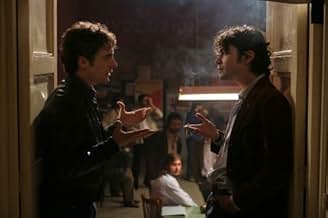
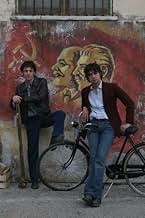
Based on the novel by Antonio Pennacci, "My Brother is an Only Child" is a tale of two brothers growing up in Italy in the turbulent 1960s and '70s. Though remarkably alike in disposition and temperament, the two siblings, nevertheless, find themselves on opposite ends of the political spectrum. Manrico (Riccardo Scamarrio), the older of the two, is a committed Communist who rallies the workers in his town to stand up for their rights. Accio (Elio Germano), his younger brother and also the narrator of the story, is a hardcore Fascist who venerates Mussolini and participates in violent protests against the Marxists. A hothead and a bully by nature, Accio (the name actually means "bully" in Italian) finds a convenient outlet for his rage and violence in the thuggery and strong arm tactics he and his fellow fascists use against their adversaries. Manrico and Accio have obviously had a tumultuous love-hate relationship their entire lives, and things get even more complicated when Accio falls in love with Manrico's girlfriend, Francesca. But each man must ultimately decide where his true loyalty finally lies - with family or with the ideological cause that moves and empowers him. This becomes an even more complex question when one of the brothers becomes increasingly disillusioned with the goals and tactics used by his side, while the other grows increasingly radicalized in his commitment to his.
Director Daniele Luchetti brings renewed life to the coming-of-age genre with his intense concentration on the sociopolitical elements of the story. It gets so bad between the two warring factions that even a performance of Beethoven becomes a pretext for bloodshed and violence. And the constant tussling between the two brothers - who can't seem to see eye-to-eye on anything except the girl they love - becomes a microcosmic reflection of the larger world around them.
Uniformly superb performances and naturalistic direction make this a complex and ultimately very moving study of brotherhood, family, maturity and commitment.
Director Daniele Luchetti brings renewed life to the coming-of-age genre with his intense concentration on the sociopolitical elements of the story. It gets so bad between the two warring factions that even a performance of Beethoven becomes a pretext for bloodshed and violence. And the constant tussling between the two brothers - who can't seem to see eye-to-eye on anything except the girl they love - becomes a microcosmic reflection of the larger world around them.
Uniformly superb performances and naturalistic direction make this a complex and ultimately very moving study of brotherhood, family, maturity and commitment.
Growing up with bro is hard to do
Good Italian movies are few and far between – the last I saw was Zefferelli's "Tea with Mussolini", and before that, "Life Is Beautiful". It seems that Italian movies, good or bad, are rare. If the list in Wikipedia is anything to go by, Italy produces about ten to fifteen features a year, far less than Australia.
This one is about growing up in a post-Mussolini, post-war world as a working class Italian. The narrator, Accio (Elio Germano), bright but temperamental, is not the most pleasant of people (his name means bully). At 13 he is sent off to a seminary by his long-suffering and pious parents but even though it's a fairly humane regime he doesn't last long. So it's back to the family's tiny, crumbling flat to grow up with his older brother, Manrico (Riccardo Scarmarcio). Rejecting religion, Accio comes into the orbit of the local fascists, though he is more interested in action than ideology. The handsome, charming Manrico becomes a communist, and beds Francesca (Diane Fleri), an attractive middle class girl who has joined the comrades. Naturally Accio gets interested in Francesca as well.
The story covers the period 1962 to 1968 and plenty of reference is made to the turmoil of the times, but basically it is about a textbook case of sibling rivalry. Acco and Manrico cannot keep their hands off each other – in order to fight, that is. Acco however does manage to reach some sort of maturity at the end.
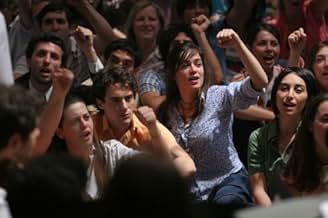
The story moves along at a good pace and there are plenty of funny scenes. The best one is the occupation by the communist students during the 1968 disturbances of the Rome conservatory where they perform Beethoven's "Ode to Joy" with the words changed to communist slogans, and are then invaded by the fascists crying "Don't mess with Beethoven" (actually the original words were from a poem by Schiller). The switch of actors (Vittorio Propizio plays the younger Accio) is accomplished in a particularly neat fashion, using a method I last saw used in "Conan the Barbarian" where the older actor is substituted in mid-scene.
In the background is Mussolini's legacy, an angry, confused and humiliated nation without a clear sense of direction. His 1930's "new towns" like Latina on the Pontine marches, jerry-built and badly designed, were crumbling already by the 1960s. Replacement housing had been built but corrupt local officials were holding up its allocation. There is a very satisfying moment at the end of the film when Accio, no stranger to causing a ruckus, takes remedial action.
Not being Italian I probably missed a lot, but the film held my attention for its full length, despite Accio not being a particularly nice lad (then neither was Genghis Khan and he had an interesting life). The film is bright, fresh and fast-moving though I'm not sure about the climax, which is rather on the melodramatic side. If the Italians can bring themselves to make more movies of this quality, I'll come along to watch.
This one is about growing up in a post-Mussolini, post-war world as a working class Italian. The narrator, Accio (Elio Germano), bright but temperamental, is not the most pleasant of people (his name means bully). At 13 he is sent off to a seminary by his long-suffering and pious parents but even though it's a fairly humane regime he doesn't last long. So it's back to the family's tiny, crumbling flat to grow up with his older brother, Manrico (Riccardo Scarmarcio). Rejecting religion, Accio comes into the orbit of the local fascists, though he is more interested in action than ideology. The handsome, charming Manrico becomes a communist, and beds Francesca (Diane Fleri), an attractive middle class girl who has joined the comrades. Naturally Accio gets interested in Francesca as well.
The story covers the period 1962 to 1968 and plenty of reference is made to the turmoil of the times, but basically it is about a textbook case of sibling rivalry. Acco and Manrico cannot keep their hands off each other – in order to fight, that is. Acco however does manage to reach some sort of maturity at the end.
The story moves along at a good pace and there are plenty of funny scenes. The best one is the occupation by the communist students during the 1968 disturbances of the Rome conservatory where they perform Beethoven's "Ode to Joy" with the words changed to communist slogans, and are then invaded by the fascists crying "Don't mess with Beethoven" (actually the original words were from a poem by Schiller). The switch of actors (Vittorio Propizio plays the younger Accio) is accomplished in a particularly neat fashion, using a method I last saw used in "Conan the Barbarian" where the older actor is substituted in mid-scene.
In the background is Mussolini's legacy, an angry, confused and humiliated nation without a clear sense of direction. His 1930's "new towns" like Latina on the Pontine marches, jerry-built and badly designed, were crumbling already by the 1960s. Replacement housing had been built but corrupt local officials were holding up its allocation. There is a very satisfying moment at the end of the film when Accio, no stranger to causing a ruckus, takes remedial action.
Not being Italian I probably missed a lot, but the film held my attention for its full length, despite Accio not being a particularly nice lad (then neither was Genghis Khan and he had an interesting life). The film is bright, fresh and fast-moving though I'm not sure about the climax, which is rather on the melodramatic side. If the Italians can bring themselves to make more movies of this quality, I'll come along to watch.
Where Are The Ideas?
I rushed to see this movie, with Elio Germano, perhaps the best Italian actor of his generation, and Riccardo Scamarcio, the heartthrob of the moment. I got upset about the rejection from the snobbish Cannes Festival and I wanted to see the film by myself. Now, after having seen it, unfortunately, I have to agree with the Cannes decision. The film is a tired rehash of other books/films/TV done indifferently and boringly with two saving graces: Elio Germano's and Angela Finocchiaro's performances. The rest is, quite frankly, unendurable. The film felt long, long, long and I got more and more impatient and eventually angry with the whole thing. The Italian cinema that once was a power force of inspiring themes and ideas seems to have arrived to a total dead stop. The artists, I feel, with something new to say, like Libero Di Rienzo - have you seen his "Sangue" with Elio Germano as well? No, I bet you haven't. It was released in secrecy and for my money, his movie had something new to say in a totally new exciting way. I fear we, in Italy, can't move forward because we're trapped in some king of structure that it's terrified of new ideas. As a consequence we have films like this one. A throw back to the past and not in a nice way. Cannes? Are you nuts?


Did you know
- TriviaTaken from the novel "Il fasciocomunista", the title has been changed in "Mio fratello è figlio unico" as a tribute to the eponymous song by Rino Gaetano.
- SoundtracksSul mio carro (Chariot)
Performed by Sonia Cruceru
- How long is My Brother Is an Only Child?Powered by Alexa
Details
- Release date
- Countries of origin
- Official sites
- Language
- Also known as
- My Brother Is an Only Child
- Filming locations
- Production companies
- See more company credits at IMDbPro
Box office
- Budget
- €5,000,000 (estimated)
- Gross US & Canada
- $255,620
- Opening weekend US & Canada
- $9,357
- Mar 30, 2008
- Gross worldwide
- $12,894,062
- Runtime
- 1h 48m(108 min)
- Color
- Sound mix
- Aspect ratio
- 1.85 : 1
Contribute to this page
Suggest an edit or add missing content