

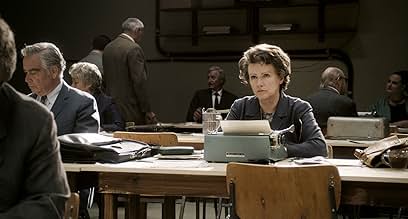
A look at the life of philosopher and political theorist Hannah Arendt, who reported for 'The New Yorker' on the trial of the Nazi leader Adolf Eichmann in Jerusalem.A look at the life of philosopher and political theorist Hannah Arendt, who reported for 'The New Yorker' on the trial of the Nazi leader Adolf Eichmann in Jerusalem.A look at the life of philosopher and political theorist Hannah Arendt, who reported for 'The New Yorker' on the trial of the Nazi leader Adolf Eichmann in Jerusalem.
- Director
- Writers
- Stars
- Awards
- 8 wins & 18 nominations total





Leila Lallali
- Student Laureen
- (as Leila Schaus)


- Director
- Writers
- All cast & crew
- Production, box office & more at IMDbPro
7.112.4K
1
2
3
4
5
6
7
8
9
10
Featured reviews
brave film with intellectual challenges
Margarethe von Trotta's Hannah Arendt is a film about thinking. Moreover, it's in favour of it. It so values thinking that it offers some elegant speeches and debate, sans computer generated spectaculars.
Barbara Sukowa portrays the German Jewish philosopher during the period she covered the Adolf Eichmann trial in Israel for The New Yorker. The film confronts the controversy Arendt raised when (i) she redefined Eichmann not as a monster but as an ordinary nobody, exemplifying "the banality of evil," (ii) she reported that some Jews collaborated with the Nazis, resulting in more deaths than chaos would have caused, and (iii) she said she loves her friends but not any "people," in this case, the Jews. On all three counts she was condemned for abandoning her people. Today, at a remove from the heat of that moment, she was clearly correct on all counts. For more see www.yacowar.blogspot.com.
Not loving the Jews was not being anti-Semitic but refusing to emotionalize her consideration of the issues. Arendt was opposed to the blanket love of any group of people, not based on personal engagement, because such nationalist or other group identification precluded the thoughtful consideration of any issues around them. She most valued a rational, thoughtful approach that was not prejudged or proscribed by any -ism or convention. As for some Jews' collaboration, she simply reported facts that arose at the trial. (Indeed, Rudolf van den Berg's new film Suskind details precisely that collaboration.) Nor was that observation anti-Semitic, for the possibly well-intentioned collaboration in the face of horrid danger is a plausible response among any people. Arendt was pilloried for facing the facts and for rejecting myths. That's what historians are required to do and apparently what philosophers periodically have to remind them to do.
Barbara Sukowa portrays the German Jewish philosopher during the period she covered the Adolf Eichmann trial in Israel for The New Yorker. The film confronts the controversy Arendt raised when (i) she redefined Eichmann not as a monster but as an ordinary nobody, exemplifying "the banality of evil," (ii) she reported that some Jews collaborated with the Nazis, resulting in more deaths than chaos would have caused, and (iii) she said she loves her friends but not any "people," in this case, the Jews. On all three counts she was condemned for abandoning her people. Today, at a remove from the heat of that moment, she was clearly correct on all counts. For more see www.yacowar.blogspot.com.
Not loving the Jews was not being anti-Semitic but refusing to emotionalize her consideration of the issues. Arendt was opposed to the blanket love of any group of people, not based on personal engagement, because such nationalist or other group identification precluded the thoughtful consideration of any issues around them. She most valued a rational, thoughtful approach that was not prejudged or proscribed by any -ism or convention. As for some Jews' collaboration, she simply reported facts that arose at the trial. (Indeed, Rudolf van den Berg's new film Suskind details precisely that collaboration.) Nor was that observation anti-Semitic, for the possibly well-intentioned collaboration in the face of horrid danger is a plausible response among any people. Arendt was pilloried for facing the facts and for rejecting myths. That's what historians are required to do and apparently what philosophers periodically have to remind them to do.
Philosophy With A Hammer.................
Folks, this is what Philosophy is all about: taking a stand which is not always popular and being able to justify it for the ages. Hannah Arendt is only in this century beginning to receive her due as the most perspicuous political philosopher of the 20th century. After all, it was Ms Arendt who first observed that post-Hiroshima, a conventional war could never again be fought and won. But rather, all pre-emptive invasions who devolve into occupations - that rather than full-scale war or revolutions - the world would sink increasingly into a mire of entropic violence. Her controversial thesis in Eichmann In Jerusalem - yet another masterpiece of at least five in her canon, is that mass atrocities are not committed by idiosyncratic madmen who erect vast engines of evil in which the followers (citizens of the state) serve as the 'cogs' – but rather the architectonic of evil consists in the actions of rather ordinary people who for various reasons and rationalizations refuse to think about the ramifications of what they're doing. I mention this point because I've studied Ms Arendt's work for over three decades, lived in Greenwich Village when she was teaching at the New School, and when I saw the film premiere at the Santa Barbara Film Festival this past January – I felt that most of the scant audience did not get the point any more than her contemporaries. The film-making is excellent. To dramatize philosophic ideas is challenge in itself. Von Trotta, in the old European style, makes her films with a regular group of actors, and, while the performances were effective throughout, in real life, Hannah Arendt was not nearly so physically engaging and Mary McCarthy quite a bit more – which, I believe had something to do with the development their respective moral characters. All in all, a great, not merely a good, film – and one of the few worth seeing thus far this year – unless, of course, the attributes of fast and furious 6 or iron man 3 overwhelm.
Interesting history lesson
I didn't know an awful lot about philosopher Hannah Arendt before I saw this movie. Now I know a lot more about her, and about the way she thinks. After seeing the film, I have even read some articles about her work.
If that's what director Margarethe von Trotta had in mind when making this film, she succeeded. Her film documents an important chapter in the story of Arendt's life: her articles about the Eichmann trial in Jerusalem, and the ensuing tsunami of negative reactions. The reason for those negative reactions was the way Arendt regarded Eichmann: not as a monster, but as a man 'incapable of thinking', a dimwit who just followed orders. This fitted her theory of 'the banality of evil': the worst kinds of evil are often the result of not thinking for oneself.
Veteran actress Barbara Sukowa portrays Arendt as a difficult and complex woman, who is a brilliant philosopher but also stubborn, arrogant and single-minded. In one scene, we see her lying on a couch, when the phone rings. On the other end of the line is her editor, who faces a deadline and asks if she is making progress with the articles. 'Of course I'm working hard, and it would be nice if I could continue working instead of chatting on the phone', she answers. After that, she returns to the couch, lies down and continues smoking her cigarette.
Sometimes it seems that Arendt is incapable of feeling, just as Eichmann is incapable of thinking. Even when her best friends turn away from her, she continues insulting them by telling them 'she doesn't love the Jewish people'. She means it in a philosophical way - you can't love a people the way you love individuals. But nevertheless, it comes across as cold-hearted and insensitive.
Arendt is clearly an interesting person. But that doesn't make 'Hannah Arendt' an interesting film. From a cinematographic point of view, the movie doesn't have much to offer. It's a rather straightforward account of this episode in Arendt's life. The only thing that adds a little depth to the film are the flashbacks of the romantic affair she had with her teacher, the famous philosopher Martin Heidegger, who sympathized with the Nazis. The film suggests that this affair influenced the way she regarded Nazis such as Eichmann, but doesn't make this explicit. In my view, the film is interesting as a history lesson about this remarkable woman, but not as a great cinematographic experience.
If that's what director Margarethe von Trotta had in mind when making this film, she succeeded. Her film documents an important chapter in the story of Arendt's life: her articles about the Eichmann trial in Jerusalem, and the ensuing tsunami of negative reactions. The reason for those negative reactions was the way Arendt regarded Eichmann: not as a monster, but as a man 'incapable of thinking', a dimwit who just followed orders. This fitted her theory of 'the banality of evil': the worst kinds of evil are often the result of not thinking for oneself.
Veteran actress Barbara Sukowa portrays Arendt as a difficult and complex woman, who is a brilliant philosopher but also stubborn, arrogant and single-minded. In one scene, we see her lying on a couch, when the phone rings. On the other end of the line is her editor, who faces a deadline and asks if she is making progress with the articles. 'Of course I'm working hard, and it would be nice if I could continue working instead of chatting on the phone', she answers. After that, she returns to the couch, lies down and continues smoking her cigarette.
Sometimes it seems that Arendt is incapable of feeling, just as Eichmann is incapable of thinking. Even when her best friends turn away from her, she continues insulting them by telling them 'she doesn't love the Jewish people'. She means it in a philosophical way - you can't love a people the way you love individuals. But nevertheless, it comes across as cold-hearted and insensitive.
Arendt is clearly an interesting person. But that doesn't make 'Hannah Arendt' an interesting film. From a cinematographic point of view, the movie doesn't have much to offer. It's a rather straightforward account of this episode in Arendt's life. The only thing that adds a little depth to the film are the flashbacks of the romantic affair she had with her teacher, the famous philosopher Martin Heidegger, who sympathized with the Nazis. The film suggests that this affair influenced the way she regarded Nazis such as Eichmann, but doesn't make this explicit. In my view, the film is interesting as a history lesson about this remarkable woman, but not as a great cinematographic experience.
A character study of philosopher Hannah Arendt
Although I was not familiar with the name "Hannah Arendt," I was certainly familiar with the phrase "banality of evil" that Arendt coined. However, "banality of evil" is not the phrase she used. The full phrase is "the fearsome, word-and-thought-denying banality of evil." Because, unlike the claims of many accusers who didn't fully understand her, Arendt didn't see a simple bureaucrat in Eichmann during his 1960 trial in Israel. She saw a truly evil man who "spoke like a bureaucrat." Her point being that Eichmann did not speak or seem to think like a genocidal maniac yet he acted like one nevertheless. That is evil cloaked in the banal. This movie revolves around the years of Arendt's life, 1960 to 1963, when she was formulating these ideas and in that, I think the movie probably has it right.
All that said, and these are certainly ideas worth mulling over, this is a film for ideas and for philosophy buffs, not for film buffs. Why do I say this? Because this movie is slow, at least for American audiences. The beginning is confusing. We see a woman in New York but we don't know the date. She speaks German. We see a man get off of a bus heading to "Victoria" in the middle of nowhere. He is promptly kidnapped. We don't know when or where. Eventually, we learn the kidnapped man is Adolph Eichmann who is nabbed by the Mossad in Argentina in 1960. Much of the movie unfolds slowly. This is a film about thinking. It is not about doing much or feeling much. It is an intellectual film.
There's one semi-action scene in the film where a 1950s vehicle corners Arendt on the road where she is walking. Israeli secret agents pour out of the car and threaten Arendt, trying to prevent her from publishing her book about Eichmann. Based on someone knowledgeable, Professor Roger Berkowitz, academic director of the Hannah Arendt Center for Politics and the Humanities at Bard College in New York, it appears this scene was invented out of whole cloth to try to give the film at least some suspense. But that's not what this film is about.
It's about thinking and it's about the fearsome, word-and-thought-denying banality of evil and how Hannah Arendt was the first to identify this 20th-century pathology of the human psyche.
Thanks to the Camera Cinema Club in San Jose for showing this film.
All that said, and these are certainly ideas worth mulling over, this is a film for ideas and for philosophy buffs, not for film buffs. Why do I say this? Because this movie is slow, at least for American audiences. The beginning is confusing. We see a woman in New York but we don't know the date. She speaks German. We see a man get off of a bus heading to "Victoria" in the middle of nowhere. He is promptly kidnapped. We don't know when or where. Eventually, we learn the kidnapped man is Adolph Eichmann who is nabbed by the Mossad in Argentina in 1960. Much of the movie unfolds slowly. This is a film about thinking. It is not about doing much or feeling much. It is an intellectual film.
There's one semi-action scene in the film where a 1950s vehicle corners Arendt on the road where she is walking. Israeli secret agents pour out of the car and threaten Arendt, trying to prevent her from publishing her book about Eichmann. Based on someone knowledgeable, Professor Roger Berkowitz, academic director of the Hannah Arendt Center for Politics and the Humanities at Bard College in New York, it appears this scene was invented out of whole cloth to try to give the film at least some suspense. But that's not what this film is about.
It's about thinking and it's about the fearsome, word-and-thought-denying banality of evil and how Hannah Arendt was the first to identify this 20th-century pathology of the human psyche.
Thanks to the Camera Cinema Club in San Jose for showing this film.
A great episode of history told on an average movie
Hanna Arendt is a biopic of the homonymous German philosopher focusing on her coverage of the Eichmann trial in Jerusalem and the outrage that her articles on it ensued.
As a historical document, the movie is gripping and mostly clear (though some lines of the discussions of her with her friends are a bit unclear) to laymen. I, for one, had never heard of Arendt and the 'banality of evil' before, but I believe that now I'd be able to talk about her thoughts with making a fool out of myself. For that, I thank the film.
Though, on a movie-making viewpoint, it is a letdown. The flow of the film is pretty odd, with leaps in time and space (eg. suddenly she is in Israel), and the efforts to use transition scenes are pretty untimely. The dialogs aren't the best either, with strange remarks here and there, and philosophic remarks not everyone could grasp.
Hannah Arendt is much more of a history and philosophy class, than a great movie. Though, it deserves a bit of appreciation for successfully exposing a great woman's thoughts to a new generation.
As a historical document, the movie is gripping and mostly clear (though some lines of the discussions of her with her friends are a bit unclear) to laymen. I, for one, had never heard of Arendt and the 'banality of evil' before, but I believe that now I'd be able to talk about her thoughts with making a fool out of myself. For that, I thank the film.
Though, on a movie-making viewpoint, it is a letdown. The flow of the film is pretty odd, with leaps in time and space (eg. suddenly she is in Israel), and the efforts to use transition scenes are pretty untimely. The dialogs aren't the best either, with strange remarks here and there, and philosophic remarks not everyone could grasp.
Hannah Arendt is much more of a history and philosophy class, than a great movie. Though, it deserves a bit of appreciation for successfully exposing a great woman's thoughts to a new generation.


Did you know
- TriviaFor a deeper understanding of this story, one might care to watch Operation Finale (2018), which depicts the undercover mission to find and extract Adolf Eichmann from Argentina and bring him to trial in Israel. Showing the background of an operation sanctioned by PM David Ben-Gurion, the film gives a glimpse of the complexity of Eichman's character, his futile attempts to justify his actions and tell his side of the story.
- GoofsWhen Arendt stands on the terrace of her hotel in Jerusalem at looks across the Valley of Hinnom at the Old City, there are Israel flags flying from the Tower of David complex. However, the Old City of Jerusalem was still under Jordanian control in 1961.
- Quotes
Hannah Arendt: You describe a book I never wrote.
Siegfried Moses: A book that will never be allowed in Israel. And won't appear anywhere else either if you have any decency left.
Hannah Arendt: You ban books, and lecture me about decency!
- ConnectionsFeatured in Kino Kino: Hannah Arendt (2013)
- How long is Hannah Arendt?Powered by Alexa
Details
- Release date
- Countries of origin
- Official site
- Languages
- Also known as
- 漢娜鄂蘭:真理無懼
- Filming locations
- Production companies
- See more company credits at IMDbPro
Box office
- Gross US & Canada
- $717,205
- Opening weekend US & Canada
- $31,270
- Jun 2, 2013
- Gross worldwide
- $8,880,936
- Runtime
- 1h 53m(113 min)
- Color
- Sound mix
- Aspect ratio
- 2.35 : 1
Contribute to this page
Suggest an edit or add missing content