Charles Wuorinen - Brokeback Mountain
Teatro Real, Madrid - 2014
Titus Engel, Ivo van Hove, Daniel Okulitch, Tom Randle, Heather Buck, Hannah Esther Minutillo, Ethan Herschenfeld, Celia Alcedo, Ryan MacPherson, Jane Henschel, Hilary Summers, Letitia Singleton, Gaizka Gurruchaga, Vasco Fracanzani
Medici, ARTE Concert - Internet Streaming, 7 February 2014
Although it goes right back to the source short story, and even has a libretto specifically written by the original author Annie Proulx, the initial idea to compose an opera based on Brokeback Mountain came to Charles Wuorinen after watching Ang Lee's 2005 film. It's likely that the popular and acclaimed film will also be the point of comparison for most people viewing Wourinen's opera version, the work receiving its world premiere in Madrid in 2014. As with any adaptation of material from another medium, the opera version of Brokeback Mountain in such a case must not only stand up on its own terms but it needs to bring something new, something specific to the nature of music theatre that literature and cinema can't. Wourinen's opera succeeds in this to a large extent and does full justice to the nature if the story, if not in any way bring anything spectacularly new to it.
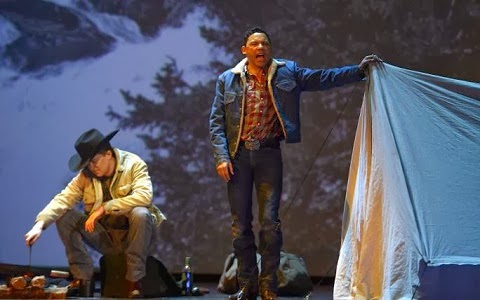
In terms of the content, while Annie Proulx does go back to the source material and treats some aspects rather differently from the cinematic version, the nature, the character and the development of the relationship at the centre of the story remains essentially the same. It deals with the troubled love affair between two men in an American mid-western cowboy community who are unable to openly express their feelings for each other, partly due to concerns about how their relationship will be viewed by a society with rather harsh and unforgiving attitudes to anything that doesn't fit in with their accepted conventional moral views, but partly due to their own masculine inability to come to terms with their emotions.
Those feelings and the contrasting views on this subject in Annie Proulx's story are very much tied into the contrast between life on Brokeback Mountain in Wyoming where ranch hands Jack Twist and Ennis Del Mar first meet, and the rather less freedom that the men enjoy when they come down from summer on the isolated mountain and have to fit into "normal" society again, finding work, marrying and providing for their families. In the opera version, the concision and compression of the material in Proulx's libretto gives greater prominence and emphasis to this division between the laws of nature and society, but it's also given additional weight through Charles Wuorinen's very distinctive musical treatment.
The tone that is adopted by the work as a whole is established immediately right from the first bold, dramatic, troubling chords that are struck, and there's not an ounce of sentimentality, romanticism or even false optimism to be found elsewhere in the music score or the dialogue. Right from the outset, the relationship between Jack and Ennis is a troubled one, one that will never be fully accepted by either society or on equal terms by both men, and it colours and deeply affects even those few moments of bliss that the two of them are able to snatch together over the years on the rare occasions that they are able to "go fishing" on Brokeback Mountain. Proulx's concisely drawn libretto authentically reflects both the sparse exchanges and general inarticulacy of the men themselves, yet is also able to use literary techniques to draw out the underlying characteristics of their relationship.
As suggested by the location and the title, the primary expression of the men's relationship is that of Brokeback Mountain. The libretto consequently is scattered with references to the natural world, but reflecting the nature of that relationship it's rarely comforting, the mountains populated with coyotes, wolves and bears. For the brief moments that they are far away from the ordinary cares of the world, they are however eagles, at least in Jack Twist's mind. Ennis however, mindful of the responsibilities placed on him, knowing that he is going to marry Alma, finds it more difficult to enjoy the same freedom of thought, but allows himself to succumb to the image of the free-flying hawk. Another highly evocative image - although it's not over emphasised - is that of the sheep. In a way, the sheep could be seen to represent regular society, and since they are employed to look after them by Aguirre, a man who we know is a stickler for rules, the two men feel some obligation of responsibility towards the social construct that allows them to make a life for themselves.
On its own, this leaner this more stripped down version of the storyline expresses the intensity of the relationship and feelings well, but for it to find full expression in an opera it needs the music and the staging to support it. In this particular work, what remains unspoken is often just as important as what is, and that has to be elaborated on further than just a few poetic images and references to nature. The American composer Charles Wuorinen manages to find a strong way to express this in the music which is 12-tone and modernist but not atonal. Without impressionism or abstraction, it's actually quite lyrical and expressionistic, well-suited to the material, the musical language not unlike the Richard Strauss of Elektra and Salome. It's never folk or country inflected, but rather directly connected to the tenseness of the situation, to the uneasy nature of the men and their relationship, matching and underlining every word and sentiment.
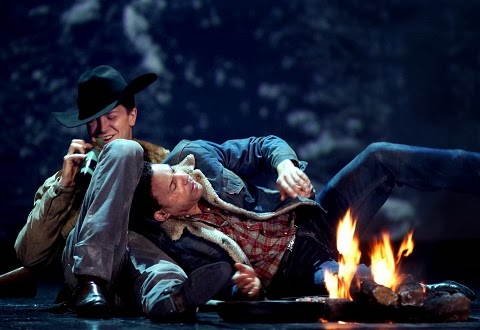
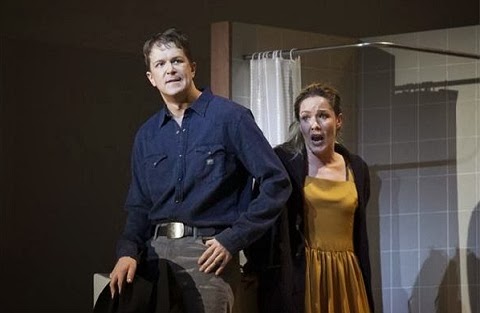
As such, the music follows the vocal line rather than setting it, attempting to capture the rhythms of English-language speech patterns, as well as the halting delivery and uncertainty of the nature of the underlying sentiments they are expressing. Daniel Okulitch as Ennis and Tom Randle as Jack deal exceptionally well with this type of expression, totally convincing in terms of characterisation while managing to make the singing quite lyrical and melodic. These are strong performance indeed, and they need to be. As Alma, Heather Buck's role is no less important to the development of the drama and she also gives a terrific performance. Using projections to open up the Teatro Real stage for the outdoors scenes that allow for moody silhouettes, and closing it down with the clutter of furniture and household appliances, Jan Versweyveld's sets match Ivo van Hove's note perfect direction of the characters.
Likely to be seen now as Gérard Mortier's legacy as the controversial but hugely creative and experimental artistic director of the Teatro Real in Madrid, the World Premiere production of Charles Wuorinen's Brokeback Mountain was streamed live on the ARTE Concert and Medici websites. The opera is currently still available to view on both sites, in English with English subtitles.
Leoš Janáček - Jenůfa
La Monnaie-De Munt, Brussels - 2014
Ludovic Morlot, Alvis Hermanis, Sally Matthews, Charles Workman, Nicky Spence, Jeanne-Michèle Charbonnet, Carole Wilson, Ivan Ludlow, Alexander Vassiliev, Mireille Capelle, Hendrickje Van Kerckhove, Beata Morawska, Chloé Briot, Nathalie Van de Voorde, Marta Beretta
Culturebox, Medici.tv, La Monnaie Internet Streaming - January 2014
Jenůfa is a challenging opera to perform and stage. Musically, despite its seemingly simple rhythmic pulsations, this early 20th century opera by Janáček bridges Romanticism and Modernism, but it has the additional complication of being very much related to Moravian folk music and to the particular rhythms of spoken language that are an important aspect of Janáček's style. An indication of the challenges of performing the work is how varied interpretations of Janáček's musical scoring can be in attempting to find that precise rhythm in music and language. It doesn't help, I find, that Sir Charles Mackerras' near-definitive editions and recordings of many of Janáček's operas set an incredibly high standard for anyone else to match.
In terms of the storyline, Jenůfa also appears to be a simple folktale, a morality tale of village life, the melodrama of a local beauty who scandalously falls pregnant and is spurned by her lover, only to have her face disfigured by a jealous admirer. Not only that, but in an attempt to resolve the difficulties and the shame that lie upon the family and in an attempt to open a way to a marriage for Jenůfa, her frantic stepmother, Kostelnička, drowns the new-born baby in a frozen river. The storyline revolves around these few highly intense situations in a way that not only makes it difficult to dramatise, but to find a suitable tone that is not overwhelmingly bleak and despairing.
On the contrary, based on the lush beauty of the musical score, the director and conductor actually have to find a way to make the work beautiful and achieve a conclusion that is heart-warming and tender. Jenůfa is not a work then that benefits from a naturalistic interpretation or from any kind of harsh social realism, but at the same time it has to emphasise or make real the human qualities that arise out of their efforts to overcome the bleakness of the situation. That's no small challenge. Relatively new to opera, the Latvian theatre director Alvis Hermanis however takes an unusual approach to the stage presentation of this remarkable work for La Monnaie in Brussels. It's not quite perfect, but it's every bit as impressive and innovative as any staging of this unique and remarkable work should be.
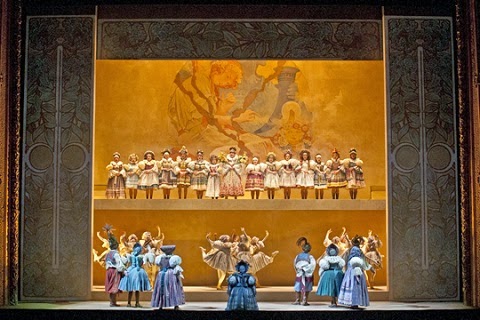
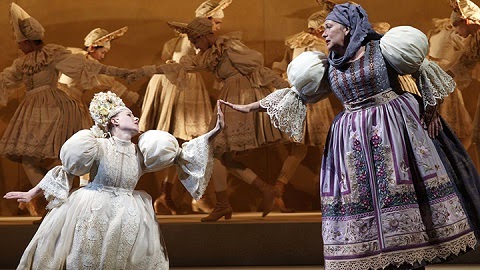
Drawing heavily from the turn of the century Art Nouveau movement, with imagery taken directly from the works of the Czech artist Alphonse Mucha, Hermanis' production for La Monnaie is therefore a highly stylised one that is far from naturalistic. At the same time however it is authentic in terms of the roots of the work in Moravian folktale and culture, while also being entirely sympathetic to the tone adopted towards the story by Janáček in his stunningly beautiful and evocative musical scoring. There are no conventional props or sets, yet the location, the background of the characters and their nature is represented brilliantly in the puffy-sleeved, embroidered and garlanded traditional costumes as well as in the elaborate decorative designs of the set.
That goes as far as using a line of dancers almost as a decorative border and background for the drama, positioned behind the singers throughout Act I and III. The upper level is used for projections of swirling and scrolling Art Nouveau patterns with Alphonse Mucha images that reflect the Czech Moravian setting and the characters, opening up at times to present the chorus who contribute to the background dramatic action and reaction. The singers act out the drama in stylised movements and dance-like gestures, never naturalistic but expressive nonetheless, retaining the folk quality of the story even though it adapts the body-language of formalised Oriental dance theatre.
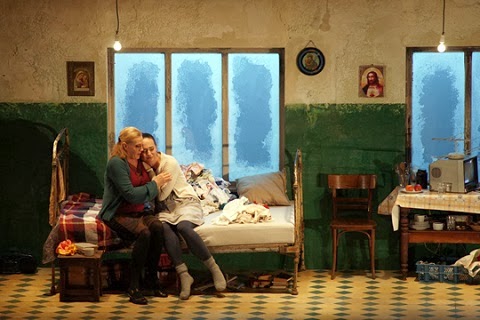
Visually, it's a sumptuous display. Words alone can't do it justice. It's simply ravishingly and almost heart-breakingly beautiful, which is something you could say also about Janáček's score, so it's clearly wholly appropriate and in tune with the musical account of the work. That's evident in the way that Act II is treated entirely differently from the formalised tableaux of the opening and closing acts. Act II presents the reality of the situation in a much more socially realistic way, depicting a poor cottage or a run-down apartment in a housing block from a 1960s' Czech New Wave film, with peeling paint, a stove, a bed and religious pictures and icons on the walls. The music written by Janáček bears out this division of styles between ritualised folktale and the human reality, so close attention has clearly been paid to the score.
The production however doesn't perhaps always come to life the way it should or respond entirely to those deeply tragic moments and emotional undercurrents, but it's hard to imagine how any staging could. Most productions of Jenůfa (and they are rare enough) tend to follow the minimalist principle of the drama being enacted by just a few characters, but this one, while it might appear to be overly busy, at least fills the stage with context. The sense of community is of vital importance in Jenůfa, and that's evident in all the cultural and costume iconography, on a stage that has dancers in constant motion, and that is enacted often before the watchful, judgemental eyes of that small community looking down from those upper levels.
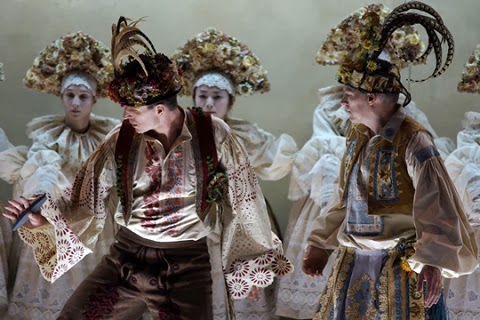
Ideally, you'd like to have native Czech singers who are capable of reproducing the speech rhythms that are so vital a component of the opera. It's rare however that anyone is able to cast in this way for the roles of Jenůfa and Kostelnička, but outside of Elisabeth Söderström and Eva Randová from the definitive Charles Mackerras recording in the 1980s, this Monnaie production is as good as I've heard with Sally Matthews and Jeanne-Michèle Charbonnet in those roles. Charbonnet feels the strain of the high pitch towards the end of the opera, but she has good presence and dramatic force in her delivery. Sally Matthew's dramatic performance is a little bit blank in the context of the stylised delivery, but she's stronger in Act II's realism and her singing performance is solid and consistent throughout. Nicky Spence is a fine Števa, but it's Charles Workman who stands out here, his gorgeous tone and impassioned delivery in Act III making that difficult acceptance of Laca's dreadful actions and his redemption meaningful and truly heart-warming.
The 2014 La Monnaie production of Jenůfa is available to view for free via internet streaming from the Culturebox, Medici.tv and La Monnaie sites. Subtitles are in French only, although the La Monnaie site also has optional Dutch subtitles.
Giacomo Meyerbeer - L'Africaine
Teatro La Fenice, Venice - 2013
Emmanuel Villaume, Leo Muscato, Jessica Pratt, Veronica Simeoni, Gregory Kunde, Emanuele Giannino, Angelo Veccia, Luca dall’Amico, Davide Ruberti, Mattia Denti, Ruben Amoretti, Anna Bordignon
Medici Live Internet Streaming - November 2013
Just when it looked like no-one had the resources, the singers or the sheer nerve to take on another grand Meyerbeer opera and succeed in putting it across with any measure of success, along come La Fenice with L'Africaine. First performed posthumously in 1865, a year after Meyerbeer's death, La Fenice selected L'Africaine to mark that 150th anniversary, and it proves to be a good choice. Meyerbeer's final opera is a fascinating work that is not quite as richly elaborate in melodies and set-pieces as some of his more famous grand operas (Les Huguenots, Robert le Diable), but it retains the glamour in a number of key scenes even as it shows some influence of a more modern style elsewhere. By and large, with only some minor reservations, La Fenice mirror that approach in their new production and in the process prove that a Meyerbeer opera can still work on the modern stage on its own terms.
Although it has a title that makes little sense to anyone with even a rudimentary knowledge of geography - the African woman of the title actually comes from India or from an Indian island - the chief attraction of L'Africaine for audiences of the day was the foreign exoticism of its setting. For modern audiences, if the work is known at all, it's for how Meyerbeer expresses that exoticism in the opera's most famous aria, 'O Paradis', sung by Portuguese explorer Vasco de Gama on his arrival at the New World of his dreams. That revelation in Act IV doesn't come as easily as it seems and there are various trials and tribulations in the first three acts that make it all worthwhile, if not unexpectedly somewhat conventionally drawn out.

Inevitably this is mainly to incorporate romantic complications. Although she has been engaged to marry Don Pédro, Inès is in love with Vasco de Gama. Awaiting his return from sea, the news arrives that her beloved has died in a shipwreck, but this proves untrue. Vasco de Gama is actually the sole survivor of the crew, and has brought news of a new world out there somewhere. If given a ship, he promises the council an empire, "new climates, rich treasures, prosperity". As proof that this new land exists, he shows the council two examples of an unknown race of copper-skinned people, Sélika and Nélusko, who have been bought as slaves in Africa. As there is nothing written of such a land and the slaves refuse to divulge where their land lies, the council reject Vasco's claims and he is rather harshly anathemised and thrown into prison.
Languishing in his cell, poor Vasco de Gama also has woman trouble to contend with. Unknown to him, Sélika, who is actually the Queen of her island kingdom, is in love with the Portuguese sailor and furious when he mentions the name Inès in his sleep. For her part, Inès is jealous of the beautiful woman that de Gama has brought back with him, even though he denies that there could possibly be anything between them and even offers her Sélika and Nélusko as slaves. That obviously doesn't go down well with Sélika either. Of more pressing concern however is rescuing her beloved from prison, and the only way Inès can do that is by agreeing to marry Don Pédro.
Strange as it might seem since they rejected Vasco de Gama's claims, the ruling council have decided to let Don Pédro lead an expedition instead. Even stranger, the released Vasco de Gama has managed to get a ship, follows them and boards Don Pédro's ship only for it to be attacked by Indian pirates, the ship burnt and all the crew killed. The only survivors are Inès, her maid and Vasco de Gama, who has been found in chains in the depths of the captured ship. A prisoner still, Vasco de Gama is nonetheless enraptured with the discovery of the land of his dreams. His delight is short-lived however, as the Brahman priest commands that a foreigner cannot be allowed to live. Now crowned Queen again, Sélika, much to Nélusko's anger, saves him by claiming that she and the explorer are married. Discovering for the first time that she loves him de Gama rejoices in their union, but only until he discovers that his beloved Inès is not dead. Rejected again, Sélika inhales the poison of the Manchineel tree and is joined in death by her ever faithful Nélusko.

Already ahead of the fashionable French love for exoticism that would be expressed later in Delibes' similarly themed Lakmé, (although it can even be seen as far back as Rameau's Les Indes Galantes), Meyerbeer's L'Africaine revels in the colour, the richness of melody and the drama suggested by the romance and the danger of the Asian setting. Surprisingly however, although it is a 5-Act grand opera, there is little of the extravagance of melody, airs and ballets in set-piece numbers that usually characterise the genre of which Meyerbeer was the master. All those elements are in place of course but to a lesser degree here, with only one Grand Air, a short ballet in Act IV and a couple of set-piece spectacles - one of the boarding of the ship and the other of splendour of the New World paradise. Showing perhaps some Wagnerian or Germanic influence, there is more through composition in this Meyerbeer work, less stop-starting for arias, and some cutting back on repetition.
Emmanuel Villaume presents a thoughtful account of the score here with the orchestra of La Fenice. Running to three-and-a-quarter hours there are evidently trims applied, but as they are mostly towards the end of the work they seem to be made out of consideration for the performers rather than really moving the drama forward. There's nothing substantial missing from the first three acts. The first ensemble of Act II is cut, but the all-important closing ensemble is there. Act III opens with the sailor's prayer, but that seems more logical than opening the act at sea with a female chorus. There are a greater number of the small trims in Act IV and there's a major cut in the removal of the confrontation between Inès and Sélika at the start of Act V, but in both cases it tightens the focus of the drama on the highlights of these acts.
Leo Muscato's stage direction and basic period setting strips the presentation for La Fenice back even further in a way that emphasises the dramatic element of the work without necessarily losing any of its musical colour. Those key scenes could certainly be a little more colourfully decorated - the New World Paradise shown for example as merely warm diffused light and some lightly floating blossom leaves, but reducing the excess works well enough in this case when you have the aria 'Pays merveilleux... O Paradis' to say all that needs to be said, particularly when it's given a fine rendition, as it is here by Gregory Kunde singing Vasco de Gama.
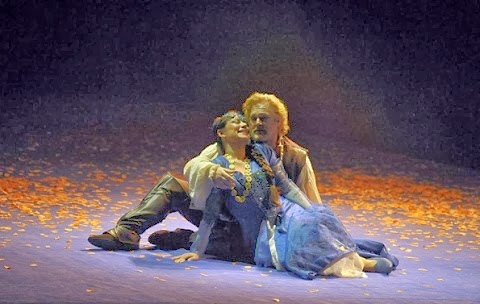
It's in this kind of casting then that La Fenice truly proves that it is possible to successfully stage a Meyerbeer opera. Clearly, despite weaknesses seen in this area in other productions, there actually are good Meyerbeer singers out there, and their lineage would seem to come from the more heavy dramatic Rossini operas. Gregory Kunde is certainly one of them. He handles the principal tenor role marvellously, with a strong, confident delivery and he has the stamina to maintain it right through to his Act IV Grand Aria. He makes his exit at this stage, but Sélika has to carry right through all five Acts while keeping enough in reserve to almost single-handedly deliver the whole of Act V, and Veronica Simeoni keeps the dramatic intensity there throughout. She seems to flag slightly with some pitch inconsistency at the start of Act IV, but only briefly, rallying through to a beautiful duet with Kunde and managing to bring about that essential conclusion with all the necessary feeling and impact.
The challenges of having the right type of voice to sing Meyerbeer are evident in the casting of Jessica Pratt for Inès. Pratt is a coloratura singer of immense range and ability, well-suited and even greatly impressive in those intense Rossini bel canto roles, but the dramatic force of Inès is a different challenge altogether. It's a relatively small role, cut back even further here, but the strain shows on the Australian soprano. She plays the part with considerable personality however and comes into the role well after a slightly shaky opening. The baritone roles of Nélusko and Don Pédro are handed well by Angelo Veccia and Luca dall’Amico.
La Fenice's 2013 production of Meyerbeer's L'Africaine can be viewed free for a limited period via internet streaming on the Medici web site. The work is performed in the original French without subtitles.
Gaspare Spontini - La Vestale
Théâtre des Champs-Elysées, 2013
Jérémie Rhorer, Eric Lacascade, Ermonela Jaho, Andrew Richards, Béatrice Uria-Monzon, Jean-François Borras, Konstantin Gorny
Medici.tv, France TV - Culturebox Internet streaming
23 October 2013
Written in 1807 and highly acclaimed at the time - admired even by the Emperor Napoleon - Gaspare Spontini's La Vestale has all but disappeared from the opera repertoire over the last century. Judging from the terrific performance of this rare opera at the Théâtre des Champs-Elysées, broadcast live on French television and available via internet streaming, its fall from grace has little to do with the quality of the work itself. Perhaps, like much of Meyerbeer, Spontini's formal and classical approach now feels a little old-fashioned and it would seem to require singers of a particular style and distinction that there are few enough capable of meeting its demands. All the more impressive then that the efforts of director Eric Lascade and conductor Jérémie Rhorer to revitalise the theatrical and musical aspects of the work benefit from a fine performance of Albanian soprano Ermonela Jaho in the key role of Julia.
Certainly La Vestale is very much classical work of grand formality that verges on being rather stuffy and academic by today's standards. Set in Roman antiquity in 269 BC, there's not a great deal to the plot, which revolves around the now very familiar operatic situation of a doomed love affair and a struggle between that great love and one's duty. Essentially, the romantic melodrama occurs when the commander Licinius returns in triumph from the campaigns in Gaul to find that his beloved Julia has been inducted into the cult of Vesta. Licinius however sneaks into the temple of Vesta with a plan to take her away, but they are discovered when Julia lets the sacred flame burn out. The temple and her purity having been so desecrated, Julia is condemned to be buried alive, only to be reprieved at the last minute when the flame miraculously sparks back into life during an attack by Licinius's men.

Much of the anguish of the situations in La Vestale is inevitably brought out through singing that is in the solemn declamatory mode, even if there is great beauty and flourishes of colour in Spontini's musical palette. The classical structure of the plot that involves a simple love story caught up in the exigencies of the political and religious establishment is moreover rounded out by all the conventional arrangements for marches, ceremonies, ballets, prayers and choruses in a way that points towards the excesses of Grand Opéra. Like Aida, which shares many elements of La Vestale's structure and plot, the human love story achieves a grander dimension if you have a composer capable of raising it to those necessary heights and singers capable of meeting them.
It's significant then that the last time this opera was popular, and the main reason why it is even known at all today, is because of Maria Callas. La Vestale requires a soprano of considerable personality and ability to hold it together centrally and bring it fully to life. Ermonela Jaho (who will be familiar from the Royal Opera House's award-winning production of Il Trittico singing Puccini's Suor Angelica) has quite a challenge on her hands and she not only proves to be more than capable, but also engaging and in possession of a strong expressive voice. There's a difference between grandstanding and dominating the role of Julia and Jaho gets the character perfectly, realising that she is a young innocent girl, who is proud, defiant and self-sacrificing. The character and the opera come to life through this performance.

Julia however also needs to be capable of standing up to the High Priestess, La Grande Vestale, which is quite a challenge when it's played with a singer of force and character as Béatrice Uria-Monzon. Both women come out of their encounters well, and prove to be the driving force and rationale behind the work. More so in this production, as it seems the High Priestess, despite her position and her protestations of love being a "barbarous monster", seems to take pity on Julia's predicament and, rather than a bolt of lightning striking Julia's veil, it seems that the High Priestess has a sympathetic hand in the "divine intervention" of the sacred flame being reignited. The masculine roles are less challenging, but Andrew Richards is a fine lyrical Licinius who is never declamatory, even in the récit. He's well supported by Jean-François Borras as Cinna, while Konstantin Gorny makes the most of the unyielding Pontifex Maximus.
The setting of the production at the Théâtre des Champs-Elysées is relatively simple, sketching in the location and period without going overboard on details. We're not quite at Grand Opéra stage yet, and there's still a Gluck-like elegance and simplicity in the music in the dramatic drive of the work and the production adheres to that arrangement with plain wooden tables, platforms and columns. There's quite enough passionate outpourings of emotion in the vocal exchanges and when you've got a cast capable of delivering it, you don't need all the accoutrements The stage direction also caters for this, never letting the performance get bogged down in static declamation, allowing the singers to pace the stage and throw those furious emotions up at the Gods, which is literally who they are often directed towards.

Jérémie Rhorer keeps a similarly tight rein on the musical side of things, excising the Act I ballet section, trimming back the sung recitative where possible and focussing on the dramatic content that is so wonderfully scored by Spontini. Who would have thought that there'd be so much vitality in such an unfashionable and rarely performed work? In every respect the production does great service to La Vestale, truly highlighting the qualities of the work and even finding humour in the musical brightness of the obligatory happy ending, with everyone running Benny Hill-style to catch-up with the happy couple and join them in their heavenly-ordained celebrations. As La Grande Vestale demonstrates however, a bit of helpful and sympathetic intervention can be invaluable.
Broadcast on the 23rd October 2013, Spontini's La Vestale at the Théâtre des Champs-Elysées can be viewed for free via Internet Streaming from the Medici.tv and the France TV Culturebox web sites. The opera is in French without subtitles.