Showing posts with label 1800s. Show all posts

Tuesday, January 18, 2022

Napoleonic game with Black Powder

For probably far too long, Pete has been suggesting meeting at his farm to play a Black Powder game using his massive collection of vintage Minifigs Waterloo armies.  This is multi-generational started by his dad and then continued by his brother and him.  Realizing he had invited me many times and I had yet to accept, and thirsting for a larger non-competitive-framework game (so, not Saga, Oathmark, or some such), we finally set a Sunday aside to play out a six-player game he had devised to be run at last year's Enfilade.

After first French move.

We were aiming to start by about 10:00 a.m. but Pete had not been able to get his tables in his garage fully set up nor armies on the table, so we lost a little time doing that and probably did not get the game rolling until 11:00 or 11:30. I took the upstart French, and Pete the British with some Nassau and Brunswick allies.

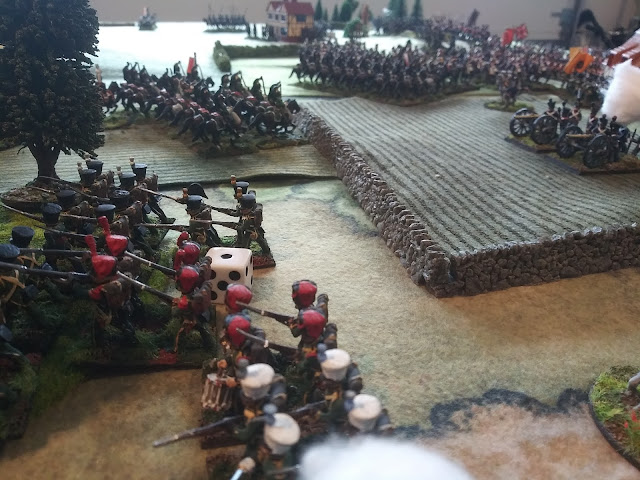
French light infantry if I recall.

We didn't really agree as to whether to use division break points or not, but there was some rough agreement that the five buildings each constituted an objective marker. 

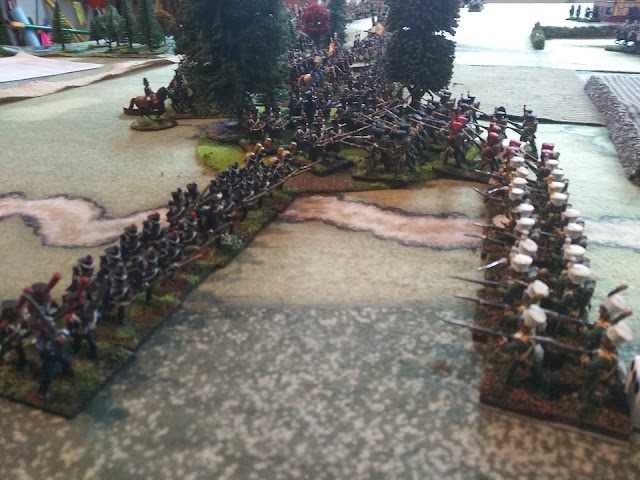
Nassau troops.

A big difference in playing this big of a game with just two people is that we each had six commanders plus an overall general. In Black Powder 2 the overall general can force a reroll of one failed order per turn, so between that and the sheer number of commanders, at least one or two divisions were liable to do something each turn, even if you were stricken with poor command rolls.

Allied center.

I spent the first few of my turns getting my the French battle line in order, and, once that was done (and noting the British were a little out of line), started pushing forward in well supported groups.


I also leaned into using the commander's "Follow Me" rule to get artillery pieces or certain cavalry units to where I wanted them.


Otherwise, while both sides manouvered about, there was the usual early artillery fire exchanges.

The various guard cavalry units.


But then some Nassau troops got into the small wood facing the French right. Since it was a single unit I set up a supported attack and moved to clear the woods.
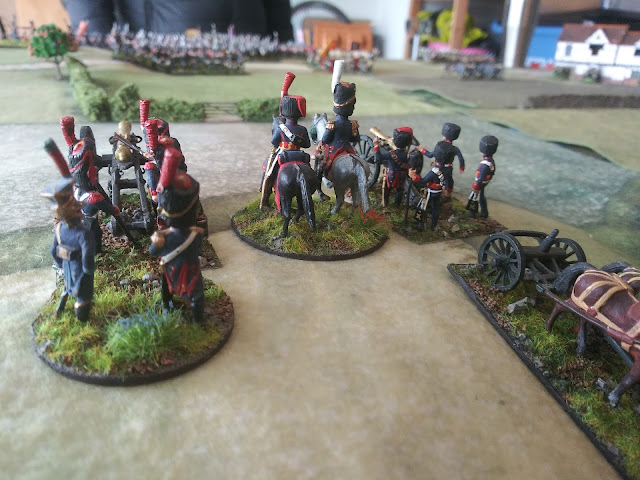

French artillery on the small hill at the center of their line.

Pete's beloved British rocket battery.

In the center the British heavy cavalry charged the French dragoons.  I opted to have the single unit counter-charge in order to gain the +1 charge bonus to hit rather than taking the +1 support to combat result.  Both dragoon units would end up falling back behind the safety of the French infantry but the British heavies were left milling around in the middle of the field.

Cavalry clash. French dragoons took worse of it.

Nassau on the move on Allied left flank.

British heavy cavalry and French Dragoons fight it out while Nassau infantry starts to give ground in the woods.

Nassau infantry under attack.

French Line infantry moves into the wood to push out the Nassau.


Having pushed the Nassau infantry out of the small wood, the French right forms up in line and advances.

The French right ends up breaking the Nassau in the wood, and moves up in line just past the woods and starts exchanging musket fire with the remaining Nassau in the building. On French left, mean while, three cavalry units are able to charge from the center of the table and break the lone British cavalry there.

The allied left (Nassau infantry) has fallen back to this house.

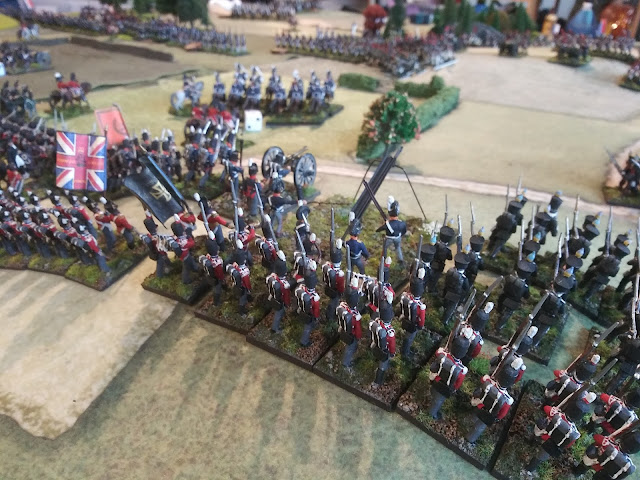
British center.

With this mass of French cavalry positioned to loop around to the British rear, the Brunswickers angle to protect the flank. Meanwhile, the infantry on French left leaves the shelter of the farm and woods and advances on the house also defended by the Brunswickers.

French cavalry on extreme British right flank.

As the French Guard infantry began to advance on the center and exchange musketry with the British, a good round of artillery and musket fire broke the stranded British heavy cavalry unit. The Nassau in the building on the British left found themselves littered with casaulties, and the assault on the Brunswick-defended house lasted two rounds but the French succeeded in carrying it. 

French left flank on the advance.

By now it was almost 4:00, and the chill was creeping through my boots, so we had to call the game for the French, who had successfully won over the majority of the objective buildings. Here's a video of the table at roughly end game point.


Overall a great time and a fun game. Some chatting about playing even bigger games (Pete has so many more units that could be added to play). Personally I think the games could benefit from my terrain card draw system to break up the collection of 6"-8" areas of woods or a hill or a house. A randomized deployment table would be fun as well to create unique initial set-ups, although I'm not sure how you take the divisional system into account with that.


Monday, January 21, 2019

Hundred Days

I participated in Pete's playtest of his 100 Days Campaign Game, entitled "Napoleon's Last Gamble" (if its Napoleon's last gamble, why do the allies go first though?) using the Black Powder 2 rules.  Pete will run this game at the Ambuscade! gaming event on February 9.  I am particularly fond of Pete's Napoleonic Wars collection as they are his dad's Minifigs collection from the '70s, to which Pete has added more units.


The game seemed to be going fairly well for the French and then in the span of a turn or so half the brigades broke!  Being one of the French players, I think our error was not getting the bulk of the infantry in the center forward fast enough - the allies were able to beat us on the flanks.

Tuesday, August 14, 2018

Trying out Napoleonic Lion Rampant

Pete really wanted to try and adapt Lion Rampant to the Napoleonic setting.  I am particularly fond of his great collection of Napoleonic French and British armies so when he offered to bring those over on a Sunday afternoon, I was all for it!  Pete drafted up some rules/notes, sent them over to me, and I did the same.  We did our best to synthesize the results and then tried them out on the table. 


In the first game I played the British.  The rules were seemed okay at first, but infantry tended to hang back and slug away with musketry and never attempt to close. This was probably because we had all shooting actions as automatic successes, supposedly offset by units in column getting automatic movement activations. 


We also tried a "supporting unit" role wherein all units within 6" of unit taking a morale test received +1 per supporting unit.  This led to the somewhat silly endgame where the British had five units still on the table but all of them had taken around 50% or more casualties yet were still unwavering! 
 
(Above: towards the end of the first game - the British are carrying a lot of casualties but are not wavering at all due to over-effectiveness of the Supports For Morale rule)

We reviewed the notes again and ditched the support rule and the automatic shooting rule.  Being in column however was still an automatic move. We also switched sides and added a few more units to the mix.  The opening rounds of the second battle clipped along nicely with some surprises and even a little tactical back and forth.  However, again, once the infantry lines closed to about 12", both lines came to a complete halt and a musketry duel ensued (which the French ultimately lost). 


 (Above: photos (with different focus points) of my French attack column. I had drafted what I thought were pretty nifty rules for French attack columns - basically two units could combine and move automatically, and their stamina was upped to 4 [from a base of 2] and movement upped to 9".  The idea was the column could relentless move forward and soak a lot of damage from closing fire. It... sort of worked.  In both games the attack column got close then ended up settling for musketry instead.)

In the post-game discussion the verdict was that to adapt the Lion Rampant system to the Napoleonic period, you had to add on so many rules that you might as well just play Black Powder!

Tuesday, December 12, 2017

'Almost the Alma' Black Powder Game

I ran my Black Powder 'Almost the Alma' Crimean War scenario at Ambuscade!, an one-day historical wargaming event that I helped organize, which was very fun by the way, and anyone and everyone is encouraged to attend next December.  The scenario set-up was the same as the previous playtests, with the following changes to unit profiles and composition:

(1)   Previously all the British cavalry units were classed as "small", with their hand-to-hand and stamina stats reduced accordingly. For this game I graded them up to "normal" size, which gave the British heavy cavalry units (Heavy Dragoons and Scots Greys) eight melee dice and the light cavalry (Hussars) six.

(2)   Per the Crimean War scenario from the back of the Black Powder rulebook, I upgraded all the Russian infantry to have a stamina of 4 instead of 3.  This acts as a counterbalance to the general lack of special rules for the Russian side as well as the plethora of special rules for the British and higher British staff ratings. 

(3)   I also calculated the point values for both sides using the appendix in the Black Powder rulebook, and using all available figures, the Russians start the scenario with a 200+ point advantage (approx. 1,200 vs. 1,000).  I went ahead with this since I figured the British need the challenge since they have so many factors in the their favor, especially the higher staff ratings.

The rough outline of the game was as follows (I did not take many pictures – I was having too good of a time!):


(Above: the Cossacks advance on the Russian left (bottom of photo) while the British heavies tussle with the Russian lights on the opposite side of the board)

Both sides advanced.  The Russians sent cavalry probing attacks out on both flanks.  The Russian light cavalry, consisting of dragoons and hussars, were effectively smashed by the British heavies, and the Cossacks on the other flank were turned back, despite 2-to-1 odds, by the British Hussars.  The Russians established a very long, dense firing line of infantry in the center of the table and attempted to out-shoot the British.  Most of the British infantry responded by falling back a bit to be out of Russian range but still in range to counter-fire with their longer-range rifled-muskets. 


(Above: the long green line of Russian infantry straddles the board)

Meanwhile, a unit each of Heavy Dragoons and Scots Greys succeeded in getting all the way to the Russian edge of the board, and turning and charging one of the Russian redoubts, and taking the position – an automatic partial victory for the British! 

At this point the Russian players conceded the game, since there was no infantry in reserve to protect the other redoubt position, and losing both would be an automatic full British victory.

I think the scenario was fair in terms of troop dispositions, and a review of the rulebook the next day confirmed that I did not adjudicate any rules wrong (phew!).  I'm a little curious why the Russian players chose to stop their advance midway across the board and engage in a musketry duel, which hurt them because it whittled down their superior stamina score of 4.  With the British heavy cavalry scattered about on the Russian flank, its seems there was a missed opportunity for the Russian infantry to put some serious pressure on the British center.  Also, a few infantry units protecting the Russian guns would have been useful in retrospect.

As in the playtests, I ignored the 'brigade morale' rule (it is optional, after all) and just tracked army morale instead – so if over half of one side's units were lost (either off table, destroyed, or on table with 'shaken' status), the entire army was deemed broken and would commence retreat.  I really recommend this method, with a visual scorecard of some sort to track how close each side is to breaking, for Black Powder and probably Pike&Shotte and Hail Caesar! as well.

Sunday, November 26, 2017

'Almost the Alma' Playtest No. 2

With Ambuscade just a week away, I cajoled Gabe into coming over for another playtest of my Crimean War scenario, 'Almost the Alma', so I could continue to hone my knowledge of the rules and also see if the game was more competitive with the addition of three more infantry units and two more cavalry units per side.  The only other change was each side had an unattached Commander-in-Chief with a higher staff rating, which benefited both sides equally, it turned out.  We also remembered to use initiative moves which really picked up the pace in the second half the game. I also ignored the "broken brigade" rules and just went with overall army break point (when half of total units in army are shaken, destroyed, or off table, that army has broken), which eliminated additional accounting steps.

Long story short, the British infantry (me) on the British left failed to cross the river and set up in the woods for almost the entire game.  This gave the Russians (Gabe) the ability to set up a very lethal and sturdy fire line across most the board, which proceeded to pile concentrated fire on select British units with the help of their artillery on the heights.  The British heavy brigade (Scots Greys and Heavy Dragoons) charged and were rather easily repulsed, since aforementioned supporting infantry was not in the woods where they were supposed to be!  Still, with the help of the scoreboard to track total number of shaken units, it came down to a nailbiter in turn 7 where the British "Almaost" bagged a 10th shaken Russian unit but came up short. In the bottom of the 7th it took the final melee of that turn for the Russian to break some British Hussars and win the game.


(Above: end of turn 1)


(Above: end of turn 2, I think, with British having significant problems crossing the Alma)


(Above: around Turn 4 or 5, I believe, with British heavy brigade charging on British left and the Guards doing a nice job enfilading Cossacks on the left)


Overall, it was the most satisfying game using a Warlord Games ruleset I have ever played, and I really think it was the 'scoreboard' visual aid (my kids' old stand-up chalkboard, in this case) which made the difference - both sides knew exactly how close they were to collapse at all times and it helped focus both commanders with short-term game decision making and also added some narrative tension.

There will be a few more tweaks for the Ambuscade version of this game but otherwise I feel very comfortable and prepared.