Showing posts with label Crusades. Show all posts

Monday, April 6, 2020

DBA Special: III/74a Seljuq Turkish army of Rum 1063AD - 1276AD


Seljuk (or Seljuq, as DBA has it) Turks ... this is a refurb of a number of oddments that accumulated during the genesis of numerous Crusades games ... put together with a brand new Camp (courtesy of a ruined temple which I won at Partizan last year and which now has a use) ..

The figures are by Museum Miniatures and Essex, with a little help fom Camelot, Outpost (the cataphracts), Irregular, Battle Honours, Tabletop and Donningon (the Snake Charmer set) ...

(Kilij Arslan was Seljuq Sultan of Rum at the time of the First Crusade)

The bulk of the army is a mix of armoured and skirmishing horse archers.

 
(DBA III/74a Seljuq Turkoman cavalry)

Indeed, all of the rest of the optional troops can, instead, be Turkoman LH.


Or Turkomans ... I've gone with the ever willing Georgians (as 3Kn


Or Turkomans ... I find a couple of Bw elements always good value in a DBA army.


Or Turkomans ... ordinarily I take the Agulani in order to boost up the strike power of the army.

The camp features a snake charmer and a man who has a performing monkey on his shoulder.  My idea was something like 'the fall of Rome in the East' with a touch of Aladin ... There's a little audience gathering ... maybe some of these are pilgrims ...

(DBA III/74a Seljuq Turkish: camp)

As usual, the Camp Follower detaches for those rare occasions where this makes sense in a game ...

(DBA Turkish Camp Follower element: part of a charming set of Arabian figures in the Donningon - New Era - baggage and equipment range) 

This army sits in my collection paired with Mongol Conquest.

(DBA Turks: camp scene) 


Wednesday, April 30, 2014

27th April Central London


The Last Emperors ...

My final ancient/medieval outing for April was a rare opportunity to join the Jockey's crowd for a multiplayer game set in the last age of Crusading.

As JB's preamble put it 1453: Constantinople has fallen.  Now the Sultan turns his eye to the Peloponnese, where the last Byzantine princelings and the final generation of Frankish lords cling to power behind great fortresses such as the Acrocorinth and Mistra while the Pope, the greatest erotic poet of the age, attempts to rally support for a new crusade.

I joined a smaller but more tightly motivated Ottoman team upstairs in Constantinople (or Istanbul as many Turks were already calling it) while the many Christian petty princes and would be Emperors pored over the big map on the common area.

(The Last Emperors ... political/deployment at start)

You can get an impression of this from the genral map at the start of the game ... a little green toe-hold at the top of the board (our Ottoman jumping off point for the campaign) and the rest of it covered in a near incoherent patchwork of colour coded factions and families.  Could we conquer Greece before they could unite and throw us back ...

Given our massive stack of resources, could they confront us at all?

Well, the answer to that would be found upstairs in beyond our sublime porte, where there was an Empire to run which would continually sap resources from our Greek enterprise.

We began the game with a convincing blitzkrieg through Northern Greece, installing unpleasant governors  (according to how compliant had been the province) and subsequently shipping in good moslem settlers ... but problems built up and we could not sustain the aggression of that first season at war.

(The Last Emperors ... game end)

The Christians had been able to launch a Crusade, the seas were running with pirates, and I was killed in a great (land) battle at Lepanto.   We had achieved our initial objectives ... taken Athens, established a puppet Duke, pushed the Venetians out of Eastern waters, but it would take a new campaign to unlock the Peloponnese.   

The game freely mixed role play with boardgame and Committee game and enjoyed a quick and dirty buckets of dice battle resolution.   It smoothly ran through a number of seasons over a working lunch and afternoon.  There was a neat spying sub-game in operation which has inspired a lot of follow up traffic (and which I can see porting nicely into Wars of the Roses scenarios) ...

No toy soldiers were harmed or endangered in this map-based game.   Nevertheless, it was nice to be able to play a Medieval/Renaissance game at the operational level for a change - and I think it brought attention to this quirky twilight period of Western history ...

DBA Northern Cup at Triples next!

Wednesday, November 20, 2013

16th/17th November, Reading

Warfare 2013

Warfare is the last outing for the Society of Ancients main UK show team for 2013.   The 'Shows North' team still has Recon and Wargamer to come, but for the big show we were as usual helping as day 2 volunteers.

Saturday saw Phil Sabin recreate the Battle of Carrhae, which I understand went well ... On Sunday, Secretary David Edwards provided a taster Crusades game loosely based on some 13th Century sources as a tryout for Field of Glory.   The Kingdom of Heaven look proved attractive ...


The way Field of Glory handles the interaction of charging Knights with lighter shooting cavalry is both plausible and entertaining and shows the game off to its best.   It has enough fun in it to be a good introduction to the Crusades period and is simple enough to explain in a show environment.

(a closeup of some of those splendid 28mm knights from David's collection)

Elsewhere around the Societies zone, John Curry's History of Wargaming Project had a memorial exhibit remembering Donald Featherstone including books and trophies from his estate ...


(Donald F. Featherstone 1918 - 2013)

Many thanks to Chris Scott who explained the significance of some of the memorabilia to me.

Don Featherstone made a massive contribution to turning an almost invisible fringe activity into the recognisable leisure activity I could get captivated by in the late 1960s.   He was a key contributor of the books I could find in the library as a lad.   Without him, Tony Bath, Charles Grant and Peter Young things might have been very different.   We miss them all.

The Lance & Longbow Society also attended with a display of publications and a WotR skirmish game ..

(Rollo guards the L&L Soc treasures)


In the rest of the show:

Overall it did seem to me a bit quieter than previous years (we usually get asked to help on the Sunday, so that is the day I am most familiar with) ... and some traders thought so too - OK takings but not particularly busy.   There was plenty of good stuff to look at, of course ...

(Celtic village terrain by Kallistra)

(Elephant action from the Old Malvern 28mm Armati game)

(54mm cattle from the Skirmish Wargames Society)

(this chap will pass for a soldier, perhaps ...) ...

(sticking with 54s, here's some ECW chaps from the Rearguard at Rowdeford game last seen at Colours)

(splendid Napoleonic Egyptian campaign game - these always look great)

(detail)

(beautiful Sengoku period Samurai game with home grown rules)

(detail)

Well, those some of my favourites, and there was alos the 1/35 scale Stalingrad game (seen at Campaign) and Peter Pig's Longships in the main trader hall.

John Curry and Chris Scott were good neighbours on the Don Featherstone stand, and Ian Lowell was a welcome guest for the Society of Ancients.  Roy Boss dropped by, too, although he was playing in one of the events.   And Richard Jeffrey-Cook.   

Notable too, Colin Froud stayed for a chat.   He was the outgoing Committee member from whom I took over sales and Back Issues in 1987.  1987!  I had to hire a van and collect the stock from Colin's attic and - another 100 miles away - Bill Thurlow's garage.   Not a home owner all those years back, I was able to store the stock together at the vicarage in Wellingborough courtesy of Ian (who became President in 1993) ... Some of us are still around, but it isn't often we meet for a chat.

Thursday, September 11, 2008

Newark 7th September

Kelham Hall - The Other Partizan

The Society of Ancients and the Lance & Longbow Society back together again for a combined 'ancient and medieval' zone ...

And yes, Dave, I'm sorry. I have been attending shows at Kelham Hall for a decade - but somehow the A1's lack of junction numbers can still leave me confused. Jinxed from previous visits, we were on schedule this time at least not to be late ... then somehow just cruised past the junction and on for about 15 miles before even realising. In total, the unscheduled round trip was 45 miles. Fantastic! Why does this nonsense happen?

Ah, well. Thanks to everyone for their help and patience.


Tell you what, though ... like all the recent Partizans, it was a great day, once we got going. And that's the main thing. Historical wargaming, and meeting fellow enthusiasts.

We had decided to follow up the popular *Crusader battle using Field of Glory* formula we had tried at Claymore, but this time reviving one of my earlier scenarios, Welcome to Jerusalem (the first Crusade 1099 siege of the Holy City)...

I had first devised this game in time to do the shows circuit back in 1999, the 900th anniversary year of the city's fall. After a fair bit of experimentation with (then) fashionable rules, I opted to write the scenario around the more traditional Medieval Warfare by Slim Mumford (so-called Mumford's Siege Rules ...).


These are still available from the Society of Ancients, and are a classic. The nearest contemporary equivalent would be Warhammer Ancient Battles: Medieval Warfare assumes you use individually-based figures and retains that skirmishy feel, with characters dicing for hits, making saving rolls for armour etc. - but with very little instruction on how to play (just a framework of mechanisms and modifiers around which you have to develop your game yourself ... ).. Ideal for adapting to scenarios, and lots of ideas for the big equipment already built in for assault games.


I think individual (sometimes heroic) characterisation has its place in siege games, however grand the notional scale. So often, in history, citadels hold or fall according to the success of one man
at the top of one ladder! The Crusades is also one of those eras rich in heroic personalities - and, like the medieval chronicles we base them on, I think we really want the Bohemonds, Stephens and Godfrey de Bouillons of legend to shine through our games. So any scenario or adaptation will need to balance the modern player's desire to use armies based up for current (often quite abstract) battlegames with the asymmetries of siege warfare and the dynamic contributions of the individual.
(a medieval style Godfrey de
Bouillon in the Crusader camp)


There has been chat, on one forum or another, of whether the very new Field of Glory might work for a siege game - and in terms of its actual game structure, no obvious reason why it wouldn't. And the equipment built for the Jerusalem assault has long been gathering dust. It seemed like a worthy challenge.

For Partizan, we devised some basic accommodations of the equipment and kit into Field of Glory (we replaced most of my 'Mumford' single figures with bases of troops from Chris's DBx Norman army - the singletons would now serve as equipment markers or similar, as appropriate - artillery would be 'bases' as in the battlegame, Siege Engines - towers ans such like - we would have to experiment with as the game progressed) ... and set about devising a list of potential points of advantage for shooting, impact melee etc. What would be Complex Moves? ... what additional factors might need adding into the Cohesion Tests and modifiers (incendiaries?) ... how might we go about the whole process of hitting/destroying siege engines ....

So, with limited space and a lot of question marks, we set up a very simple array - a shallow playing area with some assault parties lined up ready to go, a modest artillery battery to worry the defenders, and some homesick Fatimids lining the walls (determined to keep the Franks out - but unlikely to hang around once an incursion was achieved).


Each part comprised the equipment and/or markers (rams, ladders, axes, mantlets etc.) and a BG's worth of conventionally based Normans to indicate the strength, take the casualties and do the fighting.


The main function of the colossal Beam Slings would be to cause Cohesion Tests on the defenders (the odd 'disruption' result being likely to influence the chances of the ladders parties..)..

The defender artillery were equipped with incendiaries - we decided a simple Complex Move Test (pass or fail) would be sufficient to indicate whether an artillery group's shooting going to be normal or volatile ... the volatile hits igniting the target and causing extra panic for the crews.


(yes, those are Airfix walls -

a great job they do, in 15mm)

Who wins? Well for a full siege or assault game, that's an interesting balance - given that there won't always be a 'fair' balance of resources between the forces. In 1099, the issue was clear cut - if the Crusaders get in, they have won, and the defenders have lost. If all of their equipment is lost or destroyed, or the assault parties flee, the day's endeavours will be called off - and the Fatimids have won (for now, at least ...)...


Well, suffice to say this was just a preliminary outing - a chance to give it a go and get some opinion as much as anything. We were able to play through the sequences enough to see that the game will work, Field of Glory will provide a suitable platform, and that the Crusader siege of 1099 has lost none of its appeal to the showgoing enthusiast.

I will update information as this project progresses - and assuming it is all working, will build up the FoG Siege Game resource as problems are solved/fixed. Follow it here, and I will let you know as/where material gets collected.

Thanks to everyone who helped or took part - whether playing or chewing over some of the ideas. I got a lot out of both forms of involvement, and I hope you will join in again.

We are going to do all this again on Sunday, on the Society of Ancients stand at Colours (Newbury Racecourse - see the link in the side panel) ... Come along and join in if you are free.

Thanks to Chris for his assistance, figures and pictures - and thanks, too, Mike T. for some excellent ideas.

Monday, August 4, 2008

Field of Glory vs Armati: revisiting the Arsuf show game

Claymore: After Action Report

This report does not attempt to give a fair and comprehensive review of Field of Glory. It does attempt to tell you what happened when we set up our Shows North Armati scenario (here ...) for Arsuf, then played through it with Field of Glory.

The game should have a chance of working ... the scenario's orders of battle followed the historical encounter as best we could accommodate it, and both games are unit-based (in FoG they are called battlegroups - BGs). One of the differences between the games is that in FoG, the BG size is variable, where as in Armati the unit sizes (within any given troop type) are uniform. In practice, we made the (few) Saracen Heavy units into 4-base BGs, but amalgamated the Turcomans and LI/SI foot roughly so that their Armati divisions became FoG BGs (of 6 bases).

On the Crusader side, we similarly kept the HI units the same (4s), grouped the main body Knights into 4s, and amalgamated all the Turcopoles into a single 4-base BG. This left both the Templar and Hospitaller Knights (the vanguard and rearguard) with just a pair of bases each. Historically these were pretty small contingents, and the 2-base knight BG does exist in FoG (just not in the Late Crusader list) - so we decided to leave them as little elite units ... to see what would happen.

The Armati scenario listed quite a few commanders, and all can be played in Field of Glory. We rated Saladin an Inspired Commander, and his subordinate (who commanded the army on the day), Takedemus, as a Field Commander. Richard we also played as a Field Commander, with the rest of the Crusader hierarchy as Troop Commanders. This was less a judgement on relative ability as on behaviour ... the Saracen leaders exercising command from afar, the Crusader lords being much more tightly lined up with their men. The balance - a couple of long range commanders v. a cluster of limited and local ones - seemed to work fine...
Deployment, approach to battle etc.
This phase of the of the Field of Glory game worked better than expected. I knew that the FoG systems would be handy with respect to the Crusaders deploying from the march. I was a little more concerned about move distances and shooting ranges (as these are much longer in Armati): I didn't want us to have ended up with the forces too far apart, and spending all day on the approach. In fact, although you do have to get quite close to make the shooting effective, FoG has very few complications until you get there, so, like Armati, you can get on with it (gone are all those excruciating hours of irrelevant Pip management that DBM made mandatory just in order to get two distant armies to close with each other ... you can get to the proper battlegame quite quickly).

In fact, in our game, the Saracens moved across the plain and closed around the marching Crusader columns in a very similar pattern to the familiar Armati envelopment (both games encourage proper battle lines, Armati with its manoeuvre divisions, FoG with its commanders moving linear arrays). We quickly got to the phase where the Saracens were shooting, and the Crusader commanders (Chris, ably assisted by a cluster of visitors who seemed pleased to stay with the game) needed to decide how, where and when to drop out of their columns, and organise a proper response to the intensifying harassment.
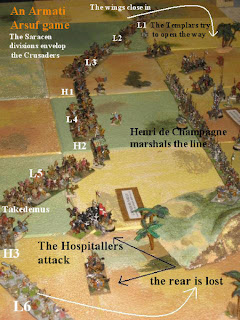
Armati, of course, normally starts the battle with armies deployed opposite each other, and only allows an (authentically) restricted capacity for units/divisions to turn, wheel, expand etc. A big chunk of the scenario, therefore, sets the parameters for deployment - fixing the orientation and composition of divisions, where and when they can be set up. This is quite complex, but worth the trouble ... as you get to play the game with a very good set of rules.

In this situation, FoG's comprehensive movement and manoeuvre rules are a real winner. For symmetrical set-piece battles, they are undoubtedly over elaborate (and if you were playing any of the open field Hoplite battles, you really ought cross most of the 'Simple and Complex Moves' page out). Here, it saves all the extra rules the Armati scenario needs. Everyone can turn to face the enemy, BG's can deploy with gaps in between ... Knights can deploy on a one-base width in order to charge through the gaps in the Crusader infantry line (and expand later and/or in the melee if they can bring one about ...) ... all pretty much as we imagine it must have happened. Again, there are issues of balance to achieve: although the Crusader infantry was seasoned, and (on this march) evidently excellently disciplined, I thought that they ought to take Complex Move Tests to deploy (a CMT is a simple 2D6 dice roll, modifiable around a 50/50 chance)... that would make them 'undrilled' in FoG nomenclature.

Shooting
Keeping the Crusader BGs small certainly helped out this phase of the FoG game. I don't really buy the 'shot = no shot' (no point in rolling the dice...) that commonly happens in the standard game (if twice as many shooting might have an immediate effect, why do smaller numbers shooting for several turns never need even pick up the dice?) . In this game, with the Crusaders in 4s and the military orders pairs, the shooting was consistently exciting. I suspect, in the fullness of time, correctly balancing the BG size of shooter and target will be an important component in designing FoG scenarios. A successful ratio of hits to the target's unit size forces a Cohesion Test, and it is collapsing cohesion which causes BGs to rout. The effects of intense archery gave encouragement to the Turks, and some failed Cohesion Tests forced the Crusaders' hand.
Charge and Chase:
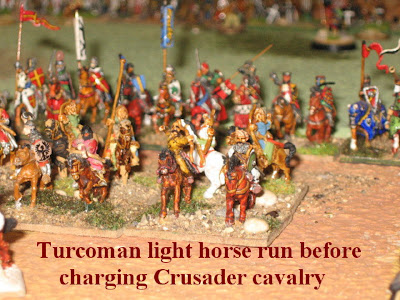
Where FoG does outclass many contemporary games is in its 'old school' sequence of declare charges/evade/dice for evaders-dice for chargers. This makes the whole process legible and exciting (like WRGs 6th and 7th edition) ... whereas Armati is legible but a little predictable - it is all on the 'whole turn' initiative roll - and, of course, DB's abstract way of doing skirmishing was just dull. Here, the sequence follows our understanding of the engagements ... the skirmishers need to get close to get their hits. If the shooting isn't doing too well, the target player will be happy enough to try to move closer without charging. If he takes damage the impulse will be to charge sooner rather than later (either they will run away which might be good, or they will be caught ... which will be better)... Crusades games are all about this interaction ... Knights against Turks ... Shock troops against mounted archers.

Everyone enjoyed this phase of the game. It was obvious that the skirmishing needed to be neutralised, it was equally obvious that the knights and Turcopoles needed to press the attacks home if they weren't to end up pulled out of position and surrounded by hostile archery.

Key Moments...
An important charge was made by the Templar Knights in the vanguard. At the end of the line, the Turcopoles (deployed by us as Light Horse, not Cavalry ..).. were getting the better of a larger unit of Turcomans who had decided to put their faith in numbers.... but the position was still compromised. A successful charge, now, would gain the Crusaders the upper hand. Actually, both target and charger threw 6s , so the charge was futile, and also pulled the Templars way out of position. They survived the shooting phase of their own turn - but the Saracen move saw them assailed from all sides. Although they still passed the Cohesion Test, they had to roll at least a 4 on a death roll not to lose a base. They failed, and in FoG BG's reduced to only one base are dispersed at the end of the turn. This mechanism worked nicely in everyone's opinion: ... the brave Templars surrounded, undefeated and undeterred ... yet shot down to just a few militarily insignificant stragglers. The Saracens looked to be getting the upper hand.

In the centre, it looked no better ... with Cavalry and LH horse archers liberally scattering Cohesion test failures about amongst the infantry. The bigger BGs of Crusader knights committed only to chase vainly after evading Ghilman cavalry ... Again everybody liked the way this passage of play depicted the relative flexibility of the fighting styles.
At this point, the Saracen player (me, that is) made some crucial mistakes .... in the centre, the first of two BGs of knights charged after some (evading) Turcomans. As these knights were disrupted (one rung down the cohesion ladder), some enterprising Ghilman cavalry launched an interception charge. Adjacent, the next Turcoman BG had declined to drop back in front of the other knights (electing to keep in close range of some infantry who had just failed a test ... and trusting to a '35/36's die roll to get away when the knights charged...). Both calls were bad. The evading roll of 1 was not enough to get away from the charging roll of 6. The disrupted knights next door still converted their 'impact' advantage on the Ghilman BG. A disaster, and a losing melee were the twin results.

To grab back the initiative, in the following Saracen turn, I declared a charge with the Saracen guard cavalry on a disrupted BG of 'defensive' Spearmen. A critical point in the line, they could be taken out quite quickly, and the Saracens would be through. Actually, the charge was a catastrophe, and the guards were immediately in trouble.

In the space of a couple of turns, accident and design had produced a rash on contacts across the battlefield, and the Saracens were losing all of them. Those valiant Templars turned out to be the only Crusader BG destroyed in the game (though many were severely worn) - and the battle had become unwinnable. I know how Saladin must have felt. It had all seemed to be going so well....

Afterthoughts ...
This game worked out very well. Field of Glory 'dropped into' a unit-based scenario with very few complications. As a rules set to play 'historical' Crusades, it worked in a clear and entertaining way. In the battle we played, the game's narrative was clear enough... the Saracens seemed to have the upper hand until the player tried to capitalise over-aggressively and found his troops in melee with the Crusaders. They are good at this, and it should be avoided at all costs. The game was lost very rapidly. The Armati game has been played dozens of time, with a very even distribution of results. We played this time with Field of Glory, and the Crusaders won hands down, once Saladin had made his mistakes. Actually, for what it is worth, that is a historical result - but there is no way one can speculate about the balance.


Field of Glory Scenarios: as mentioned before, we thought the 2 BG size for the military orders worked very well, and I suspect it is the right way to go for scenarios. Players would not do this for tournament games, and bigger BGs of military orders knights will be very powerful.

An important way of approaching these balance issues in designing the scenario is listing the units already in partial decline (starting disrupted, or disordered from the defile etc.). We started everyone fresh, but only for ease of set up.

Historically, the general engagement at Arsuf was prompted by the master of the Hospitallers (the rearguard) disobeying Richard's orders not to charge. Obedience is not a problem in the standard FoG game, but will be quite an important feature in developing plausible historical scenarios. There is quite a lot of potential here, and scenario designers have been given a pretty blank canvass.

All in all, a very worthwhile experiment. Field of Glory does 'attack on a marching force' well, and its 'charge and chase' mechanism suits the Crusades period ideally. Whatever the issues of balance maybe for tournament play, everything is there to make FoG an adaptable system for building up interesting historical scenarios. Thanks to everyone who joined in at Claymore.

Oh! Sorry .. Armati versus FoG? Too early to tell. As explained, this is exactly the sort of scenario that suits FoG's game type, and it did very well. The Crusader army and leaders were, however, too disciplined in my view, and in writing a scenario for this battle in future, I would concentrate on making the command and control far more challenging. This battle happened because, despite all the preparation, Richard lost control of the army ... and not its 'greener' European contingents, but its 'professional' military orders.