Views & Reviews From Writer Steve Miller
Formerly Reviews and Stuff at Rotten Tomatoes, 2005 - 2009.

Currently Showing at Cinema Steve

Showing posts with label Forgotten Comics. Show all posts

Tuesday, March 3, 2015

Look kids! Comics!

For a little over two years now, I've been producing comics anthologies through NUELOW Games. This is probably not news to most of you, but if it is, now is the perfect time to check out one or more of the wide variety of titles that are available.

Each of the books are in PDF format and contain anywhere from 24 to 68 pages of Golden Age comics, augmented with new fiction, roleplaying game rules, and/or biographical material about the creators. From now through Saturday 3/7/2015, most of the comics are on sale for 30 percent off the regular price, so now is the perfect time to check them out. Some of these comics have never been collected in one place before, and few have been reprinted since they originally appeared in the 1940s and 1950s.

Click here to see the title listings at RPGNow.

Here's a small cover gallery, just to show the wide variety of titles being offered.


Saturday, June 4, 2011

Forgotten Comics: Firehair

Firehair (Source: Showcase #85 - #87, Sept - Dec, 1969; and Son of Tomahawk #131-132, 134, 136, March - November 1971)
Writer and Illustrator: Joe Kubert (Series co-created with Carmine Infantino)

For roughly a decade--from the mid-Sixties to the mid-Seventies--one of the greatest talents to ever work in the comic book field was at the height of his creative powers. During this period, Joe Kubert illustrated "Enemy Ace" and "Sgt. Rock of Easy Company", two of the best war series every published; and he drew some of the very best "Tarzan" comics, producing adaptations of Burroughs' novels that equal and exceed the more well-known efforts by Russ Manning and Burne Hogarth. Kubert also created and illustrated some very excellent, lesser-known series, such as "Firehair", the subject of this Forgotten Comics review.

"Firehair" was a short-lived western series that appeared in three issues of "Showcase" and as a backup in a handful of issues of "Son of Tomahawk". It was set in the early 19th century, and it focused on a teenaged white boy with red hair who had been raised by Native Americans after a chieftan adopted him as an infant. It chronicles his wanderings--and details the racism he experiences from both Indians and Whites, as he is a man with truly no place to belong--and it was a surprisingly well-done and heartfelt series for when it was published.

All of the "Firehair" stories are superior examples of what may be created when someone with great talent treats comic books like an artistic story-telling medium on par with movies and novels.

Not only did Kubert produce stories of such depth that they can stand as equals in this day and age when critics and readers heap praise on even the most feeble attempts at producing comics that are "literature", but the look of the characters and the world they exist in have an authentic look that I don't think any other artist has captured, save Jean Giraud in the celebrated "Blueberry" graphic novels. Even the coloring on "Firehair" is far beyond what was typical in the 1960s--the use of shading and highlights is of a nature that didn't come fully into vogue until computer aided coloring was pioneered at Malibu Graphics in the 1990s.

If DC Comics ever decides to release a "Best of Showcase" or maybe "A Best of Joe Kubert" book in their hardcover "Archives" format--or even as part of the "DC Showcase Presents" black-and-white reprint series--"Firehair" should most definately be included. It's a shame that run-of-the-mill comics like "Uncanny X-Men" is kept before the public in a variety of book formats while true masterpieces like "Firehair" fade from public view and memory.

Thursday, July 8, 2010

Forgotten Comics: Silverblade

Silverblade (DC Comics, 12-issue series 1987-1988)
Writer: Cary Bates
Artists: Gene Colan, Steve Mitchell, and Klaus Janson
Rating: Nine of Ten Stars

Jonathan Lord was a hugely popular Hollywood leading man throughout the '30s, '40s, and '50s. There wasn't a genre he didn't conquer, and there wasn't a famous literary character he didn't play. As age began to catch up with him, he withdrew behind the walls of his palatial estate high in the hills above Sunset Boulevard, with his friend and manservant Bobby Milestone and copies of his old films. However, thirty years into his self-imposed, lonely and bitter retirement, Lord's youth is restored and his granted the power to assume the form of any character or creature he ever portrayed on film by a mysterious spirit who has chosen him to battle an ancient evil that threatens to consume the world.


"Silver Blade" is a highly creative 12-issue series that deals with such mattters as pre-destiny, reincarnation, the nature of reality, and the lines between good and evil. It is a highly entertaining story of great depth, and it's a shame that it's never been reprinted in graphic novel form, given the crap that has been reprinted. ("Death of Superman"? "Batman: No Man's Land"? These were nothing but third-rate, elaborate advertising stunts.) It's an extremely intelligent series from a writer who has never really received the acknowledgement from comic book fans that I think he deserves. Bates' 100+ issues run on "The Flash" during the 70s and 80s is one that is criminally underrated, and "Silverblade" is a prime example of the fact that mature comic book storytelling existed before someone hit on the idea of marketing it.

One of the best aspects of the writing in "Silverblade" is that Bates uses Bobby Milestone--a former child actor whose life has been a string of failures since his movie career faded--as the primary point of view character in the story. Bobby stands apart from Lord's new life, and he remains very suspicious of what is happening, serving as the perfect "stand-in" for the reader as the tale unfolds. Milestone also becomes the anchor point when the series takes a couple of very strange and unexpected twists toward the end--daring twists, actually.

The artwork by Gene Colan is spectacular, as Colan's art through the mid-1990s always was. Colan brings the mixture of realism and surrealism to his art that a series like "Silverblade" demands. Although he is starting to slip past his prime here, he does a great job on this. Inkers Mitchell and Janson enhance Colan's art just enough to make it shine even brighter. (Yes, even the usually heavy pen of Klaus Janson is just here to augment rather than cover... then again, Colan is such a powerful artist himself that I doubt the heaviest inker could obscure his style.)

Maybe we'll see "Silverblade" re-presented in graphic novel form one of these days. It's long overdue.

Thursday, June 10, 2010

Forgotten Comics: Destroyer Duck

One of the greatest writers to ever work in comic books was Steve Gerber. I will eventually be posting reviews of the bulk of his output for Marvel Comics here at companion blog Shades of Gray, but I will be covering some of his more recent contributions to the artform in this space.

I was torn between making the first Gerber review on this page one of his grossly underappreciated "Nevada" mini-series (arguably his last great comics work), his obscure (yet important) "Omega: The Unknown", or the wildly rebellious and anti-establishment and anti-corporate greed "Destroyer Duck." All three are Vintage Gerber, with strong doses of social commentary, rampant and hilarious absurdity and bone-chilling moments of terror (the latter being perhaps the most remarkable part about Gerber's output, because he has stated he didn't like doing horror and monster stories, yet his superhero tales often contain more horrific elements that those written by others who are expressly trying to scare their readers.

I settled on leading with "Destroyer Duck," because not only is it one of Gerber's greatest, darkest satirical series, but it was pencilled by the equally brilliant artist Jack Kirby and inked primarly by the monstrously talented Alfredo Alcala, but the series also featured a back-up strip, "The Star Child", a horror-tinged superhero tale that ranks among some of the best work from Jerry Seigel and Val Mayerik. Finally, it certainly it firmly belongs in my "Forgotten Comics" series, as it's one of Gerber's works that are unlikely to be reprinted, because the original films were destroyed during a flood of publisher Eclipse's offices and the original art pages are either likewise destroyed and/or scattered among who-knows how many collectors.
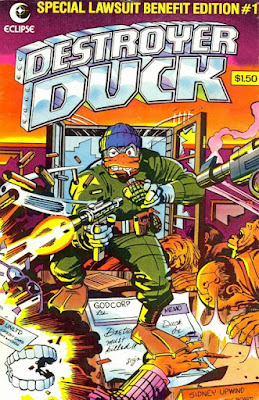

However, as I did a little fact-checking, I came upon a webpage that contains a article that was pretty much what I had already planned on writing... and which did it better than I probably would have. Click here to visit the article about Gerber's "Destroyer Duck" at Comics Should Be Good.
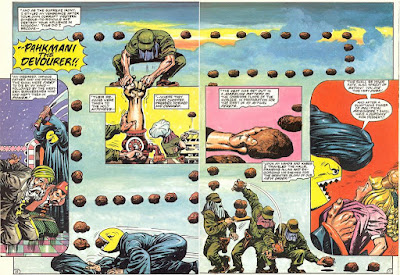

As you will read on that page, "Destroyer Duck" had its origins in an effort to raise funds to help Gerber in a creator's rights dispute against Marvel Comics involving Gerber's most famous creation, Howard the Duck. To say the references to the real-world players are thinly veiled is an understatement. However, like most of Gerber's work--and all good literature--"Destroyer Duck" is both a product of its time and relevant to this very day, because the roughly three decades that have gone by between the publication of "Destroyer Duck" and now have not seen the targets of Gerber's ire become any weaker, nor has the big picture in regards to the problems he was calling attention to gotten any smaller. With the exception of some Pacman-based humor, the bad actors of "Destroyer Duck" and the reasons for its hero's rampage against the corporate power structure could just as easily been written today. (Heck, the same excuse that one of the villains use is even still being used by Middle Eastern terrorists and their apologists/supporters to justify their monstrous actions. Like all of Gerber's best work, "Destroyer Duck" highlights more than anything the depressing fact that the more things change, the more they stay exactly as crappy as they've always been.

The eight issues of "Destroyer Duck" may not be easy to find, but they are worth tracking down, if you are interested in reading some of the best work Steve Gerber had to offer, as well as seeing some of the greatest late-career artwork by the legendary Jack Kirby.