"...we should pass over all biographies of 'the good and the great,' while we search carefully the slight records of wretches who died in prison, in Bedlam, or upon the gallows."
~Edgar Allan Poe
Showing posts with label Independence Day. Show all posts

Wednesday, July 2, 2025

Newspaper Clipping of the Independence Day

Via Newspapers.com


For this year’s Fourth of July, I’m bringing you something a bit different: A patriotic mystery!  The “Bonner County Daily Bee,” August 26, 2014:

KELLOGG - Old Glory is flying high atop a large ponderosa pine on Fourth of July Pass. 

How the flag got there, on national forest land, is a mystery.

At night the American flag, which is on the north side of the highway around mile marker 27, is illuminated by a light which makes it clearly visible from Interstate 90.  Jay Kirchner, a spokesperson for the Idaho Panhandle National Forest, told The Press Monday that they first got a call about the flag a month ago.

“We have no idea how it got up there,” Kirchner said.  "It's on the tip-top of the tree and I can't imagine it would hold the weight of the person holding onto it.”  

The Idaho Panhandle National Forest sent its professional tree climbers to assess the tree the flag flies from in order to possibly remove the flag.  However, Kirchner said even professionals were reluctant to make the climb.

“It’s just too dangerous for them,” Kirchner said.  “To get up on that skinny part of the tree that high up would be too risky.  Since it’s not hurting anything, we’re just going to leave it up there for now.  It’s not worth the risk.”

But Kirchner added that they would like the flag and light to come down eventually.

“We applaud and respect this individual’s display of patriotism,” Kirchner said.  “But they did this on public land and we don’t want more people putting up displays on public land.”

As far as I know, it was never discovered who put the flag up, and, more importantly, how the devil they did it.

Wednesday, June 30, 2021

Newspaper Clippings of the Independence Day

"Meriden Journal," July 3, 1902.  All items via Newspapers.com


Practical jokes have a way of going wrong.  Long time readers of this blog know by now that Fourth of July celebrations have a way of going very wrong.  So what do you get when you mix the two?

That’s right:  Strange Company’s annual Independence Day party!

For some people, the holiday goes straight down the toilet.  Literally.  “The Pantagraph,” July 5, 1992:

Elaine Sims isn't sure anymore what to expect when she walks out to get the newspaper in the early morning hours. 

One morning in March when she went out of her home at 224 Leland St, Bloomington, she was greeted by two toilets in the flower box. One was white with plastic flowers, the other black with plastic flowers. Each was decorated with crepe paper and, of course, toilet paper. 

She knew immediately that the "gift" was compliments of her brother and sister-in-law, Robert and Shaun Hermes of Hudson, and her sister and brother-in-law, Tim and Lisa Legner of Bloomington. 

She took it in stride. 

"It provided comic relief at the time," she said, because her father was in the hospital and quite ill. 

But after yesterday, Mrs. Sims is trying to figure out an appropriate method of revenge for her dear relatives. 

Yes, it happened again. When she went out to get the newspaper about 7 a.m. yesterday, there was yet another toilet. This one was appropriately decorated for the Fourth of July - complete with red, white and blue stripes, stars and a flag cemented in the toilet bowl. 

"I woke up my husband, Rick. He looks at it and says, 'Oh, your family did it again,'” Mrs. Sims said. "We've been married 18 years, so he knows."

Mrs. Sims said her brother "is extremely creative and artistic, and his style is reflected in our toilet." 


Mrs. Sims laughs when she says, "our family is warped and sick," while she and her husband are "quiet, sweet," she adds. However, she said, "there will be revenge." 

The practice of practical jokes comes naturally to the family, she said. "My dad was a famous practical joker." 

It seems that his offspring plan to carry on that family tradition. 

This story, Mrs. Sims said, "is to be continued."

Let us all be thankful that I could find no more about this family.

"Pittsburgh Press," July 5, 1911


As I have mentioned before, homemade explosives have provided me with no end of blog material.  The “Moline Dispatch,” July 6, 1986:

MELBA, Idaho (UPI) - A Fourth of July practical joker trying to blow up a church float depicting the space shuttle ignited the blast prematurely Friday and caused a $100,000 fire that gutted a warehouse, police said. 

Carl Hint, 24, told police he intended to play a joke and blow up the float during the annual Fourth of July parade in Melba, about 25 miles southwest of Boise, Canyon County Sheriff Bill Anderson said. 

Anderson said Hinz told police he entered the Security Heating and Air Conditioning warehouse, where the Melba Catholic Church's float was stored. Hinz said he planned to put black powder and balloons filled with acetelyne and oxygen inside the space shuttle float and then blow it up during the parade with a radio detonator, Anderson said. 

But the detonator malfunctioned when Hinz was installing the explosives and they were ignited, Anderson said. Hinz was taken to Mercy Medical Center with second degree burns over 20 percent of his body. Anderson said the blaze caused at least $100,000 in damage to the warehouse, scorched another building and burned several cars.

Yet another “joke” that wound up in a courtroom was reported by the “Buffalo Times,” July 7, 1906:

Special to THE TIMES. FREDONIA. July 7. Joseph Callahan started a John Doe proceeding Thursday before Justice H. C. Drake, which is the outcome of an ante-Fourth of July practical joke, in which Callahan was injured about the right hand by the explosion of a cannon cracker which was thrust into his hand by a crowd of young men Tuesday night. Callahan was taken into a doctor's office by the men and had his injuries dressed and they thought the matter ended until the service of the subpoenas. Thus far the proceeding has not indicated who was the active party in the affair.
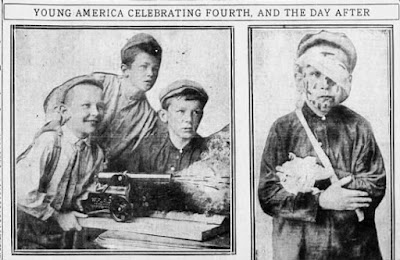

"Binghamton Press and Sun Bulletin," July 5, 1911


And, finally, a case where the tables were satisfyingly turned.  The “Chicago Tribune,” July 5, 1891:

There is undoubtedly more practical joking on the Fourth of July than on the first of April, and whatever may be the opinion regarding practical jokes in the abstract, few there be that having arrived at the age of discretion will not agree that the typical Fourth of July practical joke is rarely humorous, especially from the victim's point of view. There is a young man in Chicago who may be called Smith, to whom the idea of a practical joke on some other fellow is excruciatingly funny, or rather was so until a late hour last night. There is reason to believe that he has undergone a change of opinion on the subject.

A few days before the Fourth the young man conceived a brilliant idea. He bought a mammoth cannon cracker, over a foot long and several inches in diameter. Then he carefully removed the fuse and the charge, tunneling the gunpowder out and scorching the hole with a red hot wire until the last vestige of the explosive was removed. The big cannon cracker was then perfectly harmless. 

He started out early yesterday morning with his big, harmless cracker and a five-cent bunch of little ones. He inserted one of the little ones in the top end of the cannon cracker and dropped into the first saloon. After buying a drink he calmly set the big cracker on the bar and set fire to the fuse. 

The bartender crouched behind the bar, frightened nearly out of his wits. Sizz! went the fuse, and the other customers glanced at the big cracker and then scrambled all over each other in their haste to get out of the way before the explosion came. 

It came: a puny little pop! and the big cracker turned listlessly over on its side. The bartender peeped out timidly, with a sickly grin, and finally recovered his courage when the joker put the cracker in his coat pocket. Then everybody took a drink at the bartender's invitation. 

Strange to say the young man with the cannon cracker successfully played his little joke all day long, from place to place, with the usual accompaniment of drinks on the bartender. But every lane has an end, and every practical joker meets another sooner or later. 

Smith had meanwhile accumulated a Fourth of July "jag," which made him an easy victim. Someone who saw him play his little trick went straightway and bought another cannon cracker the same size as Smith's. But he didn't remove the load. He followed Smith. 

The opportunity soon came to replace the bogus cracker with the real one. It was the latter Smith drew from his pocket, while he braced himself against the bar and unsteadily touched a match to the fuse. Smith was knocked down in the rush to the door. To this adventitious circumstance he probably owes what remains to him of his physical well-being. 

The cracker exploded with a terrific report, shattered $200 worth of glass, for which young Mr. Smith must pay, and incited the proprietor to an assault upon Smith which made him wish he had gone off with the cracker. 

That cracker joke will be labeled " dangerous" and hid away in the darkest closet the young man can find when he comes to his senses today.

A happy Fourth of July next week to all my American readers!  At least, we will be happy if we all do the prudent thing and hide under the bed.  For all you know, Elaine Sims' brother may be heading your way with a toilet.

Wednesday, July 3, 2019

Newspaper Clipping(s) of the Independence Day

"Boston Globe," July 4, 1907. All items via Newspapers.com

Yes, it is once again time for Strange Company's annual Fourth of July celebration! This year, we have a roundup of assorted holiday oddities. Something for everybody!

Well, assuming everybody is a little weird, and if you're reading my blog, you probably are.

This writer for the "Muncie Evening Press" got into the proper Strange Company spirit for Independence Day 1939:
...July Fourth only comes once a year, too, like Christmas, and plenty often enough, at that. On Christmas we don't burn up buildings, put out the eyes of our fellow celebrants, nor maim and kill hundreds of people...I learned to hate Fourth of July demonstrations many years ago when a little boy who lived with his parents in an apartment on East Main St in the business district, died of shock caused by the barbaric noises of the day. The child had been very ill, but had begun to recover when the noise demons let loose their two-day barrage and killed him as certainly as if they had fired bullets into his frail body. How many, if any, victims will there be in Muncie, this year?

More importantly, how many hens will fall victim to the Fatal Fourth? The "Philadelphia Evening Telegraph," July 13, 1870:
They had an instance of the peril of trifling with explosive materials way down in Province-town on the Fourth of July. An old hen attacked a torpedo, and by persistent pecking, caused it to explode and blow her own head off. Not a very serious beginning in Fourth of July casualties for Cape Cod.

"Arizona Daily Star," June 30, 1935

Some handy tips from the "Appleton Post Crescent," July 4th, 1930:


You want to survive until the Fifth of July? Get a corset. The "Boston Post," July 5, 1921:
New York, July 4.--The steel stays of her corset probably saved the life of Mrs. Anna Stole, 25, when a bullet, fired by boys celebrating the Fourth of July, ricocheted from the curb and struck her left side. The woman's only wound was a slight abrasion.

Back in the day, lockjaw was as much a part of any Independence Day celebration as fireworks, ice cream, and parades.  The "Daily Journal," July 13, 1903:


A typical 19th century Fourth of July was reported in the "Dayton Herald," July 6, 1897:
Chicago, July 6. Fourth of July accidents yesterday resulted in a list for the day which included four dead, eight seriously injured and twenty-five slightly hurt. The dead are:

JOHN HOFFWATER, 8 years old, premature explosion of leaded pop bottle.

JAMES W. KEEFE, 21 years old. found dead in the rear of his home, with a bullet in his heart; supposed to have shot himself accidentally or been struck by a stray bullet.

CHARLES SMITH, fell asleep in a window; startled by explosion of giant cracker, lost his balance, and fell to the ground.

JOHN THOMAS, JR, 12 years old, jugular vein severed by fragments of glass bottle he had placed over muzzle of his toy cannon.


Because I know you're dying to learn what Independence, Kansas, spent on the holiday in 1880:


I shall close with two items dealing with the origins of our national birthday party.  In 1778, New Bern, North Carolina had the honor of being the first place in the country to hold public celebrations for the Fourth of July.  This report of that epochal day comes from the "North-Carolina Weekly Gazette" for July 10:


And, finally, this clipping from "Purdie's Virginia Gazette" for June 21, 1776, carried the biggest news of the day: the sad passing of Mrs. Martha Scasbrooke.  They managed to report on less momentous events, as well.


A happy Fourth of July to all my fellow Americans!

Wednesday, July 4, 2018

Newspaper Clipping(s) of the Independence Day


Happy Independence Day to my American readers! So, how would you like to spend this holiday? Picnicking? Boating? Watching a professional fireworks display? Listening to patriotic orations?

If you answered, "No, silly, I'd rather read about death, dismemberment, and disaster," well, you've come to the right blog. Yes, it's time for the annual Strange Company 4th of July celebration!

In some of my previous posts, I've compared the 4th to a war zone. In 1910, the American Medical Association took me quite literally, and made a scientific comparison. And guess what? Yes, you'd be safer in the war zone.

"Hutchinson Gazette," June 25, 1910


This roundup in the "Dayton Daily News" for July 5, 1904, was typical post-4th newspaper reading:
Chicago, July 6.--According to dispatches from all parts of the country, 25 persons dead, 1384 injured, and a property loss amounting to $177,800 is the price which the United States paid for its Fourth of July celebration, and the deaths from lockjaw will probably double or triple the number of fatalities already listed.

Of the injured, 177 were hurt by firecrackers, sky rockers or other explosives, and nearly all the dead owed their fate to these. Cannon prematurely exploding brought death to two persons and injuries to 101; firearms, including revolvers and guns, caused the hurts of 171; gunpowder and dynamite mistaken for gunpowder severely hurt 220 persons, and the deadly toy pistol this year claimed 209 victims. Runaways caused by explosions injured 39 persons, and in such an accident a woman lost her life.

Chicago this year escaped fortunately in comparison with the past. A new feature was the absence of a death roll in Chicago, and but 41 persons were injured.

The fire loss throughout the country likewise was extremely small, the largest damage reported being $50,000 in Boston. Janesville, Win., suffered a $35,000 fire, caused by a skyrocket. Small boys fired the stick, and it stuck on the roof of the Rock River Cotton company's mill, where the blase smouldered for six hours before it was discovered.

Baltimore, warned by its disastrous fire, restricted the use of explosives as, it is reported, never before has been done in an American city.

The records of other big cities follow: New York--Killed by fireworks, 1; injured by fireworks, 20; cannon, 3; firearms, 20; pistol, 4; total, 52; fire loss, $1500.

Philadelphia--Injured by cannon, 12; firearms, 28; gunpowder. 106; toy pistols, 67; total, 271; fire loss, $7000.

Meanwhile, the "Billings Journal" for July 5, 1909, chose to look on the bright side.


By the 1920s, the movement to hold "safe and sane" Fourth of July festivities had firmly entered the American consciousness. People looked for ways to celebrate the holiday that didn't involve racking up long rows of casualty lists. No, by golly, this time everyone was going to make it out alive!

This worked about as well as you'd think. The "Montreal Gazette" for July 5, 1921 had a good laugh on their neighbors to the south.


New York, July 4. Seven men were drowned today at beaches in the vicinity of New York as hundreds of thousands of sweltering masses fled from the intense heat that has enveloped the city since Saturday. An unknown man, believed demented by the excessive temperature, committed suicide by jumping into the reservoir in Central Park.

One death from prostration was reported in the city, while numerous persons, overcome during the day's festivities, were revived at hospitals. Several minor accidents resulted from the premature explosion of fireworks.

The crowds that sought relief at the beaches yesterday and today were the greatest in the history of any of the nearby resorts. At Coney Island and other popular hot weather rendezvous thousands slept on the sand last night and a throng fully as great was following their example tonight. Police details at the beaches have been augmented and the patrolmen instructed to see that the sleepers were protected from molestation.

Although five degrees cooler than July 4, 1914, today was still among the hottest Independence Days in New York in recent years. A maximum temperature of 93 degrees was reached during the afternoon, which, according to weather bureau reports, is ten degrees above the average for this time of year.

The list of casualties due to celebration of the "Glorious Fourth" began to arrive in dispatches early In the day and indications were that the efforts to make the U.S. national holiday, "safe and sane" were not likely to meet with any greater degree of success than in previous years.

At San Jose, California, . Gladys Flatham, youthful celebrant, is dead and her playmate, Joyce McLaughlin, is not expected to live. Their dresses caught fire while they were playing with fireworks and they suffered severe bums despite the efforts of neighbors to save them.

During celebrations today at Springfield, Mass., a young girl was assaulted and badly beaten; Joseph Startari, also of Springfleld, is in Mercy Hospital suffering from severe knife wounds received during a fight in east Longmeadow. Two Italians In the same city engaged In a revolver duel, said to have resulted from a family feud. Neither were injured.

Lockjaw, resulting from the explosion of blank cartridges being used to celebrate the fourth resulted today in the death of William Drumm, 15, and Michael Santello, 14, at Norwalk, Conn. The sale of explosives for Fourth of July celebration had been forbidden in Norwalk, and the police are investigating.

Milwaukee, Wis., July 4.--Nine persons are dead in this vicinity as a result of fourth of July celebrations, two of them being overcome by heat. Six were drowned, while another was killed in an automobile accident.

Chicago, July 4.--Twelve persons died and a score or more injured as the result of the three-day fourth of July holiday. Two were accidentally shot to death, a three-year-old. boy died in a three-storey fall, five persons were drowned and four were killed in automobile accidents.

Philadelphia, July 4.--Three drownings, several heat prostrations and the highest temperature of the year marked Independence Day here. At 2 o'clock this afternoon the thermometer registered 96, the highest previous temperature this season being being 94.

New York. July 4.--Minneapolis reported Its first Fourth of July fatality this afternoon. George Wheelan, 24 years of age, died in that city today from injuries he received when he accidentally shot himself yesterday with an automatic pistol, which he was preparing for use in celebrating Independence Day.

Cleveland, July 4.--John Shollis, 69, was killed tonight, a victim of a Fourth of July celebration. He was shot through the breast when a neighbor placed a cartridge on the sidewalk fifty feet away and struck it with a hammer, according to the police.
You get the feeling the Canucks were really enjoying rubbing it in?

So, forget the fireworks, forget the beach party. Who needs explosions or swimming parties to celebrate the holiday when there's good food and drink to enjoy? What could be more all-American like an ice cream party?

Oh.

Glens Falls, New York "Post-Star,"July 9, 1887
New York, July 7.--There is now a strong suspicion that the twenty families who were poisoned on July 4 by eating ice cream furnished them by Ernest A. G. Interman, of Sixth avenue, were the victims of some of the confectioner's business rivals or personal enemies. Interman has been established in business in his present store for many years. He uses only pure fruit syrups for flavoring the cream. The cream is made in the basement, with an entrance from the street, and the door is nearly always open. Interman kept a big dog in the basement to keep intruders out, but on Thursday last the dog died with all the symptoms of arsenical poisoning. It is now believed that some one gave poison to the dog for the purpose of getting it out of the way, and that on the Fourth of July they entered the basement and dropped poison into one of the cans of ice cream. As most of Interman's customers buy mixed cream, the contents of one can would thus be mingled with cream from a number of others. The police and health authorities are both engaged in investigating the matter. All those who were poisoned by the cream either have entirely recovered or are out of danger.

Well, I wasn't hungry, anyway. Let's just pass around some ice-cold lemona...

Never mind.

"Onaga Democrat," July 8, 1886


That closes our July 4th, 2018. We all have our own individual ways of spending this day, but I dare any of you to top Mr. William Prendegrast's holiday merriment.

"Weekly Bulletin," (Anthony, Kansas,) July 17, 1885

Tuesday, July 4, 2017

Newspaper Clipping(s) of the Day, Annual Independence Day Edition


As we all know, nothing gets the good old-fashioned holiday spirit going like endless tales of death, terror and destruction. And as anyone who has perused old newspaper archives can attest, nothing says "death, terror, and destruction" like a vintage American Fourth of July celebration.

Yes, indeed, it's time for Strange Company's annual Independence Day party. (Our proud boast: "No one gets out alive.")

Look up old newspapers for "July 5" of any year and be prepared for what reads like casualty statistics from a particularly brutal war, all presented with a barely disguised glee.


Harrisburg Courier, July 5, 1908


If I have learned anything from compiling these annual July 4th posts, it's that there are few phrases more terrifying than "homemade fireworks." The "Arizona Republic," July 4, 1939:
New York, July 3--Five youths playing with homemade fireworks were injured today, two probably fatally, in an explosion of 50 giant crackers touched off inside a large tin container.

One victim lost his left hand. Two others suffered the probable loss of one eye each. The accident occurred in a boathouse on Jamaica Bay, Queens.

Fragments of flying metal inflicted deep cuts on the pre-Fourth celebrators, and all suffered severe burns.

Police said the youths had tied together 50 highly explosive "cherry bomb" firecrackers and touched them off to make "one big one."

Put railroad flares together with a lighted match, and what do you get? Yes, of course. This headline.

Wilmington News, July 5, 1944


When you come across the words "boy chemist," around the beginning of July, you just know the story will not end well. The "Akron Journal," July 2, 1928:
New York, July 3--Because of a boy chemist's efforts to make his own Fourth of July explosives one lad and a fireman were in a hospital today.

An explosion in the home laboratory of Philip Rosenblatt, 17, wrecked the apartment. Philip's skull was fractured. Robert Withers, inspector of the bureau of combustibles, was burned severely by another explosion when he was investigating the first.

Four other persons received minor injuries.

A month ago Philip graduated from an evening trade school. He is a cripple. Barred from play he became something of an expert in chemistry.

"Wait until you see the fireworks I'm making for the Fourth," he boasted to a friend.

A policeman heard an explosion yesterday and dashed up the stairs to the Rosenblatt flat. In the small front room the boy was prone from injuries. His 16-year-old sister had been blown from her bed and was bruised. In the adjoining flat a baby was thrown from bed and bruised.

Five hours later as Inspector Withers was wrapping torpedoes which Philip had made, one of them exploded and set off several others. Withers' hands were mangled.

Louis Rosenblatt, Philip's 11-year-old brother, was severely burned by the second blast and a patrolman was struck in the eye by flying debris.
You don't have to be an "expert in chemistry" to send yourself to a hospital. The amateurs manage that very well on their own. The "Pittston Gazette," July 19, 1934:
Barnesville, O.--Matthew Van Fossan, 14, wanted to invent some fireworks of his own. He tried using carbide of the type which fills mine lamps, put a quantity in a fruit jar, was blinded in one eye when water reached the chemical, exploded it.

Well, kids will be kids, right? Once a person reaches maturity, they put things like DIY explosions behind them, right?

Medford Mail Tribune, July 6, 1936


The lesson is clear: don't set off fireworks yourself. Go out and enjoy a professionally-run city-sponsored display instead.

Oops. ("Deseret News," July 5, 1904)
Tacoma, July 4--The fireworks, which wee to have been set off here this evening in Wright park to make a finish to the big Fourth of July celebration, caught fire from almost the first rocket that was sent up, and in an instant the entire heap of explosives was flying in every direction. About four dozen eight-pound rockets flew through the audience of 30,000 persons, creating quite a panic, in which many were injured. Others were struck by the flying explosives, and it is estimated that as many as 50 were more or less injured, none fatally.

Van Allen Smith, who was assisting with the fireworks, stood his ground in an effort to scatter the fire, and was terribly burned. One arm was broken by an explosive. It is believed that he will survive.

Miss Hattie Braizeman was struck in the stomach by a rocket and seriously injured. One child is reported to have lost the sight of both eyes. J.H. Davis, chairman of the committee, had his right hand severely burned. Two children of E.S. Squires, who superintended the firing of the explosives, were burned about the face.

The audience was congregated along the slopes of the hill on which the fireworks were to be set off, and had crowded in a circle around the men at work, being only a few feet from them. Only slight precautions had been taken to protect the fireworks from flying sparks.

About 50 children were lost in the panic, and the police were busy at a late hour tonight trying to restore them to their parents.

More proof that July 4th is the most lethal of holidays, and in ways you'd never expect. The "Los Angeles Herald," July 7, 1908:
Chicago, July 6--Suffering all the agony, physical and mental, and exhibiting many of the symptoms that accompany death by poisoning, John Nerisa is dead, the victim of hallucination and auto-suggestion. It is believed his condition resulted from worry because of Fourth of July noise.

A weak mental state is believed responsible for the self-hypnotism. It was asserted by several physicians that scores of deaths occur annually in every large city from such conditions.

And then there's this odd little item from the "Pacific Commercial Advertiser," July 14, 1909:
The first Fourth of July fatality in Seattle was recorded when Louis Rohs, aged ten years, died of tetanus, caused by the premature explosion of a toy pistol.

Just another Independence Day celebration in Hillsboro, Ohio? Or guerrilla warfare in Afghanistan? Who can tell the difference? From the "News-Herald," July 7, 1898:

Some one must have taken Johnny Ervin for a Spaniard on the night of the Fourth. At any rate they tried to blow him up. He was passing along North High street when a sub-marine mine or other dangerous explosive exploded. He was just stepping over it and the concussion came near taking his pants leg off. A large hole was torn in his shirt, his hat was knocked off and almost torn in two and his clothes and himself were otherwise mutilated. Johnny, though, is able to be about and still swears allegiance to the American flag.
[Note: Many thanks to Chris Woodyard for bringing the above item to my attention.]

These next three items just seemed to go together:


"Deseret News," July 5, 1904: Paterson, N.J., July 5--Aaron Vandebrink, 6 years old, was accidentally killed by his aunt, Mrs. Mary Demarest, who was celebrating the Fourth. She was firing a revolver from a window in her house, and one of the bullets struck her nephew, who was standing on the sidewalk. Mrs. Demarest was arrested.
"Norfolk News-Journal," July 5, 1921: Paris, Ill., July 5--While celebrating the Fourth with a revolver last evening Everett Whalen, 15 years old, shot and instantly killed Luis Mullenix, the 12-year-old daughter of John Mullenix, a wealthy farmer.

Not all the Independence day dangers come from gunpowder. Insulted cooks are among the unexpected hazards of the day. From the "Buffalo Commercial," July 5, 1890:
Brooklyn, July 5--Patrick Landrigan and Philip Kavanagh, a boarder in Landrigan's house, celebrated the Fourth by visiting saloons and getting drunk. They returned to the house last night, and when Kavanagh sat down to supper he made disparaging remarks about the food.

Mrs. Landrigan resented this and demanded the money for board which Kavanagh owed. Kavanagh struck Mrs. Landrigan in the face, knocking her down. Her husband rushed to her assistance, when Kavanagh knocked him down also. When Landrigan regained his feet he rushed at his assailant and a desperate struggle ensued. Mrs. Landrigan, seeing her husband was getting the worst of it, went to his assistance and succeeded in separating the men. Kavanagh again rushed at Landrigan and struck him a powerful blow on the jugular vein which knocked him to the floor unconscious. An ambulance was summoned, but the man expired before its arrival. Kavanagh was arrested.

Another story illustrating how holiday festivities bring out the best in people comes from the "Los Angeles Times," July 6, 1902:
Cattlettsburg (Ky.) July 5--Jesse Rule, a retired merchant of this city, was stabbed and killed at a Fourth of July celebration here yesterday. Fred Burnett has been arrested and charged with the murder.

And finally, let's end on a cheery note. Meet Bertha Rice, who took the spirit of the holiday exceptionally literally:

Los Angeles Herald, October 11, 1905


Sunday, July 3, 2016

Newspaper Clippings of the Independence Day


Uh-oh.


As has become traditional on this site, here's a little round-up of star-spangled Independence Day horrors, directed in particular to that idiot down my street who, on the night of every July 4th, insists on setting off an arsenal that sounds like a riot in Hell. I doubt he reads this blog--public opinion questions whether he is capable of reading, full stop--but one can dream.

Our first example comes from the "Los Angeles Herald," July 7, 1908:
Chicago, July 6.--Suffering all the agony, physical and mental, and exhibiting many of the symptoms that accompany death by poisoning, John Nerisa is dead, the victim of hallucination and auto-suggestion. It is believed his condition resulted from worry because of Fourth of July noise.

A weak mental state is believed responsible for the self-hypnotism. It was asserted by several physicians that scores of deaths occur annually in every large city from such conditions.

The "Reading [PA] Times" of July 7, 1913 showed that their city really got into the holiday spirit:
Mrs. Charles J. Stahl was accidentally shot twice in the arm from a revolver held by her husband in their home, 1640 Muhlenberg street. The weapon was the property of their son and was lying upon the table. When Mr. Stahl was examining it the blank cartridges were discharged.

A package of fire crackers in the pocket of Stanley Kozlenski, aged 8 years, 653 Strong alley, became ignited from a stray spark and exploded before they could be extinguished by a bucket of water. He was removed to the residence of Dr. F.H. Lawrence, 1502 Perkiomen avenue, where it was found that he had suffered severe burns of the left leg from his toes to his hips.

Catapulted by the explosion of a giant fire cracker, a large piece of wood struck Warren Bechtold, 17 years old, 935 Robeson street, in the face while walking upon the street near his home. He was knocked unconscious and was carried to the residence of Dr. A.N. Seidel, 824 North Tenth street, where it was found that he had suffered a broken nose.

Frightened by the explosion of several fire crackers, Lester Lincoln, 14 years, Seventeenth-and-a-half and Haak streets, fell from a bicycle he was riding, receiving a concussion of the brain, several lacerations and body contusions. He was carried unconscious to the residence of Dr. F.G. Runyeon, 1390 Perkiomen avenue, who dressed his wounds and later he was removed to his home. His condition is serious.

Fred Miller, 14 years, 549 North Eleventh street, received a charge of shot in the face while walking along the street. When brought to the residence of Dr. M.L. Cahn, 551 North Eleventh street, he was unable to explain how he was shot, declaring that he did not see the person who held the gun. The physician removed most of the shot.

Warren Bechtold, 17 years, 935 Robeson street. Broken nose, premature powder explosion. Dr. A.N. Seidel, 824 North Twelfth street.

Mrs. Charles J. Stahl, 1640 Muhlenberg street. Accidental shot wounds in arm. Dr. H.H. Wanner, 1619 Perkiomen avenue.

Mary Rahr, aged 3 years, 1611 Perkiomen avenue. Fractured nose, tripped in running from firecrackers.

Walter Flatt, aged 4 years, 1564 Perkiomen avenue. Dog bite. Animal maddened by fireworks.

Clarence Rappaport, aged 10 years, 1651 Cotton street. Severe burns from holding pack of firecrackers.

Madeline Zieber, aged 7 years, 1411 Muhlenberg street. Severe burns from holding lighted cannon cracker.

Clinton E. Fisher, 39 North Seventh street, broken leg responding to fire. Homeopathic hospital.

Mrs. Mary Bellis, 324 Mulberry street, burns of face and arms from explosion of gunpowder. Homeopathic hospital.


On July 5, 1911 "Seattle Star" congratulated everyone for the relative lack of casualties, rather in the tone of survivors of an annual natural disaster:


The "San Francisco Call," on July 4, 1903, celebrated the holiday in a decidedly grim manner:


Yeah. We can guess how this one's going to end.


As a change of pace, here is a holiday reveler who was not lethal, just...overenthusiastic. The "Philadelphia Inquirer," July 12, 1876:
A deranged man, whose diseased mind is crowded with patriotic thoughts, created a genuine sensation and much amusement yesterday by his antics around the State House. Early in the afternoon he made his way into Independence Hall and was determined to sign the original draft of the Declaration of Independence.

After being removed from the hall he climbed to the roof of the State House by a lightning rod, and then with considerable effort clambered up the steeple, finally ascending into the belfry. He grasped the hammer of the new bell and rang it violently for some five minutes, until the hand of Captain Donnelly, the special officer of the hall, was laid upon his shoulder.

The lunatic was locked up in the Central Station, where he gave his name as W.J. Sullivan, and residence No. 404 West Fifteenth street, New York. He was neatly dressed, but had no money upon his person.

So, my fellow Americans, I trust you now understand how to have a happy July 4th. No DIY fireworks, no self-hypnotism, no efforts to annotate the Declaration of Independence.

And if one of you could hog-tie that guy down my street and lock him in a closet until the holiday is over, I would be most grateful.

So would the cats.


[Note: Previous Independence Day disasters can be found here and here.

Saturday, July 4, 2015

Newspaper Clipping(s) of the Independence Day

As you old-timers around this blog may remember, last year I did a roundup of some cautionary tales about the many hazards of Fourth of July celebrations.  For this year's holiday, I thought I'd take a look at the lighter side of its history.  Browsing through the old newspaper advertisements for local July 4th events, I can't help but feel our ancestors got a lot more fun out of the holiday than we usually do today.

That is, of course, when they weren't blowing themselves to smithereens with DIY fireworks.

Arizola [AZ] Oasis, June 24, 1904

I find it particularly endearing how communities all boasted how their celebration would be bigger and better than anyone else's.  "The Eagle is going to scream his loudest!  We will have the best ever!"  And, no, I do not have an explanation how the "Wondrously Rich Chinese Pageant" fits in with the American Independence Day, but I'm sure it was a grand show regardless.

"Coconino Sun," July 1 1899


Who could resist a hose contest?

"Mohave County Miner," July 3, 1897

Greased poles and greased pigs.  Not to mention the Beautiful Queen De Cacti!

"New Anaconda Standard," June 30, 1891

I have a sneaking suspicion that "A Famous Orator of National Note Booked for the Occasion" means, "Our original speaker bailed out at the last minute, and we're still scrambling to find a replacement."

"St. Paul Globe," July 5, 1880

"Six Experienced Tubbists!"

"Hayti [MO] Herald," June 21, 1917

The oldest married couple!  50 yards Fat Men's Race!  Running Board Jump!  The Hayti Hussar Band in person!  Rain or shine!

"Hood River Glacier," June 28, 1917
A wartime celebration, with half the proceeds going to the Red Cross, and half to the mess hall of the boys of the Twelfth Company, so they can be kept away from those beans.

"Iron County Record," June 18, 1915

I wonder which of those young ladies was the proud winner of the "Goddess of Liberty" contest?

"Mansfield Mirror," June 22, 1922

Come on!  Let's go!  Something doing every minute!

"Mansfield Mirror," June 23, 1921


It's you we're talking to!

"Mohave County Miner," June 3, 1911

It's hard to top the lure of this one:  Come to Kingston or stay dead!

"Oroville Gazette," June 20, 1919

Nearly a century ago, they already felt the need to advertise a "real old fashioned" celebration.  A Wild West Show, a parade of soldiers and Boy Scouts, and continuous dancing.  Who could ask for more?

"St. Martinsville Weekly," June 12, 1915
Under the auspices of the Woodmen of the World!

"Wibaux Pioneer," June 19, 1909

I have no idea what a Bowery Dance is, but I want to attend one.  With a Cowboy of Montana.

"Yakima Herald," July 1, 1908

Out-of-towners cordially invited!


All right, I admit this one could get a bit too lively.

It's also interesting to see how long the history of the "Safe and Sane" campaign has been.

1903


"Daily Missolian," July 4, 1914

"Cambridge Sentinel," June 25, 1910

"Kenna Record," June 27, 1913

"Seattle Times," July 4, 1914

So, there's our little look at Fourth of July in the days of old.  Enjoy the holiday, my fellow Americans.  Let's see if we can get a tug-of-war game and a Goddess of Liberty contest going.