Showing posts with label eurosploitation. Show all posts

Tuesday, May 19, 2026

THE FOX WITH A VELVET TAIL (1971)


PHENOMENALITY: *naturalistic* 
MYTHICITY: *poor*
FRYEAN MYTHOS: *drama*
CAMPBELLIAN FUNCTION: *psychological*


The "fox" in the title means nothing as such, it's probably just a marketing tactic to make consumers associate the movie with other "animal-named" giallos. However, there's nothing Argento-esque about this movie by Spanish director/co-writer Jose Maria Forque. If anything, FOX has more in common with a suspense-giallo like 1969's PARANOIA in being focused on a mundane murder-plot. 

The alternate title IN THE EYE OF THE HURRICANE applies better to the situation of wealthy lady Ruth (Analia Gade), in that for almost half the movie she seems to be peacefully ensconced on her estate, immune to any forces of chaos that might be swirling about her. At the film's outset she tells her husband Michel (Tony Kendall) to move out, because she has a new lover, Paul (Jean Sorel). Michel is downcast but not overly upset, so he leaves, expressing the hope that Ruth will change her mind. But for over half an hour, Ruth and Paul live things up in the lap of luxury. Sure, a little chaos intrudes when the brakes on Ruth's car fail, but hey, that could happen to anyone, right? And that gorgeous redhead Daniela (Rosanna Yanni) who moves in next door-- just part of the cheery scenery, right?

No detective-work is required for Ruth to suss out the destructive forces in her life: she simply lucks onto three conspirators openly discussing their plans to murder her. But with no proof of the murder-plot, Ruth must find some way to cause the destructive forces in her life to rebound on her enemies. At one point, she appears to be under the thumbs of two of her oppressors, but Ruth may have one more card to play.

FOX is beautifully photographed and both Gade and Yanni are glamorous, but there's just not enough characterization to make any of the principals seem like more than bare functions of the plot. While in many films like this the predators are eminent, this time it's the potential victim who holds the narrative together. FOX is watchable but strictly non-demanding.     


Saturday, May 9, 2026

KISS THE GIRLS AND MAKE THEM DIE (1966)


PHENOMENALITY: *marvelous*
MYTHICITY: *poor*
FRYEAN MYTHOS: *adventure*
CAMPBELLIAN FUNCTION: *sociological*

I'm using my label "eurosploitation" for this Italian-American production because KISS feels a big-budgeted version of one of Italy's cheapie eurospy flicks-- not least because it shows what I've found to be those films' worst feature: crappy villains. Conversely, despite KISS having a storyline that ought to make maximum use of beautiful actresses, I've seen a number of cheap spyflicks that did a better job with their presentations of pulchritude.

The middle sixties displayed the apogee of the superspy movie. KISS was preceded in 1966 by both OUR MAN FLINT and the first of the Matt Helm movies and followed in 1967 by the "Bond-comedy" CASINO ROYALE, which used a "world-peril" very similar to that of KISS, but did it better. By the early seventies the more naturalistic spy-films became prevalent and the superspy subgenre didn't rally until the early 2000s. KISS probably did the subgenre neither lasting harm nor any good.


The story was mostly filmed in Rio de Janiero, where much of the action takes place. The famous Rio statue of Christ the Redeemer provides journeyman director Henry Levin with what might be his only "Hitchcock moment," as American agent Kelly (Mike Connors) fights off an attacker beneath the statue's shadow. Allegedly Kelly came to Rio investigating a white slavery ring, but this mundane rationale is dropped. Somehow Kelly gets on the track of eccentric Brazilian businessman Ardonian (Raf Vallone), who's seen hanging out with a gorgeous jet-setter type, Susan Fleming (Dorothy Provine). Kelly questions Susan and learns that she's a British agent who's also investigating the disappearance of nubile young women. In contrast to most Bond knockoffs, the hero's leading lady shares the spotlight here, even though Susan tends to fight with assorted gadgets (like a ring with a drugged needle) while Kelly uses basic fisticuffs.

Ardonian may be the most under-characterized "bad spy" from this period. The viewer soon learns that he's conspired with Red Chinese agents to engineer a radiation-weapon that can sterilize all of the United States, thus putting China in the catbird seat as a world power. The Dino Maiuri script gives Ardonian no particular motive, ideological or pecuniary, for collaborating with Red China or for building a rocket-silo in Africa, in order to launch a radiation-satellite into orbit. But Maiuri's reticence stems from a "Big Reveal:" Ardonian actually plans to neuter every other man on Earth, aside from himself and maybe a few aides. But the script presents this revelation with zero insight into the villain's psychology, in marked contrast to the better-conceived motives of Woody Allen's evildoer in CASINO ROYALE. All that said, the Reveal does provide KISS with its only mythic moment: a scene in the facility showing that all the kidnapped women have been placed in frozen blocks of ice, moving on a conveyor belt like so many delicacies at the villain's command.


There are a few decent moments of action and comedy in KISS, but they're drowned in lots of dull, pokey scenes, suggesting that often Levin was just marking time. There's also a senseless incident wherein Kelly enters a beauty's room, saves her from a deadly scorpion, and then-- tells her to leave her own room? Half a dozen lovely actresses appear in KISS, but the only ones who have half-decent roles are Provine and Marilu Tolo, the latter playing one of the villain's Chinese contacts.                        


Wednesday, April 15, 2026

SPECTERS (1987), MAYA (1989)


PHENOMENALITY: *marvelous* 
MYTHICITY: *poor*
FRYEAN MYTHOS: *drama*
CAMPBELLIAN FUNCTION: *metaphysical*

Having been thoroughly disgusted with this inferior "demons on the loose" flick from Lucio Fulci, I promptly watched a couple more by a director I'd never heard of, Marcello Avallone. Neither was very good, but cumulatively they did cleanse my palate.

SPECTERS had nothing going for it except that all its thoroughly routine characters are at least consistent in the ways they act and react, in contrast to DEMONIA. Donald Pleasance is the only "name" actor, and he's just playing a standard "archeologist who unearths a demon from an old sepulchre." The archeological dig takes place near Rome, but Avallone and his co-writers couldn't be bothered to name the evil entity that starts knocking off cookie-cutter victims. The one slightly memorable thing about SPECTERS occurs when Avallone shamelessly rips off a scene from a Freddy Kruger film.

The flattery of imitation served Avallone better in MAYA, his second and last horror movie. This too is also a "demon on the loose" flick, but this time he's doling out gore-scenes worthy of Fulci, whom I suspect he studied before doing this film.

This time Avallone leads off with a Carlos Castaneda quote, a Mexican setting, and a demon whose name, Xibalba, is taken from the cognomen of the Mayan land of death. William Berger-- who's the Big Name this time, at least in the Euro-market-- dies early in MAYA, when his meddling unleashes Xibalba-- not a pure demon, but a once-mortal Mayan ruler who crossed over to the land of death to escape an enemy tribe. Now that he's loose, Xibalba wants to kill pretty much all the descendants of his enemies.

This dollop of mythology has no purpose save to give context to the multiple gore-killings, but that's a good in itself, given how little context appeared in both SPECTERS and DEMONIA. Further, MAYA offers two relatively memorable POV characters: Lisa, who comes to Mexico to learn how her father (Berger) was slain, and Peter, who helps Lisa because he hopes to get into her pants. Avallone also works in three other hot girls, all of whom get horribly killed by Xibalba, and even the non-gore scenes are much more vivid than anything in SPECTERS. MAYA suggests that Avallone might have been able to do at least more passable horror-thrillers-- but the movie flopped, and Avallone turned to other genres thereafter.


Sunday, April 12, 2026

DEMONIA (1990)


PHENOMENALITY: *marvelous* 
MYTHICITY: *poor*
FRYEAN MYTHOS: *drama*
CAMPBELLIAN FUNCTION: *metaphysical*

Wow. I suppose Lucio Fulci may have done worse films than this one, but it's the worst Fulci movie I remember seeing.

We see a prologue set in the 15th-century, depicting a mob slaying five nuns accused of witchcraft. Then we shuttle back to 20th century Toronto, where our viewpoint character Liza (Meg Register) participates in a seance with some friends. She suffers a vision of the nuns and collapses. Evans (Brett Halsey), Liza's professor from archaeology class, upbraids her for monkeying around with such outdated notions of the supernatural, particularly since they're scheduled to travel with an expedition to Greece for a dig. When Evans asks Liza why she fools around with such things, she has no explanation whatever.

Liza's a pretty good ringer for Fulci himself. Despite being the director and co-writer of this movie, he's not invested in any of the story's narrative action, except (maybe) for setting up a few of the gore-scenarios that his eighties fans came to expect of him. Once Liza and Evans are in Greece, along with a team of archaeological redshirts, the most immediate threat seems to be that of the Greek islanders. All of them make clear that they don't approve of grave-robbing scientists, though the locals don't seem aware of any legends about demon-worshipping nuns from the 15th century. One local corners Liza when she's alone in one of the forbidden sepulchers and mentions that he's a "butcher"-- by which he means the legal kind, though he's menacing enough to suggest the serial-killer variety.

DEMONIA jerks from one stupid horror-scene to another, and I suppose the main reason Evans doesn't close up shop is his skepticism about the supernatural, meaning that he blames the deaths of his colleagues on the locals. Liza has no such excuse, given how often she begins experiencing more visions of evil nuns. The fact that she doesn't even consider hopping the first flight back to Toronto underlines the vapidity of her non-character. Since neither Evans nor Liza can think worth a damn, Fulci sticks in some nothing characters to interact with them and suggest dire fates ahead-- a police inspector for Evans (one played by Fulci himself) and a medium for Liza (played by Carla Cassoli, who contributes the only half-decent performance).

The Satanic nuns are real of course, but they have no more depth than their victims. Sometimes they kill the redshirts directly, and sometimes they lure the victims into booby-traps, but their lack of motive made me miss the complex subtleties of SATAN'S CHEERLEADERS. Near-total waste of time.                   

Monday, March 30, 2026

SHE BEAST (1966)


PHENOMENALITY: *marvelous* 
MYTHICITY: *poor*
FRYEAN MYTHOS: *drama*
CAMPBELLIAN FUNCTION: *metaphysical*

"Hey, we can only afford Barbara Steele for a few days' shooting on this picture!"

"Not to worry: we'll shoot her few scenes so that they bookend the main story, and audiences will be satisfied as long as they see her at the beginning and the end."

That's of course a made-up idea of what might have prompted Michael Reeves to invest his own money into this mediocrity in order to launch his directing career. Other considerations could have been simply finding out that the bankable actress was only available to Reeves for a limited amount of time, or any number of other contingencies. Nevertheless, SHE BEAST is not a Barbara Steele film just because Steele is in the movie for maybe 20 minutes, and I as a viewer resent that what Reeves and company gave viewers was the menace of an ugly old witch in place of Steel's imperial beauty. "Subverting expectations" was as much of a cop-out then as it is now.         

A prologue shows us a town of aggrieved Transylvanians lynching an ugly witch, one Vardella, back in the 1700s, by drowning her in a local lake.  a honeymooning couple named Veronica and Philip (Steele, Ian Ogilvy) trek through Transylvania and get lost. They check into the only hotel available, run by slovenly owner Ladislav (Mel Welles). The couple meets a local eccentric, Count Von Helsing, who claims to be descended from the same (non-aristocratic) doctor from the DRACULA story, which he intimates was real life. At night Ladislav peeps through a window at Veronica, and Philip responds by beating the tar out of the innkeeper.

Morning comes and the couple get in their car and drive away. They don't get far, for when they near the lake where Vardella died, an occult force seizes the car, causing it to plunge into the lake. A truck driver pulls two bodies out of the waters, a still-living Philip and what looks like the corpse of a raddled old woman. What happened to Veronica? Philip doesn't have a clue, but Von Helsing knows that if he and Philip don't complete an exorcism ritual, Vardella will come back to life in Veronica's usurped body. And then most of the movie is devoted to Philip and Von Helsing trying to overcome Vardella's curse, and the ambivalent results of their endeavors.

This is largely a paint-by-the-numbers horror flick, which was probably sufficient for a lot of viewers back in the day, though it's pretty scant of strong horror moments. Only two elements stand out from the routine. One is Mel Welles, who played his lascivious, Commie-maxim-spouting innkeeper for all he's worth, and almost certainly contributed his own lines to the script. The other-- as if to make up for the absence of the regal Steele beauty-- is a scene in which Ladislav's niece (Lucretia Love) tries to take shelter with her uncle to avoid the weirdness, and the slob tries to rape her. He doesn't succeed but the incident does serve to inject into the film some nubile flesh, thus slightly offsetting the repellent image of Vardella, who's equally ghastly both dead and alive.


Tuesday, February 17, 2026

THE MYSTERIOUS MAGICIAN (1964)


PHENOMENALITY: *uncanny* 
MYTHICITY: *poor*
FRYEAN MYTHOS: *drama*
CAMPBELLIAN FUNCTION: *sociological*

Opinions seem divided as to where DER HEXER, the "krimi" adaptation of Edgar Wallace's 1925 book THE RINGER, stands. Some reviews call it one of the worst of its ilk, others, one of the best. My take is somewhere in the middle: MAGICIAN is an enjoyable romp without a lot of substance.

A young woman is gruesomely murdered and her body gets tossed in the Thames. When Scotland Yard investigates, it's discovered that the victim possesses an indirect celebrity: she's the sister of a professional assassin, the Ringer-- whose name in German became "hexer," meaning magician or wizard. (The English dub uses the latter term, even though the movie's title uses the former.) He's called the Ringer because he's got an uncanny ability to assume many disguises in order to knock off his targets. The movie's vague about what the Yard knows about the Ringer: on one hand, they have the info that he was somehow exiled from Britain, yet no one knows what he looks like sans disguises. Perhaps the book's more consistent on that point.


I would guess that the book doesn't inject as many allusions to sex as MAGICIAN does. For instance, from Goodreads reviews I know that though the book-version of the story has the sister killed for discovering some skullduggery, MAGICIAN has her find out that her employer's involved in white slavery. Similarly, I'll bet the main character of the book isn't as much of a "player" as Joachim Fuchsberger's Inspector Higgins-- for all that the cop's engaged to a pert young miss named Elise (Sophie Hardy). The overall sexiness of the film stands in contrast to the comparatively higher quotient of violence in many krimis: only the opening murder and the Ringer's killing of the big boss-- with a sword-cane through his heart-- caught my attention.  

Edgar Wallace created a fair number of oddly named masterminds in his career, but the Ringer's only an "uncanny villain" by virtue of his power of disguise-mastery. It's suggested that the cops covertly admire the assassin because he's only targeted other criminals, and indeed the Ringer is really the star of the story, more than any of his pursuers. I can't speak for the book, but the movie ends with the assassin escaping after killing the last of the white slavers. I don't think Wallace usually resurrected his criminals for any encores, but Goodreads also informs me that the author also published a collection of stories, ALIAS THE RINGER.        


Monday, February 16, 2026

EL ROJO (1966)


PHENOMENALITY: *marvelous*
MYTHICITY: *fair*
FRYEAN MYTHOS: *adventure*
CAMPBELLIAN FUNCTION: *sociological*

The "fair mythicity" rating on EL ROJO isn't at all for the generally routine spaghetti-western plot, but for an assortment of odd little touches writer-director Leopoldo Savona throws into the mix. 

We open on the scene of a wagon-train family arriving at the site of their newly acquired land, where they intend to work a gold mine. Then everyone in the family gets shot dead by arrows-- yet we don't see any marauding Indians about. Years later, four stalwart citizens of a nearby town are celebrating how rich they are before the admiring townfolk. Then a mysterious arrow is shot from an unknown Indian assailant, just missing the luminaries-- all on the very same day that a laconic stranger named Joe (Richard Harrison) arrives in town. Can there be a connection between all of these events?

No surprises here: the four rich guys-- Navarro, Wallace, Laskey and Ortega-- made their riches by killing off the family of goldminers and then by acquiring their mine. However, one member of the family wasn't there to be slaughtered, and it's the laconic stranger named Joe, who's looking for revenge. The Indian sniper, who has no lines in the picture, witnessed the slaughter of the family. Maybe the association of their bloody deaths is why Joe is called "Rojo" just once-- not counting a very oblique reference at the movie's end.

Though Joe has four obnoxious targets for his revenge-- one of whom, Laskey, married a local girl, Consuelo, who was apparently Joe's girl at some time-- director Savona doesn't play up the action/violence scenes as one might expect of a 1966 spaghetti western. Yet ROJO does maintain a curious offbeat charm in some little details Savona throws in. On a couple of occasions, Joe offers cubes of sugar to acquaintances and never explains where he picked up this habit. During one of Joe's revenge-plots, an accomplice-- also a patent-medicine peddler-- sets up a means of distracting the town by offering to burn the Devil in effigy, an odd ritual that the locals immediately embrace. Joe snipes at Consuelo for having sold her soul to one of the rich guys, and the script seems to agree with Joe, for unlike the majority of spaghetti-heroines Consuelo bites the dust.


However, the oddest thing in ROJO is also the only element that makes the film an uncanny western. At one point, a gunhawk comes to town, wearing a black mask over the lower part of his face-- except once, when he removes the scarf and displays an extensive scar that would do Jonah Hex proud. One assumes that one of the villains summoned the outlaw, not least because he's billed as "Nero Burt"-- in English, "Black Bart." Yet Bart (Angelo Boscariol) doesn't make any moves on Rojo. Then, near the movie's end, when Joe has wiped out the last enemy, Bart shows up and utters some cryptic line to Joe about how "the red and the black are together at last." Then the movie just ends, implying-- possibly-- some equivalence between the righteous vengeance-seeker and the Man in Black.

Savona directed four or five westerns I've not seen, some period historicals and one horror movie with the wild-sounding title, "Byleth the Demon of Incest." I may check out other sagebrush sagas in Savona's ouevre to see if any of them are as oddball as ROJO.                 


Saturday, February 14, 2026

NIGHT FRIGHT (1967), TOP LINE (1988)


PHENOMENALITY: *marvelous* 
MYTHICITY: *poor*
FRYEAN MYTHOS: *drama*
CAMPBELLIAN FUNCTION: *cosmological*

Despite having lots of trash-films to choose from on streaming channels, I can't help checking out the various junk offered on the Mill Creek collections. I haven't found anything outstanding yet, even in a "so bad it's good" way. Yet at least sometimes even crap gives me exercise in finding a new way to condemn it.

I'd seen the cheapie "teens vs space monster" flick NIGHT FRIGHT broadcast on TV long ago and remembered nothing about it but a general negative impression. And there really was almost nothing to remember. It's at least a small curiosity that this dull 1967 drive-in fodder got re-released on some 1980s video label with a new title, implying that FRIGHT might be a more violent version of Spielberg's E.T. 

Most of the film involves a gorilla-like monster who emerged from a "spaceship" stomping around a rural town and killing off a few generally "clean" teens, before the sheriff (John Agar, the only "name" actor) brings the creature down. No one else can act their way out of a paper bag, and the monster is only shot in darkness, probably to conceal the suit's zipper. One small novelty in the script is that the monster isn't an alien. According to an explanation by the town's high-school professor-- who was apparently involved with the US space program at some time-- the creature is an Earth-animal, possibly a real gorilla, whom American scientists experimented on so that it could survive in outer space. So the "spaceship" was American-made, but it was launched with, what, zero publicity?  Frankly, the 1959 origin of DC's monster-ape Titano-- also an Earth-anthropoid sent into space, where he got special powers-- makes this bland piece of tedium look pretty sad.


TOP LINE, an actual eighties movie, is at least lively if no more consistent than NIGHT FRIGHT. 

Italian writer-director Nello Rossati had worked on at least two decent junk-movies known to me: the Ursula Andress sex-flick THE SENSUOUS NURSE and DJANGO STRIKES AGAIN, the only legitimate sequel to the 1960s DJANGO. I suspect that Franco Nero's association with TOP LINE was born of having worked with Rossati on the DJANGO sequel. The poster makes TOP look like another Indiana Jones clone, but what viewers got was an erratic, confusing "thriller" about an author and his girlfriend who discover that there are aliens among us.

What's the nature of the aliens, and what are they doing on Earth? Why do various government agencies pursue Author Ted and gal-pal June (Nero and Debrah Moore) to keep them from revealing the aliens' dubious secrets to the public? Why did guys like William Berger and George Kennedy consent to do glorified cameos here? Maybe this nonsense would have been more bearable if Nero and Moore had played a tough guy and girl like the leads of RAIDERS. Then, TOP might have been a decent "Indiana Clone." But all the stars do here is run away a lot. There are just two diverting scenes. In one, the protagonists are pursued by a Terminator-like robot, but they manage to thwart the automaton by luring him into the horns of a dilemma-- a dilemma consisting of a savage bull. In the other, Ted finds out the hard way that his ex-wife is one of the aliens, and that she's actually a lizard-like humanoid in Earth-disguise. Rossati doesn't write any memorable dialogue here, but Nero sells the scene with his look of horror, implicitly at having slept with a lizard-lady without catching on to any difference. The bottom line is that TOP LINE is pretty close to the bottom, but Moore and Nero keep this crap from being as stinky as many other timewasters.


Saturday, January 10, 2026

THE LONG HAIR OF DEATH (1964)


PHENOMENALITY: *marvelous* 
MYTHICITY: *fair*
FRYEAN MYTHOS: *drama*
CAMPBELLIAN FUNCTION: *metaphysical, psychological, sociological*

**SPOILERS SPOILERS SPOILERS**

Roughly four years after the international success of Bava's BLACK SUNDAY, director/co-writer Antonio Margheriti made two 1964 horror films with Bsrbara Steele. Of the two, I've always thought the less heralded LONG HAIR OF DEATH the better offering. HAIR seems designed to be the obverse of SUNDAY, as in "sympathy for the witches," though in comparison to that film, Margheriti's is replete with a lot more twisty melodrama. 

At the end of the 15th century, tyrannical Euro-noble Count Humboldt orders the burning of an accused witch, Adele Karnstein. (The last name is certainly borrowed from LeFanu's central character in CARMILLA, though it doesn't carry any special symbolism.) Humboldt believes that Adele cast a spell that killed his brother Franz, though some years later the noble will learn that his own grown son Kurt killed his uncle to secure the family's power. I bring this up because some reviews claim that Humboldt is executing Adele out of lust for her body. The confusion may stem from the fact that on the night scheduled for Adele's execution, the accused's grown daughter Helen (Steele)-- also suspected of witchcraft-- sneaks into the count's castle to plead for her mother's life. Humboldt offers to delay the execution while the two of them make love, having told Kurt not to proceed until he's present. But Kurt is in a hurry to knock off his patsy and orders the witch killed. Adele dies amid threats of supernatural vengeance while her pre-teen daughter Elizabeth looks on. Helen learns that her sacrifice was for nothing, and she flees the castle, but the count doesn't want her spreading nasty rumors, so he tosses her off a waterfall. But as if inviting a serpent into his own bower, Humboldt also adopts Elizabeth as his own ward.     

Roughly a decade passes, during which Elizabeth grows into young womanhood (Halina Zalewska, who also plays Adele). She's first seen mourning at the grave of her sister Helen, and then vaguely menaced by Kurt, who wants to marry her despite what his father says about her "witchy" looks. Clearly any supernatural vengeance is going to be channeled through innocent-seeming Elizabeth, the same way Katya, descendant of evil Asa in SUNDAY. was the medium through which the evil witch worked her will. However, Elizabeth apparently doesn't have any conscious magic mojo, because Kurt uses his royal power to force her into marriage. So even though Kurt doesn't know that his father deflowered Helen, here we have the makings of a cross-generational incestual pattern. 

Time passes, and in line with Adele's final curse, plague strikes the land. Elizabeth prays to her sister's grave for counsel, which may lead to the next big event: lightning strikes the grave and restores life to Helen-- though when she appears at the Humboldt's door, she pretends to be an amnesiac stranger named Mary. The sight of the woman he killed strikes Humboldt dead, putting Kurt fully in charge.

At this point one might expect a pretty linear path in which Helen/Mary (who also in a sense Adele as well) takes vengrance on Kurt, who caused Adele's death and who violated Elizabeth, albeit under the auspices of formal marriage. However, the script takes an odd turn in that Elizabeth-- who may have brought Helen back in the first place-- has become possessive, if not actually enamored, of her husband, and doesn't like it when Kurt starts moving in on Mary. History seems to repeat itself as Kurt makes love to the Helen-Doppelganger even as his father made love to the original. Elizabeth, far from collaborating with her sister-semblance, considers stabbing Kurt from behind but can't pull it off.

Kurt plans to kill off his wife in order to possess Mary. who has continued to sleep with the evil ruler but doesn't seem in a big hurry to knock him off. Then she changes her mind and conspires to drug Elizabeth and entomb her alive. This section feels like the scripters trying to extend the run-time with a meandering salute to Poe's "Premature Burial," and it has the consequence of crippling the momentum of the plot. Kurt goes through the whole rigamarole of wife-murder, and the next day, his courtiers act like she's still walking around healthy as a horse, though Kurt never catches sight of her.

Then things get freakier still, as Kurt conveniently finds a document left behind by Franz, the uncle he murdered. The paper tells him that Franz left provisions to acknowledge that he left behind a bastard daughter by the witch Adele, who is none other than Elizabeth. Therefore not only did Kurt sleep with two women who were his half-sister and her sister, Humboldt slept with a woman in a sibling relationship to his niece. These revelations upset Kurt's sense of control as the court prepares for the ritual sacrifice of a human-sized effigy by fire-- but when the supernatural vengeance finally falls, guess who winds up inside the effigy?

There's a lot of good potential in the script, which was also co-written by Ernesto Gastaldi, one of the premiere giallo writers. The problem with HAIR-- whose title makes no sense whatever-- is that it takes too long to deliver the vengeance, and that, when it does come, it seems a routine turnabout at best, with none of the personal touches of a really great revenge-dish.
           

Tuesday, January 6, 2026

THE TESTAMENT OF ORPHEUS (1960}


PHENOMENALITY: *marvelous* 
MYTHICITY: *good*
FRYEAN MYTHOS: *irony*
CAMPBELLIAN FUNCTION: *metaphysical, psychological*

I confess one of the reasons I revisited both of Jean Cocteau's famous "Orpheus" films is because this one, 1960's TESTAMENT OF ORPHEUS, was rumored to include an appearance by Brigitte Bardot, who passed the previous month. By all indications, the pouty-lipped blonde above is not Bardot, but Annette Stroyberg, the Bardot-lookalike whom director Roger Vadim married immediately after he and Dear Brigitte divorced.

But once one knows that-- so what? I'm sure Cocteau fooled a lot of French people with the Bardot-imposture. And though TESTAMENT has no cast members credited except for "The Poet" (Cocteau himself), some players are iconic enough to compel recognition, such as Yul Brynner and Jean Marais, while others are famous primarily for their roles in ORPHEUS, as with Princess Death (Maria Casares) and Heurtebise (Francoise Perier). Toward the picture's end Cocteau the Poet tells the audience that he included these celebrities (hence the lack of advertising) because he considered them his "friends." But then why the Bardot imposture? Because she was not his "friend?" More likely, as in most of TESTAMENT's set-pieces, he just threw in anything that appealed to his sense of fun. The characters that Cocteau channels from ORPHEUS aren't really faithful recreations of the originals; they're more like playing cards whom the poet reshuffles for a new game.


I could go into great mythopoeic detail about why I think Cocteau chose (say) to have his poet-self killed off by Athena (Claudine Auger), a deity not predominantly associated with poetry. But in most if not all the film's bewildering set-pieces, Cocteau juxtaposes banal imagery with profound imagery, as if he's trying to confound even his ardent fans. Could he be trying to say that both the banal and the profound are inextricable parts of real experience? Qui sait? I critiqued this Bob Burden's FLAMING CARROT story on the theory that Burden did have a linear narrative hidden beneath all the attempts at randomness. But I won't attempt that with Cocteau, because I feel as if every profound image is meant to be undermined by random occurrences that mean nothing to anyone but Cocteau and possibly his inner circle. For that reason, I term TESTAMENT an "irony" rather than a drama like ORPHEUS, given that in Cocteau's farewell film it's possible to choose any particular set of images over any other.


If TESTAMENT has any sort of structure, it might be a sort of career overview/confessional poem, in which the artist celebrates all of his favorite creations and/or motifs. Cocteau died three years after the film's release. I don't know if the French artist knew the works of Irish poet Willliam Butler Yeats. However, one of the last poems Yeats released before his passing, "The Circus Animal's Desertion," includes a strong resemblance to TESTAMENT's apparent theme in the verse's closing stanza.

Those masterful images because completeGrew in pure mind but out of what began?A mound of refuse or the sweepings of a street,Old kettles, old bottles, and a broken can,Old iron, old bones, old rags, that raving slutWho keeps the till. Now that my ladder's goneI must lie down where all the ladders start
In the foul rag and bone shop of the heart.   


Wednesday, December 31, 2025

ORPHEUS (1950)


PHENOMENALITY: *marvelous* 
MYTHICITY: *good*
FRYEAN MYTHOS: *drama*
CAMPBELLIAN FUNCTION: *metaphysical, psychological, sociological*


"No excess is absurd." --the Former Poet, defending a book of blank pages entitled "Nudity."

I've seen all three of Jean Cocteau's "Orpheus Trilogy" in the past, but as the first was not readily available, I'll hold forth on the second part, which is arguably the best-known and most critically celebrated. I'll note that Cocteau wrote and had performed a play with the same title back in 1926. Yet according to the Wiki writeup, the play doesn't share much with this movie but the basic reworking of tropes from the Greek myth of "the troubadour of Thrace," as an opening line calls the Greek singer. Clearly Cocteau had to rethink this project in terms of what could be accomplished on a certain cinematic budget, and what might impress viewers within the venue of postwar art-cinema.     

In 1950s Paris, Orpheus (Jean Marais) is not a singer but a poet, married to a faithful young wife, Eurydice (Marie Dea). Unlike the majority of poets in modern times, Orpheus is so well known for his works that at one point a bunch of female fans stop him on the street for his autograph. Yet, in a scene at a Parisian cafe, the young man confesses to an acquaintance-- an older, retired writer-- that he knows many people think him a poseur, and he seems to wonder if they may be right. It's during this conversation that the old fellow makes his rather Bataillean comment about "excess," though the concept is never elaborated.


A beautiful woman, called only "the Princess" (Maria Casares), arrives at the cafe with her entourage. Cegeste, a young member of that entourage, creates a row at the cafe, so that police are summoned. Trying to escape the law's long arm, Cegeste runs into the street and is killed by two black-clad motorcyclists who simply keep going. The French cops are apparently too flummoxed to notice how the Princess orders the dead guy loaded into her car by her chauffeur and then invites the fascinated Orpheus along for the ride.

Both in the car and at the Princess's mansion, the mysterious black-clad woman refuses to answer questions from Orpheus. At some point he's simply sent back to Paris, ignorant of his new role in the Princess's world. But the audience sees her true nature when she simply restores Cegeste to a semblance of life and consigns him to her world, the world of Death. To the extent that the Princess resembles anyone in the Orpheus myth, it would be Persephone. But it's a Queen of Death who moves freely in the living world, and who implicitly chooses Orpheus as a replacement for Cegeste.
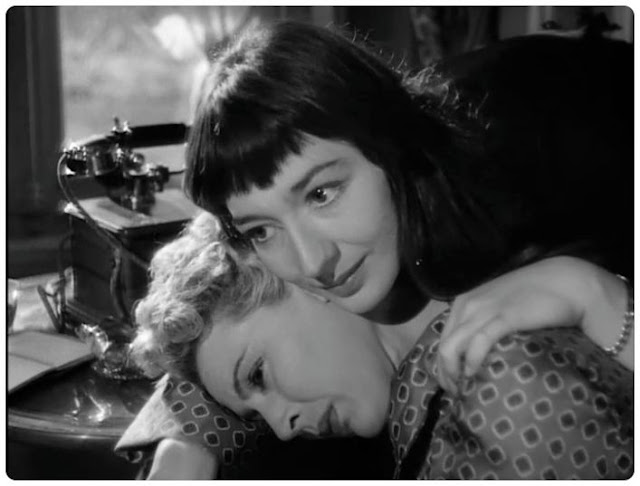

 Orpheus, returning home, finds Eurydice more than a little concerned at his being absent all night. Also present are a Surete inspector, who questions Orpheus about the missing body of Cegeste, and Eurydice's sometime friend Aglaonice (Juliette Greco). The cop doesn't return, but Aglaonice becomes a familiar presence in the film. She's a member of some vague feminist group to which Eurydice once belonged (and thus a stand-in for the classical Maenads), and she clearly has a thing for Eurydice. The doting wife only wants her husband to love her and even discloses that she's pregnant with his child.  
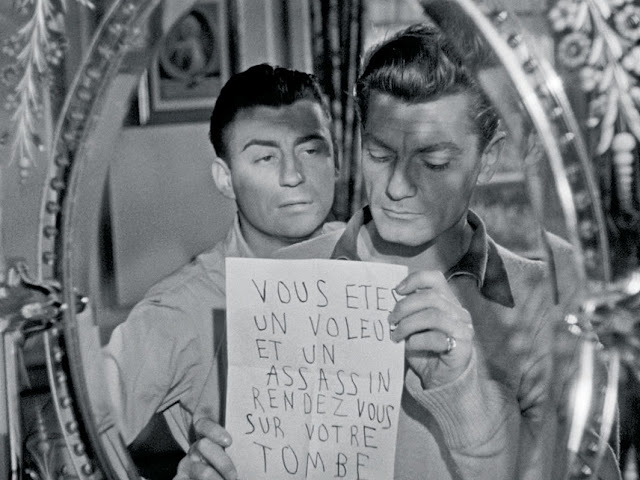


By accident or design, the Princess' chauffeur Heurtebise makes certain that Orpheus is beguiled by the world of Death, making the curious arrangement to keep the Princess's car in Orpheus' garage. Orpheus starts hearing broadcasts of poetic phrases from the car's radio, and he's entranced by a level of poetic accomplishment foreign to him. Cocteau doesn't clarify if these are things the poet actually hears or just imagines hearing, but in any case, he does fall in love with the Princess. For that matter, Heurtebise becomes enamored of Eurydice, but she remains entirely fixated upon her husband.

Eurydice is killed, but Heurtebise tells Orpheus that Princess Death answers to an otherworldly tribunal, to whom Orpheus can make an appeal. The strongest visuals show the hero and his guide passing through mirrors into the death-realm, though the confrontation with the tribunal proves underwhelming, as the superiors of Death are just a trio of middle-aged men seated at a table. They rule that Eurydice's life was taken unfairly, and they send her back to the living world, but with the stipulation that Orpheus can never look at her again. This seems like an extreme take on the original myth, since in that narrative Orpheus only had to convey his restored love to the living world, at which point she would have been real again. Inevitably, the injunction is violated, and not even in line with iterations in which the male seeker simply fails because he wants to see his beloved again.

The conclusion shows Cocteau drifting away from the original story's tragic denouement. Once Orpheus returns to the real world, he's besieged not by Aglaonice's "League of Women" but by a crowd of poetry-lovers who for some reason think he's responsible for the death of Cegeste. Orpheus dies and goes back to the death-realm. However, the tribunal decides to release the young couple back to life, sans all memories of these experiences. The old guys do allow the young poet to bid farewell to his former love Princess Death before he forgets her, and before she pays an unspecified penalty for her actions. I don't know whether we should assume that the young couple manages to work out all problems thanks to this do-over. 

I think Cocteau meant in part to caution those vulnerable to the siren-song of poetry, possibly implying that poetry's "excesses" could separate them from the foundation of life itself. However, the death-realm loses some of its claim to transgressive fascination once it's been revealed that "Hades" is managed by three older guys keeping track of who's supposed to die and when. ORPHEUS doesn't quite rate the accolade of "masterpiece." However, despite its flaws it's still one of the most important art-films of the 20th century.


Sunday, December 14, 2025

GARTER COLT (1968)


PHENOMENALITY: *naturalistic* 
MYTHICITY: *poor*
FRYEAN MYTHOS: *adventure*
CAMPBELLIAN FUNCTION: *sociological*  

Along with 1967's LOLA COLT, the similarly named GARTER COLT stands as one of a very small handful of Euro-westerns starring tough female protagonists. Unfortunately, it also may be the worst of that small group.

The script shows traveling gambler Lulu "Garter" Colt (Nicoletta Machiavelli) as sharing the distanced manner of standard spaghetti male protagonists: emotionally reserved and super-competent. However, Lulu is never interesting, even when she shows off her skills with a pistol, routing stagecoach robbers or protecting a young maiden from rapine. Part of the problem may be that Lulu herself is never in real danger. Her projection of coolness is interrupted when she falls for a French soldier involved in the war between Emperor Maximillian and Juarez, but the lover is killed by a bandit named "Red" (Claudio Camaso).

Though most of the screenplay is filled with jokes and absurdities that go nowhere, the one thing the writers seem to be passionate about is the Red character, who is as "hot" as Lulu is "cold." For once a spaghetti villain has his own romantic arc, for throughout GARTER Red pursues a spicy young lass, Rosy, whom he may have already bedded. Rosy mostly resists Red in favor of a younger swain, but the movie's only real amusement inheres in her vacillations as to which lover to choose. Red tries to persuade her to choose him by tying Rosy above a boiling-hot, muddy spring. Also, he situates an innocent little boy upon her shoulders, so that the kid will die with Rosy if she falls in. The setup doesn't make much sense, but it's relatively original. Lulu comes along at the right minute and propels Red into the boiling spring, which kills the fiend on the spot.

Despite various ludicrous occurrences in the wandering narrative, the only thing that rises to the level of a "fallacious figment" concerns a talking parrot. After some byplay with the bird seeming only to imitate whatever human speech it hears, the creature gets caught between two gun-happy parties-- at which point the parrot cries out, "I'm neutral!"              

Friday, November 28, 2025

FRECKLED MAX AND THE SPOOKS (1987)


PHENOMENALITY: *marvelous* 
MYTHICITY: *poor*
FRYEAN MYTHOS: *comedy*
CAMPBELLIAN FUNCTION: *sociological* 

Well, at least FRECKLED MAX can lay claim to being the best German cut of a Czech TV series adapted from a book, FRANKENSTEIN'S AUNT, by a Swedish author.

I usually don't review compilations, but given that the seven episodes of the Czech (I think) series FRANKENSTEIN'S AUNT probably won't ever come my way intact, I thought I might as well give this hour-and-a-half smorgasbord a look.

However, aside from noting MAX's place in the history of monster mashup movies, there's not a lot I can say. Often compilations can be incoherent because they leave out a lot of establishing elements. However, here there were only seven episodes, and it still seems incoherent. I think it's unlikely the show had regular scripts, but rather that the makers just jammed a lot of goofy incidents together and let the actors have fun performing them.

The "Max" of the title is an orphaned circus kid who resents the adults exploiting him after his parents' deaths. So he runs away from the circus, and to the Castle of Doctor Frankenstein, where he becomes the roving viewpoint character for some or all of the absurdities. Henry Frankenstein is gone, but both his monster, named "Albert" after Einstein, and his aunt Hannah (Viveca Lindfors) are still around. The main plot, such as it is, seems to be the quest of Albert-- who just looks like a big dumb guy-- to marry a local human girl, Klara (sexy Italian actress Barbara de Rossi). While Albert courts Klara, other monsters hang around the castle doing silly things for who knows what reasons-- the ghost of Erzebeth Bathory, called "The White Lady," and Dracula, played by Ferdy Mayne of FEARLESS VAMPIRE KILLERS fame. The IMDB page says that Eddie Constantine played some sort of water spirit in the TV show, but I didn't see him in the compilation.

Though MAX is about as plotless as a movie can be, I must admit all the actors and their costumes looked good, so I was moderately entertained once I gave up expecting anything but pretty pictures.    


Sunday, October 5, 2025

LIGHT BLAST (1986)


PHENOMENALITY: *marvelous*
MYTHICITY: *poor*
FRYEAN MYTHOS: *adventure*
CAMPBELLIAN FUNCTION: *cosmological*


Sometimes there's a lot of fun to be had, when Italian exploitation directors take some American actor with only mediocre "chops" and stick him in a half-witted B-picture. Not this time, though.

The half-witted premise of LIGHT BLAST is that a mad scientist with a laser beam is out to extort $10 million from San Francisco, else he'll destroy the city. One might think that such a threat-- amply illustrated at the film's opening when Mad Doctor Soboda annihilates a railway car, and the two teens who happen to making out inside. One might think that the entire SFPD would be combing the streets, looking for the culprit or at least the technological sources of his laser ray. But no, most of the people in charge seem to want to pay up, and only Inspector Ronn Warren (Erik Estrada) seems determined to scour the city and eventually turn up the heat on the mad doctor.

Director/co-writer Enzo G. Castellari, best known for the two lively "Escape from the Bronx" movies, might have found a lot of ways to have fun with this routine pulp outing. Instead, the viewer is forced to wade through endless driving scenes, interpolated with Warren occasionally interrogating boring suspects. Aside from the opening, the only standout scene in BLAST involves Warren investigating something or other in a morgue. There, one of the mad doctor's confederates-- a lady in a nurse's outfit-- nearly kicks the cop's ass with her kung fu skills. But after that one scene, we're back to driving, driving, and more driving. Even the sight of the former CHIPS star speeding around in a dune buggy doesn't improve things. After this fiasco, I get the sense that Estrada spent most of his career doing featured walk-ons in support-roles. I never liked or disliked the actor, but it's a shame he didn't get a chance to shine in just one memorable starring vehicle, even if it was pulp nonsense.               


Friday, October 3, 2025

FANTOMAS (1932)


PHENOMENALITY: *uncanny* 
MYTHICITY: *poor*
FRYEAN MYTHOS: *drama*
CAMPBELLIAN FUNCTION: *sociological* 

This French movie is apparently the first sound outing for the mysterious criminal Fantomas. It starred a French cast and was directed by a Hungarian, Pal Fajos, who'd made a couple of Hollywood films prior to working on this project. I don't know what if any of his non-American oeuvre might be metaphenomenal in nature but, as other reviewers have said, the first half-hour of FANTOMAS feels like a better-photographed version of one of the silent "old dark house" movies of the period. 

I reviewed the first FANTOMAS novel in 2018 and liked it well enough. However, I didn't make that many notes about the plot of the novel, so I guess the parts of the novel involving the mysterious villain's crimes didn't do much for me. Though I'm not a Fantomas fan, I give the character props as an important transitional figure within the superhero idiom. Bur since I remember little about the crimes of the novel, I can't say if the 1932 movie is adapting them accurately. All I can say is that Fajos works well with the French actors, particularly in the opening scenes, making them seem reasonably alive despite their being bare plot-functions. The movie does get across the inscrutable nature of this perhaps-uncatchable fiend, and unlike the book, there's a scene in which the villain dons an all-black catsuit with a black cowl, in which garb he strangles a woman to death. Later he wears another "costume" of sorts, attending a party in a tuxedo but donning a domino mask when he attacks a potential witness. I assume that actor Jean Galland portrays the murderous thief in all his disguised personas.

One omission I did note was that the character of Charles (rechristened "Fandor" in the novel) is downgraded to just the assistant to Juve, the inspector in charge of pursuing the elusive criminal. So here Charles has no real backstory, but he does-- in contrast to the novel-- get to face off with the disguised Fantomas in a climactic brawl. In contrast to the practice of later sound serials, the two combatants more time whaling on one another with lamps and chairs than with bare fists. But before the viewer gets there, one has to forge through a lot of dull mystery scenes.          


Thursday, September 25, 2025

BLONDE IN BLACK LEATHER (1975)


PHENOMENALITY: *uncanny* 
MYTHICITY: *fair*
FRYEAN MYTHOS: *comedy*
CAMPBELLIAN FUNCTION: *psychological, sociological* 


On this blog I generally review either metaphenomenal films or isophenomenal films that are in some way relevant to metaphenomenal tropes. For that reason, I've hesitated to review my favorite film by Italian actress Claudia Cardinale, who passed away this week. Zany as it is, I'm not sure how much I have to say about the comedy-western THE LEGEND OF FRENCHIE KING, wherein Cardinale teamed up with French legend Brigitte Bardot (as of this writing still among the living). However, four years later Cardinale teamed with another Italian luminary, Monica Vitti for a film originally called "Here Begins the Adventure." The English title for this comedy-road film, BLONDE IN BLACK LEATHER, may be better in that it suggests the allure of adventure that Moreau's leather-clad motorcyclist holds for homebody Cardinale. However, director/co-writer Carlo di Palma does bring in elements of irony here, given that Cardinale's character is in some ways much more dynamic, even though BLONDE is primarily one of the many knockabout comedies that the Italian film industry so often produced.     

For the first ten minutes BLONDE almost does look like a precursor to the over-fifteen-years-later drama THELMA AND LOUISE. Claudia (Cardinale) works in a laundry while her barely-seen pig of a husband sits on his ass. Later there's a line about how Claudia's husband beat her, but the English translation doesn't say this right away. Claudia encounters the leather-clad, motorcycle-riding blonde Miele (Vitti). After hearing some of Miele's stories about her adventurous life, Claudia begs Miele to take her away from her drudgery. Miele, preoccupied with making a rendezvous with her fiancee up north, initially takes Claudia a little way, leaves her flat, and then changes her mind, rescuing the laundress from a lothario.

It's soon evident to the viewer, though not to naive Claudia, that Miele is a complete bullshitter. The next half hour is pretty boring, as the two women tool around the Italian countryside. Miele carelessly loses the motorbike and whines ceaselessly about making her appointment. The ladies try to steal a car and end up almost kidnapping a kid, but that action quickly peters out. 


Still on the way to the northern city, the girls stop in Naples, where the film's best scenes take place. The heroines help an old woman get back her money from one of the local gangsters. In return she gives them a magic charm that may or may not have real power. A few scenes later, the girls end up at a casino-- one where, curiously, the gangster-owner punishes his subordinates with an electrical torture machine. The girls break the bank, which sounds like the charm at work, though technically, Claudia is shown invoking the power of the charm AFTER the ladies start winning. However, the casino's gangster-boss lures them into another game. The girls lose but accuse the gangster of cheating and try to leave with their dough.

Now, the charm is never mentioned again, but it would be the only explanation for what happens next. As gangsters surround Claudia, Miele tells her that since her husband used to beat Claudia, Claudia ought to do the same to the thugs. And so the slim Cardinale proceeds to slug her way through a dozen men as if she had become Bud Spenser, the bulky colossus from the TRINITY films. (This might have been an intentional reference since one of those films is seen airing in a theater at the film's climax.) Miele, supposedly the big adventuress, does little to contribute to the fight, but though the girls get free they lose their money and are reduced to hiking north once more. They have another adventure on a train (where the director briefly emulates a silent movie with B&W photography and undercranking). They both have Edenic dreams wherein Claudia hooks up with a devil while Miele does the same with an angel, and both beings are played by the same actor. They eventually quarrel and part, only to come together to get Miele to her goal. Only after parting again does Claudia find out just how much of a fake Miele is. Yet Miele redeems herself by kicking her own bad boyfriend to the curb, and the two hit the road again, getting more of a happy ending than Thelma and Louise.

BLONDE is too whack-a-doodle to be credited with strong sociological intent, feminist or otherwise. But I was never completely bored, given that even the slow first half-hour spotlights the stunning looks of the two costars. BLONDE certainly doesn't deserve to be listed with the many more serious movies in Cardinale's repertoire. But in contrast with her LEGEND-ary costar Bardot, I never felt that Cardinale's vivacity was best served by sober dramas. She possessed one of the screen's most infectious smiles, and so I tend to like her comedies better than her serious stuff. And as I said, BLONDE is also one of the very few times Cardinale dabbled in any kind of fantasy-story.   


Thursday, July 24, 2025

DRACULA'S FIANCEE (2002)


PHENOMENALITY: *marvelous*
MYTHICITY: *fair*
FRYEAN MYTHOS: *drama*
CAMPBELLIAN FUNCTION: *metaphysical*


Though I've seen about ten Jean Rollin flicks, I've never reviewed any. I confess I find it hard to get a handle on Rollin's almost plotless exhibitions of female pulchritude, most often in the form of willowy lady vampires. And yet, though I don't think most Rollin movies have much thematic content, he does have an individual style that sets him apart from thousands of routine sexploitation filmmakers. FIANCEE is one of the last three films he directed before he passed in 2010. 


Now, while there exist dozens of films which invoke the name "Dracula" without having any relation to the character, or to any aspect of the Stoker novel, FIANCEE has both. Stoker's DRACULA is a rich work with more symbolic layers than all of Rollin's films combined-- or all the Hammer vamp-films too, for that matter. Yet for FIANCEE Rollin isolated one major trope from Stoker and made it his own: the trope of innocence seduced by timeless evil. For most of the novel, the king-vampire stalks Mina Murray, and almost makes her into one of his own kind-- and yet Mina becomes, in many ways, Dracula's foremost opponent, summoning forth a primal goodness to battle archaic evil.

 Yet Rollin inverts that formula for his own purposes. The viewer never knows much about Isabella (Cyrille Gaudin), the "fiancee" of the title. There's a toss-off remark by the nuns who keep her prisoner that Isabella shares the genes of Dracula, which loosely implies that she, unlike Mina, is some descendant of the vampire. Further, Isabelle is entirely willing to become joined with the dark lord, and though it's not clear exactly what will happen if the two of them are united in unholy matrimony, the nuns are eager to prevent her nuptials, as are the film's primary POV characters. An elderly somewhat psychic professor with no proper name and his young male student Eric (Jacques Orth, Denis Tallaron) have dedicated themselves to preventing the wedding of Isabella and Dracula. It takes them a while to gsther intelligence, as they first engage in colloquy with a (very good looking) village madwoman in order to learn Isabella's presence in the nunnery. Yet, even though technically the madwoman doesn't have much to do with the story, thematically she reflects Isabella's true nature, for the fiancee seems able to spread some virulent madness to her captors. Rollin gets a lot of incidental humor from the weird behavior of the nuns, by the way.

In many similar stories, Dracula would be stage-managing a bunch of lackeys to secure Isabella's release. Instead, he seems to exist in some sidereal world, gaining access to the mortal world through the venue of a grandfather-clock. The vampire-lord does so little in FIANCEE that this may be one of the only Dracula movies in which Dracula is less central to the story than the maiden he seeks to violate-- which would make the FIANCEE title unusually appropriate. Isabella, Dracula's willing bride, spreads madness among the nuns, and the mostly feminine beings who assemble for her wedding seem more like Isabella's unholy bridesmaids. I'm not sure if Rollin was hip to the cinematic tradition of the "monster mash"-- it doesn't appear in any of his works I've seen, in contradistinction to, say, what one sees in the films of Paul Naschy. But if Rollin had just wanted an excuse to film a lot of scenes with hot monster-women, he could have just made all the bridesmaids vampires. Instead, Rollin's script takes the trouble to make up a weird term for non-vampire creatures-- "Parallels," for whatever reason-- and the wedding party includes at least two non-vamps: an "Ogress" and "a She-Wolf," though naturally Rollin blows no bucks on makeup or appliances. Incidentally, the small role of the She-Wolf is played by frequent Rollin collaborator Brigitte Lahaie.

So Isabella gets free, and the Professor and Eric try to stop her from hooking up with the Big Vamp-- and after a lot of incidents, they fail, and the unholy union apparently takes place. Rollin's script also tosses out various psuedo-poetic bits of dialogue, but he's never been a filmmaker known for scintillating repartee. So the film just kind of ends on a dispiriting note, though as I said it's hard to feel much when one doesn't know what's at stake. But it's a nice-looking film, maybe one of Rollin's best in a formal sense.                            


Tuesday, May 20, 2025

THE WILD WILD PLANET (1966)


PHENOMENALITY: *marvelous*
MYTHICITY: *fair*
FRYEAN MYTHOS: *adventure*
CAMPBELLIAN FUNCTION: *cosmological, sociological*            

"I'm a person, not a collection of hunks of meat."            

I've already reviewed the second and third releases in Antonio Margheriti's "Gamma One" tetralogy, WAR OF THE PLANETS and PLANET ON THE PROWL. I've not had the opportunity to re-screen SNOW DEVILS, the one that was fourth to be released to theaters (that is, irrespective of the order of actual filming, given that all four movies were generated within the same year). But I have no hesitation in proclaiming the first-released, THE WILD,WlLD PLANET, to be the best in this short-lived series. And in contrast to many other Italian space-operas, PLANET has more to it than just the usual "so bad it's good" elements-- though I admit some of those elements are present. 


Take the line I quoted above. Following a few shots establishing that PLANET takes place on a far-future Earth that has colonized other planets, the line is spoken by Mike Halstead (Tony Russel), commander of a space-station orbiting Earth, as he has a testy exchange with Doctor Nurmi (Massimo Serato). Nurmi has been allowed to set up a lab on the station due to the influence of certain planetside "corporations," where he conducts experiments with skin grafts and "miniature organs" (not explained). Halstead makes clear that he doesn't approve of all this monkeying around with piecing together people out of "hunks of flesh," while Nurmi clearly has some agenda involving the eugenic production of "perfect people." Nevertheless, Halstead has to offer Nurmi hospitality aboard the station, and invites him to dinner that evening, where, as Nurmi notes, they will be eating "hunks of meat." Clearly, if one can trust the English translation, writers Ivan Reiner and Renato Moretti were having some fun with the standard tropes of space opera-- although all their other film-work seems to be nothing but undistinguished sci-fi time-fillers. 


Halstead's futuristic paradise also gets some trouble from his current girlfriend Connie (Lisa Gastoni), who serves on the space-station under Halstead's authority. Connie's first seen in a gym, drilling male and female officers in judo moves. But even though she twice drops Halstead's officer-buddy Jake (Franco Nero) on his ass with her own skills, don't mistake Connie for a modern girlboss. In this scene and the one at dinner, she makes it clear to Nurmi that she doesn't appreciate her boyfriend treating her like "one of the boys." In a way she's as traditionally minded as Halstead, and that includes the tradition of accepting an invitation from smooth talker Nurmi to pay a visit to his experimental center on the space station (or planet?) Delphus.    


But some mysterious agents of Delphus come to Earth long before Connie goes anywhere. It appears these agents have been operating on Earth for some time, causing mysterious disappearances of scientists, but what we first see of them is eight women and one man, a tall guy with dark glasses and a dark cloak. Whenever one of the girls and Glasses Guy approach a solitary victim, Glasses Guy spreads his cloak over the victim, who just disappears. Even when I saw PLANET in my youth, I knew that this was a cost-cutting effect. Yet the way Margheriti films these disappearance-scenes, they're much creepier than the use of some optical image. In one of the attack-scenes, Glasses Guy botches things somehow, and the victim escapes, though he's been weirdly shrunken, causing him to fall into a coma. The woman with Glasses Guy then makes him disappear, though she doesn't have a cloak to bring off the effect. 

I'm not sure how it happens that Halstead, commander of a space station, gets assigned to investigate missing scientists, though in one scene he and his agents certainly act like they have police-powers. At one point, Glasses Guy (or a clone thereof) is sighted in a future-car, and agents give chase. The car cracks up and the driver disappears, but Halstead makes the scene in time to see that the car contains doll-sized, miniature people held in stasis within a suitcase. In addition, slightly later the authorities find the dead body of a Glasses-Guy, and discover that he has four arms, the result of skin grafts. The call goes out to find Doctor Nurmi.


 Somehow Halstead and two other officers track down two of the female Delphus agents and their leader (Moha Tahi). This confrontation scene is in equal measure both risible and symbolically significant, for the three girls show themselves to be judo-mistresses and hand the three guys a pretty tough battle. While the spies are being taken into custody, Connie arrives on Delphus and begins to encounter some weird phenomena, including an oddball doctor who tells her "your other half will soon be here." Back on Earth, Halstead tries to choke the truth out of Nurmi, but Halstead's superior reins him in. Nothing daunted, Halstead takes a contingent of men to Delphus to rescue Connie and destroy Nurmi's mad scheme, whatever it is. Nurmi gets to Delphus before Halstead and informs Connie that, in addition to somehow conquering Earth with his clones and his shrink-tech, he plans to be joined with Connie in a manner more surgical than sexual. In other words, when Nurmi isn't playing Frankenstein, he's a Moreau who works on himself, and he wants Connie's body only to create a perfect male-female hybrid. If you credit Nurmi with nothing else, he certainly has the courage of his convictions, for even though Halstead brings down his operation Nurmi does his best to take the space-soldier with him into oblivion.


I don't know which of the "Gamma Ones" was written first, but PLANET is the most detailed and feels most like the authors projecting their societal concerns upon a future-scape. The writers did this by creating two sets of oppositions. Halstead may sound as conservative as a Hebrew patriarch out of Leviticus when he rails against skin grafts as a threat to bodily autonomy. But Nurmi is entirely blasphemous in creating a race of perfect humans to people the universe, suggesting a god-complex-- though he might be the first such mad scientist who wanted to become "god and goddess in one body." And though Nurmi's female servants may be judo-trained marvels, none of them have any individuality-- which Connie, even in her rejection of ultra-feminism, certainly possesses. I'm not saying that it's entirely wrong to laugh at some of the movie's missteps, like the soldiers using acetylene torches to suggest ray-guns. But Margheriti, who had completed two Gothic horrors before PLANET, puts a lot of social content into this space-opera, as well as undermining a lot of the gosh-wow sci-fi nicknacks with uncanny, and sometimes apocalyptic, imagery. One might not want to think of PLANET, with its "wild" space-babes and square-jawed heroes, as quality sci-fi. But it's much more imaginative than most space-operas from any decade or nation.