Eduard Mörike (1878-1929) was a house conductors of the Parlophon of Berlin, itself part of the Carl Lindström A.G. group of companies in Germany. In the early 1920s, together with HMV, Columbia and DGA/Polydor they began to record, and compete, with more or less complete recordings of orchestral works. Parlophone was the only company to attempt a fairly complete version of
Scheherazade during the acoustic recording period. This is not at all surprising as the music was then quite exotic and the purchase of 5 records, even at 4s 6d each [£1 2s 6d], was then quite an outlay. I have had little luck in finding a portrait of Mörike and that below is but a third generation copy and the best I can do I'm afraid.
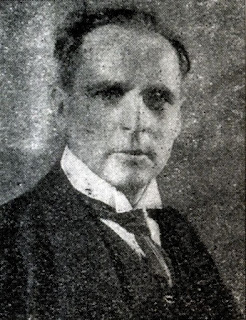 |
Eduard Mörike
|
I have transcribed two articles from the
Gramophone magazine. The first from September 1925 has a biography of the conductor, a grading of his recordings and also describes the faults common to Parlophone acoustic recordings - 'The chief flaw in these records is that in
forte passages the deeper toned instruments, including the 'cellos and double basses, sound muffled and "woolly."' - I have, I hope solved this problem but it still leaves a certain amount of noise behind for the muffled sound is just the shear volume of noise directed down the recording horn. The recording diaphragm nor the record player could really cope with this, there is inevitably record wear common to these passages.
The second article I have transcribed is the review from the February 1925 issue. This is a very detailed review, possible beacause the music was new to most record collectors. It very helpfully also identifies the cuts made in this performance. The cut between the two sides that form the Part II is too great to make any attempt at a join. The other sides can be joined together and still make musical sense - Part IV is the only uncut section of music.
Mörike having died at 51 has caused him to disappear in large degree from general consciousness, very few of his recordings have ever been reissued and most of his acoustic records, by far the largest corpus of his recording career, have yet to see the light of day since there original issue. I have no proof for this but the concertmaster of the orchestra at this period was
Rudolf Deman (1880-1960), later to found and lead the Deman String Quartet, he may well be the solo violinist heard throughout the recording.
As performances go this one is exciting, with a reduced orchestra size, unimaginably difficult studio conditions, transpositions to brass instruments I can forgive the odd lapse of concentration, the passages that go awry, and a certain 'lost' feeling in places, despite all this its a real piece of music-making that grows on me from repeated listening.
Rimsky-Korsakov: Scheherazade
Orchester, Staats-Theater Opernhaus, Berlin
Conducted by Eduard Mörike
Parlophone E10227- E10231
Part I: [2-6818, 2-6819 & 2-6820, Saturday 12th April 1924]
Part II: [2-6846 & 2-6847, Wednesday 30th April 1924]
Part III: [2-6821 & 2-6822, Saturday 12th April 1924]
Part IV: [2-6843, 2-6844 & 2-6845, Wednesday 30th April 1924]
4 Flac files in a .rar file, Here at Mediafire. [about 82Mb]
Gramophone Celebrities
XIII. - Eduard Mörike By W. A. Chislett
Mörike (or Moerike), which was a comparatively unknown name in
England less than two years ago, has now become almost a household
word in gramophone circles.
Herr Eduard Mörike was born in Stuttgart on August 16th, 1878, and
comes of old South German stock, being one of the eight sons of a
successful merchant and the great-nephew of his namesake the lyric
poet. His mother was an enthusiastic lover of music and it was from
her that he received his first lessons. When he was ten years of age
the family moved to Leipzig, where he attended the High School. Up to
the age of sixteen the career that had been mapped out for him was
that of medicine, but as at that age he already showed unmistakable
talent he was induced by Felix von Weingartner to devote himself to
music. He continued his education at the Leipzig High School for some
time and then entered the Conservatoire in the same city, where he
studied the piano under Adolph Ruthárdt, the organ under Homeyer,
the violin under Hans Sitt, and composition under Hofmann, the then
most renowned teacher in Germany. Originally Ruthardt had planned for
him a career as a piano virtuoso, but, following his own
inclinations, the youth devoted all the time he could spare to the
study of conducting, both orchestral and operatic.
At the age of nineteen
he was awarded a Schumann composition prize for a piano concerto in A
minor, and shortly after this became a private pupil of Silotti. The
call of the theatre was still strong, however, and, on the
opportunity occurring, he accompanied Ernst Kraus, the singer, on a
visit to America, where he was engaged as a soloist at the
Metropolitan Opera House, New York, under the direction of Walter
Damrosch.
After a period in
America the student returned to Germany more strongly attracted to
the theatre than ever, and soon secured an engagement as second
conductor at the Stadt Theatre Rostock, and later, at the early age
of twenty-four, was appointed chief conductor at Kiel. While holding
the latter appointment, in 1906, he was honoured by being called to
assist in the great celebrations at Bayreuth. His next permanent post
was at Halle/Saale, where in addition to the opera he took over the
direction of the symphony concerts. In the summer of 1907, while
still at Halle, Herr Mörike received a personal invitation from
Richard Strauss to conduct the rehearsals of the German operas to be
given at the Paris Opera House. This invitation was gladly accepted
and the visit to Paris ultimately extended over two mouths, for, in
addition to taking charge of the rehearsals, he was called upon to
conduct several performances of Salome and other operas during
the season. At about this time he also directed the famous Wagner
festivals at Halberstadt and at Lauchstadt.
In 1912 Herr Mörike received the appointment of principal conductor
of the Deutches Opernhaus, Berlin, which post he held for twelve
years, being responsible mostly for the production of Wagnerian
works, including the first performance in Berlin of
Parsifal
on January 1st, 1924. He revisited America in 1922 and again in 1923,
on each occasion as the general musical director of the Wagner Opera
Company, which toured all the principal towns in Northern America.
Since 1924 he has been
the conductor of the Philharmonic Orchestra in Dresden - devoting
himself entirely to concert work - and is now also the director of
the Dresden Academy of Singing.
Herr Mörike has had a
wide experience of conducting music of all schools, but his records
of the works of Wagner and Strauss are the most valuable, for though
all his interpretations are thoughtful and full of vitality, these,
in addition, bear the hallmark of authority, and the Parlophone
Company have done us good service by including so many of these works
in the records issued.
These records have the
virtues and faults common to all Parlophone orchestral records. The
tone is full and forward, but inclined at times to be rather rough.
Although this is doubtless largely the fault of the recording, it may
also be partly due to the fact that the tone of the reeds in
continental orchestras frequently is more pungent than that to which
we are accustomed, and, I believe, that the brass tone, particularly
that of the trumpets, is not quite so refined and suave as that of
the best English orchestras. The chief flaw in these records is that
in forte passages the deeper toned instruments, including the
'cellos and double basses, sound muffled and "woolly." This
defect can be overcome partially by the use of suitable needles.
I know of no records
which respond more to care in the choice of needles. It is, of
course, impossible to lay down any hard-and-fast rules, for not only
do the records themselves vary considerably, but machines also
differ. I have found that a Columbia medium needle not pushed quite
home into a Jewel sound-box with a Nom-y-ka diaphragm an ideal
combination for most of these records. Splendid results can be
obtained also from doped fibres after the record has been got into
good condition by the judicious use of fine steel needles or
otherwise ; fibres, however, are not a great success until this
condition is obtained, as the material of which the records are made
wears all needles very rapidly.
In grading these
records I have had to adopt a somewhat different system from that
used previously by other contributors. Comparisons are apt to be
invidious, but when it is appreciated that much of the music recorded
by Herr Mörike for the Parlophone Company has also been issued by
other companies, they must be made when necessary. Grade I. only
includes really first-class records, and it can be assumed safely
that any Record in this grade is at least as good as, if not better
than, any other record issued of the same music quite irrespective of
price. Grade II. contains a large proportion of records which would
have been in Grade I. but for comparatively slight flaws ; the most
frequent fault being that occasional indistinctness of tone in heavy
passages. Records in this oracle are well worth buying, and most of
them will ''bear comparison with similar records issued by other
companies, particularly when price is a factor to be considered.
The most successful
complete recording is Ein Heldenleben, which is a magnificent
piece of work. It is not absolutely without a fault throughout, but I
am afraid it will be a long time before we get a work scored for such
a large orchestra and which occupies ten sides recorded without a
single fault.
Les Preludes and
Scheherazade both contain records which considered
individually might be placed in Grade I., but the works as a whole
just fail to reach that standard. The last movement is my own
favourite bit of Scheherazade, and this is really splendid. It
is better than the Columbia version which is not too well recorded in
places and which annoys me every time I either see or play it because
of the absurd waste of space; why it was ever made to spin out to
four sides I cannot conceive, as it can be got on to three easily
and, moreover, with equally, if not more, convenient places for the
divisions. The first movement of Beethoven's Sixth Symphony,
considered purely from the recording point of view, is worthy of a
place in Grade I., but I have relegated it to Grade II. because of
the disfigurement occasioned by a huge cut. Other records which only
just miss being placed higher are Don Juan and the Overture
and Sailors' Chorus from The Flying Dutchman. In the
Overture the tympani are heard better than in any record I
know, the pitch being easily distinguishable; the horns, however, are
overpowering in some places.
The Ballet Music
from Aida is issued twice, but both, records seem to be
pressed from the same matrix. In No. E.10288 the reverse is occupied
by the Introduction to the same opera, which is beautifully played
and recorded, while in No. E.10055, we find on the reverse the Vale
des Fleurs from Tchaikovsky's Casse Noisette Suite, which
is a thoroughly bad record.
I am very sorry to have
to relegate Beethoven's Seventh Symphony to Grade III., but it
is not a good specimen of recording. The best that I can say is that
the Columbia records of this symphony would be in the same grade and
cost 15s. more! The reason for the lowly positions of the three
excerpts from Wagner's Ring is the old trouble of muffled tone
again, though it is only fair to say that Siegfried's Funeral
March would have been a candidate for Grade I. had the first side
been as good as the second.
GRADE I.
Aida - Introduction
(Verdi).
Fin Heldenleben
(Strauss).
Lohengrin - Prelude
(Wagner).
Parsifal
Introduction and Good Friday Music (Wagner).
Rienzi - Overture
and March of the Warriors (Wagner).
Tannhauser -
Overture (Wagner).
Tannheiuser's
Pilgrimage to Rome (Wagner). Tod und Verkleirung (Strauss).
GRADE II.
Aida - Ballet Music
(Verdi).
Don Juan
(Strauss).
Fingal's Cave
Overture (Mendelssohn).
The Flying Dutchman
- Overture and
Sailors' Chorus (Wagner).
The Magic Flute -
Overture (Mozart).
The Merry Wives of
Windsor - Overture (Nicolai).
The Marriage of
Figaro - Overture (Mozart).
The Midsummer
Night's Dream - Overture and Scherzo (Mendelssohn).
Oberon - Overture
(Weber).
Pagliacci -
Selection (Leoncavallo).
Les Preludes
(Liszt).
Saint Elizabeth -
Crusaders' March (Liszt).
Scheherazade
(Rimsky-Korsakov).
Siegfried - Forest
Murmurs (Wagner).
Slavonic Dances Nos.
6 and 8 (Dvorak).
Symphony No. 6, 1st
Movement (Beethoven).
Symphony No.8
(Unfinished) (Schubert).
Tristan and Isolde -
Liebestod (Wagner).
GRADE III.
Götterdammerung -
Siegfried's Funeral March (Wagner).
Symphony No. 7
(Beethoven).
Symphony No. 8 -
Allegretto (Beethoven).
The Valkyrie -
Wotan's Farewell and Fire Music (Wagner).
GRADE IV.
Casse Noisette Suite
- Valse des Fleues (Tchaikovsky).
Lohengrin -
Introduction to Act III. and Bridal Chorus (Wagner).
The Rhinegold -
Entry of the Gods into Valhalla (Wagner).
Many of the Parlophone
records are pressed from old German matrices, and as I have a number
of records purchased in Germany before the English company was formed
I have been able to compare the two issues. The English records are
pressed from a material which gives a better surface, but apart from
that I do not think they are quite as good as the German ones. The
general impression left after hearing all these records is that
though many of them are really excellent many more would have been
equally good had a little more care been exercised in both recording
and pressing. The general standard has improved considerably during
the last few months, and I am hopeful that this improvement will
continue and that we shall be given more fine records of the music
upon which Herr Mörike is such an acknowledged authority.
SCHEHERAZADE
PARLOPHONE. - E.10227, 10228, 10229, 10230, 10231 (12in., 4s. 6d. each).-The Opera House
Orchestra conducted by Ed. Moerike : Scheherazade (Rimsky-Korsakov).
(Min. score, Belaieff - G. and T.).
This great Russian
master of orchestration gives us all sorts of coloured delights in
the Scheherazade Suite, even though (after the Russian manner,
with all the Russian limitation of outlook and weakness in practice)
he is little concerned with the development of themes, here or
anywhere else in his music. His treatment, of course, suits this
particular subject well. His suite is a kind of suggestion, rather
than illustration, of certain pages in the Arabian Nights'.
The suite is entitled after the wily wife of Sultan Schahriar, who
beguiled him with tales into continually postponing, and at last
renouncing, his intention of putting her to death" to-morrow."
The composer did not envisage the ballet accompaniment to the music,
with which Londoners are fairly familiar. The suite has as poetic
basis the story of Sinbad the Sailor, various phases of which are
suggested in the four movements.
FIRST MOVEMENT.
The sea and Sinbad's
vessel are in view. One can feel here the slow surge and constant
motion of the sea. (It is interesting to remember that
Rimsky-Korsakov adopted as his first profession the navy).
Part 1 - After a few
loud chords, a solo violin improvises, to the harp. Soon comes a
tune, on violins and wood-wind, calm, but with a decisive little
two-note figure at its tail, the two chords being echoed. The lower
strings make an arpeggio background. The first side ends with an
interlude of wood-wind chords, to soft plucked string accompaniment.
There is a cut from here (page 13, bar 5, of the miniature score) to
page 15, bar 2.
Part 2. - A little
ingratiating theme, developed from the violin's improvisatory bit at
the commencement, starts, with clarinet echoes. Then comes fuller
orchestration of the first chief theme of Part 1, the wood-wind
taking up the arpeggios, the horns having sustained descending
chords, and repeating their little pattern many times. The
development is in the orchestral colouring, not in the theme, which
cannot be said to grow much. The side ends with clarinet and flute
winding downwards, against six solo violins moving in chords in the
contrary direction - one of those charming yet simple effects that
Rimsky-Korsakov was so skilful in devising.
Part 3. - Clarinet,
oboe, and 'cello have little solos, with plucked string background.
The solo violin again has the winding, improvising theme, which is
answered in snatches by delicate wood-wind. Then comes a period of
greater animation - the working up by pattern-repetition of part of
the material already heard, wood-wind trills going on continuously.
This soon dies down, and a melancholy flute takes up the strain, with
clarinet supporting in arpeggios. So the movement comes to its
pianissimo close.
SECOND MOVEMENT.
Here the composer had
in mind the story of the Calender Prince - the king's son who went
about as a wandering monk, seeking adventure.
Part 1. - The little
extemporisation that opened Part 1 is heard again - linking up the
tales, so to speak. (A bar of cadenza is omitted.) The bassoon starts
a languid, five-bar-long dance tune, on a drone bass. This is
directed to be played capriciously, in a manner resembling the
delivery of recitative. It is a little stodgily played here. The tune
soon livens up, as it is passed to oboe, and later to strings, with a
plucked accompaniment. It is frequently held up while the
improvisatory little tune, weaving round a few notes, muses for a
moment. After a cut from the end of the top lino on page 55 to page
60, we hear a rapid plucking accompaniment on the strings, over which
the clarinet plays a free version of the interjectory theme. There is
then a considerable cut, to page 76, bar 4, where begins -
Part 2. - The lively
march-like tune, played by trombone and bassoon, is four bars long,
and is answered by a wood-wind phrase only three bars long - one of
the effective means of variety in rhythm that the composer uses. This
theme is broken in upon by the bassoon, with the plucked strings
fretting below - the effect we noticed at the end of Part 1, when the
clarinet then held the stage with similar matter. Then the dance
tune, brisker than at the opening of the movement, returns. There is
another cut (page 98, bar 4, to last bar of page 102), and after the
lower strings have uttered a complaint the movement grows still more
vivid in the last few pages.
THIRD MOVEMENT.
This concerns The Young
Prince and Princess - a love affair, needless to say.
Part 1. - Here is
mildly romantic music, bearing less resemblance to real Eastern music
than anything else in the suite. But Rimsky-Korsakov's peculiar brand
of Orientalism is well worth savouring, though it be no more
authentic than most such decoctions. His chief theme here might have
done just as well for any salon piece, without its wood-wind skirls.
The strings have the first statement of the tune, the oboe and 'cello
the second. (There is then a cut, pages 112 to 117.) Now comes a new
clarinet theme, with a drum-tap accompaniment. This lasts for the
remainder of the side, after which a cut is made, from page 127, bar
1, to page 133, bar 2.
Part 2. - Again the
slow, romantic tune, the solo violin's improvisatory passage breaking
in soon. This is followed by a cadenza, over which the wood-wind has
its old theme. A more impassioned moment, for full orchestra,
follows, and the horn has a very lovely passage. There is a cut from
page 143, bar 3, to the last bar of page 146, and a few bars of
quicker, lilting music bring the movement to an end.
FOURTH MOVEMENT.
The Festival at Baghdad
comes into this, besides the Sea, the Shipwreck, and then the
conclusion of the story.
Part 1. - A fierce
opening (the first few bars of the suite quickened up). The solo
violin again has that cadenza that runs like a thread through the
whole texture; but now it is in double and triple notes - chords.
After more excitement and a repetition of the cadenza, the violas,
with tambourine and horn marking the bars, announce a rhythmic figure
that can be taken either as two in a bar or three. This is the
liveliest lilt we have yet heard in the suite. The flute announces a
jaunty tune that only moves over a few notes. The orchestration
becomes increasingly brilliant. Up to now we have felt two beats in
the bar. Now, with a snatch of new tune, comes a change to three ;
and soon we are back at two, with scurrying triplets in strings and
wood-wind. A third theme is given out, more gently, by the latter;
this flows along lightly, in contrast to those which preceded it.
Part 2. - The various
snatches of tune continue, in this and the last part, to be bandied
about in the most infectiously exciting rhythms, which the composer
agitates still more as we near the end. The opening rhythm of this
movement, for example, advances from five notes in each bar to seven,
in which form, with its swing of two in the bar, it is pumped out by
the flutes and strings, very high up, against the more languid tune,
in threes, played by the rest of the orchestra.
Part 3. - Soon, to a skirling accompaniment in the heights, the first theme of the first
movement comes, on the brass, dominating the scene with dignity and
reminding one a little of the end of the Tannhauser Overture,
in this respect - though, of course, widely different in suggestion.
The excitement subsides, and after a solemn chord on the horns the
wood-wind lets down the tension with the ascending passage we noted
at the end of Part 2 in the first movement. The solo violin
interjects yet another reminder of its opening improvisation, ending
on a very high harmonic. A few more calm chords, and the violin
climbs into the empyrean and the music ceases.
Throughout this very
taxing music the playing is eminently clear, resourceful, and
full-bodied. Perhaps one does not want too many suites made up after
the manner of this, but an occasional turn of Scheherazade is
refreshing exceedingly. K. K.