Showing posts with label Michele Soavi. Show all posts

Tuesday, October 16, 2012

Italian Horror: A Primer


Now that I’m on my third year of hosting this-here blogathon, I figured now would be as good a time as any to write up a proper introduction to the subgenre I love so much. I have invited many people to participate in this humble project the last couple of years, and one of the things I love hearing most is that people were introduce to Italian horror through this blogathon. I hear quite often that people were always apprehensive to try out Italian horror because they knew so little about it (aside from the fact that narrative structure was meaningless). Inevitably, whenever I hear from or read something by someone that encounters Italian horror for the first time, it’s almost always in the vein of, “Wow, that looked really great – it was illogical and frustrating at times – but it sure was nice to look at.” So, on the week before the blogathon, I thought I would throw up on the blog this little primer about the history of Italian horror, where one might want to start, what one should expect from an Italian horror film, and some of its major contributors. Remember, the blogathon begins next week on October 24, so if you’re still on the fence about contributing or what to write about, maybe this will help.


Monday, October 31, 2011

Italian Horror Blogathon: The Sect (aka La setta, The Devil's Daughter)


I knew when I started this blogathon that I wanted to make sure I covered some stalwarts of the Italian horror subgenre. Everyone knows about Fulci and Argento (both have been covered with the first blogathon), but I always feel the urge to carry the torch for the lesser known, underappreciated Michele Soavi. Last blogathon I covered three of his four horror films – Stagefright, Cemetery Man, and The Church – and this year I knew I wanted to cover the other one: the much maligned The Sect. I also knew that I wanted some of these posts to coalesce a little bit more than the previous blogathon, and so I found it natural to talk about this film in light of my piece on Lamberto Bava’s Graveyard Disturbance, and how that film marked the end of bigger budget Italian horror movies. Made in 1991, The Sect had a budget of 2 million dollars (actually quite large at the time for Italian horror movies) and wasn’t much of a success. The film clocks in at almost two hours and seems to take itself way more seriously than Italian horror films of the past. However, I’ve always liked the film and feel that it is unfairly maligned when you compare to the weak attempts by contemporaries Argento (Trauma), Fulci (Demonia), Deodato (The Washing Machine), and Bava (Mask of the Demon) around that same time. Soavi, when compared to his contemporaries, was actually making the most interesting and innovative Italian horror films at that time and was reminding people why the subgenre had such an avid cult following to begin with.  In short: When Soavi came on the scene in 1987, he was the only making true Italian horror films (with one exception being Argento’s Opera which was released in 1987).


Saturday, October 31, 2009

Italian Horror Blog-a-thon: Links (Updated 10/31)


[Here's what other people have contributed so far to the Italian Horror Blog-a-thon. Keep 'em coming...you can submit a piece anytime you'd like during the blog-a-thon's run. I will continue to update this on a daily basis so that it will be easy to find who has contributed and where you can find it. Everything will be in this one post organized by date. I will try to keep this updated at the top of the blog. All reviews written by me can be found below this post. Enjoy.]

Updated links after the jump...

Update: I have class from 8:30 until 3:45 today so if you send me a link to your post during that time trust that I'm not ignoring you...I will link to your review when I get home. However, my Oregon Ducks have a huge game against USC today at 5:00 (meaning I won't peel myself away from the television) and then I have a Halloween party at 7:30...sooo again, I promise I will post links when I get back from that. I just want to quickly say (and I'll wax poetic in a longer post) that I have been thrilled with the results of this blog-a-thon. It's been great to meet new lovers of the genre and have old friends contribute. I'll definitely be doing this again next year. Happy Halloween everyone!

Update #2: Check out the newly updated links below! Thanks for these amazing last minute entries, guys.


10/31

Jamie Uhler, one of this blogs nicest followers, has a wonderful post on Torso that is being featured and the equally wonderful Sam Juliano hosted Wonders in the Dark blog. Check it out.

Elgringo, author of the fabulous He Shot Cyrus blog, chimes in with some thoughts on Zombi 2.

And last but certainly not least is Dennis Cozzalio author of the amazing (and influential) blog Sergio Leone and the Infield Fly Rule pens an exemplary essay on Fulci's Don't Torture a Duckling, and some of the baggage that comes with a Fulci film.

Reviews are still coming in...I expect a few more updates today so keep checking back. A couple early one's for you, though. Chris Voss of the wonderful Celluloid Moon takes a look at one of my favorite Argetno films, Tenebre.

Also Jandy Stone of Rowthree.com checks in with her first attempts at the genre. I'm thrilled that so many people are introducing themselves to Italian horror because of this blog-a-thon. Jandy has some great thoughts up on Argento's Suspiria and Bava's The Mask of Satan. Check it out.


10/30

With just one day left in the blog-a-thon there are still some entries trickling in. Alec Pridgen (who has a picture of Reb Brown on his blog, so he's alright in my book) of the Mondo Bizarro blog has reviews up for Soavi's The Church and Argento's Phantom of the Opera.

Goregirl chimes in with some great thoughts on the classically named Black Belly of the Tarantula.

Samuel Wilson of the wonderful Mondo 70 blog (one of my favorites) gives his thoughts on the kinda-Italian horror/sleaze picture Delirium.

And finally my brother Troy is back from Italy and was inspired enough to write about the least Italian of Italian horror movies: Welcome to Spring Break by Umberto Lenzi. You have to check this review out...Troy has compiled some great stills and clips from the movie that will surely make you want to run out and get this movie. Plus it has Italian horror staple John Saxon! What more do you need? Get on over there and read about this so-bad-it's-good classic.


10/28

Roderick Heath co-contributor of one of my favorite daily stops, Ferdy on Films, contributes a fantastic review on Argento's brilliant Deep Red. Roderick and I share the same opinion on this particular Argento: it's his best film.

Another one of my favorite blogs is Antagony & Ecstasy, and if you've visited Tim's blog you know how prolific he is; but, what's even more impressive than the amount of work he produces is that there is an obvious care and craft that goes into each essay. Tim offers up his thoughts on what is considered the first (and most influential) horror film, I Vampiri. Check it out.

And finally today previous contributor Evil Dead Junkie has some thoughts on Bava's The Girl Who Knew Too Much.


10/27

Bob Turnbull of the extremely good Eternal Sunshine of the Logical Mind blog chimes in with some great capsule reviews.

Samuel Wilson of the fantastically entertaining Mondo 70 blog submits a piece on Pupi Avati's masterful and criminally underrated The House With Laughing Windows...easily one of the best Italian horror movies I've seen.

And thanks to my brother Troy there is a Youtube clip of Willy, the crazy caretaker of the sound stage in the movie Stage Fright. I mentioned in my review last Monday that you didn't want to miss Willy's delivery of the line "right between the eyes", and now it's online thanks to my brother. Check it out...it's pretty funny.

10/23

Neil of Agitation of the Mind makes it a hat trick as he covers the giallo The Case of the Bloody Iris.

Francisco Gonzalez chimes in with reviews for Soavi's Cemetery Man, Fulci's 8 1/2-esque A Cat in the Brain, and the famous Italian version of The Exorcist entitled Beyond the Door.

Jacob Burton of the B Movies Forever blog covers a couple of classics by also throwing his hat in the ring for The Case of the Bloody Iris, and Jacob also has some thoughts on Argento's seminal supernatural horror film Suspiria.


10/22

One of my favorite blogs The Basement of Ghoulish Decadence has a great entry up on Fulci's City of the Living Dead (a popular choice for this blog-a-thon).

And Michael Parent is back with some thoughts on Zombi 2.


10/21

Evil Dead Junkie, author of the wonderfully titled blog Things That Don't Suck, has a great review up for Fulci's gore classic City of the Living Dead.

One of my favorite blogs (maybe because Troll 2 is referenced in their banner) belongs to Tower Farm Reviews...two brothers who review horror movies (naturally Troy and I are trying to copy them with our blog Garbage Day), and back in September the brothers reviewed Lamerto Bava's bizarre horror film entitled Delirium. You have to check out the pics...just crazy.

Hans A. has been a good friend to this blog, and over at his site, Quiet Cool, he takes a look at an Exorcist rip off entitled Cries and Shadows. It wasn't uncommon at all for the Italian horror industry to latch onto whatever was trendy at the time. It's what killed Mario Bava's career. Check out Hans' submission.

Neil over at The Agitation of the Mind is back with another stellar contribution...this time it's for Fulci's A Lizard in a Woman's Skin. Great stuff, Neil.

And last but not least today is Starmummy, author of the B Movies and Beyond blog...here are two links where you can find all of his wonderful and succinct reviews for Fulci and Argento. Enjoy.


10/20

J.D. of the always enjoyable Radiator Heaven tackles one of my favorite Italian zombie films, Michele Soavi's Cemetery Man.

Neil Fulwood author of The Agitation of the Mind gives Fulci's giallo Don't Torture a Ducking a look.

Erich Kuersten of Acidmeic Film has a wonderful piece on the style and allure we Italian fans love so much in a piece that looks to be a part of series entitled Bad Acid 70's-80's. Make sure to check it out.

Michael Parent of Le Mot du Cinephiliaque offers up his take on Argento's Suspiria.

Will Errickson author of Panic on the 4th of July has a post up on one of the seminal Italian horror films (and the one film that a lot people think was the catalyst for Italian horror becoming a pop culture phenomenon), Lucio Fulci's Zombi 2 (aka Zombie Flesh Eaters).

Chris Voss of Celluloid Moon has a write-up on Mario Bava's extremely influential Bay of Blood, which introduced to horror world to one of its favorite tropes: the dead teenager film.

Last but certainly not least is Samuel Wilson, a good friend to this blog, author of the always fascinating Mondo 70 film blog. He covers Lucio Fulci's finale to his Gates of Hell trilogy The House by the Cemetery. Check it out.


That's it for now. Keep the reviews coming, though. If you talked to me via email a few backs back I am still interested in you posting something for this. Just email it to me or leave the link here in the comments and I will make sure to link it up. I will continue to update this post.

Thursday, October 29, 2009

Italian Horror Blog-a-thon: The Church (aka Cathedral of Demons, aka Demon Cathedral, aka Demons 3, aka In the Land of the Demons)


[Today we have a review for one of my favorite Italian horror films by my favorite Italian horror filmmaker. Here's another one, like City of the Living Dead, that I kind of dismissed when I initially watched, but subsequent viewings have been much kinder to this film. Oh, and it has what is possibly the best Italian horror soundtrack...Keith Emerson and Goblin doing Philip Glass! Enjoy]

Michele Soavi’s The Church is probably the most atmospheric, feast-for-the-eyes type of Italian horror film since Lucio Fulci's 1981 masterpiece The Beyond. It shares a lot of the surreal, nonsensical plot structure of Fulci’s film, too. But as we’ve come to discover through this blog-a-thon, if there’s one general rule to Italian horror it’s that you leave logic at the door. What Soavi has created here, despite less than favorable working conditions (I’ll get to that later), is a visual masterpiece of the subgenre. One of the best Italian horror movies to come out of the 80’s, and clearly shows why everyone thought that Soavi was the savior of Italian horror. He never made an uninteresting film, and The Church is one of his most fascinating.


A group of Teutonic Knights kick starts the story as they decapitate and plumage a small town full of people thought to be devil worshipers. They’re buried hastily, and a church is erected on top of the grave so that it will lock the evil in for eternity, but of course that doesn’t work. Right away Soavi shows his hops as we get plenty shots from the Knight’s POV, masking the screen and allowing us only to see the action through the clearing of their masks which is in the shape of the cross. Soavi seems to be doing two things here: showing us the limited vision of these “with hunters” by not just masking part of the screen, but also showing us the limited vision (or narrow-mindedness) of how organized religions were killing – the death and destruction is seen through the image of a cross. It’s one of many instances where Soavi showcases his skill of wanting to do more with this particular subgenre; Italian horror wasn’t all about gore for him like it was becoming for Fulci and Argento, and the genre was better for it as Soavi was getting back to the more unsettling nature that Italian horror lends itself to.

Back to the story: In modern day Germany we are introduced to what the cathedral looks like today. Lisa (Barbara Cupisti) is restoring a baroque fresco on the wall of the church and is immediately smitten with Evan (Tomas Arana) the new librarian. These characters are the catalyst for the evil that is about to be unleashed within the cathedral. The bishop knows about the architecture of the building and how it holds a key to a horrible secret that will unlock the demons of the past, but he is reluctant to share that information with Father Gus (Hugh Quarshie) who is not well liked by the other priests. All of this is kind of hard to keep track of (there’s not much care with the story as we have three different “main” characters throughout the film) as we keep cutting back and forth between Lisa and Evan’s story, the story of the priests, and the story of the daughter of the family that lives in the cathedral and are employed as caretakers for the priests. The daughters name is Lotte (a young Asia Argento) and she hates having to be cooped up all day in the cathedral. She has a secret getaway that not even the priests know about (because supposedly there’s only one way in and out of the cathedral), which comes in handy towards the end of the film.

Soavi films The Church in an unsettling, unnerving fashion where we are never quite sure what is going to happen next. He relies on hallucinations to displace the viewer (instead of playing the otherworldly scenes as if they were real), and this adds to the nightmarish feeling the film so perfectly evokes. At the hour mark or so the gathering of victims begins and the movie turns from curious and interesting supernatural horror flick to generic Demons-esque gore fest. And I think this is where there was a clear disconnect between Argento and Soavi. The gathering of victims trope doesn’t seem to fit with Soavi’s deliberate pace and moody storytelling (it seems more suited for a slasher movie or the schlocky Demons series helmed by Lamberto Bava…Soavi’s film is sometimes referred to as Demons 3), but somehow Soavi is able to make the film interesting despite the generic nature of the films plot (much like he did with Stage Fright). Soavi is able to fashion some really creepy moments amidst all the banality where people who just happen upon the church enter and die.

One of these scenes is where Evan, after opening the portal to the damned, is obviously not himself. He’s sitting at his typewriter pounding on the keys (wisely Soavi doesn’t use cheesy music to ramp up the creepy factor – he just lets the typewriter noises and the squeaky chair Evan’s sitting in do all the work) while Lotte sits nearby and listens to music. We see immediately that something isn’t right as the only key he is hitting is “6”. This leads to a rather bizarre and scary exchange between Evan and Lotte.

There’s also a creepy tracking shot towards the film’s climax where Lotte is leading Father Gus to her secret escape out of the cathedral. As they make their way underneath the cathedral they walk by what we presume to be the devil making love to Lisa (in a scene that seems cribbed from Polanski’s Rosemary’s Baby, but it’s effective nonetheless), and Evan leading the group of possessed in a satanic chant. The tracking shot, accompanied by the unnerving organ score by Emerson and Goblin, is one of the down-right creepiest things I’ve seen in a horror movie.

There’s also a great scene at the end (again showing what Soavi could do with a budget) where Father Gus solves the riddle of the architect, and just as the cathedral is about ready to crumble to the ground, the stack of bodies buried beneath the church (from the beginning of the movie) rises up in a muddy blob. It’s one of the weirdest visuals I’ve seen.

Despite the films deliberate pacing Soavi always manages to keep your interest. The man really knows how to frame a shot and make every image pop off the screen. There's a scene that shows Soavi's skill and ability to have a funny/shocking moment without being gratuitous. An old couple locked in the church bicker at each other; after the wife has been infected by the demons she wants her husband to accompany her to the bell tower. When they get up to the bell they notice there aren't any strings to ring the bell. What we get is more generic old married couple humor; however, the punch line is pretty funny as Soavi cuts away from the scene for a moment and then in a completely different scene we hear the bell...Soavi cuts back and it's the old woman hitting the bell with her husbands severed head.

Soavi had fun with this one, too, made evident by the aforementioned scene of the elderly couple in the bell tower. However, despite the fact that Soavi has some fun with certain scenes one aspect of the film that makes it so interesting is how it deals with its bizarre imagery. Soavi plays it straight in this regard unlike the previous camp film Demons and Demons 2, which were more about people morphing into disgusting monsters after becoming possessed; here Soavi seems to take the world of the occult pretty seriously (he would return to the subject just two years later with The Sect). Instead of these bizarre goings-on being played for reality (thus they would inevitably be played for laughs because there’s some pretty bizarre imagery in the film) Soavi has the victims hallucinate the odd things that happen to them – it’s the perfect way to elicit the uncertain feeling he wants his audience to have while watching his movie.

For instance in one scene a man who has been scratched by one of the possessed (or infected, if you will) begins to see weird reflections in the holy water. When he looks closer a giant piranha like fish comes out of the fountain and attaches it to the man’s face. A priest happens upon this and wonders what is going on as all he can see is the man scratching and pulling at his own face. There are numerous occurrences like this throughout the film, and they work so much better than had Soavi tried to legitimately pass off that there is a giant devil fish jumping out of the basin holding the holy water (which someone like Lamberto Bava or Fulci would have done with gory gusto).

Soavi once again ends one of his films with someone smiling at the camera (as he did in Stage Fright), but here I don’t think it’s a sardonic touch, I just think he has a devilish finish in mind. I think what one can extract from that ending (and the fact that Asia Argento plays the little girl in the beginning of the movie) is that Lotte is timeless…that she is always around when this evil is unleashed, so perhaps she is the one that brings the evil from city to city. I don’t know if that’s what Soavi intended, but one can definitely infer that from the smile Lotte gives at the end of the film as the blue light washes over her.

The movie is the epitome of what makes Italian horror so great. It's more than just gross scene after gross scene...it has genuinely scary moments that aren’t accompanied by a thrashing of keys or noises employed only to make the viewer jump, but these unnerving and unsettling scenes are always accompanied by the equally unsettling and unnerving musical score...a norm for Italian horror. The way these Italian horror soundtracks (Emerson and Goblin were favorites of Argento and Soavi) usher the viewer through the film ( I especially like how Soavi’s camera is fluid in introducing the cathedral while Philip Glass’ “Floe” is playing) is exactly how the filmmakers want you to approach their films: these aren’t films designed to make you jump out of your chair with cheap scare tactics, these are more cerebral films designed to get under your skin through a deliberate process – the films put you in a kind of reverie that you wish you could snap out of. I think it’s one of the reasons why this particular subgenre has such a passionate following, because these are definitely different kinds of horror movies…they’re a breath of fresh air from all the blasé horror films that get released in American theaters (this was especially the case during the 80’s).

The Church marked an important time in the Soavi’s career. Fresh off his slasher hit Stage Fright, Soavi was asked to join the production team for Terry Gilliam’s The Adventures of Baron Munchausen after Gilliam had seen Stage Fright at a film festival. Soavi was asked to film over 200 special effects scenes, and after the ordeal was over, longed to be back in Italy making films with a close-knit crew, rather than on a film backed by Hollywood producers. Soavi stated that he liked the intimacy he experienced being First AD for Argento’s Opera, Tenebre, and Phenomena; and that the hugeness of Gilliam’s production just wasn’t for him (though he was thankful for the opportunity, and eventually worked with him again on the 2005 film The Brothers Grim as an AD).

The film also added more stress to the already strained relationship between Soavi the protégé and Argetno the mentor. Apparently during production Argento really wanted Lamberto Bava, another of Argento’s acolytes, to be the director of the film (since The Church was intended to be the third in the Bava/Argento series Demons), but he was kicked off the project after a lackluster script. Soavi was brought in to punch up the story, but Argento wouldn’t allow him to employ any of his own crew members. Argento insisted on using his own crew and breathing down the neck (he was co-writer and producer of the film) of Soavi throughout the production. Amazingly Soavi managed to survive and create something that still had his particular stamp on it. The style may be indebted to Argento, but if you’ve seen any of Soavi’s other films then you know after watching The Church that it’s unequivocally a Soavi film; and the fact that he was able to push his style through despite all the on-set problems proves the talent of this Italian maestro.

Many people felt like Soavi was the savior of Italian horror – especially after the success of this film and his hugely popular Cemetery Man – but family issues derailed his career as he took an extended sabbatical from filmmaking to care for his sickly son. When he returned to making movies it became more apparent that Soavi wasn't joking when he mentioned in a Fangoria interview that he doesn't like to repeat himself with his films and that he's "always trying to do something new with each film". That sentiment couldn't have been more true as he has made a handful of films since returning to filmmaking and none of the have been horror movies. A few have been mob flicks, and another was about the life of St Francis of Assisi…something new indeed. We can only hope that he tries his hand at horror again.

Here are tons of extra stills:


Thursday, October 22, 2009

Italian Horror Blog-a-thon: Beyond the Darkness (aka Blue Holocaust, aka Final Darkness, aka Buried Alive)


Ah yes, Joe D’Amato…the man who gave us Porno Holocaust, a slew of Emmanuel movies, and the brilliantly titled Erotic Nights of the Living Dead. I couldn’t let a blog-a-thon about Italian horror go by without talking about the man who is probably the most famous of the hack Italian horror filmmakers. His real name is Aristide Massaccesi and he actually did one good thing in his career of 150+ movies: he hired a young up-and-coming assistant director named Michele Soavi and helped him write and finance his first feature, the wonderful giallo/slasher hybrid Stage Fright. His one good deed aside Massaccesi is a horrible director who is most famous for filming someone eating a fetus (not a real one, but people were convinced for a while – it was actually a skinned rabbit wrapped in bacon). In one of his early films – Beyond the Darkness – you see a filmmaker who is at least trying, and isn’t simply resorting to the hack tendencies of his colleagues Umberto Lenzi, Claudio Fragasso, Bruno Mattei, Jess Franco, and Ruggero Deadato.


The story kicks off on a familiar note as the sounds of Goblin pump through the speakers assuring us that at least one thing about this movie will be good…even if it sounds like recycled b-sides for their better soundtracks they composed for Argento. We meet Frankie a well-to-do 20-something who is on his way to pick up a baboon. The baboon serves no purpose except to show us that Frankie’s hobby is taxidermy. Yeah, there’s no doubt where this movie is going.

Well, Frankie’s girlfriend dies at the hands of some bad voodoo put into effect by Iris, an older woman who runs the manor that Frankie lives in (his parents, presumably, left it to him). See she wants his girlfriend out of the way so that she can have Frankie all for herself in an early demonstration of a cougar on the prowl. This movie was way ahead of its time. Frankie decides to dig up his girlfriend and inject her with new blood and body parts from victims he kills; random girls of course, and then the story just keeps getting weirder and more unnecessary. See…the whole taxidermy thing comes back into play. Brilliant!
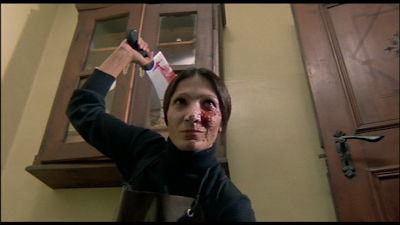

Iris and Frankie fall in love and share some tender moments together; whether it’s her shoving her breast into his mouth in a weird psycho-sexual maternal gesture, or whether they’re hacking up victims together and melting their flesh off. It’s one big happy family:
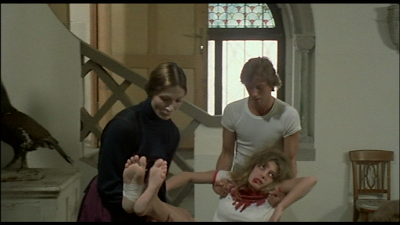

Frankie decides he wants to keep his girlfriend’s body around, though, and in one of the films funniest scenes he seduces a girl who sprains her ankle running by his house. He invites her in – of course this is D’Amato we’re talking about so it doesn’t long before they engage in some awful soft-core banter – and the gettin’ busy commences. The only problem is that Frankie thought it would be a good idea to do it in the room where he has his girlfriend preserved in the bed right next to his.

This creates one of the films funniest shots. When the girl is horrified to see a corpse lying in the bed next to them, she (naturally) screams…so Frankie takes a bite out of her neck in a reference to the cannibalism themes that D’Amato has so often touched on. The only problem with it here is that it is completely out of nowhere. Essentially Frankie just, on a whim, decides what a great idea it would be to take a bite out of some poor girl’s neck. There’s no prior reference to his love of cannibalism and there’s no mention of it after the fact (except in an odd dinner scene that flashes between Iris burying body parts and Frankie eating a stew that looks rather suspicious).

In an odd twist to end the film the girlfriend’s twin sister shows up and Frankie gets all warm inside and begins to feel the way he used to before he started diggin’ older women. After he initially tells Iris he will marry her, he breaks it off at an odd family gathering, causing her to go crazy. The ending is all a blur because there’s nothing memorable about it.

This is your standard bad Italian horror film…and there are a lot of them, but it’s one of the charming things about this subgenre. Discovering tripe like this is fun because it’s not offensive tripe – it’s not a film that makes you feel like you completely wasted your time; rather, it’s the perfect example of the “so-bad-it’s-good” type movie where you can sit back with your friends, enjoy some adult beverages, and just have a good time watching a bad Italian horror flick. You get all the goodies you come to associate with this kind of Italian horror film: bad gore effects, a soundtrack that sounds like it has been recycled from a more popular film, bad dubbing, weird moments of eroticism that don’t work, hilariously bad dialogue, and of course a nonsensical plot that just makes you laugh at how inane it all is.

Now some people will argue that if a movie is bad then it’s not worth watching at all; that there is no such thing as a movie being “so-bad-it’s-good”. I see their point, but honestly sometimes I just want to watch something like Beyond the Darkness with my friends and laugh – I prefer these types of films to any kind of comedy released today, because these type of Italian horror movies made by hack directors elicit more genuine laughs than something like Step Brothers or The Brothers Solomon (okay, maybe not the best examples…but I caught them on Starz recently and they’ve been on my mind). Beyond the Darkness is not as fun as Virus (Mattei), Nightmare City (Lenzi), or Troll 2 (Fragassi); but it shows a director who is trying to make a decent movie and failing on so many levels because they just can’t leave their hack tendencies in the past.