Showing posts with label naval. Show all posts

Sunday, August 3, 2014

Sorry for the long gap -- update

So the Fatal Choices Kickstarter was successful. I have been spending most of my time working on finishing up the book and the Rewards.


This is the final version of the countersheet that goes with the book. Kickstarter backers will get a copy of the countersheet with their copy of the eBook or physical book. I am getting the final proof version within the next day or so. Assuming no more changes need to be made I will order the first batch.

These will also be available for separate purchase once the Amazon edition of the book is published.

Also on their way are the sets of Topside Miniatures Fatal Choices wood-backed stickers that those who pledged at the higher levels will get.

I am still expecting to start fulfilling the Kickstarter pledges by the end of the month.

Friday, January 4, 2013

Impossible to game out

USS Gambier Bay under fire from a Japanese cruiser, visible at right

Came across, again, the incredible Battle off Samar while doing some research on another topic.

Military History is full of forlorn hopes, last stands, surprising victories and heroism. But even amidst such legendary company as The Alamo, Thermopylae, Rorke's Drift and Camaron, I think the Battle Off Samar stands alone.

You really can't find a set of naval wargame rules that are going to allow the saga of Taffy 3 to occur.

On the one hand you have Taffy 3. Six CVEs with a couple dozen aircraft each, armed for the most part with GP bombs and depth charges. Three Fletcher class destroyers and four destroyer escorts are the screen. A number of aircraft from neighboring CVE task forces and land bases eventually also help out.

On the other you have a Japanese surface action group with four battleships (including Yamato), six heavy cruisers, two light cruisers and 11 destroyers. Oh, and the Japanese have Kamikazes.

And it's broad daylight. Morning as a matter of fact, so the Japanese have essentially all day.

I mean, really. How can that turn out any other way but a complete massacre?

And yet, not only did Taffy 3 survive, losing just two CVE, 2 DD and a DE, but the Japanese lost 3 CA as well as retreated!


Thursday, December 20, 2012

The ships of 1914 -- Spee's armored cruisers


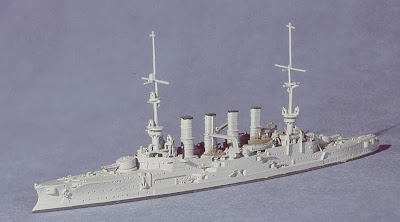
Scharnhorst -- model by Navis


The central players in the drama of the 1914 affair were the sister ships KMS Scharnhorst and KMS Gneisenau. These two warships represented the heart of the military threat posed by Von Spee’s squadron.  The accompanying light cruisers had a role to play, but they were minor warships and could be countered by similarly minor combatants that would have negligible affects on the naval balance.

                The Scharnhorst and Gneisenau, in contrast, were capital ships, albeit of an obsolescent type in 1914.  They were armored cruisers – a type of capital ship that had a relatively short heyday as such major warships go. The first “armored cruiser” were in the 1870s and the very last armored cruiser was the HMS Defense, completed in 1908, so the total length of time this type was in first-line service was barely four decades.
                Still, while they didn’t serve very long as first-line units, they did play prominent roles in the several of the battles that occurred during the pre-dreadnaught era, notably the Battle of Santiago in the Spanish-American War and the Battle of Tsushima in the Russo-Japanese War. 

                The main reason why armored cruisers enjoyed their brief time in the sun was the undeveloped state of naval gunnery during the closing decades of the Nineteenth Century. Cannon technology grew by leaps and bounds during that era, resulting in naval artillery that could fire at unheard-of ranges with great accuracy. During the naval battles of the American Civil War and the Battle of Lissa, gunnery duels between ships were often still  measurable in hundreds of yards and it was practicable for ships to get close enough to use ramming tactics. This was despite the fact that the guns, themselves, could easily hurl projectiles for many miles.  The ranges the guns could fire increased even more over the ensuing decades but the problem of actually hitting the target remained. Long-range gunnery was inherently challenging, but naval gunnery added additional complexities as both the target and the firing ship were constantly changing position. At the Battle of Manila, Dewey’ fleet managed to achieve only 2-3% hits on the nearly immobile Spanish squadron. The destructive power of modern artillery was sufficient, however, that this was enough to annihilate the Spanish squadron. 

                Under the gunnery conditions of the late nineteenth century there seemed to be a lot to be said for volume of fire. The very largest naval guns, like those carried on battleships, were very destructive, but had such a slow rate of fire that there was little opportunity a gunner to successfully use the information from a miss to adjust  his fire to get closer on the next shot. Too much time would pass between shots and the relative positions of the ships would likely be so different that each shot was basically starting anew.  The higher rate of fire of smaller guns would not only throw a lot more metal in the vicinity of the target, but provided some chance for adjusting fire from misses.  Because of this, battleships of the ear commonly carried a mixed armament of some very heavy ship-smashing main guns, some medium caliber secondary guns and a tertiary battery of quick-firing guns for defense against light craft. 

                Armored cruisers essentially traded the large main battery guns for additional endurance and speed compared to battleship, but were often armored at similar levels and carried as their main battery guns equal in size to the secondary batteries of battleships.  As such they were generally able to stand in the line of battle alongside the battleships, as they did at Tsushima.

                By 1914, however, the situation had dramatically changed, and the armored cruiser was no longer able to stand in the line of battle. The Dreadnought concept of an all-big gun battleship and the similar Invincible class battle cruiser had changed the equation. Improvements in the large guns had increased their rate of fire and improvements in gunnery techniques were promising improvements in accuracy that suggested that having a uniform battery of large guns would be more effective than the mixed armament of earlier ships and that armored cruisers could no longer safely operate in the main battle line. 

                Still, the Scharnhorst and Gneisenau were still powerful ships, especially on detached stations such as the Far East, where dreadnought-type warships were still uncommon. 

                The two German ships were conservative designs, very well-built as was usual for German naval construction and well-armed. They were identical sister ships, and therefore worked well together as unit. Their main battery was a total of eight 8.1-inch guns,. Four of the guns were mounted in twin turrets fore and aft, but the other four were mounted in casements on the side, which meant that the total broadside was only six heavy guns.  Also in casements were the secondary battery guns, eight 5.9-inch guns, for total broadside of four. 

                They were well-protected with belt armor of 6 inches and a 2-inch armored deck and, like most German warships, well compartmented. 

                They were not especially speedy for armored cruisers, with maximum rated speeds of around 22 knots. This was enough to outrun any pre-dreadnought battleship but markedly slower than many British armored cruisers and hopelessly insufficient to outrun one of the new battle cruisers. This speed deficiency would play a major role in the outcome of the campaign and was a major consideration a Spee weighted his options.

                A bare recital of stats is not the sum total of a warship’s effectiveness in any era, but its especially important to note the more intangible aspects when evaluating the ship in this campaign. 

                The nature of the German East Asia Squadron’s mission, as  a detached squadron on a distant foreign station, had a major impact on its efficiency. All the crew members were long-service regular navy men, without any of the conscripts that filled out the rosters of homeland-based vessels. It was an elite posting and the two ships were widely regarded as efficient and well-led.

                This manifested itself in at least two ways. First, both ships were noted for their proficiency in gunnery, being recent and multiple-year winners of the German Navy’s gunnery competition. This had obvious implications in the coming engagements, as the tow German ships could be counted on to be very dangerous adversaries.

                Less visibly, but also vital, is that the two ships were evidently very well-served by their engineering crews. In an era when large ship engineering plants were still relatively new and often temperamental, the exceptional reliability of the two ships played a key, if little noted roles in the campaign. Von Spee confidently set forth on a journey of extraordinary length and with little available support if something should go wrong with his systems. In the event both ships performed exceptional feats of steaming right up until their final moments.

Saturday, December 1, 2012

Big E lives on!!

USS Enterprise CVN-65 inactivation ceremony

The big news at the inactivation ceremony was the announcement that the next Ford class carrier, CVN-80, will be called the USS Enterprise!

USS Enterprise CV-6 in 1939
There have been eight ships named USS Enterprise (and a few historic British ons of that name as well) but the last couple were clearly the most famous of the lot.

The first "Big E" was CV-6, the USS Enterprise of World War II fame. Planes from that Enterprise sunk two Japanese aircraft carriers at the decisive battle of Midway and the Big E served to the end of the war -- the only one of her class to survive. The battle honors of the USS Enterprise CV-6 were extensive -- 20 Battle Stars -- including taking part in three of the four big carrier-to-carrier battles of 1942.
With the USS Bainbridge and USS Long Beach in 1964

The Enterprise also took part in the two big carrier battles of 1944, the Philippine Sea and Leyte Gulf, so basically the ship only missed one of ALL the carrier battles ever fought.

Attempts to preserve her as a memorial did not pan out and the ship was scrapped in 1958. This may have been for the better, in a way, because it freed up the name for use in the innovative ship to follow.

USS Enterprise CVN-65 reprises the famous photo while home-bound in 2012
The USS Enterprise CVN-65 had a big act to follow, and the ship managed to do it, as proven today when it was finally inactivated after an astonishing 51 years of service. A few warships of the past have served similarly long periods, but I don't think any, since the Age of Sail, have served as first-line battle fleet units for more than 50 years. It's a tribute to the flexibility of the modern CVN that it's so adaptable that it can still be a main force battle unit even as weapons evolve over 50 years.

Because of the nuclear reactors, there was never any serious consideration of preserving this edition of the USS Enterprise. Decommissioning the reactors literally requires dismantling most of the ship, so that was that for that idea.

The next USS Enterprise CVN-80, will be a Ford-class carrier. This class is similar in appearance to the Nimitz class CVNs but will have many improvements. It's scheduled to enter service in 2025, so there will, sadly, be a pretty long gap without an active USS Enterprise, but at least an end is in sight.

Artists depiction of the USS Gerald R. Ford. The next USS Enterprise will be similar


Friday, October 26, 2012

Interesting graphic on global Cvs


There's been a lot of attention recently about the strength of the Navy, most recently in the third presidential debate as the Republican candidate has made increasing the size of the Navy one of his key campaigning points. Similarly there's been a thread on BoardgameGeek about the USN vs. The Rest of the World., as well, which is where this graphic was lifted from.. I don't know the original source, but it does display rather starkly the differences in capability that we are talking about.

Especially noteworthy is the inclusion of the US navy's amphibious assault ships in the list. Often commenters compare the 11 CVNs to the 11 carriers owned by the ROTW, but this is misleading because many of those 11 other carriers are really much more like the amphibious ships than they're like US carriers. Indeed, NO ONE has a carrier that's truly comparable to an American CVN. The seven British, Thai, Spanish and Italian vessels are basically the same as the nine amphibious ships, although generally smaller.

This leaves just five ships that could possibly be called some sort of "fleet" carrier, one each for Brazil, Russia, China, India and France. Again, all of them are notably smaller than an American CVN.

Hyuga, right, with a US Nimitz-class CVN
Of the 11 foreign carriers of all flavors, seven belong to NATO allies and the US has friendly relations with most of the rest. Only the Russian and Chinese carriers might plausibly be considered in opposition to the USN.

One might give the ROTW a little more than 11 "carriers," though because I think you could fairly consider the Japanese "destroyers Hyuga and Ise as really being light aircraft carriers or amphibious assault ships at least comparable to the smaller Spanish and Italian ships shown in the graphic. They're only called "destroyers" for political reasons having to do with the Japanese constitution and relations with neighboring countries.

Still, even adding those two doesn't change the odds in any meaningful way.


Wednesday, October 24, 2012

Operation Torch convoys depart for North Africa

On this date 70 years ago the American forces taking part in the invasion of North Africa, called Operation Torch, left their various anchorages, including Maine and Virginia.

Operation Torch was a remarkable endeavor. It was the first major offensive taken by the United States since the beginning of the war, almost a year earlier. It involved an amphibious invasion across the entire Atlantic Ocean, making it among the longest direct invasion voyages ever undertaken. And it did this while most of the amphibious techniques and equipment that would later make over-water operations almost routine for US forces were still being developed. The lessons from Operation Torch would pay dividends for the rest of the war.

By a few days, the USS Massachusetts beat out her sister ship the USS South Dakota and near sister USS Washington for the first shots fired by the 16-inch gun in action and the first battleship duel in US Naval history.

The entire force was organized as Task Force 34, otherwise known as the Western Task Force.

The sub groups were:

Task Group 34.1 Covering Group with the new battleship USS Massachusetts, heavy cruisers Wichita and Tuscaloosa, four destroyers and an oiler,
TG 34.8 Northern Attack Group with the old battleship USS Texas, the light cruiser Savannah, two escort carriers, nine DD, eight transports, five support ships and a submarine.
TG 34.9 Center Attack Group with the heavy cruiser Augusta and light cruiser Brooklyn, 10 DD, 15 transports and six minecraft.
TG 34.2 Air Group with the fleet carrier USS Ranger and the escort carrier Suwannee, the light cruiser Cleveland, five DD, an oiler and two submarines,
TG 34.10 Southern Attack Group with the old battleship USS New York, light cruiser Philadelphia, escort carrier Santee, eight DD, six transports, three minecraft, two oilers, a tug and a submarine.


Monday, October 22, 2012

When time stood still -- Cuban Missile Crisis at 50

Destroyer USS JOSEPH P KENNEDY JR sends a boarding party over to freighter Marucla during the Cuban Missile Crisis, October 1962. NHHC photo USN 711187.

You don't go through life without a close call or two. I think most of us can think of at least one occasion where, if things had gone a little differently, we might not be here. But for anyone over the age of 50, there was a collective moment when it could all of come to an end -- late October 1962.

The Kennedy today at Battleship Cove
I was too young at the time to understand what was going on. I was seven years old in 1962, and I can't even recall from this distance any particular feeling of dread during the crisis. I remember knowing that something bad was going on -- and like most members of that duck-and-cover generation, there was a certain low-level terror that never really went away. I remember being under covers and hearing the engines of passing aircraft overhead and wondering if that plane, THAT noise, was the ONE.

I, for one, felt an enormous sense of relief after 1989, that I hadn't even really understood was there until it was no longer there. Notwithstanding 9/11, which brought its own kind of terror, things have been different since 1989. There's still danger in the world, and dangers in life, but instant  annihilation is not one of them.

But in October, 1962 it was  a very real possibility. We know now that the danger was even greater than we knew at the time. And I'm no great fan of John F. Kennedy, as his poorly conducted foreign policy played a not inconsiderable role in causing the crisis in the first place.

Scene from the movie Thirteen Days
The military reality was that the Soviets were not well placed to come out on top of a 1962 nuclear exchange -- even by the horrific metrics that the concept of coming out on top would entail. Evidently well aware of the unfavorable "correlation of forces" (to use the Soviet term), Khrushchev found away out of the crisis that preserved the Soviet state -- if not his job. 

Still, there's no way that "winning" a nuclear war is still not an enormous tragedy for any country, let alone a democratic one. The scarring of the national psyche by 9/11 provides a hint of what a nuclear exchange might have meant for America. It's not a world any of us would want to live in. And, of course, many of us wouldn't have lived in it. How many might have died is impossible to say. A figure of 100 million Americans and 100 million Soviets has been bandied about. I'm very skeptical that it would have been THAT high (that represents more than half of all the people in the country -- 179 million -- in 1962) but even a tenth of that amount would have been an unthinkable loss -- dwarfing the toll of all American wars.

In 1962 the Soviets had about 3,000 warheads, the United States maybe 10 times that number. The Soviets only had a couple dozen ICBMs in 1962 (which is why the MRBMs in Cuba were so attractive) and therefore would have had to rely on bombers to get through. There can be little doubt that some would have made it, but it's fruitless to even guess how many and which ones. Would even one bomb going off in just one major city have not been a disaster?

Fortunately it didn't come to that, but for the next quarter century there was a pretty complacent view in many quarters about the possibility of "surviving" or even "winning" a nuclear exchange. In my opinion, it wasn't until the disaster at Chernobyl in 1986 that I think it dawned on even the most hard-headed and cold-hearted that the consequences of a nuclear exchange made concepts of winning and losing laughable. Chernobyl, as massive of a disaster as it was, was merely a fraction of the fallout of a nuclear exchange.

From the IAEA FAQ on Chernobyl:
12. How does Chernobyl’s effect measure up to the atomic bombs dropped on Hiroshima and Nagasaki?
The accident at Chernobyl was approximately 400 times more potent than the atomic bomb dropped on Hiroshima. However, the atomic bomb testing conducted by several countries around the world during the 1960s and 1970s contributed 100 to 1,000 times more radioactive material to the environment than Chernobyl.

Note that the Hiroshima bomb was  about 16 kilotons yield, making it a tactical weapon by later Cold War standards.

From a gaming standpoint, there haven't been too many that looked expressly at the Cuban Missile Crisis alone, although it does figure as an important event card in the very popular Twilight Struggle game about the Cold war.  Maybe the most on-topic game legacy of the Cuban Missile Crisis is the darkly comic card game Nuclear War, which first appeared in 1965 -- less than two years later.

From the larger standpoint of the human race, it's worth noting that the Cuban Missile Crisis occurred just a little over 17 years after Hiroshima and Nagasaki. Maybe the scare was worth it, after all, because we've already gone half a century more without another nuke being used. That's a better track record than I think anyone could have hoped in 1962.

Monday, October 15, 2012

Part 2 of the Cape Esperance games

The Kirishima goes down from a  vital hit at close range by the USS West Virginia


Here's the second part of the Cape Esperance commemorative games I recently played.

As always, Andy did an excellent job of writing up the session.

Saturday, October 13, 2012

A little commemoration of the Battle of Cape Esperance -- War at Sea style

The USS West Virginia advances under the steady hand of Admiral Owen in War at Sea


Andy R. and I played a doubleheader of War at Sea Thursday in commemoration of the Battle of Cape Esperance from the naval campaign around Guadalcanal. He reports on the event with one of his fantastic write ups as always.

Sunday, September 23, 2012

Is China making the Kaiser's blunder?

Reading a  good book like Castles of Steel is a good way to get the intellectual juices flowing.

It's shallow reading of history to find "lessons" in it. Cases differ and fact sets are never precisely the same, so you can't simply transfer directly from one case to another. But experience is valuable, and it's certainly profit from the experience of others after making allowance for what is different and what is similar.

Former Varyag
There's certainly reason to think that Germany's naval expansion at the turn of the Twentieth Century played a role in bringing World War I and even led Germany;s defeat. Castles of Steel repeatedly points out that German naval officers were shocked that Britain joined the war. And it's clear that Britain's entry into the war was hardly a forgone conclusion. It broke with long-standing British practice of playing balance of power politics and avoiding the commitment of major land forces on the continent. It brought the British and French into an alliance -- pretty amazing considering those two nations had spent the bulk of the last five or six centuries as rivals.

Germany was -- and is -- the dominant nation in continental Europe. As a continental  power it necessarily had to give primacy of place to the army.  Resources are always finite and a navy could never get more than the leftovers after the army was taken care of.

Britain, of course, was a naval power. Its army would necessarily take second place in the defense of the island nation. Indeed, it's a truism that an island can only be defended off shore. There are very few cases of a successful island defense if an enemy manages to land on it.

So when the Germans started their naval buildup in the early 1900s it ended up being worse than a waste of resources. Not only did all the treasure sunk into the navy come at the expense of land forces, but it antagonized Britain and drove it into alliance against Germany.

Geography made any attempt at naval superiority for Germany impossible. Britain controlled access to the sea approaches of Germany. British national interests precluded allowing Germany to ever achieve parity in naval power.

If the Germans had restricted themselves to a naval force sufficient to guard their coasts against French and Russian naval forces there's every reason to think the British would have stayed out of the war. With no naval blockade or just the limited blockade the French could have mounted, the widespread suffering inflicted on the German economy. No British entry in the war means no BEF and probably victory for the Germans in 1914 or 1915 at the latest.. And, of course, with no unrestricted submarine warfare against Britain, there would have been no reason for an American entry into the war,.

It seems to me that China's situation a century later resembles Germany's in some ways. Its a rising economic power that is also tempted to expand its clout in international affairs and boost its military. Like Germany, however, China is a continental power with rival major powers that share borders with it. The army always will come first.

Like Germany, as well, the naval geography works against China. All the sea approaches to China are controlled by other countries -- who all have historical beefs with China. And like Germany, a hundred years ago, China's main rival is the world's biggest Navy. Except, of course, China's situation is even more dire. While the British were forced to be satisfied with a Navy as large as the next two combined, the U.S. Navy is nearly larger than all the other navies in the world, combined.

Germany, at least in theory, could over strain the British by building a large enough navy that some other navy would be able to take advantage and strike. The British negated this strategy through diplomacy. It made allies of the other significant navies, including  some it had fought against like France and the United States. By the time war came, the Germans stood almost alone at sea.

In China's case the ground is even harder to make up. The US Navy is far stronger than the Royal Navy ever was --and nearly every other significant navy in the world is already an ally. Among the few that are not formal allies, namely India and Russia, there's little reason to think they'd be inclined to side against the US on China's behalf and every reason to expect the opposite.

The bottom line is that any money spent on a blue-water navy is a complete waste as far as China is concerned. The geography, politics and military technology are hopelessly against them. They can't possibly spend enough money to make their naval forces militarily relevant -- but they can easily spend enough to annoy, alarm and drive into alliance their neighbors. There's been a lot of talk in the news lately about China's new aircraft carrier, submarine construction and other naval improvements. While obviously bearing watching, anything China does in this sphere seems like a trip down the road of folly.

Tuesday, September 4, 2012

Wargaming a US-China War

This post looks at the possibility, via Larry Bond on FaceBook.

From a wargamer's perspective, this sort of speculation has some interest, if only because China is about the only power that could, theoretically, be considered anything like a "peer competitor." That is, it's about the only potential foe that would pose any sort of challenge involving conventional warfare. A war with Iran, in contrast, while more likely, would mostly pose unconventional warfare challenges for the US, much less fertile ground for wargamers, especially those interested in naval affairs.

On the other hand, from a political standpoint a war between China and the United States seems highly unlikely, but also would probably be an unmitigated disaster should it occur.

As Edward Carr noted here:

"The tripwire for outright conflict might be trivial: a scrap between China and one of its neighbours over some islands, or a miscalculation as American warships sail up to the 12-mile limit that defines Chinese territorial waters. But when the dominant male and the pretender square up, everything about them is at stake. Just as two conflagrations burnt the heart out of the 20th century, so a war between the leading powers of the 21st could set off an orgy of destruction.
The shadow of nuclear devastation is one reason to be fearful. But even if we avoided that last, hideous step, the cost would be immense. That is partly
because today’s conventional weapons are so potent, but also because China and America depend on each other in ways that Russia and America never did. The flow of goods to our shops would dry up, as globalisation failed. The financial system might collapse, because America could not borrow from China, and China would have nowhere to put its savings. Cyber-warriors might wreck communications and infrastructure. Collaboration on trade, science and action on climate change would be swept aside. Global economic depression would drag billions back into poverty."

Now, clearly the fact that a war would be a colossal bad idea is no guarantee that it won't happen after all. One only needs to remember the summer of 1914 to know that it can happen anyway.  But neither country seems very interested in stoking tensions at this point and I'd rate the chances as being rather low at this point. What the situation would look like in 20 years, or even 10 years, is hard to say. A lot can happen in that amount of time in politics. In 1923 Hitler was in jail for the Beer Hall Putsch, a decade later he was chancellor of Germany and a decade after that was embroiled in a global war. Clearly few prophets in 1923 would have foreseen 1943. So caution is warranted. Still, wars between global powers usually turn on identifiable clashes of interests and its hard to discern what those might be in the case of China and the US. Much of the great power rivalry of the 20th Century turned on ideology -- one sees no great ideological rivalry between the US and China. There are always possible geopolitical clashes of interest, as seen in the first half of the 20th Century, but it's hard to see much of that in the US-China relationship. China' disputes and concerns are very local. Even the Taiwan situation doesn't really represent a clash of interests, really. In large part it's a dispute left over from the Cold War. A Chinese invasion of Taiwan now would not have the same implications that a Chinese invasion of Taiwan would have had in 1980.


Saturday, August 11, 2012

Thursday, July 19, 2012

Desperate measures


The War of 1812 was pretty much a wash for the United States, two years of fighting settling nothing really, but it was a successful and important period for the US Navy. It's professionalism was cemented by the successes it earned in battle against the premiere naval power of its day, the Royal Navy. In particular, a series of single-ship action in the war's first months mortified the British and boosted American morale.

But some of that success came close to never happening on this date, 200 years ago, as the USS Constitution was nearly trapped by a far superior force of British warships. It was only through exceptional seamanship that the ship escaped.

The official Website

Monday, July 9, 2012

Things wargames miss

HMS Argyll. Note the low-to-the-water midships gun and the lower gun on the aft quarter.

One of the limitations of wargames is the annoying complexity of the real world while the erstwhile wargame designer is striving to keep his game rules reasonably succinct. Actual operations are filled with examples of unforeseen complications that can have a significant effect in a given circumstance, but are very hard to take account of in a systemic way. This is one of the reasons why a certain amount of randomness doesn't bother me in wargames because the real world is fluke-filled.

What prompts this discussion is the additional handicap that the British armored cruisers at Coronel suffered due to the rough sea state during the battle -- a problem generally ignored in most wargames.

On both the HMS Good Hope and the HMS Monmouth, as well as the similar HMS Argyll shown above, some of the secondary guns are mounted one above the other in battery along the broadsides. Presumably there were some compelling engineering reasons for this arrangement -- maybe it eased ammunition handling or simplified construction somehow. But service conditions revealed that the lower gun in the set was too close to the water to be usable if the sea was too rough. This had the effect of cutting the secondary batteries of the Monmouth and Good Hope in half. The Argyl design was somewhat modified as the problem became apparent and only two of the 6-inch guns on the ship's broadsides were still subject to the problem. Eventually in the surviving ships of the Monmouth class the lower guns were actually moved up to the topside deck and the sea-level gunports plated over.

Even Larry Bond's Fear God and Dread Nought rules, which are justly considered exhaustive, only assess an accuracy penalty for gunfire in heavy seas, but don't formally include a way to account for guns rendered completely unusable by the waves. this is the sort of thing that can be handled by scenario special rules, of course, but it requires that the scnerio designer have dome the sort of in-depth research needed and is also the kind of thing that's not likely to be included in a "what-if" scenario. It's the sort of thing to keep in mind, however, when considering the "on-paper" strength of a unit.

Monday, July 2, 2012

Death at Sea - Part II, Battle of the Falklands

1:1250 scale SMS Scharnhorst by Navis


In Eric Dorn Brose's "novelistic history" Death at Sea, he engages in an extensive amount of speculation over how the Battle of the Falklands could have turned out differently.

The actual course of events is pretty straightforward and most histories treat the outcome as nearly pre-ordained:

On Dec. 7, 1914, a powerful British squadron comprised of two battle-cruisers, three armored cruisers and two light cruisers arrived at Port Stanley in the Falklands, where the pre-dreadnought battleship Canopus had already been grounded to act as a guard ship.The British began coaling their ships and conducting boiler maintenance in preparation for beginning operations to find the the German East Asiatic Squadron, under the command of Graf Maximilian von Spee, victor of Coronel.

The next morning , Spee approached the island, intent on a destructive raid, but was surprised by large caliber shots from the Canopus and drew off. Shortly most of the British force sortied and chased down Spee's doomed squadron, which was heavily outmatched. Only one light cruiser and one support vessel escaped the carnage.

And yet, was Spee doomed, really? Brose argues that Spee lost a golden opportunity to win a stunning victory in the Battle of the Falkands by aggressively closing in and attacking the British fleet in the harbor. There being little chance of outrunning the battle-cruisers anyway, due to their superior speed and longer-ranged guns, Spee could have accepted that battle was inevitable and tried to do as much damage as possible.

And a lot of damage was, indeed, possible. When the Germans approached the Briitsh squadron was in an embarrassing state. Most of the ships were in the midst of coaling, boilers were not lit and in the case of the light cruiser HMS Bristol, partially dismantled. Indeed, only the HMS Kent had steam up and was mobile,

A key limitation of steam-powered ships is the need to "raise steam" in order to get underway. In the technology of 1914 it could take one to two hours to fire up the boilers and raise enough steam to achieve full speed. When sighted Spee was within half an hour of being within effective gunnery range -- and as we saw at Coronel, German gunnery was highly effective. The Germans could have fired at the virtually immobile British force trapped in the harbor. Their main opposition at first would have been the Canopus, firing indirectly guided by a spotter on a nearby hill, and the one mobile British armored cruiser the Kent, which was  sister ship to the wholly inadequate Monmouth that Spee destroyed at Coronel. There's little reason to think the Kent would have fared better. Of the other armored cruisers, the Cornwall was yet another Monmouth sister ship while the Carnavan was similar in capability, with a handful of larger 7.5 inch guns instead of the all-6-inch battery of the Monmouths. None was a match for Spee's ships.

No, the main, really the only, threat to Spee was the battle-cruisers Invincible and Inflexible. In the open ocean, where they could use their superior speed and firepower, they definitely outmatched Spee's two armored cruisers. But under fire at close range in a harbor, not so much. Because the battle-cruisers sacrificed armored protection in order to purchase that high sped and heavy firepower and, in fact, they were not any more heavily armored than the German or British armored cruisers were. They all had the same 6-inch thick armored belt, which the German 8-inch gun could penetrate at battle ranges.

The awkward arrangement of turrets on the Invincibles was a factor as well,  with just one turret for and aft and the other two arranged as "wing" turrets en echelon. The bottom line was that the battle-cruisers, at best, had a broadside of six guns, and given the confines of the harbor might often have been reduced to two turrets. Altogether then, the entire British force would have had around a dozen or so heavy guns available to fire, and about as many 6-inchers. Spee's squadron would have had broadsides of 10 8-inchers and eight 5.9-inch guns, well-served. Given the demonstrated speed and accuracy of the German gunners, a very even fight. None of the British ships in the actual battle much distinguished themselves in the gunnery department, so there's little reason to think they'd have shot better under the duress of being caught in harbor.

So why didn't Spee attack? He had already demonstrated repeatedly that he was an aggressive, fighting admiral. Unfortunately, we can;t be sure, because he didn't survive the battle. No one the flagship did. And few did aboard the other German cruiser, either.

Here Brose proffers a reason I haven't seen mentioned in other accounts, and I can't tell from his notes on his sources whether he has a witness saying this, or whether it's another fictionalization. In any case, he blames  a case of miss-identification


According to Brose, the British battle-cruisers were spotted and correctly identified by the gunnery officer on the Gneisenau, but the captain of the Gneisenau refused to believe the report, passing on the Spee the erroneous report that the ships were Queen-class pre-dreadnoughts. Believing that the British force were slow, old battleships, Spee decided to simply slip away from shipos that could not chase him. This gave the British the chance to raise steam unmoloested and give chase and by the time Spee discovered thre truth, there was little he could do.

Yet even then the battle was not completely hopeless, Brose says. He points out that the battle-cruisers were, in fact, quite vulnerable to catastrophic loss. Indeed, the HMS Invincible herself, along with two other British battle-cruisers, would blow up during the Battle of Jutland a year-and-half later. According to Brose's account there was at least one close call from a German cruiser hit at the Falklands as well. A lucky German hit that destroyed one of the battle-cruiser might have changed the complexion of the battle immediately.

So, does Brose have a point? Could Spee have won at the Falklands?

It's the nature of counterfactuals that a definitive answer is not possible, but unlike the Carhart book on Gettysburg I criticized earlier, Brose seems to stick closely to the realities of time, space, tactics and weapons effects. Nearly all his speculative forays involve human decision and choices made between plausible alternatives.

It's my hope to take a look at the Brose's what-ifs in the future. I'm busy collecting the necessary ships to refight Coronel and the Falklands , including some of Brose's what-ifs.


Sunday, July 1, 2012

Death at Sea -- book review


Death at Sea is  a privately published "novelistic history" of the saga of the German East Asiatic Naval Squadron of World War I -- the ships of the famous Graf Maximilian von Spee. Written by Eric Dorn Brose, a professor of history at Drexel University in Philadelphia, it's an odd book in many ways, but, I think, of unusual interest to wargamers and students of "what-if" history in general.

With the centennial of the First World War approaching rapidly, I think there will be heightened interest in the topic. Most of the interesting naval action happened early in the war, especially in the summer and winter of 1914 and 1915. Perhaps the most dramatic saga was that of Von Spee's squadron, which resulted ion two bloody naval battles that resulted in several ships being lost with all hands.

Professional and academic historians generally have a strong aversion to "what-ifs" and speculative history. They often note, correctly, that once you go down the rabbit hole of speculation there's little to guide you in the maze. The worst sorts of speculative history will set out to "prove" some wild-ass pet theory about what could have happened or should have happened. A year or so ago I reviewed Tom Carhart's Lost Triumph: :Lee's Rea;l Plan at Gettysburg and Why It Failed which argued, unpersuasively in my view, that Lee's real plan at Gettysburg on the third day was to coordinate Pickett's Charge with an attack on the rear of the federal army by JEB Stuart's cavalry corps.  Incredibly Carhart argues that the plan would have worked had it not been for Custer and some other federal cavalry commanders who foiled the plan. As I pointed out, a look at a wargame map shows that Carhart's theory runs aground on the realities of time, space and forces present. He got carried away, which is easy to do when you are an author and have complete control over the narrative. Wargamers, on the other hand, know that the opponent has  a vote and  neat plans are unlikely to survive contact with the enemy.

Yet speculative history is the life-blood of wargaming, and all wargames are, to a certain degree, speculative histories. Death at Sea is unusual because Brose freely engages in speculation about how things may have turned out if certain key decisions had been made differently. As it turns out the Spee saga is rich in those kinds of decision points. Standard histories of the events in question tend to emphasize the foregone nature of the two major battles.  At Coronel an outclassed British squadron had no chance against Spee's powerful ships and was quickly dispatched. And a month later Spee's squadron was equally outclassed by  a powerful British battlecruiser force that leisurely annihilated the Germans.

Brose raises interesting questions about both battles, and explains how they might not have been as lopsided as they appeared, particularly if the losing commanders had made better decisions. Both Spee and the British commander at Coronel, Rear Adm. Sir Christopher Cradock, perished in battle and were martyred heroes to their respective publics, so there was long a reluctance to second-guess their performance. Likewise, the British victor at the Falklands, Adm. Frederick Sturdee and the First Lord of the Admiralty, Winston Churchill, made questionable decisions that could easily have led to disaster. Yet things turned out OK and the rush of later events swept away most questions.

Brose also points out any number of alternative engagements that might also have occurred had deployments been just a little different.

Brose's approach to thew whole story is an unconventional one, especially for an academic historian, which probably explains why this is self-published. It bears the hallmarks of something written for the pleasure of writing it, not to burnish some academic reputation. It is, however, a serious work, for all that, and Brose explains his souring quite clearly and lays out the rationale for his fictionalizing.  Some degree of fictionalizing is almost inevitable in  a work about this battle because so many of the key witnesses died. As I alluded to above, three of the armored cruisers involved were lost with all hands and a fourth was sunk with barely a hundred survivors. Several of the light cruisers were also sunk with very heavy loss of life. Most of the senior officers of the two defeated squadrons were among those lost, so we cannot know what they thought or why they made their decisions.

He calls it a "novelized history" because it's a sort of hybrid work. It's not a full scale novelization in the mode of Michael Shaara's The Killer Angels. I'm not sure Brose has the proper touch to pull off something quite like that. His fictional story line vignettes seem a bit contrived and conventional to me. He is more successful at fleshing out actual events with conversations that at least advance the narrative efficiently. I think readers expecting something as literary as The Killer Angels will be disappointed. Brose is still at heart a historian , not a novelist. On the other hand, the book is much more free-wheeling a read than most histories, especially histories that deal in depth with technical and tactical topics like naval warfare at the ship-to-ship level. While I think some readers, therefore, will find it neither fish nor fowl and be turned off, I think the book makes an excellent resource for the wargamer and the counterfactualist.

For example, Brose spends a considerable amount of time discussing the choices available to Cradock at Coronel, suggesting that the British admiral was far more aggressive than wise and made a challenging tactical situation far worse by accepting battle immediately and letting himself be outmaneuvered on top of it. In particular Brose suggests that Cradock ought to have considered avoiding a decisive commitment as evening fell on Nov. 1, 1914, and try to lead Spee's squadron south until Cradcok could rendezvous with the battleship Canopus. Brose rightly points out that Canopus was hardly the "citadel" that Churchill imagined. And indeed,  the "battleship" was hardly better armored than the armored cruisers Good Hope and Monmouth that Cradock already had. But it did have four 12-inch guns, which would have tripled the long-range firepower of Cradock's force. And Canopus' later marksmanship at the Falklands strongly suggests that it would have been a more dangerous opponent than the reservist-manned Good Hope and Monmouth, which barely managed to hit Spee's fleet at all. And this was the key point, of course, because any damage to Spee's cruisers was a critical danger to their survival. They were thousands of miles from any shipyards for repair or replenishment of ammunition. With three capital ships to shoot at, the two German cruisers would have necessarily used up more of their ammunition even in victory, and they were just one lucky hit away from disaster at all times. It's probable that Spee would still have defeated Cradock's squadron -- I've seen it happen when wargamed out -- but he may have had one or more ships crippled in the bargain.

Cradock's main reason for leaving the Canopus behind was that its slow speed meant that Spee could merely run away, and this was a valid concern. Yet Brose makes the case that Spee would have attacked in any case, whether or not Canopus was in the line.

Later I'll look at Brose's take on the Battle of the Falklands, where he also makes a case for a closer-run affair than commonly believed.


Saturday, May 26, 2012

Bringing out the big guns -- Interesting video

War at Sea session report

Check out this excellent session report.

A sample

Game 1 Turn 6

At this point, it was pretty clear this was going to be the last turn; Seth advanced both Prince of Wales towards the center, and the crippled Tirpitz could not get away. In the end, I managed to get enough torp hits to sink one more battleship, but alas a final salvo from the lesser damaged Prince of Wales sent the Tirpitz to the bottom. British victory!


Well, yeah, I picked the game I won. If you want to see the game I lost, see Andy's blog!

Friday, May 25, 2012

All out effort on Independence Day -- Falklands 1982

Stunning photo from the HMS Broadsword showing two A-4 Skyhawks on a low-level bomb run through flak attacking the ship on May 25th, 1982.
The Argentinian high command decided to cap off a week of raids against the ships in San Carlos waters with an all-out effort on May 25th, Argentina's Independence Day.

The raids were not as large as the first ones a few days earlier, but they were just as intense, and in the end just as deadly for the British fleet, with the destroyer HMS Coventry and the container ship-turned aircraft transport Atlantic Conveyor sunk and the frigate HMS Broadsword damaged.

Sadly for  the Argentine war effort, however, this level of effort was unsustainable. Three more jets were lost on May 25th, which, when added to the four lost the day before and two lost on May 23, left the Argentine land-based air arm well and truly decimated. There would only be a handful of raids for the rest of the war, as reflected in the loss rates. Only six more high-performance planes would be lost before the final surrender.

Explosions rip through the HMS Coventry after several bombs hit the ship on May 25th. The photo was taken from the HMS Broadsword.
Perhaps even worse for the Argentinians, the May 25th attack that took out the Atlantic Conveyor used up the last of their small stock of highly effective Exocet missiles. Despite strenuous efforts by the Argentinians to somehow find a few more of the air-launched versions of the missile from sources as diverse as Iraq, Libya ad Peru, British counter efforts helped all those efforts fall short. Given that the British were losing a ship for every 2-3 Exocet missiles expended, having a few more of them could have proven decisive.


The loss of the Atlantic Conveyor meat the loss of all but one of the task force's heavy lift CH-47 helicopters, which would soon be felt keenly.

With the Argentine Navy and Air Force largely neutralized, the war was about to move into its final and decisive phase as the British and Argentinian ground forces confronted each other. Despite all the high technology of guided missiles, high-performance aircraft and advanced warships, the war was about to be decided, as wars usually are, at the end of a bayonet wielded by riflemen.