Showing posts with label ozploitation. Show all posts

Wednesday, 13 May 2026

Inn of the Damned (1975)

Inn of the Damned was the first Australian western. It’s also a horror western. It wasn’t the world’s first horror western but this was (and is) are rare subgenre although I’ve never understood why.

There’s an obvious spaghetti western influence. I guess this could be called a Vegemite western!

It’s beautifully shot and it looks like a western but not quite. This doesn’t look quite like the American West. I suspect that this was a deliberate move to give the visuals a slightly unusual flavour.

This was producing team Rod Hay and Terry Bourke’s follow-up to the notorious Night of Fear with Bourke once again writing and directing.

Initially it seems like a standard western. An American bounty hunter, Cal Kincaid (played by American import Alex Cord), has been recruited to hunt down the notorious outlaw and killer Biscayne (Robert Quilter). The local law enforcement are not entirely comfortable with this. Kincaid is paired (against his will because by nature he’s a loner) with Trooper Moore (Tony Bonner). Moore is very much a do-it-by-the-numbers military type and Kincaid is a lone wolf but they develop a certain respect.


Biscayne seems to have a connection with the Bildara Inn and odd things have happened there. Guests have disappeared. Now gold assayist Cummings and his travelling companion, a friendly prostitute, have vanished. They had been on their way to the inn. The old German couple who run the inn insist they haven’t seen these two. Trooper Moore isn’t entirely satisfied but he’s not sure why.

At this point we start to realise that this may not be the story we thought it was going to be. And Kincaid is starting to have some nagging doubts.

The movie now becomes more of a full-blown horror movie than a western. And as in Night of Fear the impact of the horror doesn’t rely purely on gore.


Two more guests arrive at the inn - Mrs Millington (Diana Dangerfield) and Beverley (Carla Hoogeveen). We assume that Beverley is her stepdaughter. Mrs Millington displays what might be seen as a not entirely appropriate affection (an affection of a physical nature) for her stepdaughter. It’s clear that Beverley has in the past reciprocated these affections but now she’s decided that it’s wicked and she threatens to tell her Dad.

Given that Diana Dangerfield and Carla Hoogeveen spend almost all their screen time naked one might assume that this is just a way of adding some commercially desirable exploitation elements (which would have been a smart move) but it does add an extra helping of perversity to an already perverse movie and so it’s keeping with the overall tone.


It builds to a very suspenseful climax.

There’s not a huge amount of gore. It’s the twisted bizarre motivations that provide the real horrors.

Judith Anderson was lured back to her native country to star as the old German woman running the inn. She’s very good without going too far over the top.

Alex Cord at the time seemed about to make the transition to major stardom, which sadly never happened. He just never got that big breakthrough role. He’s an excellent hero here. He doesn’t try too hard with the tough guy thing but we get the message that Kincaid is a formidable guy and he’s smart as well as tough.


There are lots of fine Australian actors here with John Meillon amusing as Biscayne’s hopeless drunken accomplice. Tony Bonner provides a perfect contrast in styles to Alex Cord. Carla Hoogeveen must have been delighted that she actually gets to speak in this one (unlike Night of Fear).

Terry Bourke keeps the momentum going. The action scenes are good. It’s a polished handsome production with terrific location shooting.

I just love the horror western idea and Inn of the Damned carries it off well. Highly recommended. 

I’ve also reviewed Terry Bourke’s previous effort, the superb Night of Fear

Saturday, 11 April 2026

Night of Fear (1973)

Night of Fear was the first Australian horror movie. It’s an incredibly tough brutal ozploitation classic and the story behind it is fascinating.

Producers Rod Hay and Terry Bourke had persuaded the ABC (the Australian equivalent of the BBC) to make a pilot episode for a horror TV series which was to be called Fright. The ABC gave Bourke access to their production facilities and very rashly allowed him to do what he liked. 

Then the ABC hierarchy saw the pilot, Night of Fear, and had collective heart failure. Not only was there no chance it could be shown on television, there was no way it could be edited to make it acceptable for TV. They would have needed to cut at least 40 minutes of the 54-minute running time. It was not a problem with particular images or events in the film - the whole thing was just so relentless violent, sleazy, scuzzy, brutal and confronting.

Terry Bourke wasn’t concerned by their rejection of the pilot because somehow he had persuaded them to allow him to shoot it in 35mm. That meant it could be released theatrically. But there was a snag. The film censorship board banned the movie. And again the problem wasn’t particular moments - it was the tone of the whole movie. They didn’t order cuts. They banned it outright. After an epic fight by the producers the ban was reversed.


The most striking thing about this movie is that there is no dialogue. No dialogue at all. None. Making a movie with minimal dialogue is tricky but possible. Making a movie with zero dialogue is a real challenge but in this case it is not a gimmick. Dialogue would have softened the impact of the horrors.

None of the characters have names. In the credits  Norman Yemm is The Man and Carla Hoogeven is The Girl.

Night of Fear begins with a pretty blonde (played by Briony Behets) riding her horse. She encounters a weird guy who looks feral. The encounter does not end well for the girl.

Then we are introduced to another attractive young woman, also blonde (played by Carla Hoogeveen). She enjoys a game of tennis. She doesn’t know she is being watched.


Shortly afterwards after a motoring mishap she ends up on a lonely dirt track with a broken down car. And she encounters The Man. He smashes the windscreen on her car to get at her. We know something terrible is going to happen to her and we make the obvious assumption about what it’s going to be. But we’re wrong. It’s something worse, something much more twisted. I’m not going to spoil it by telling you what it is.

This is where the cleverness of the absence of dialogue comes in. The Man is so feral and so deranged and so cut off from human society that he is not a man. He’s a monster from a fairy tale or a nightmare. He cannot speak. He cannot understand human speech. There is no possibility of communication with him on any level. This is what makes the Girl’s situation so terrifying. There is no possibility of reasoning with him or pleading for mercy. And she has no way of knowing what he will do next or what his ultimate intentions are. She faces the ultimate terror of the unknown.


This guy makes Michael Myers and Jason seem warmhearted and easygoing. Norman Yemm gives us the scariest psycho in movie history.

Since the Girl cannot communicate with him Carla Hoogeveen has to convey the Girl’s terror without any words at all. She does a superb job.

This movie gets very confronting in an extremely visceral way. After more than half a century it still has the power to shock.

Night of Fear was made on an incredibly tight schedule with virtually no money upfront but it doesn’t look cheap and never seem amateurish. It’s a very professional production and Terry Bourke was a very competent director.


The very short running time works in its favour. There’s not a wasted moment and the horrors build relentlessly. And the ending is excellent.

Night of Fear isn’t quite a slasher but it’s very much in the mould of the increasingly violent horror films being made in various countries at that time. And it’s as effective a horror film as anything being made at that time. It’s not exactly pleasant viewing but it achieves what it sets out to do. Highly recommended.

Umbrella’s Blu-Ray looks great and includes an audio commentary with Rod Hay and Carla Hoogeveen. They are both (rightly) proud of this movie.

Sunday, 2 February 2025

The ABC of Love and Sex: Australia Style (1978)

John D. Lamond’s 1978 ozploitation opus The ABC of Love and Sex: Australia Style was very obviously a follow-up to his 1976 success Australia After Dark so you might assume that this is going to follow the same formula. To a superficial extent it does (they’re both a collection of erotic vignettes) but it’s actually quite different in some surprising ways.

Australia After Dark is very much a mondo movie and it has all of the weirdness and all of the idiosyncracies of that peculiar genre. It’s deliberately outrageous and not intended to be taken the least bit seriously.

The ABC of Love and Sex is a sex education film. Well, sort of. Of course the intentions are entirely commercial. It is in reality a sexploitation feature. There were reasons for choosing the sex education film format, which we’ll get to later.

As the title suggests the movie goes through the alphabet, giving us brief snippets of information/entertainment on various topics related to sex. A is for Anatomy, C is for Contraception, etc.


The actors and actresses give visual demonstrations. For example, for Anatomy they take their clothes off.

There is an extraordinary amount of both male and female frontal nudity. And lots of sex.

The film was shot mostly in Melbourne but with some shooting in Sweden (including scenes in a live sex club).

This is a movie that tries to be whimsical and lighthearted but also tries to convince us that it’s a real sex education film (in fact most of the information about sex is quite factual). As a result the movie has an odd mixture of tones which gives it a certain offbeat charm.


It also tries really hard to be positive. F is for Fun. Yes, sex is allowed to be fun. Fun was legal in 1978.

Don’t expect to be convulsed with laughter but it does have a few amusing moments.

Given that it was made in 1978 you won’t be surprised to learn that it’s deliciously and gleefully and uncompromisingly offensive, dated and problematic.

It’s also entertaining in its own odd way, and erotic in a strange sort of way.


The most startling thing about this movie is that many of the sex scenes are clearly, obviously and very visibly non-simulated. Yes, these guys and gals are actually getting it on. There’s lots of visible penetration. We’re not talking about blink-and-you’ll-miss-it glimpses. There’s even very obviously non-simulated fellatio. This movie is certainly borderline hardcore. Well, actual hardcore.

Presumably the producers figured that if they presented the movie as educational they would be able to get away with a lot more. In fact they didn’t get away with it and the censors made quite a few cuts. Those cuts have been restored for Umbrella’s DVD release.


These kinds of sex education movies released as sexploitation were moderately common at the time, the best-known being the Swedish The Language of Love (1969). The Swedes of course managed to make sex seem like a dreary but necessary biological function, about as exciting as brushing your teeth. But The ABC Of Love is Australian so it suggests that sex is something you might actually enjoy doing.

The ABC of Love and Sex: Australia Style has an oddball appeal. It’s so very very 70s, and very very Australian. Recommended for those reasons. John D. Lamond went on to direct Felicity (1978), one of the best softcore erotic movies ever made.

Umbrella paired this one with Australia After Dark on a double-header DVD. The transfer is not dazzling but it’s perfectly acceptable.

Sunday, 8 December 2024

Australia After Dark (1976)

Australia After Dark is a 1976 ozploitation/sexploitation feature which belongs to the weird and wonderful mondo film genre.

The mondo film, which began in Italy in 1962 with Mondo Cane, was very much an artifact of the 1960s. A mondo film is a pseudo-documentary focusing on brief looks at weird and sensational things, with some genuine footage and some faked footage. It’s a genre that hasn’t aged well. The mondo sex film is a curious sub-genre of a curious genre and Australia After Dark is such a film.

Being a mondo film means that there’s no plot at all. And since each segment only runs a couple of minutes there’s absolutely zero narrative anywhere. The connections between the segments are tenuous at best but mostly non-existent. There are no thematic connections. But that’s how mondo films are. Insofar as they have an appeal it lies in the fact that you have absolutely no idea what to expect next.

It was the nudity that was going to sell the movie (and in fact did sell it) and there’s an immense amount of frontal nudity. On the other hand a mondo film is supposed to cover a huge range of sensational or weird subjects so the sexy segments are interspersed with odd sensational stuff.


Director John D. Lamond always had an eye on international markets so there’s lots of Australiana (especially stuff dealing with the Outback) which would have bored Australian viewers to tears but would have seemed exotic to overseas audiences.

And you know that the boring segments will be over in a minute or two and we’ll be back to nude women. Lamond really did understand what sells.

The challenge of course is to find dozens of different ways to get attractive young women out of their clothes. Lamond is up to the challenge. Girls trying on bikinis. Nude bathing on the Barrier Reef. Clothing fetishism. Food fetishism. Nude scuba diving. A gentleman’s club that offer lovely handmaidens for stressed businessmen. Painters using nude women as their canvases.


No movie such as this would be complete without a witchcraft in the modern world segment. Here we get two - white magic and black magic. Fortunately both kinds of magic require beautiful young ladies to get naked. If you can’t attract an audience with nude witches you’re just not cut out to be a filmmaker.

There are also UFO cultists and they’re always fun. These ones are so crazy it takes one’s breath away. There are hippies. And there’s an insane entertainer who is insane in ways you never imagined were possible. You might be wondering if the Chariots of the Gods craze gets a mention. It does. Yes, ancient astronauts.

People today believe just as many crazy things as people in the 70s (people in every generation believe different crazy things) but the crazy things people believed in then were totally different, and more fun.


This movie’s appeal at the time was obviously the copious quantities of nudity. Today it’s a fascinating time capsule. It’s so very very 1970s. Guys with long hair. Women with hair, well you know where women had hair back then. 70s fashions. 70s cultural attitudes guaranteed to make twenty-somethings of today burst into tears. 1970s Sydney street scenes. Sydney’s notorious red-light district, King’s Cross, in all its seedy sleazy 70s glory. Surfer’s Paradise in the 70s. And that attitude to sex - that it was naughty but lots of fun.

No mondo film was ever meant to be taken seriously and this one is no exception. There’s some obviously genuine footage and plenty of obviously staged footage.

Lamond went on to make the best of all Emmanuelle clones, Felicity, in 1978.


I’d love to be able to report that there’s a fully restored special edition Blu-Ray but sadly that hasn’t happened. Your best bet is the old Umbrella Entertainment DVD double feature which also includes Lamond’s 1978 follow-up, The ABC of Love and Sex Australian Style (this DVD is still available). The transfer is letterboxed and not fantastic but this is the kind of movie that is more fun to watch if the print looks a bit scuzzy.

That time capsule element is certainly the reason to see this film. It’s just like being back in the 70s! If that appeals to you you’ll enjoy Australia After Dark.

The idea of a mondo film focused on sex was not exactly original back in 1976. British filmmakers Arnold L. Miller and Stanley A. Long made several in the 60s, beginning with West End Jungle (1961) and continuing with London in the Raw (1965), Primitive London (1965). Their sexy mondo films are actually quite entertaining.

Sunday, 3 November 2024

Pacific Banana (1980)

Pacific Banana is a 1980 ozploitation sex comedy directed by John D. Lamond.

When the Australian film industry was reborn at the beginning of the 70s it quickly split into two bitterly opposed camps. On one side was the official respectable industry that made the government happy (these movies were all financed by the government) and pleased critics. These were middle-brow movies with artistic pretensions and everybody knew these were good movies because they were dull and could never have been made unless the taxpayer footed the bill. They were seen as movies that would give people overseas a favourable impression of Australia and of the artiness and seriousness of Australian filmmakers.

On the other side were the ozploitation filmmakers. They made movies that people actually wanted to see, which enraged Australian film critics. Their movies made money, which enraged critics even more. Their movies sold well overseas and made money on the drive-in circuit in the U.S., which was yet another black mark against them.

John D. Lamond definitely belonged to this disreputable side of the industry. In 1978 he had an international success with Felicity, by far the best of the countless 1970s Emmanuelle rip-offs.


He followed up that success with Pacific Banana.

This movie concerns a young airline pilot named Martin (Graeme Blundell). His problem is that after a traumatic sexual misadventure he can no longer perform in the bedroom. This sexual misadventure also cost him his job. He ends up flying an ancient DC-3 for Banana Airlines, a cheap broken-down airline at the bottom of the airline food chain.

His pal Paul (Robin Stewart) on the other hand can perform anywhere at any time. He has two fiancées, Sally (Deborah Gray) and Mandy (Alyson Best). They’re Banana Airlines stewardesses. In fact they’re the airline’s only stewardesses.


In Tahiti Martin’s friends do everything they can to help him overcome his problems. He is offered sexual temptations which no man could resist, but poor Martin fails to rise to the occasion.

Even the amazing Candy Bubbles (Luan Peters) is helpless in the face of Martin’s inadequacies, and Candy has never failed to arouse a man’s interests.

The problem has some connection with the female members of the Blandings family, and especially with the young Julia Blandings (Helen Hemingway) who seems to terrify Martin. And Julia keeps showing up.


The basic idea is fine. Lamond knew how to do this sort of thing. The script is by Alan Hopgood, who wrote Alvin Purple (one of the best sex comedies of the 70s). Graeme Blundell is perfectly cast. There’s an exotic setting. There are lots of lovely ladies. There’s a huge amount of nudity. All the right ingredients are there, and it works up to a point but it doesn’t quite come off.

The voiceover narration is a major problem. Not only is is unfunny, it actually detracts from much of the humour. The pie fight was a terrible idea. The slapstick elements are lame and out of place.

It does have some very funny moments. It has the right playful feel and the abundant nudity and sex are handled in a cheerful good-natured way.

The ladies are not just lovely. They prove themselves to be very adept at comedy. The whole cast is good.


Umbrella’s DVD looks extremely good. Extras include an interview with Lamond speaking very wittily and amusingly about his career plus a featurette which includes Lamond, scriptwriter Alan Hopgood and star Deborah Gray (who seems to have thoroughly enjoyed making this movie).

Pacific Banana is very good in parts but one can’t help feeling it should have been just a little better. It’s still amusing and sexy and it’s worth a recommended rating.

Speaking of Australian sex comedies, I’ve reviewed Alvin Purple (1973) which I highly recommend. I’ve also reviewed Lamond’s Felicity (1978) which is absolutely top-tier erotica.

Friday, 1 November 2024

Turkey Shoot (1982)

Turkey Shoot is a 1982 ozploitation movie. When you see “produced by Antony I. Ginnane” and “directed by Brian Trenchard-Smith”it always gives one a feeling of confidence. At least the movie is unlikely to be dull.

The setting is a totalitarian future Australia in which absolute social conformity is enforced. This is a movie that seems much more chilling today than it was in 1982. It’s all very Orwellian, complete with very Orwellian slogans. All dissent is forbidden.

Chris Walters (Olivia Hussey) is a very ordinary woman who finds herself suspected of wrongthink and is sent to a re-education camp. The camp is run by the sadistic Charles Thatcher (Michael Craig). His political boss is Secretary Mallory (Noel Ferrier) whose sexual tastes seem to be more than a little outré. Mallory takes an immediate interest in Chris. She is terrified. That excites him.

The main protagonist is Paul Anders (Steve Railsback) who is convinced he cannot be broken. Thatcher intends to break him.

Also caught up in the net is Rita Daniels (Lynda Stoner). She’s been accused of sexcrime.


Anders is awaiting a chance to escape, as is Griff (Bill Young) who also believes that Thatcher cannot break him.

Life in the camp is an endless round of brutality and humiliation.

Thatcher is putting on an entertainment for a couple of important people. One is Mallory. The other is the very rich very sophisticated and very depraved Jennifer (Carmen Duncan). The entertainment will be a hunt, with five prisoners as the prey. The prisoners are told that if they are still alive and have not been captured by sundown they will be freed. Maybe it’s true, poor Chris desperately wants to believe it’s true, but it seems very unlikely.


The hunters are Thatcher, Mallory, Jennifer, several of the camp guards and a circus freak. I have no idea where he came from but he adds an extra exploitation element.

Most of the hunters are armed with guns but Jennifer prefers a crossbow. She likes to kill her victims slowly.

There’s plenty of graphic violence and gore and a very nasty sadistic tone. There’s some nudity as well, because this is after all an exploitation movie.

The action scenes are lively and energetic and over-the-top, as you’d expect from Trenchard-Smith.


The characterisations are all wafer-thin but this a straightforward violent action movie so who needs characterisation? The acting is mostly cartoonish which suits the feel of the movie. Olivia Hussey seems out of place in this movie but her performance works in the sense that she’s playing a woman who finds herself in a situation in which she really is hopelessly out of place. The standout performer is Carmen Duncan as Jennifer. She’s deliciously wicked and perverse.

Steve Railsback does his best but he isn’t quite convincing as an action hero. He’s a bit too weedy.


This is not a women-in-prison movie as such but will probably have some appeal to fans of that genre.

Turkey Shoot has all the violence that fans of violent action movies could hope for and it’s nothing if not entertaining.

The Umbrella DVD (they’ve released in on Blu-Ray as well) offers a very nice transfer without any extras.

This was approximately the 10,000th screen adaptation of Richard Connell’s 1924 short story The Most Dangerous Game. The best of these is The Most Dangerous Game (1932) although Seven Women for Satan (1976) is definitely worth seeing as is Herb Stanley’s completely off-the-wall 1968 Confessions of a Psycho Cat.

Friday, 21 June 2024

Snapshot (1979)

Snapshot is a 1979 Australian thriller which is a lot more interesting than its reputation would suggest. The surprises here are not the plot twists but the way in which the characters just don’t behave quite like conventional thriller characters.

The opening sequence is rather shocking, with a horrific fire and an hysterical woman. Most of the movie is an extended flashback.

This is a difficult movie to discuss because it has quite a few plot twists and to offer a hint that may prove to be a spoiler for one twist would then spoil the other twists as well, so I’m going to be very vague about the plot.

Angela (Sigrid Thornton) works in a hairdressing salon and she’s always broke. She lives with her mother and her kid sister and the atmosphere at home is very uneasy and very unhealthy.

Her friend Madeline (Chajntal Contouri) a rich successful model. She is trying to persuade Angela to give modelling a try. Angela eventually agrees and is then shocked when her first very well-paid modelling job for an advertising agency requires her to be photographed topless. She is persuaded to do the job and she becomes a minor sensation. She appears to have a glittering modelling career in front of her.


This is where the movie springs its first surprise. We assume this will be yet another movie in which a naïve girl tries to break into modelling and is drawn into a world of sex and debauchery and decadence. But that doesn’t happen. The advertising shots are tasteful and at no time is she pressured into doing girlie magazine stuff or sex movies or anything like that. The photographer who does the shoot is definitely an eccentric but he’s totally harmless. He doesn’t try to exploit or manipulate her.

Angela’s real problem is that someone is stalking her. She’s pretty sure she knows who it is and she’s not overly worried. She think it’s an ex-boyfriend but while he’s persistent and annoying she doesn’t think he would ever try to hurt her. The audience however has seen the opening scene of the movie so we’re more worried than she is.


Angela has another problem to deal with. Madeline wants to put their friendship on a different, shall we say more intimate, level. She wants them to be more than just good friends. Angela isn’t that way inclined.

The stalking becomes a bit scarier. Angela finally figures out that maybe she’s in real trouble but she may be working on a false assumption and may end up putting herself in worse danger.

Eventually we get back to that opening scene.


I think that what a lot of people failed to notice about Snapshot is just how weird it is. People saw it as being a very conventional by-the-numbers thriller, but it’s actually in its own low-key way quite unconventional. It plays around with some of the conventions of the genre. It certainly plays around with the conventions of the psycho killer genre. It sets up straightforward thriller situations but they play out in odd unexpected ways. The problem perhaps is that it’s a movie that needs to be seen a second time to be fully appreciated. On a repeat viewing you notice how often it appears to conform to genre conventions but in subtle ways it doesn’t do so.

The stalker driving a Mr Whippy ice cream van is a wonderful touch. The secret room with all the photos of Angela is an idea that had been used before but the fact that every single square inch of the room, including the floor, is covered by the photos and the fact that they’re all exactly the same photo repeated endlessly makes it striking and especially creepy, and the movie’s major visual set-piece takes place in this room.


Producer Antony I. Ginnane had a big international hit with Patrick in 1978 and another with Thirst in 1979. Snapshot came in between those two films and while it was reasonably successful it wasn’t quite the major hit that had been hoped for. The reasons for this are pretty clear. Snapshot is a bit too low-key for its own good. Compared to European thrillers of its era (and Europe was a major market for Ginnane) it just lacks a bit of edge, it doesn’t have the same adrenalin-rush excitement and it really only has one major visual set-piece.

Snapshot is also an erotic thriller (everything in the plot is driven by erotic obsession) that isn’t very sexy. There is the celebrated Sigrid Thornton topless scene. Interestingly that scene didn’t bother Thornton in the slightest. In fact she got the role because of her relaxed attitude towards nudity. But that’s it for the whole movie. In strictly commercial terms this movie really needed to be a bit raunchier.

The ending is wonderful. I can’t tell you why for fear of spoilers but it does represent a major shift in the entire perspective and tone of the movie.

While it needed to be spiced up a little I liked Snapshot quite a bit. Highly recommended.

Umbrella’s Blu-Ray look great and includes a stack of very worthwhile extras.

Monday, 1 April 2024

The Adventures of Barry McKenzie (1972), Blu-Ray review

The Adventures of Barry McKenzie was released in 1972. It was torn to shreds by Australian film critics (who wanted worthy earnest Australian films) and proceeded to make a fortune at the box office. It was the newly revived Australian film industry’s first smash hit.

The Adventures of Barry McKenzie was shot partly in Australia and partly in London.

Barry McKenzie (Barry Crocker) is a young Australian who has just inherited some money, but the condition is that he has to use it to travel to Britain. His aunt Mrs Edna Everage (Barry Humphries) decides to accompany him.

Bazza’s problems (he is known to his friends as Bazza) start at Heathrow. He gets ripped off by the customs inspector but worst of all his supply of Fosters Lager is confiscated. Bazza is worried he won’t be able to buy Fosters in London.

Bazza has a series of outrageous adventures. He is recruited as an advertising model. He falls in with crooked hippies who plan to launch him as an Aussie folk-singing sensation. He encounters a middle-aged Englishman (played by the great Dennis Price) who wants Bazza to cane him. He falls into the hands of a crazy psychiatrist. He looks up a childhood friend, Gaylene (Mary Anne Severne), unaware that she is now a lesbian. Gaylene’s ex-husband Dominic (Peter Bentley), a TV producer, persuades Bazza to be interviewed on television.

All these adventures seem to end with wild fist-fights, chaos and in one memorable scene with Bazza throwing up over the psychiatrist’s head. Thousands of gallons of Fosters Lager are consumed. Bazza makes desperate attempts to persuade a variety of young females to go to bed with him, with a striking lack of success.


Bazza could easily have come across as obnoxious but Barry Crocker, giving a terrific performance, avoids that pitfall. He manages to persuade us that underneath the crude exterior Bazza is really quite vulnerable. Bazza just doesn’t understand anything that is happening to him. He’s a virgin and he’s terrified of women. His uncouthness is a defence. He’s really rather scared. If the audience hated Bazza the film would not have worked at all but Crocker is able to get us on Bazza’s side.

Barry Humphries had the Edna Everage schtick ticking along nicely by this time. He plays two other roles as well, including the hapless psychiatrist.

There are some notable British comedy figures in the guest cast, including Peter Cook and Spike Milligan.


To appreciate this movie fully you have to have some historical background. The 1950s had been the era of Cultural Cringe in Australia, a period in which Australians took it for granted that everything about Australian culture was inferior to British culture. By the late 60s a reaction was happening with the rise of the “new nationalism” which aimed to establish a distinctive cultural identity in both high culture and pop culture. The resuscitation of the long-dead Australian film industry was a part of this. And The Adventures of Barry McKenzie was the movie that proved that Australian movies could be commercially viable.

It’s also necessary to place Barry Humphries in the context of what was happening in British comedy in the 60s. This was the golden age of satire and at the forefront was Peter Cook. Barry Humphries was very part of this scene. He and Peter Cook were good friends and in 1964 Cook asked Humphries to write a comic strip (which became The Wonderful World of Barry McKenzie) for his satirical magazine, the legendary Private Eye. Both Peter Cook and Barry Humphries favoured a deliberately provocative style of comedy. They wanted to provoke howls of outrage, and they did.


And no-one could provoke howls of outrage more effectively than Barry Humphries. When the Barry McKenzie comic strip was published in book form it was promptly banned by the Australian Government. This of course was exactly the kind of reaction Humphries wanted.

The Adventures of Barry McKenzie is very much a movie that seeks to provoke and outrage. When Australian critics savaged the movie Humphries was delighted - if so many people whom he despised hated it he figured he was on the right track.

This movie is of course dated, offensive and problematic, but only in parts. I’d estimate that only 112 of its 114 minutes are dated, offensive and problematic. Of course it was intended at the time to be offensive. Nobody used the term problematic at the time but if the term had been used then Humphries would certainly have aimed to be as problematic as possible. It should be pointed out that the movie sets out to mock and offend absolutely everybody. It’s actually very offensive in a non-offensive way. You’re not supposed to take it even a tiny bit seriously.


It’s also crude and vulgar, and deliberately so. Again Humphries is gleefully setting out to provoke and outrage.

The Adventures of Barry McKenzie has a couple of flaws that are almost certainly a reflection of inexperience. Bruce Beresford had never made a feature film. Neither Beresford nor Barry Humphries (who co-wrote the script between them) had ever written a feature film. The movie is a bit too long. It’s also very episodic. On the other hand this is an adaptation of a comic strip, not a novel. Its episodic quality can be seen as both a flaw and a virtue.

The Adventures of Barry McKenzie is a unique cinematic experience. I enjoyed ever moment of it. Highly recommended.

Monday, 25 March 2024

Alvin Purple (1973)

Alvin Purple is a 1973 Australian sex comedy which probably did more than any other movie to establish the commercial viability of the newly reborn Australian film industry.

Alvin Purple is a sex comedy and it does feature a great deal of frontal nudity. It does however differ a little from British sex comedies of that era.

A young man named Alvin Purple (Graeme Blundell), just turned 21, has a problem. Women won’t leave him alone. They take one look at him and they want to go to bed with him. It’s not that Alvin dislikes sex. Not at all. But he can only take so much.

Naturally he gets himself into a certain of trouble. He also has problems holding down a job. A friend suggests they go into partnerships selling waterbeds (which were a huge fad at the time). The friend will do the in-store demonstrations while Alvin will do the installations.

The trouble is that when he installs the waterbeds in people’s homes the lady customers insist on having Alvin demonstrate to them just how much fun a woman can have on a waterbed. The job is becoming a bit exhausting.


Then he meets a really nice girl who isn’t interested in sex. She seems like an answer to his prayers but she rather disapproves of his colourful sexual history.

Alvin decides to consult a psychiatrist. Dr Liz Sort (Penne Hackforth-Jones) seems to be helping him but unfortunately Dr Sort is a woman and is therefore madly sexually attracted to Alvin.

Her male colleague Dr McBurney (George Whaley) takes over the case and suggests to Alvin that a career as a sex therapist could be very lucrative, for both Alvin and Dr McBurney. Alvin would seem to be uniquely qualified to treat female patients with sexual problems.

Of course it all gets out of hand.


What’s clever about the central idea is that Alvin does not look like a super-stud nor does he behave like one. He’s very ordinary looking and is a bit socially inept. He’s the sort of guy one might expect would have problems persuading girls to go out with him. He just has this mysterious totally inexplicable quality that drives women crazy with lust. All of this has the effect of making a character who could have been obnoxious come across instead as very likeable. Alvin does not chase women. They chase him. It also makes the movie more likeable.

A major difference with this film compared to British sex comedies of the time is that it has a fairly well-developed plot with a few clever twists.

And this is an ozploitation movie, so it’s not just a sex comedy. You get action scenes! There’s a car chase and there is aerial action when Alvin, much against his will, finds himself skydiving.


Graeme Blundell proves to be a fine comic actor.

There were certainly some satirical intentions here. The movie pokes fun at various aspects of the Sexual Revolution and is particularly scathing in its treatment of psychiatry in general and sex therapists in particular. It’s equally scathing when it comes to the inanities and hypocrisies of the criminal justice system. That’s not to say that this is in any way a political film. Mercifully it has no actual political axe to grind but it does reflect the cheerful (and healthy) anti-authoritarianism of the 70s.

What matters of course is whether it’s funny or not. And yes, it really is funny. It’s a very rare case of an Australian comedy feature film that actually works.


With 1960s/1970s British sexploitation movies one often gets the feeling that they were made by people who were very uncomfortable with such material and very embarrassed by it. One doesn’t get that feeling with Alvin Purple. There is no implication that there is anything wrong with wanting to have sex. The film does not condemn Alvin for his sexual adventures nor does it condemn the women for being lustful. It’s good-natured fun without guilt.

Umbrella’s DVD release looks good and has some worthwhile extras. There are interviews with most of the key people involved in the making of the film. There is also a “making of” featurette dating from the time of the film’s original release which is notable for including a lot of scenes that were cut from the final release print.

Alvin Purple is rather a lot of fun and vastly superior to most British sex comedies of its era. Highly recommended.

Saturday, 18 March 2023

Age of Consent (1969)

In 1960 one of Britain’s most distinguished and admired film directors, Michael Powell, turned himself into an outcast with a movie called Peeping Tom. It’s now recognised as a masterpiece but at the time British critics could not accept the level of violence and the perverse sexuality and they could neither understand nor accept what Powell was trying to do. Powell ended up in a kind of exile in Australia, where he contributed enormously to the rebirth of the Australian film industry. His 1966 comedy They’re a Weird Mob was a huge hit in Australia. If you’ve never seen this movie I urge you in the strongest possible terms not to. It’s embarrassing and hopelessly dated and completely unfunny and generally very annoying. But it was a success and proved that Australians would pay money to see Australian movies.

Three years later Powell bounced back with another Australian movie, a movie calculated to make him even more of a pariah in the eyes of British critics than Peeping Tom had done. The movie was Age of Consent, based on a scandalous novel by the notorious Australian artist Norman Lindsay (on whom the 1994 movie Sirens was based). It was controversial at the time and was savagely cut by censors in various countries, due to what was by the standards of 1969 a quite considerable amount of nudity. Surprisingly it was apparently released uncut in Australia. It also ran into major problems with Columbia Pictures who insisted on commissioning a new score. They were also unamused by the opening credits sequence featuring a painting of a nude Helen Mirren as the Columbia lady with the torch.

Bradley Morahan (James Mason) is an internationally successful Australian artist living in New York. He makes plenty of money, but he feels that he’s lost touch with the reasons he became a painter in the first place. He exiles himself to a remote island of the Great Barrier Reef in north Queensland, in the hope that he will be able to rediscover his muse. Which he does, in the form of an almost feral girl named Cora (Helen Mirren).

Morahan has become an outsider as he has grown more disillusioned with his life and with his art, while Cora has always been an outsider due to her incredibly restricted and rather nightmarish existence with her vicious alcoholic grandmother. She is trying to save money to escape to Brisbane, earning the money by selling shellfish and by petty theft. There is an immediate sympathy between Morahan and Cora.
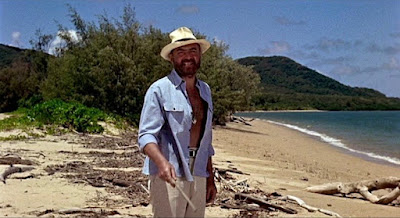

Martin Scorcese contributes a brief but very insightful introduction, pointing out that Powell spent years hoping to get a movie adaptation of The Tempest off the ground and that Age of Consent was in some ways a kind of dress rehearsal for that film, a film that he was destined never to make. And in fact if you see the island as being a little like the island in The Tempest, a place not quite of this world, and if you see Morahan as Prospero, them the movie makes a lot more sense. Although he is not a magician, he is an artist, which is perhaps the closest equivalent we have in our world. And I think Scorcese is right to see the film a having a slight suggestion of the magical about it.

I think it’s certainly true that Brad Morahan sees his island retreat from the modern world as an island of enchantment, very much like Prospero’s island in The Tempest. You could even at a stretch see Cora as being a bit like Miranda. You could perhaps even see Cora’s grandmother as an analogue of Caliban.

Scorcese’s interpretation even helps to explain the various comic relief sub-plots. Although they are annoying and do break the mood, they do also add a touch of the grotesque and a feeling of unreality to proceedings, and add a theatrical touch, which may have been the intention.


Apart from a brief but memorable and typically outrageous appearance by the great Australian character actor Frank Thring early on the supporting actors are not terribly impressive. Fortunately the two leads, James Mason and Helen Mirren, more than make up for this deficiency (even if James Mason’s Australian accent is deplorable). Mason resists the temptation to make Morahan a stereotypical irascible and eccentric artist, or to overdo the misanthropy and the loneliness. He makes Morahan likeable and good-natured, in fact a man whose biggest problem perhaps has been that he’s always been too good-natured and unwilling to disappoint others. The sympathetic portrayal makes it easier to understand why Cora is attracted to him. He’s the first person who’s ever shown her respect and kindness. It’s an unsentimental respect and kindness, but it’s more than she’s ever had before.

Mirren is extraordinary. Not only was this her first feature film, she had not even done any TV work, and yet she’s in complete command. It’s one of the most impressive film debuts you’ll ever see.

Both Morahan and Cora are on a voyage of discovery. For Morahan it’s a rediscovery of a zest for life and art; for Cora it’s an awakening to the world and to the possibilities of life as well as an awakening of sexuality. The fact that Mason was 60 at the time the film was made, while Mirren was 24 (and her character is clearly intended to be somewhat younger still) means there was the potential for a certain amount of tackiness, but they bring a kind of innocence to their characterisation which avoids this pitfall.


That the movie, despite some weaknesses, actually works is due in large part to their performances. The gorgeous cinematography and the breath-taking locations also help. It really is visually magnificent, and since it’s a film about an artist it’s not just visual splendour for the sake of it. It is after all a movie about an artist’s love affair with beauty and light and colour.

The problem most people are going to have with this movie is the comedy. It’s not vulgar but it’s very broad. Powell had injected some comedy into Peeping Tom as well and I suspect this is one of the things British critics disliked about his later work. He was dealing in both Peeping Tom and Age of Consent with the all-consuming devouring nature of artistic obsession but he refused to be grim and miserable about it.

It’s worth pointing out that virtually all the comedy in the movie is lifted straight from the novel.

While it’s a coming-of-age movie I also see this movie, along with The Red Shoes and Peeping Tom, as part of Powell’s Artistic Obsession trilogy.

James Mason co-produced Age of Consent with Michael Powell and apparently Mason had quite a bit of creative input. Mason apparently pushed for changes to the ending and he was right to do so. The ending that was finally used is in fact pretty much identical to that of the novel.


Age of Consent
was Powell’s last feature film although at the time he had no way of knowing that. He would spend the remaining twenty years of his life desperately trying to get financing for another film. And of course Powell only made two features after Peeping Tom. So the theme of Age of Consent, of an artist trying to recapture his artistic vision, was a very personal one for Powell.

Age of Consent was a huge hit in Australia but didn’t do so well elsewhere. Certainly it didn’t do well enough to restore Powell’s reputation as a bankable director.

This is a movie that for many years seemed lost in obscurity, but in 2009 it was given a terrific DVD release packed with extras. It’s also uncut and it restores the original opening credits and Australian composer Peter Sculthorpe’s original score which was heavily influence by Balinese music and which works very well. That’s the version reviewed here. It was paired, in a two-movie two-disc set, with the celebrated Powell-Pressburger film A Matter of Life and Death. For my money Age of Consent is by far the more successful and more interesting film. There’s been a more recent Blu-Ray release.

This is an odd quirky little movie, but if you give it a chance (and if you can accept the comic sub-plots) it may well work its charms on you. A fascinating movie by a great film-maker. Very highly recommended.

I’ve also reviewed Norman Lindsay’s Age of Consent, the 1938 source novel. The movie follows the novel very closely indeed.