Pages

Showing posts with label Planescape. Show all posts

Friday, July 25, 2014

The Faelhen

The Faelhen (Elven for "Neutral Eye") is a planar assassin organization.  Based out of a hidden monastery and training school located in the Outlands, the Faelhen are not organized like most assassin's guilds.  Instead of being available for hire, they are devoted to the concept of Balance (being True Neutral as a whole) and work directly for the rilmani.  In addition to whatever tasks their argenach contacts give them, they are believed to somehow monitor various Prime Material Planes to determine when Balance is threatened, allowing them to dispatch assassins to deal with the situation.

(There is some suspicion that the Red Scale Guild of Nerath [Player's Option: Heroes of Shadow, page 16] has somehow fallen under their influence of the Faelhen, as they have similar goals.  However, it is difficult to say; they are obfuscated, possibly deliberately, by the dichotomy between the Great Wheel and the World Axis cosmologies.)

The Faelhen do not stringently revere any gods, although they do recognize and occasionally invoke Chronepsis, the Furies, and Sirrion in their Neutral aspects.

The Faelhen citadel's location is unknown, but is suspected to be somewhere highly defensible, possibly underground.  The fact that some of their members have displayed shadow magic suggests that they are not so close to the Spire as to lose their magical abilities; otherwise, how would they train?

It may look something like this.
The assassins are led by Kalanna Aleanathem, known as the Maikash Thaltria ("Fateslayer Bladedancer") to her pupils.  Evidently centuries old, Kalanna's longevity comes from her stature as a half-elf, half-dragon of concordant lineage.  Although not a cleric of Chronepsis, she keeps a sandclock by her bedside so that she may contemplate her life slipping away.

Kalanna Aleanathem, the Maikash Thaltria
Referees wishing to run Kalanna as an NPC in old school games should assume she is an elf assassin of the maximum level allowed by the game system at hand (ignore elf level restrictions).  She moves at Movement 15ʹ, flies at Movement 30ʹ.  She has a natural armor as per Scale armor and is immune to poison.  At will, she can Detect Balance as per the Druid spell (in systems without this spell, assume she can determine how far from Neutral a character's alignment is, although she cannot expressly determine the alignment in question).  Three times per day, she can use invisibility, as per the spell.  She can claw twice per round (1d4/1d4), and twice per day, she can use her breath weapon — an eight foot long cone of antithetical energy.  Assume antithetical energy deals no damage to Neutral creatures.  Neutral Good, Neutral Evil, Lawful Neutral, and Chaotic Neutral creatures take 2d4 damage, while all other creatures take 4d4 damage.  In games with only Lawful-Neutral-Chaotic alignments, assume Lawful and Chaotic creatures take the full 4d4 damage.

Referees wanting something in the 3.x paradigm can use Pathfinder statistics for Kalanna (and anybody with more Pathfinder/3.x experience than I should feel free to revamp her statistics and equipment).  And yes, I'm aware she breaks the rules in a couple of spots (Neutral assassin, breath weapon).  Strange things happen out in the planes.

Kalanna Aleanathem (CR 21)
XP 409,600
Half-dragon elf rogue 10
Assassin 10
N Medium dragon (elf, half-dragon)
Init +9; Senses darkvision 60 ft.; low-light vision; Perception +26
————————————————————
DEFENSE
————————————————————
AC 27, touch 20, flat-footed 21 (+7 armor, +5 Dex, +1 dodge, +2 natural)
hp 118 (20d8+20)
Fort +7, Ref +19, Will +7; +2 vs enchantments
Defensive Abilities evasion, improved uncanny dodge, trap sense +3, +5 vs. poison; Immune paralysis, poison, sleep
————————————————————
OFFENSE
————————————————————
Speed 30 ft., fly 60 ft.
Melee +3 stalking dagger +22/+17/+12 (1d4+6/19–20/×2 plus poison)
Melee claw/claw/bite +18/+18/+18 (1d4+4/1d4+4/1d6+4)
Ranged +1 called dagger +20/+15/+12 (1d4+6/19–20/×2 plus poison)
Special Attacks angel of death 1/day, breath weapon 1/day (30-ft. cone, 6d8 antithetical*, DC 11), death attack (DC 25), quiet death, sneak attack +10d6, swift death 1/day, true death (DC 25)
————————————————————
TACTICS
————————————————————
Before Combat The assassin uses Stealth or Disguise to get close to her prey so she can study and strike with her death attack.
During Combat Using her fast stealth to rush into the fray, the assassin attacks the most threatening target using bleeding strike. Next, she moves out of melee to soften foes with throwing dagger attacks before reentering melee.
————————————————————
STATISTICS
————————————————————
Str 18, Dex 20, Con 12, Int 20, Wis 12, Cha 15
Base Atk +14; CMB +18; CMD +34
Feats Critical Focus, Dodge, Improved Initiative, Lightning Reflexes, Mobility, Shadow Strike, Sickening Critical, Skill Focus (Stealth), Spring Attack, Stealthy, Weapon Finesse, Weapon Focus (dagger)
Skills Acrobatics +28, Bluff +15, Climb +27, Craft (alchemy) +28, Diplomacy +15, Disable Device +18, Disguise +25, Escape Artist +30, Linguistics +18, Perception +26, Sense Motive +14, Sleight of Hand +28, Stealth +36, Swim +17
Languages Abyssal, Aquan, Auran, Celestial, Common, Elven, Draconic, Dwarven, Goblin, Ignan, Infernal, Orc, Rilmani, Sylvan, Terran, Undercommon
SQ hidden weapons, hide in plain sight, poison use, rogue talents (bleeding attack +10, combat trick, fast stealth, feat, surprise attack), trapfinding +5
Gear +5 improved shadow leather armor, +3 stalking dagger, +1 called dagger, bag of holding II, ring of feather falling, ring of mind shielding, hat of disguise, minor cloak of displacement, black lotus extract (1 dose), tears of death (2 doses), oil of taggit (2 doses), dust of tracelessness (1 dose), 2,070 gp

* The antithetical energy breath weapon deals the full 6d8 damage to Lawful Good, Chaotic Good, Lawful Evil, and Chaotic Evil creatures; 3d8 damage to Neutral Good, Neutral Evil, Lawful Neutral, and Chaotic Neutral creatures; and no damage to True Neutral creatures.

Referees wanting a D&D fourth edition version of Kalanna can use the statistics below.  Her vial of poison can represent any poison the DM sees fit to use; assume she is trained in any of them, including the assassin's poisons from Heroes of Shadow.

Wednesday, July 23, 2014

The Great Planar Race

I happened to see this video last week, and as it seems to be in theme with this week's blog posts, I felt it was noteworthy enough to share.

Plus, I really like the idea of the plot in question, the so-called "Great Planar Race."  (I particularly enjoy the idea that the Planar Trade Consortium is using it as a form of advertisement — Esteban has already appeared in one of my D&D games to monetize a dungeon, so the idea of the Consortium as shameless money-grubbers is already well established in my Planescape headcanon.)

Watch the video after the jump:

Monday, July 21, 2014

A Word on Cosmology

So when this blog was but a young blog, I wrote a short post about a post that Zak S. wrote inspired by a theoretical science article he read.  The main thrust is that if fantasy worlds are polyhedral worlds rather than spherical worlds, gravity would still pull the atmosphere into a spherical shape, meaning that each face of the polyhedron would be a flat plane with a bubble of air atop it.  The edge of this bubble would form the outer edge of the habitable zone of the world, meaning that one could not cross from plane to plane overland, but one could do so through the megadungeons carving their way through the interior of the earth.

My idea was that all myths are true, and so one can paradoxically reach alternate planes by going deep enough into the earth, or going into the sky via Spelljammer, or accessing planar portals, or getting transferred through the Mists, or whatever.

To elaborate: as previously noted, my background in modern occult conspiracy games informs my current fantasy gaming trend.  As such, my wizards tend to be the weird obsessives Unknown Armies paints its wizards to be, and the world tends to run on belief and consensus the way it does in Mage: the Ascension (which neatly coincides with Planescape, and to a lesser degree, Unknown Armies again).  There are a couple of bits from the Mage book Infinite Tapestry, the sourcebook on the spirit worlds, that really illustrate this.  To wit:

  1. The spiritual realms beyond the Horizon (what we would term outer space but a lot of mages call the Deep Umbra, particularly once you hit the asteroid belt) are full of Ether, which is breathable.  If you're a mage.  And if you believe you can breathe it.  A modern Hermetic, raised on modern science, probably doesn't believe he can breathe it anymore than a Technocrat can, so he doesn't try and suffocates in the "vacuum."  One of the books notes a bit of dissonance that occurs when Technocratic Union astronauts in full space suits arrive on a planet to find a half-naked shaman there beside a campfire.  It doesn't compute, but both things are true.
  2. The High Umbra, the spiritual realm of concepts and ideas, initially appears as a mental landscape called "The River of Language."  (Fans of The Book of Worlds will note that this was originally its own realm; it got transplanted as the near High Umbra as part of Revised Edition.)  The River of Language forms a variety of branches and deltas mirroring a a diagram of linguistic family trees, and emptying into the Great Ocean of the Future — itself containing the potential of languages yet-to-be.  The further up river one goes, the farther back in the zeitgeist of the language one goes, so that the modern cities of modern English will give way to the Elizabethan towns of early modern English which will give way to the walled, medieval cities of Old English, which will pass through locales indicative of its Germanic and Latin roots (incidentally, most American characters will find themselves on the Indo-European branch of the River).  However, scientifically-minded magi (such as Technocrats) may only be able to navigate the River by the avenues posited by modern psychology and linguistics, whereas pseudoscientists and old-school occultists might be able to navigate discounted linguistic relationships — The Infinite Tapestry makes reference to the Technocracy trying to hunt hidden Traditionalist Masters who disappeared into a linguistic region corresponding to Barry Fell's discredited work in New World epigraphy, which the Technocrats cannot find because they don't believe in it!
I run my D&D games the same way (although it rarely comes up).  As noted above, all things are true — you might be able to access Oerth via Toril if you dig deep enough, or you can take a Spelljammer, or you can just get there by way of Sigil.  Or maybe you bypass Sigil, instead accessing planar travel through the city of DisTanelorn (good luck finding it, though), or the World Serpent Inn.

Likewise, an old-school planewalker from Áereth might be familiar with the Great Wheel Cosmology of AD&D and 3.x, whereas a new planewalker from fallen Nerath might be more acquainted with the World Axis Cosmology of 4e.  Of course, that affords them different opportunities — the Nerathi planewalker might be able to lose the Áerethian planewalker by using the Shadow Passage ritual to jaunt into the Shadowfell, where he cannot follow because it's outside of his knowledge and belief structure, whereas the Áerethian can lose the Nerathi via a Plane Shift to the Outlands.

Tricky, eh?

As such, when the Shields of the Sorrowfell go plane-hopping — let's say to Baator because the DM hates them — they do so according to the World Axis (and therefore they'll likely sail across the Astral Sea) because that's what they learned to be true.  But when Dr. Dagger Nazareth tries to track them down (probably to try to score some space-cocaine), he has to take a different path (maybe he goes to the Outlands and travels through the gate-town of Ribcage) because the University of Wiss Khan Sin only teaches Great Wheel Cosmology.  Of course, if either side has an open mind about the experience, or simply finds evidence leading from one place to another, they might be able to backtrack through the alternate cosmology.  After all, if your ranger is tracking someone and finds that they fled to Arcadia, the trail is still evident even if the destination is not.

(And given the differences in cosmology, what might be important to one person has less relevance to another, but may still be reconciled — Dr. Dagger Nazareth realizes that the Outlands and the Spire form the axis around which the Outer Planes turn, whereas the Shields of the Sorrowfell might just assume they're in some weird demiplane that nulls magic the closer they get to the Spire.)

Monday, July 14, 2014

The Crystal Sphere That Wasn't

Overheard at the Smoldering Corpse Bar in the Hive in Sigil:

I heard a tale from some right barmy berk one time, some spacefaring sailor — you know, those weirdoes who take sailing ships, bolt a magic chair into 'em, and set them off toward the sun or whatever — who claimed he'd been somewhere no one else had ever been.

Yeah, they all say that.

I was intrigued by this Prime's premise, though.  Every planewalker with a bit of age on him knows the Domains of Dread, but this addle-cove claimed that he'd sailed there in one of his rickety space boats.  He said that the Mist was still a problem, but a little easier to navigate than you always hear.

More to the point, he was talking about some world I'd never heard of.  I can't tell if it was supposed to be the world on which the Domains of Dread lay, or another system, but he said this world is called Aryth or Eredane.  I think Eredane is a large continent, the rough equivalent of calling Toril by the name Faerûn instead.  Anyway, he said this whole land labored under the direction of the evil god named Izrador — again, never heard of him — the god of corruption whom the gods cast out for generally being a bad blood.

The thrust of his tale, though, was that the gods made this Crystal Sphere — that's a world and its nearby planets, what some astrologers call a "solar system" — and used it to imprison anyone who seems like they deserve it.  Or maybe the Dark Powers did it.  Or maybe they're one in the same.

And what's more, he says it's in the middle of Known Space, just cut off from all the routes through the Flow — that's the phlogiston, the substance outside the Crystal Spheres — and practically unreachable unless you're willing to go off the path and you have a spell like Phase Door or some such.

Of course, I'm no spacefarer, but I think I heard that most folks suspect the gods can't affect the crystal shell of a world.  Although I've also heard that the Immortals of Mystara might be able to do it, leastwise according to certain tomes.

But if that's true, that suggests the first Darklord of the Domains of Dread isn't a person, but some entity too unwholesome for the rest of the Powers.  Of course, then you'd figure deities like the Chained God would be cast out, but then again who claims to understand the Powers anyway?

Of course, who knows if that sailor berk knows a damn thing.  Seemed like the unhendest leatherheaded sod in all the Planes, that's for sure.

Tuesday, June 4, 2013

On Game of Thrones:

"I keep hearing all these barmy berks rattling their bone-boxes about Lannisters and Starks and Targaryens, but I can't bang my brain-box on it. Clueless and primes to the last man. The dark of it is that I've never seen those Westeros types banging around the Cage, that's for damn sure. Just a collection of outsiders, screeds, and sods. So what if they've got jink or galbas, or if a bunch of bodies are counting worms? They don't know the chant about the Blood War, and they aren't offering me a ride. Pike it, leatherhead." — Tratus Pastoj, planewalker

Friday, January 4, 2013

Rockulon Prime

Excerpts from the lecture "The Straight Shit on Rockulon Prime" delivered by Dr. Karl Satan, natural philosopher and space-wizard holding dual Ph.D.s in metalphysics and wizardology, as delivered before the Arcane Brotherhood, Guildhall Ward, Sigil.  As the name suggests, Dr. Satan's penchant for profanity occasionally becomes apparent; most attendees are fairly certain he was in some state of inebriation throughout his presentation.

The esteemed Karl Satan, Ph.D.

People who talk a lot of science shit say there's a multitude of crystal spheres in the universe — I've heard a septillion.  Of course, dudes with the kind of time to count a septillion stars don't get laid often, do they?

Those in the know would know that most of those spheres and the planets around them are boring as hell.

Rockulon Prime was probably fated to be the same.  Maybe the gods would intervene and seed the planet with life, maybe an advanced race would do the same thing.  Hell, maybe the whole shebang would self-organize into living systems.

The intervention of the Space-God!

Instead, we received the Space-God.

Some claim to see the Space-God in their dreams.

The nearby Blood Nebula — possibly an incursion of the Galaxies of Blood in our crystal sphere — probably vomited forth the Space-God's Corpse.  The Corpse crash-landed on Rockulon Prime.  Maybe the native microflora overtook it, maybe the God's own parasites started to feast upon it.  Who the fuck knows?

We do know that the little beasts began to grow.

The residual magical energies from the Corpse of the Space-God mutated life to fit new forms; we're all descended from the soulstuff of the Space-God.

Plants and dumb beasts evolved first, most notably the Hell-Maggots that are thought to be some of the most ancient life on the planet.

A small Hell-Maggot

Hell-Maggots can be found everywhere on Rockulon Prime, typically underground, but are most heavily concentrated in the Sea of Maggots, feasting on the Corpse of the Space-God.

The truly big monstrosities lurk in the vicinity of the Corpse of Space-God.

The first sapient race to evolve from these monstrosities was probably the drider.  As the adult form of one of the varieties of Hell-Maggot, the driders began to form their own civilization.  So suffused were they with the Space-God's cosmic energies that their mutations continued.  A subrace of driders appeared, known as the drow.

The drow are better than you

These aren't the pussy, angsty, emo drow of some worlds.  These drow are fucking metal.

I should probably explain that term, shouldn't I?  We understand life and much of our material resources to come from the bounty of the earth, from the Underdark.  The most abundant substance in the planet is iron; as a metal, it is one of the most stable and least reactive, and pretty damn important to our industries.  Metal is our lifeblood.  So, when something is a great goodness, we define it as metal.  We recall the strength and utility of metal, as well as its sublime beauty.  It's hard to describe the concept of metal to one who is not from Rockulon Prime, but understand that metal is quintessential.

So, our drow developed grand civilizations and advanced technologies.  Most importantly, they developed magic, including the Maglaban Chambers which wizards still use for wizard's duels today.  As one of the first races, there were few other sapients to subjugate, so they made their own.  Drow are probably responsible for most sapient life on the planet, most likely beginning with the bullywugs or troglodytes.  Their experiments on frogs and lizards yielded the creatures, eventually spawning lizardmen and yes, even dragons — for some reason, the ancient drow experimented on drakes and uplifted them as mounts and slaves.

A drow sorceress with her mutant experiments.

The drow created a vast empire that conquered the entire world, making use of magically-created slave races to cater to their every whim.  Their experiments continued as they began to uplift the primitive apes of the savage jungles.

Of course, with nothing left to conquer, they turned on each other.

The drow go to war.

One faction tried to grab territory, the other resisted, and war was upon the land.

It was brutal.  It was bloody.

The drow are believed to have created some of their mutant ape races, such as the savage white apes, as well as hybrids such as the dragonborn and the vat-bred orcs and their goblinhobgoblin, and bugbear kin.  The trolls were almost assuredly bred as an engine of war, as were various other creatures too numerous to mention.

Drow society was so advanced by this time that their magic and tech was devastating.  Other worlds have things such as blood rock or godsblood or bloodstone (or even the gemstone known as "bloodstone"); our Bloodstone is cast-off detritus of the Space-God, and the crystallized crimson rocks have magic powers.  The drow used them and their magics to make very effective weapons.  Whole portions of the world were turned into blasted, wasted hellholes.  Many of these are still dangerously toxic, spawning mutants and all manner of abomination into the world.
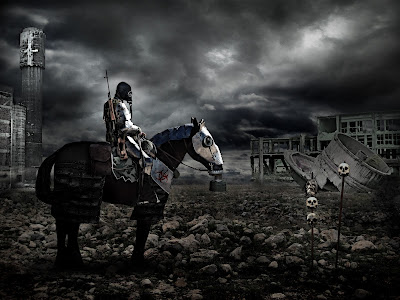
And you still get douchenozzles like this questing in the Wastes.

Records from this time are still spotty, so we don't quite know the order of things.  We know the schism among the drow led them to acquire various territories.  The classic drow were forced underground, and their various descendants would eventually evolve into the elven subraces of today.

Elves are still among the most ruthless predators of Rockulon Prime.

Around the same time as the conclusion of the Drow War came the first threat from Outside; the aboleths.  We're not entirely sure if the aberrations came by some manner of spelljammer, or if the magical energies of the Drow War opened gates to Outside, but the aboleths arrived to take Rockulon Prime for themselves.

Many of the sapients of the sea, such as kuo-toa and sahuagin, were likely created by the aboleths as part of their bid for takeover.

Much as the drow, the aboleths gladly used slaves to aid them in their goals.

Of course, the aboleths didn't win, probably because giant fucking fish suck at fighting on land.  Weakened and in decline, the elves still managed to fight off the aquatic creatures and force them to back the fuck up.  Of course, whatever channel to Outside had been opened would never close.  It wasn't long before illithidsbeholders, and other aberrations appeared in the Rockulon Underdark.

As many slave species revolted during the Drow Wars, the elves continued their experiments with apes, crafting such kin to them as the dwarves, halflings, gnomes, and yes, the humans.  Weakened and fractured by centuries of warfare, however, the elves could hardly maintain their new slaves, and after a scant generation or two, the new creatures revolted and found themselves out in the world.

And what a beautiful world it was.

The land was sick, warped by magic and irradiated by blasphemous technologies.  Using secrets plundered from the vaults of the elves, the new races banded together to survive.  Survival was pretty tenuous in those days; the world was still full of arrogant elves, mutants, aberrations, and monsters of all types.  Still, within several generations, the dwarves had built a stable civilization that would grow into the grand Wraithsmasher Empire.

The dwarves are a most capable race.

The dwarves never hit the grand expanse of power the ancient Wormwarper Empire of the drow achieved, the Wraithsmasher Empire succeeded in unifying several races without enslaving them, and bringing civilization to lands untamed for centuries.

Of course, the secret to the Wraithsmashers' downfall lies in the name; the Wraithsmasher family of dwarves specialized in fighting undead and planar outsiders.

He who fights monsters and all that.

The Wraithsmashers became an infernal bloodline.

The Wraithsmasher Empire didn't truly collapse — not right away, anyway — but they did become corrupt bureaucrats and demon-worshipping shitheels.  Deals with infernal creatures were established, and pretty soon, the ruling dynasty was replete with maeluths, dwarves with infernal blood.  Tieflings and wisplings — fiend-touched humans and halflings — also appeared among their retainers.  Just when it appeared that the whole of Rockulon Prime would go tumbling into the Nine Hells or the Abyss (thought by scholars to be the ultimate goal of the corrupted Wraithsmashers), internal conflicts wracked the world with war again.

Although these conflicts were not as destructive as the Drow Wars of antiquity, war was total.  Any race that wished to grab for glory or settle an old conflict leaped into the fray.

After nearly a century of war, all was finally silent.  Most races on the surface were in decline, their numbers low, and they teetered on the brink of extinction.  Most of the infernal lineages were pushed elsewhere, into dark corners or their home realms.  The world was silent for a time, and sapient life was again a precarious thing.

Some artfag probably captured this shortly before being devoured by cannibal mutant halflings.

Of course, with their short lifespans and compressed reproduction time, this allowed humanity to take control through sheer numbers.

The teeming throng of humanity, brought to you by copious fucking.

It's the same sort of boom-and-bust cycle we've grown accustomed to on Rockulon Prime.  The historians keep track, but otherwise, the human dynasties tend to change hands way faster than those of the demi-humans.  There's more variety now — the dwarves and elves have their own homelands, the few remaining dragonborn lord over their degenerate kobold kin while ultimately owing fealty to the dragons, the mutants claim territory in the Wastelands, and the various other subraces hold sway in their own spheres of influence.  Presently, the grand empires of yore are gone, but humanity is definitely the most notable force on Rockulon Prime, and the time is ripe for another ruling power to rise.

But if the yuan-ti hybrids take over, seriously, fuck those guys.

The landscape of Rockulon Prime is currently dotted by a loose confederation of city-states joined by the old highway system.  Despite the lack of large-scale organization, much of the infrastructure of the old empires remain; as best as we can tell, we're more technologically advanced than other worlds we have encountered.  We've got gunpowder, steam, and internal combustion, but they have yet to match the efficiency of magic.

Exactly.

Magic is still more versatile, and more intuitive to those who understand it, although tech tends to be more intuitive if you don't know magic.  Why use a gun which requires constant maintenance when you can launch a magic missile or a fireball that replenishes as you study and rest?  Why use a gas-guzzling van when you can ride a nightmare that only needs a small amount of feed?

Although it's harder to listen to your 8-track on a nightmare.

Of course, us magic-using types combine magic and tech.  Enchanted guns are pretty scarce, though they tend to be popular with adventurers if they can be found.

 Kickin' rad.

Some wizards have also combined the ancient magic of the spelljammer helm with the more recent automobile.

Seriously?  Wizards fucking rule.

Rockulon Prime still contains many of the dangers and features we have encountered on other worlds.  Outside civilization, roving bands of monsters threaten travelers.  Ancient ruins of fallen civilizations hold danger and treasure for those with the balls to face them.  Civilization ebbs and flows, but maintains a sort of dynamic equilibrium with the wild places.

And now, we close this transcript with images of Rockulon Prime:

We all start as apprentices.

But some wizards may progress to higher accomplishments of magic.

When the student is ready, the master will appear.

Evil wizards lord over petty fiefdoms.

Barbarians stalk the Wastes.

Although some evidence of civilization may exist in those borderlands.

Although not all settlements on the frontier are friendly.

Beastmen may be a danger in the wilds.

Some have even learned the metal mysteries of arcane music.

Of course, you should probably be a bit more worried about the mutants.

Fortunately, there are always those willing to defend the borderlands.

Especially since vast rewards lie beyond civilization.

Interested parties are directed to the subsequent post, On the Subject of Rockulon Prime.

Wednesday, October 17, 2012

Persons of Interest: Loturik the Bound, Kolyarut

Loturik the Bound

Loturik the Bound is one of the Inevitables, order-aligned extraplanar constructs originating from Mechanus (and thusly making them spiritual kin to the Modrons).  Specifically, Loturik is a Kolyarut, a type of Inevitable that hunts oathbreakers.  They are known to be the most personable of the Inevitables because they will actually deign to speak to their chosen prey, and may even attempt to negotiate a settlement (so, rather than killing the oathbreaker, they may simply convince the person to uphold the broken bargain).

In this case, Loturik the Bound is occasionally seen around Sigil, and is identified as a member of the Planar Trade Consortium.  Scholars can think of no reason why a Kolyarut would willingly serve any authority less than its duty, but rumors suggest that Loturik, as his moniker suggests, is bound to the will of the Planar Trade Consortium.

Rumors suggest that no less authority than Estevan himself (an oni mage and a key leader of the Consortium) tricked this rogue Kolyarut into forging an oath with the wily magus.  If this is true, Loturik is bound to serve because it cannot break its own oath without defying its base nature.

Loturik is currently thought to be gathering adventuring parties to help cultivate the town called Skyfall in a grim and distant Prime Material World known as Carcosa.  Special attention is to be paid to the ruins below the town, as there is apparently wealth to be had down there.

(Also, the above image was found on http://www.themistway.com/Ravenloft-Session14-DMC.html at the phrase, "human-shaped clockwork automaton.")

Monday, August 20, 2012

Sharpened Hooks: Planescape Fusion

Dig this.  You're going to get a lot of background, so feel free to skip it if you like (and you're already down with magnetic confinement fusion reactors).  This all has a point.  Trust me.

There are two types of nuclear power: fission and fusion.  Both types of power rely on the mass-energy and binding energy of elements: iron and nickel have the lowest mass per nucleon and the highest binding energy of any element, making them the most stable (binding energy measures the amount of energy needed to break bonds, meaning that a high binding energy suggests a more stable system that is harder to break).  All other elements, under duress, will strive for this low energy state.  This is most striking for particularly heavy or particularly light elements, as they'll release the most energy when they are transformed.

We'll talk about fission first, because it's necessary to differentiate the two.

Nuclear fission provides 13.5% of the world's electricity.  (If you don't like my description, The Simpsons provides a fairly succinct summary.)  The principles behind nuclear fission are the same as those behind an atomic bomb: certain heavy elemental isotopes (such as uranium-235 or plutonium-239) are inherently unstable, throwing off energy and neutrons.  If you bring them in close contact, those released neutrons collide with other atoms of (for example) uranium-235, causing them to become more unstable and release more neutrons and more energy.  This nuclear chain reaction is a positive feedback loop.  If one performs it too quickly, it forms a nuclear weapon; nuclear power requires a more controlled reaction.

This energy is harnessed in a fairly simple way, recognizable to Vitruvius, Hero of Alexandria, Thomas Newcomen, and James Watt.  Since these reactions throw off a lot of energy as heat, the fissionable materials are usually shaped into rods and placed in a vessel to transfer the heat to water or liquid sodium.  This heat energy is then transferred to water, which turns to steam, which turns turbines, making the whole apparatus a steam engine.

But what about fusion power?

If fission power breaks down atoms into their component pieces, fusion power builds them up.  Taking light elements such as hydrogen (typically as heavy deuterium or tritium) or helium (typically as helium-3), one can build these elements to helium-4.  This operates on the exact same principle as fission — helium-4 has less mass-energy than heavy hydrogen, and so is more stable.  Fusion reactions are extremely energetic, releasing lots more energy than fission reactions (it's why the hydrogen bomb is much more powerful than uranium bombs).  From there, modern fusion reactors look a lot like fission reactors — keep it controlled so that it doesn't explode, and the heat energy is diverted to a steam engine.

Of course, fusion reactors have a lot of problems.  There's a very successful one that produces most of the energy on Earth, but it's the near black-body called the Sun.  The Sun is so successful because it's so massive; a lot of energy needs to go into a fusion reaction, and so far, scientists haven't made it efficient enough to be viable.  That's why cold fusion is such a big deal — if scientists could figure out a way to produce fusion reactions under low-energy conditions, fusion would be much easier.

It seems unlikely, though.  For the moment.

Fusion reactions require a lot of energy, produce a lot of heat, and require a lot of space.  One approach is  magnetic confinement, best exemplified by the tokamak reactor.  Magnetic confinement uses magnetic fields to contain the superheated plasma, and typically takes place in a torus-shaped reactor.  (Compare with inertial confinement, which uses lasers to confine the pellet; inertial confinement can withstand higher temperatures, but magnetic confinement lasts longer.)

Which brings us to the actual point of this article: where can one find a big, indestructible torus among the Planes, complete with its own injection system?

Sigil.

Sigil contains portals to everywhere and everywhen, and some of those portals are either permanently open, or can be opened at will with the proper portal key.  Some enterprising scientist with enough manpower could divert power from the portals to the Inner Planes in the Lower Ward to act as the injection and containment center, and then open another portal to allow heat transfer to a site in another Plane, likely building a steam engine on the other end.  Containment would likely be a non-issue; it's called the Cage for a reason.

Sure, it would kill everyone and destroy all structures in Sigil, while also venting hot plasma out of every open portal to Sigil, but that's a small price to pay for nearly limitless energy.

Of course, the dabus and the Lady of Pain would likely have something to say about it.  As might any enterprising adventurers and Faction-types who catch wind of the plot.

It's also notable that Sigil contains roughly 50,000 residents, while hosting as many as 200,000 transients at any given time.  Certainly no entity would consider that a sacrifice of any kind, would they?

Also, didn't Vecna wrest apotheosis and change 2e to 3e by causing mayhem in Sigil?  What would happen to the scientist who finally does what Ravel Puzzlewell and Vecna could not?

What happens to the person who breaks the Cage?

Print Friendly