Showing posts with label Goldenrod. Show all posts

Friday, January 3, 2014

American Tree Sparrows blew in with the snow...

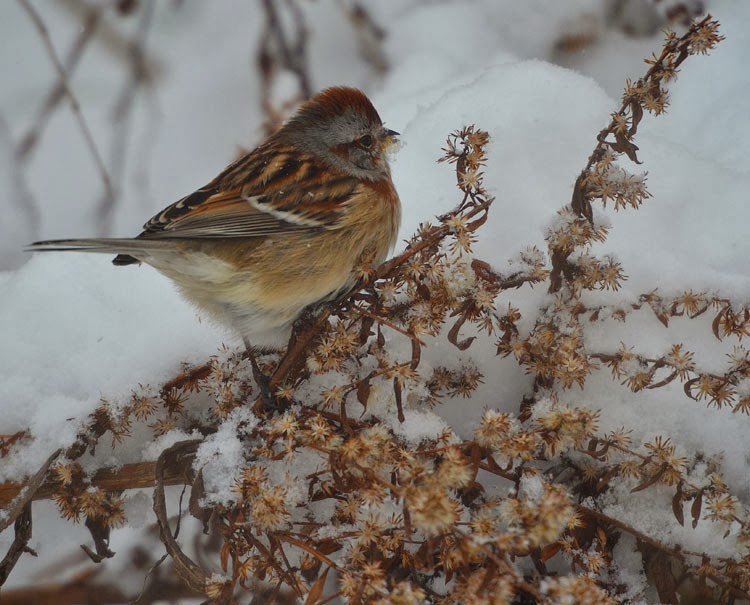
...finally our American Tree Sparrows have arrived for the winter! They always seem to ride in on the night winds of the first big snow in January, so when I looked out the kitchen window yesterday morning, I had my fingers crossed. Sure enough...the little sparrows were under the feeders searching out seeds. I cracked the window so I could hear their pretty, twittery calls. It only took colder temps and five inches of snow to lure them in...
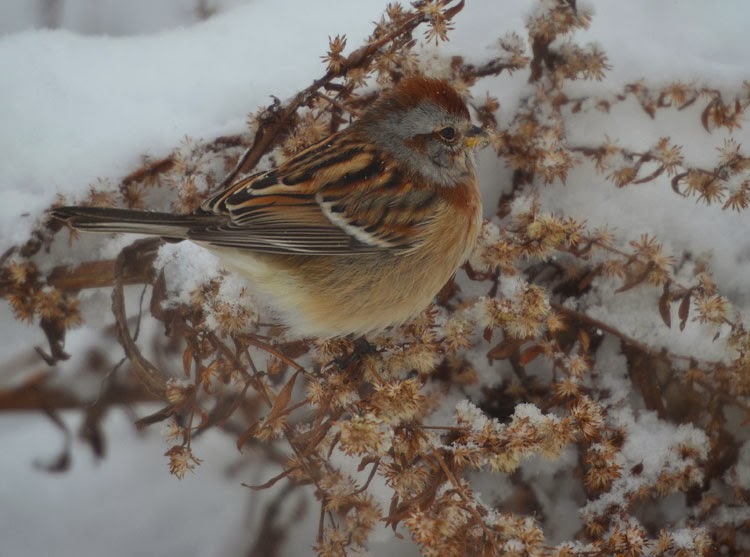
A sweet American Tree Sparrow (Spizella arborea) pulls seed from brush in our backyard. 
American Tree Sparrows are birds from the far north, so they are well adapted to our cold winters. This spring our little flock will pick up and head back home, flying over 2,000 miles to reach their breeding grounds in Manitoba, so we have to enjoy them while we can. I'm thankful we have a little flock that stays with us each winter. Their cheery calls and warm, beautiful colors always brighten up the gray that can descend during winter. I just checked the thermometer and it's 4 degrees Fahrenheit. These little fellas should feel right at home!

The chocolate brown of the sweet American Tree Sparrow is pretty against the white of the snow. Here he's pecking at spent goldenrod seeds.
American Tree Sparrows eat the seeds at my feeders, but they also scour the yard looking for weed seeds and spent flower heads. I know they love the purple coneflowers that I have all over, especially those mixed into the weed patch I've created in part of my yard. They go for Goldenrod too...and almost any plant packed with seeds.

...a weed seed eating demon!  
In the January 2009 issue of Birds and Blooms magazine, George Harrison mentioned that over a hundred years ago, a Professor F.E.L Beal reported that in Iowa, American Tree Sparrows consumed 875 tons of weed seeds annually, and farmers considered these little birds economic allies. (These angelic looking birds are weed-seed-eating demons!)


...to ID these birds, look for a rusty cap, a two-toned yellow and black bill, and the dark spot (stickpin) in the chest. These sparrows resemble Chipping Sparrows, but they leave our area in the winter.
The two-toned yellow and black bill, and the stickpin in the center of his chest are two identifying field marks of the American Tree Sparrow...not to mention his jaunty rusty cap!

Head-on view of an American Tree Sparrow on golden rod in the snow.
...a pretty bird in beautiful snow! I can never resist head-on shots of the winter birds.

...the beautiful warm colors of these arctic birds also help them blend into dried and dead winter foliage.
The warm chocolate browns, caramels, and rusty oranges are beautiful against the white snow. 

Don't clean your yard up in the fall...birds like it messy!
I always leave flower heads, weedy areas, and brushy areas for the birds in winter. The little sparrows can't resist these wild pockets in a suburban yard. I've let a section of my yard "go wild" with goldenrod, black-eyed susans, purple coneflowers, and grasses and I can always find something interesting hiding out in the brush...

American Tree Sparrow in the weeds.
An American Tree Sparrow hangs out in the wild weed patch. I never cut down flower heads and weedy areas in the fall. I leave them as is for the birds, who eat seeds and wintering insects in them all winter long. In our yard, the American Tree Sparrows, Dark-eyed Juncos, White-throated and White-crowned Sparrows, American Goldfinch, and Carolina Chickadees really love the uncut grasses in the weed patch. 

Thursday, October 7, 2010

A Female American Kestrel in the grasses and goldenrod...

Along with the Common Buckeye butterflies and the sweet Savannah Sparrows in the high meadow at VOA Park a few weeks ago, an American Kestrel was about, hovering and hunting for prey in the tall, golden grasses. When I first caught sight of her, she was hovering high in the sky, a beautiful sight as she hung in the same place, her wings fluttering to keep her motionless. It was a very windy day, and I watched her hovering in the sky over and over. At one point, however, while I was very still and listening for the chip of a Savannah Sparrow, I saw her perched at a distance on a rusty post. Her coloring matched the tall goldenrod and teasel stalks surrounding her, and she blended in to almost nothing, but the bright white on her face and the two two black bars by her eyes gave her away as the dramatic contrast caught my eye among the golds and browns covering most of the autumn field.

Using one of her preferred methods of hunting, the American Kestrel sat patiently on the old fence post, vigilant to movement, and watched for grasshoppers or small rodents. The field was thick with grasshoppers, so when she suddenly would swoop down into the overgrowth, I assume she was nabbing a grasshopper.

Our smallest falcon, the American Kestrel is beautiful and colorful. It is always a special day for me when I spot one. Every now and then a kestrel tears through our side yard--those gorgeous kestrel colors a flash in the sky as he or she whips past our kitchen window.

It was a windy day, and she used the wind velocity to fuel another of her favorite hunting methods--the hover! Looking like a giant hummingbird, she would hang in the sky for minutes scanning the field below for food.

I saw her hovering six or seven times--each time in a different spot. She covered territory across all four corners of the high meadow. The American Kestrel doesn't hover like a hummingbird, instead, it flies into the wind at the same speed of the wind, the result being stabilized hovering. (Click here for an older post that describes how a hummingbird uses a figure-8 wing motion to hover.)

Monday, October 4, 2010

A Common Buckeye Butterfly (Junonia coenia) nectaring on goldenrod

Common Buckeyes were abundant in the high meadow at VOA Park last weekend. I've never seen so many in one place. They spent most of their time nectaring on the bright yellow flower clusters on plumes of goldenrod.

A Common Buckeye Butterfly (Junonia coenia) nectaring on autumn-blooming goldenrod.

...the nectar from the goldenrod must have been especially sweet because the buckeyes were incredibly obliging, keeping their wings open for photographing.


...a little bee gets in on the nectar action...

Monday, September 27, 2010

A Savannah Sparrow on goldenrod...in the evening's golden glow no less...

Two sweet little Savannah Sparrows played hide and seek with me among the sunshiney crowns of blooming goldenrod at VOA Park yesterday evening. They would pop up and fly a quick burst, frantically diving back into the grasses and goldenrod stalks, and only occasionally perching long enough for a glimpse of their golden faces made even lovelier by the sun’s golden evening light.

...unfortunately, this fellow was a little too far away for a great shot, but his charm definitely shows through in the wash of evening sunshine.

...temps dipped almost wickedly yesterday evening, and I was shivering while I snapped this shot. Illusions of an endless summer were suddenly cut short, and with all my efforts, I couldn't conjure any heat out of the radiant, warm yellow tones of the goldenrod blossoms...

...you are such a sweetie, and I'll definitely miss you when you decide you've had enough of autumn and head south for the winter.

...hopefully he has a home to return to next spring. The high meadow at VOA Park is falling prey to succession and the awful little Bradford Pear saplings are taking over...along with waves and waves of teasel, which is not choice habitat for Savannahs or my favorite little summer sparrow, the Henslow's Sparrow. They prefer grasses, and this summer the grasses were definitely in decline. Funds are thin in the Butler County park system, and there's not enough money to bushwhack or burn the fields.

...don't look south sweet little bird! I want you around a little longer...