Showing posts with label TV. Show all posts

Sunday, August 2, 2020

Comedy in Tabloid! (et al.)

A public domain photograph of the King which TSR could have used for Tabloid!

Tabloid! has a four-page chapter on death called 'The Final Byline,' beginning with the phrase, “Dying Is Easy...”  The following chapter, 'Anything for a Laugh,' begins with the conclusion of the aphorism, “Comedy is Hard.”  In this two-and-a half-page chapter, designer Zeb Cook attempts to explain how to instill comedy into playing Tabloid!

Cook writes:
This is not a game where the mighty, brave, or even the cynically mani-pulative profit.  In this universe, success goes to those who are willing to risk their characters on the stupidest, most lame-brained, and ill-thought-out plans possible.  It's kind of like real life in that way.
Thereafter, Cook supplies “a few rules of comedy.”

1. Get Physical.  This rule has two parts.  First, “Comedy is action – it's called slapstick.”  (Evidently, Cook did not want to address cerebral humor.)  For inspiration, Cook recommends that the prospective Editor “watch some cartoons... and some Three Stooges.”  (The TSR lawyers may have missed this.  Given that they censored B*g B**d, I would have expected them to give the same treatment to the T***e S*****s as well as R**d R****r and W**e E. C****e.)  The other part of this rule encourages the Editor to be active during the game.  (e.g. “Pretend you're the airplane spinning into a dive.”)

2. Maintain a Manic Pace.  Essentially, this means keep the action going and don't let up on the humor.  Cook says not to give the players a break.  “If they players have time to think,” he comments, “then they won't get themselves into stupid messes.”

3. Steal Shamelessly.  These first five rules actually come Mike Pondsmith's Teenagers from Outer Space.  We know this because Cook tells us he stole them from said game.  Cook also explains that he “stole” the rules with Pondsmith's permission.  Of course, having permission defies the notion of stealing, but I suppose Cook wanted to provide an example of incorporating – “stealing” – outside material.  Anyway, Editors should take jokes “and give them a whole new spin” to keep players from anticipating the punch line.

4. Use Running Gags.  According to Cook, “every adventure should have at least one or two set-ups that always seem to reoccur.”  However, “An important part of a running gag is that it can't always be the same.”  Again, this keeps the players on their toes.

5. Dare to be Stupid.  “Your players aren't going to be stupid if you aren't.”  I beg to differ.

6. The Innocent Must Suffer.  “It's undeserved stuff happening to any character,” Cook tells us.  “If they deserve it,” he continues, “it's a comeuppance” and therefore not funny.

7. More is Better.  “There's no such thing as too much,” Cook says.  He advises adding complications to any situation.  This echos Rule 4 from Cook's Bullwinkle and Rocky Role Playing Party Game ; namely, “The Good, The Bad, and The Funny” or “Bad is Good, the Worse the Better.”

8. Plot?  Cook tells us that plots “give the characters some motivation to do things,” but this should be secondary to fun.  “Just throw out the encounter that's not working,” Cook writes, “laugh, and get the characters toward the goal by whatever means.”  Cook uses the word “Improvise,” which ought to have been the name of this rule.  Contrary to what is said at the beginning of the chapter, Cook reveals the “real secret” is that “Comedy is simple.”

After these rules, Cook provides a concluding section to the chapter, part of which reads:
Because this is a silly game, you've got a freedom referees don't get in other games.  You don't even have to be consistent.  You don't even have to make much sense.  By their very nature, silly universes are illogical! That's part of their fun... Just don't worry.
Cook presents four words in large, bold font and in capital letters, presumably to emphasize their importance:
MAKE IT ALL UP.
This should have been a coda to the last rule rather than a separate section called, “Some Other Extremely Useful Advice.”

I might be inclined to add another rule, Embrace Absurdity.  Regardless, humor is subjective and what might be funny to someone might be tasteless to someone else.  Back in the nineties, one could still get some comedy mileage from disturbed people going on shooting sprees.  Result #10 on the Work table for character generation begins, “Co-worker comes in and plays disgruntled postal worker.”  Yet even twenty-five years ago, there were some things that just weren't funny.  Result #16 on the Journalism School table for character generation reads in part:
Killing the neighbor sure livened up a slow news day.  With good behavior, character gets out after five years.
Yikes.

Sunday, July 19, 2020

Character Creation in Tabloid!

Cartography by Dennis Kauth

Included in the back of the Tabloid! rule book fold-out poster map of “The Real Weird World,” a portion of which is shown above.  It's incorrect to call the map a selling point since there's no mention of it in the cover copy.  I suppose it was meant to be a source of inspiration, but it just seems like a mistake.  If anything, it exemplifies some of the things I find off-putting about the game.

Apparently Tom Wham was unavailable to draw the map, not that there's anything wrong with Tom Wham.  However, having Dennis Kauth draw the map in the style of Tom Wham seems such a waste.  Speaking of waste, the map for one of the included scenarios is attributed to Dave Sutherland.  If you have Dave Sutherland on tap, why limit his contribution to drawing a house plan?

Attention to accuracy is somewhat lacking.  Roswell is, of course, in New Mexico and Hangar 18 (not 'Hanger') is in Ohio.  In the rules, author Dave Cook refers to the Trilateral Commission as Trilateralist Commission and Nostradamus as Nostrodamus.

The map refers to Lake Geneva as the location of a “secret mind control base.”  This is interesting given the degree of caution with which TSR's lawyers approach other portions of the game.  Elvis is a beloved staple of tabloid journalism (or was in the twentieth century, at least) and any game regarding the tabloids cannot ignore the King.  However, Tabloid! scrupulously avoids direct mention of his name.  Instead, we get a sequence of asterisks – E***s P*****y.  One image of Elvis in the game as a 'censored' block over his eyes and another image is a bust, but with everything above the mouth is cut off.  Other entities that get the asterisk treatment include Burt Reynolds, Big Bird, Geraldo Rivera, Michael Jackson, and Satan.

Tabloid! has no pre-generated characters.  In other games, this may be cause for me to complain, but this doesn't pose a problem in Tabloid!  There are sufficient examples in the System Guide and the components specific to Tabloid! comprise a clearly described career path mechanic.  To begin with, there are “Résumé Steps.”  The first step is to select a post-high school option:  College, Journalism School (to be “an idealistic reporter – like G*****o R****a”), Work, or the Beach.  Each choice is represented by one the remaining steps; however, after the first step, the steps are not followed in order, nor will every step necessarily apply to a given character, and a character may repeat the same step multiple times.  Each time a character engages in a step, a year passes.

A player character in Tabloid! is entitled to a number of skills equal to Intuition / 15 (rounded up) plus Learning / 10 (also rounded up).  Skills are divided into seventeen pools called schools.  Some examples include the Institute of the Secret Truth, Lawson's Absolute Center of the Universe School, and the G*******d Tour Guide Training Program.  Most skills are only available from a given school; however, there are some skills that are available from more than one school.  For instance, Photography is available from both the CIA University of the Air as well as the Forbert School of Celebrity Nude Photography.  Unlike the CIA, however, the Forbert School offers the specializations and enhancements of Video Camera, Paparazzi, Darkroom, and Photo Retouching.

For the College step, the player chooses one of the schools.  If a Learning roll is successful, the character enrolls.  If the roll fails, the character can try to enroll in another school.  If the second attempt fails, the character must go to the Work step.  Assuming the character successfully enrolls in a school, the player selects one of the skills from that school's pool.  Each time the character engages in the College step, the player rolls 1d10 and adds the number of times the character has taken that step.  A roll of ten or more means the character develops a quirk; specifically, the player rolls 1d20 on the quirk table.  Possible results include tinfoil user, alcoholic, and paranoid.

The Journalism School step is similar to the College step, except the character automatically enrolls in the Columbia School of Journalism (and the player selects a skill form that pool).  Instead of developing a quirk, a character can acquire “one of those wonderful traits that so endears journalists to the rest of the world.”  The 'trait' table requires 1d12 and possible results include irritating whiner, caffeine addict, and one set of clothes.

With the Work step, the player rolls 1d20 to determine the character's job.  If the character engages the Work step more than once, he or she can keep the job or roll for a new job.  Most jobs are listed with a school from which the player can select a skill.  Each job also has a Savings Account modifier.  (In Tabloid!, finances are abstracted into a Resource Rating derived from a character's Savings Account.  Characters start with a Savings Account determined by 1d4.)  We are informed that, “All of the jobs described below (save one) are real and were held by people the designer knows...”  Examples include, Chicken Defroster - Night Shift (School of Hard Knocks), Convention Organizer (Kult College), and Fishmarket Gopher (San Diego Cryptozoological Society).  Additionally, in the Work step, at the cost of one point from his or her Savings Account, a character can attend night school and chose a skill from any school.

For the Beach step, the player selects one skill from either the School of Hard Knocks or Louie di Chang's Dojo and Shooting Range.  The character's Savings Account is also reduced by one point.

The College, Journalism School, Work, and Beach steps each have a 'life event' table.  Each time a character engages in a given step, the player rolls 1d20 and the result is checked on the table.  Any given result offers a bit of color commentary and describes an effect which may grant an additional skill, require the character to switch to a different step, or cause something else to happen.

Result number 9 from the Journalism School table reads:
Playing the D&D® game at work does not count as “reviewing.”  Character learns RPG Mind Control skill but takes a pay cut.  Lose 1 point of Savings Account and roll again on this table.
RPG Mind Control is distinct from Army Mind Control.  The description of the RPG Mind Control skill occupies half of a page; Army Mind Control is described in four sentences.

Result number 5 from the Work table reads:
The one-armed man did it – really!  The cops aren't buying it.  Your character barely gets away in time and is now Hunted by the law for a crime someone else committed.  Lose 2 from the character's Saving Account but immediately gain Disguise and Survival Instinct.  Go to Step 5: The Beach.
The process of engaging in the various steps continues until the character fills all of his or her skill slots.  However, the last step must be followed to the end; this may mean the character acquires skills in excess of the nominal maximum.

Some skills are more useful than others, but if they lack utility, at least they are interesting.  Tabloid! is likely the only game where Smug Liberalism is a skill (with Secular Humanism as an enhancement).  Having the Predictions skill means a character “has studied famous predictions – biblical, astrological, oriental, alchemical, mystical, and whatnot” and can relate them to current events.  Additionally, the character “can fashion predictions for every occasion.”  Cook provides the following advice for cruel Editors:
If you really want to have fun with your players, secretly make a skill check for every prediction made.  If a success margin of 1 is rolled, secretly make note that the prediction is real.  Then use it later to build an adventure for the player characters.  Have fun – make them sorry.

Sunday, October 14, 2018

The Volturnus Trilogy (part II) (spoilers)

Art by Jim Burns

Lawrence Schick, in his Heroic Worlds, says the following about the second installment of the initial offering of three Star Frontiers adventure modules:
Scenario, sequel to “SF-0”: the adventurers, still marooned on Volturnus, must make their way across the planet to a forest.  Once there, the alien Kurabanda may be able to put them in touch with other offworlders who can rescue them.  Unfortunately, the offworlders turn out to be Sathar pirates.  Includes two new intelligent races and six new creatures.
This statement is wrong in several ways. The journey “across the planet” is only about a hundred miles.  The “other offworlders who can rescue them” are instead presented as “Demons from the Sky” who take prisoners.  In these circumstances, expectations of rescue might be optimistic.  In the previous post, I discussed how the so-called pirates do not conform to common definitions of pirates but since the module refers to them as pirates, I will give this a pass.  The pirates, however, are not Sathar nor are they associated with Sathar.  There are briefings for three intelligent races, not two.  Technically, one of the races, the Eorna, is briefly mentioned in the first module.  However, that first module admonishes the referee, “It is very important that no hint of the Eorna be given to the characters.”  The alien creature update file describes twelve new creatures, not six.  One can quibble that a couple of the “creatures” are plants, but there are certainly more than six non-plant creatures presented in the module.  On the other hand, the marooned part is totally accurate.  Schick should have merely summarized the back cover copy.

There is a half-page summary of the events of the prior adventure if the players did not participate in it.  Given that the first adventure is bundled with the Star Frontiers rules, there's no reason not to have played it.  Regardless, the Ul-Mor inform the party there are people like the player characters “living with the Kurabanda, a foolish tree-dwelling race.”  The presumption is that these others are survivors from the first expedition.  An Ul-Mor guide leads the characters part of the way to the Kurabanda, but they must travel the final leg of the journey themselves.  Upon reaching the bachanda tree forest, they find “a raging battle between ten of the Star Devil's men and the Kurabanda.”  The “pirates” will attack the player characters even if they don't come to the aid of Kurabanda.  When five pirates have died, the remainder will attempt to escape; they “will not allow themselves to be captured alive, as they know the Kurabanda would torture them to death.”  I suppose its possible for a pirate to be knocked out.

According to the briefing update, “A Kurabanda stands 1.2 meters tall and looks somewhat like a tarsier monkey.”  We learn that “Kurabanda are also natural practical jokers.”  A paragraph is spent describing four typical practical jokes:  The Fake Vine Joke, Snipe Hunting, The Fire Joke, and the Flea Joke.  After the battle, the characters are taken to the Kurabanda village and, eventually, presented to the chief.  Because the party (presumably) helped in the fight against the pirates, the chief “will be favorably impressed” but the players don't know this.  After conversing with the party, the actions of the chief depends upon the extent to which he trusts the characters.  Their are five possible reactions:  Complete trust, Partial trust, Insulted, Greatly insulted, and Distrusted.  The last two reactions result in the death of the characters.  With the most favorable reaction, the chief conveys information necessary for the continuation of the adventure.  With the partial trust reaction, the characters are given an opportunity to improve their standing.  If the chief is insulted, “he will offer the party many, many gifts of furs, arrows, and wives.”  These must be accepted or the characters will be killed.

Anyway, two members of the first expedition stayed with the Kurabanda (which is how the Kurabanda learned to converse in Pan Galactic).  The two explorers were taken by the space pirates and the Kurabanda can direct the player characters to a pirate outpost.  The party is expected to raid the outpost and defeat four Humans and two combat robots.  From the outpost computer, the player characters...
...can learn that the pirates have discovered rich deposits of vibrillium and tomarillium in the hills of Volturnus.  They have discovered an intelligent race, the Edestekai, living in the hills and have taken advantage of their religious beliefs to enslave them.  They accomplish this by capturing priests, planting radio receivers in their brains, and convincing them that the voices they then hear are the voices of the gods.  Of course, the voices are the pirates, telling them they must serve and obey the Star Devil and his men.
Also in the computer is information that the expedition members have been taken to the pirate mining town awesomely named Slave City One.  Other than information, the players can gain equipment from the outpost; they can also obtain a jetcopter.

In the middle of the module, a briefing update describes the enslaved race:
          The Edestekai are an intelligent race descended from Volturnian arthropods.  They are trilaterally symetrical,  That is, if their bodies were divided lengthwise into three equal parts, the parts would be mirror images of each other.
          The body of an Edestekai is shaped like a giant peanut with three bulbous lobes on top.  Three eyes are arranged in a circle around the narrowest part of the body, the midpoint or waist.  The eyes are arranged in such a way that the Edestekai have a 360 degree field of vision.
          Edestekai have three lower limbs arranged like a tripod.  The first and largest joint on each of these limbs is covered with a hard extension of shell and serves as a foot.  The limb continues to a second and third joints which are roughly analogous to a Human elbow and wrist.  Below the third joint are three tentacles which are used for grasping and manipulating objects.
          Underneath their bodies, Edestekai have a number of special thick cilia, or hair-like filaments.  These cilia are used as a base to support the body when the limbs are extended completely straight.  Except for their tentacles, cilia, and eyes, Edestekai bodies and limbs are encased in an exoskeleton made of chitin, a hard shell-like material.
          The mouth of an Edestekai is located near the base of the body and is hidden by the special cilia.  The Edestekai communicate by means of a language composed of shrieks, whistles, groans, and other sounds combined with clicks of the limbs and signs with the grasping tentacles.
It is assumed that the party will travel to Slave City One.  On the way, they encounter an air whale.  Part plant and part animal, an air whale generates hydrogen as a by-product of its diet (which includes “floating plankton”).  This hydrogen, “stored in hundreds of inner membrane sacs,” allows the air whale to float.  There are crystal-based life forms that live symbiotically with air whales.  “These crystals focus sunlight into a beam,” the description states, “much like a laser.”  The concept of air whales may be risible, but it has precedent in science fiction:  Quest of the Three Worlds by Cordwainer Smith, The Wind Whales of Ishmael by Philip José Farmer, and that one episode of Blackstar.

If the party attempts to attack Slave City One without assistance from the Edestekai, “they will probably be destroyed by superior numbers.”  So, once again, the player characters must gain the trust of alien beings.  According to the module, “a persistent party should be able to slowly convince the Edestekai priests using demonstrations of how radio works, perhaps even a demonstration of minor surgery.”  Apparently, this convincing must be accomplished without attracting the attention of the pirates.  The actual Star Devil is not encountered in the module but the Star Devil's personal quarters are described:
This lavishly furnished small one-room building contains a bed, bath, bar, holovision projector, several art objects (worth a total of 5,000 Credits), and numerous cheap books, mainly adventure novels.  There is a shield mounted over the bed with the Star Devil's personal insignia on it.
In the punishment/torture cells, player characters find the corpse of one of the original expedition members and strips of cloth with the name tag of another member.  If the party is victorious against the pirates, the referee is supposed to read the following description:
As you stand amid the ruins of Slave City One, you see in the distant desert a solitary figure surveying the wreckage of the pirate town.  This creature is a tall fur-covered animal with a large tail, large hind legs, and small forelimbs or arms.  The creature has a long, slender neck and a small head with large eyes.  In its arms, the creature is carrying the unconscious Lieutenant Colonel Louis V. Jameson.
Jameson was the leader of the first expedition and it was his name tag that was found in the cells.  Although the creature is in the “distant desert,”  the characters can recognize Jameson (and there's no indication that they have ever seen him previously) and can tell he is unconscious rather than dead.  The Edestekai explain “that this creature is one of the messengers of the gods” and they reside under ruins near the center of the southern edge of the planetary map.  “The purpose of this encounter,” the module states, “is to cause the party to go and explore the ruins in hopes of finding Jameson alive.”

The “messengers of the gods” are actually the Eorna, “a race of intelligent dinosaurs” nearly extinct due to the “Day of Death” inflicted by the Sathar.
          Less than 150 Eorna survived the Day of Death.  They soon realized they were doomed as a race, for they knew that their numbers were not large enough to provide a viable gene pool.  The survivors chose to dedicate what remained of their lives to the evolution of other intelligent races on Volturnus.  The Eorna hoped to prepare these races to meet and defeat the Sathar.
          The Eorna are using a subtle process of hypnotic indoctrination and DNA manipulation to accelerate the development of three races toward intelligence.  Most of the Eorna survivors have undergone cryogenic sleep, waiting to be awakened until they are needed to continue the project.  Despite the fact that most of their young are born physically or mentally deficient because of the limited gene pool, the Eorna continue to breed, relying upon the few normal children to help continue the project.
The underground complex of the Eorna is another sci-fi dungeon.  Within the complex is the Asylum Storeroom, a trapped location.  We read, “The player characters will not be able to detect the trap in this room.”  [original emphasis]  This trap is a “challenge to the ingenuity of the players.”  While “air is pumped out slowly from the room,” the characters can use the contents of the storeroom in an attempt to survive.  We are informed, “There are at least four ways the player characters can get out of the room alive.”  One way is to electrolyze water.  Another way is to create gunpowder from available chemicals.  Since this is a challenge of player ingenuity, the characters do not need to possess Demolition skills to employ gunpowder.  (“These are special conditions of this encounter and do not apply to other situations where gunpowder or other explosives may be used.”)  Evidently, for this to work, the players must know how to formulate gunpowder.

Once the characters have traversed five levels of the complex, they locate Jameson and the Eorna “attempt to make friendly contact.”  An exposition dump follows.  There is one more section to the Planet of Mystery module, but I associate it thematically with the final module and feel it is best discussed in conjunction with that module.

Sunday, March 18, 2018

Omegakron (spoilers)

A post-apocalyptic Mod Squad

Art by Dave Billman


Have you ever wanted to use the history of your home town as the basis of a rollicking RPG adventure?  Neither have I.  Yet Tom Moldvay, not being me or you, took the idea and ran with it until he couldn't run any further.  Had Moldvay come from Chicago or San Antonio, this probably would not merit mention; however, he hailed from the Buckeye State... specifically Akron.  Lacking the élan of Cincinnati or the gravitas of Cleveland or even the je ne sais quoi of Toledo, Akron might not be the most marketable of Ohio's cities.  Maybe it was home town pride, maybe it came about because of a dare; regardless, the third (and last) of the Lords of Creation adventures features the (former) Rubber Capital of the World.  Toss in a dead abolitionist and – in Moldvay's estimation – you have suitable components for a commercially successful role-playing romp.

“Omegakron” refers to the greater Akron area two centuries after a world war using nuclear, chemical, and biological weapons.  The result is a combination of science and savagery populated by intelligent animals, street gangs, mutants, cyborgs, and androids.  The player characters can arrive at this future setting via the dimensional gate from the conclusion of The Yeti Sanction, but “the Game Master can choose any means he wishes...”  On page 3 we read, “The simplest method is to have the characters mysteriously appear in the city.”  The setting of Omegakron was “an obscure probability branch diverted from the main time-flow.”  Instead of leading to the Imperial Terra setting, the main-time flow 'now' leads to Omegakron due to a temporal shift.  “The characters entrance into Omegakron was a way of nature seeking to restore the proper time-flow.”  Of course, the player characters don't realize this at the start of the adventure; they just “mysteriously appear.”  However, before arriving, the player characters “see a vision of Prometheus” and receive a 31-line poetic message.  “Even if the characters have never before seen Prometheus, they will recognize him as friendly.”  Naturally, the “cryptic message...holds the key to the success of the adventure.”  The adventure consists of several missions.  “Each time the characters succeed at one of their ten missions, the old town bell will mysteriously ring.”

Omegakron is dedicated to three TSR alumni:  Mark Acres, Jim Ward, and Steve Sullivan.  Given the time travel aspects of Omegakron, Acres makes sense due to his association with TIMEMASTER.  Given the gonzo post-apocalyptic nature of Omegakron, Ward makes sense due to his association with Gamma World.

Various factions exist in the Omegakron area, some of which are races of intelligent, mutated animals.  There are anthropomorphic raccoons who ride semi-intelligent buffalo, anthropomorphic woodchucks who ride semi-intelligent wolves, and anthropomorphic squirrels who ride mutant rhinoceri.  Although not anthropomorphic, there are also intelligent tigers and bears.

Player's Aid #1 is “A Short History of Akron,” a pamphlet with eight pulse-pounding pages of canal building and rubber litigation.  This pamphlet “contains clues woven into the manuscript which will help the characters solve most of the mysteries in the vision of Prometheus.”  The player characters are meant to find this pamphlet early in the adventure; however, the location of the pamphlet is considered sacred to the intelligent animals.  When the intelligent animals catch the player characters violating their shrine, they give the characters three options.  The first option is to fight against a hundred animal warriors and undoubtedly die.  The second option is to submit to a trial in which “one character chosen at random will be killed.”  The third option is to endure an ordeal that will allow the characters to become tribal members, thereby absolving them of their trespass.

The ordeal consists of running along a path to the Cuyahoga River while avoiding booby-traps and fending off animal warriors.  In game terms, the ordeal “has been designed abstractly.”  This means the characters will have 41 - 60 chances for encounters in the course of the ordeal.  For each chance, 1d10 is rolled; a result of '1' indicates an encounter and a table is then consulted.  So, 1d10 is rolled up to sixty times.  The adventure even acknowledges that “it can become boring for the players to watch the GM roll dice.”  Why not just have 4 - 6 encounters?

One of the factions in Omegakron is Novos Akros.  It has a high level of technology, including longevity treatments and “a small intergalactic spaceport.”  Novos Akros has a small 'Manager' class that exerts Orwellian control over the 'Worker' class.
A 12-hour work day is still common in Novos Akros.  Education stops at age 12, when the youths join the labor pool. Workers are kept hopelessly in debt. Any rebellious attitude is immediately crushed.  Offenders are kept in a state of drugged obedience.
To maintain the sophisticated technology of Novos Akros, there are “about 1500 technicians on loan from Old Akron,” a democratically ruled faction established at the University of Akron.  Old Akron has a level of technology roughly equal to the late twentieth century.  For reasons not explained, Old Akron helps a tyrannical regime maintain a technology superior to that which Old Akron enjoys.

The Akros Rangers are the police force for Novos Akros.  Rangers are recruited from personnel not native to Novos Akros.  The player characters are enticed into Novos Akros so they can be drafted into the Rangers.
While drafting the characters might appear to be an underhanded trick at the time, it is actually a way of helping them succeed in their ultimate mission.  As Akros Rangers, they can go anywhere in Omegakron with reasonable safety.  Even the street gangs and intelligent animals hesitate to attack Akros Rangers...
Noted radical John Brown was once a resident of Akron.  This association is all Moldvay needs to bring John Brown's ghost into the adventure.  We learn from Moldvay's pamphlet that “John Brown was one of the world's foremost experts in appraising wool.”  However, he was financially ruined when people refused to buy his overpriced wool.  (If people don't pay the price you set, can you really be considered an expert at appraisal?)

Anyway, the player characters encounter the ghost of John Brown who wants to liberate the “wage slaves” of Novos Akros.  (“For the adventure to work best, it is suggested that the GM make sure the characters join the Akros Rangers before meeting John Brown.”)  The player characters can successfully foment a worker revolt in Novos Akros only if they steal a copy of the Bill of Rights from Old Akron.

By completing all of their missions, the player characters “opened the way” for the Time Adjustors, “a mysterious group of individuals who strive to maximize the time flow.”  (Maximizing the time flow entails the preservation of the branches of time “which lead to the most successful of all possible futures.”)  The Time Adjustors explain to the player characters about such concepts as time flow, temporal shift, and probability branches.  The Temporal Adjustors can recruit the player characters to seek out the reason for the temporal shift that redirected the main time flow toward Omegakron.  This would have lead to the fourth, unpublished Lords of Creation adventure, The Towers of Ilium.  Moldvay claims “the GM should be free to use his impression of the Time Adjustors” and thus provides little detail about them.

Art by Dave Billman

Sunday, February 5, 2017

Inspiration: Gloriana and the Gargoyles


Usually, the back of a game's packaging presents selling points for the game:  component descriptions, flavor text, endorsements, etc.  Cyborg, published in 1978 by Excalibre Games, has crudely drawn comic panels (shown above).  Still, these panels give the prospective purchaser a very good idea of what he (or she) is getting.  The setting is post-apocalyptic.  The king is dead and the favored heir is Gloriana, a garment-challenged princess.  She must travel to the Holy City for her coronation; however, the king's evil sister, Aemulatio, wants the throne for herself.  In order to reach the Holy City, Gloriana and her allies must avoid Aemulatio and her minions.

Cyborg has the subtitle “The Ultimate Adventure” and describes itself as “Game Class – Sci Fi Character to Character Adventure Wargame.”  Even if we define 'adventure' as “pursuing a goal while fighting things,” Cyborg falls somewhat short of 'ultimate'.  Also, while some of the units are individuals, most represent multiple entities; as such, the phrase 'character to character' does not seem entirely accurate.  The cover boasts that the game has a “new design style.”  Units are represented by counters and have movement factors; this is not new.  When one unit attacks another, a die is rolled and a combat results table is consulted; this is also not new.  Perhaps the design style is new in that it was rushed and evidently incomplete.

Among the possibilities that the CRT discloses, there is “Defender Slain, Remove Defender Unit from Board.”  There is also “Defender Eaten,” “Defender Melted,” and “Defender Disintegrated” – all of which are no different than “Defender Slain” in game terms.  Also listed among the results is “Defender Blasted, Unit Hit by Exploding Bullets and Is Removed from Board,” but the actual CRT never yields this result.  Roads are indicated on the board, but they have no effect upon movement.  Several rivers are displayed; however, all but one have no game effect.

Although post-apocalyptic, the setting includes magic.  For instance, The Guardians of the Holy City can cast spells; so can Aemulatio's necromancers, Nootrac and Kcud.  (Read backwards for alleged humor.)  Casting a spell entails selecting a target unit and rolling on the appropriate chart for a random spell result.  The Guardians might disintegrate a unit or teleport a unit to the snake pits of Lacnar.  The necromancers might gain control over a unit or cause it to be “fooled by illusions.”

We learn that killing Gloriana isn't enough for Aemulatio.  Ideally, Aemulatio wants to sacrifice Gloriana “into the the volcano of IMMOLARE” (shown below).  According to the rules, “The game ends when the Princess is sacrificed or safely reaches the Holy City.”  Yet, “Should the Princess be sacrificed, Aemulatio may begin casting spells every turn...”  I guess this starts on the first turn after the game ends.  One might think that the game would end if Gloriana otherwise dies or if Aemulatio perishes.  One would be wrong.  It is unclear why Gloriana's protectors would proceed once her coronation was no longer possible.  It is equally unclear why Aemulatio's followers would continue after her demise given their entire motivation was to place her on the throne.

The game's unidentified designer is a student of Latin.  Aemulatio means “rivalry” and immolare translates as “sacrifice.”  The 'Spells' section of the rules states, “To add quality to your spell we suggest you utter some Latin before rolling.”  It's nice that a dead language is remembered after the apocalypse.

Despite its mechanical failings, it is possible to appreciate Cyborg for its outlandishness.  It is not difficult to get a Thundarr the Barbarian vibe from the game, even though Cyborg pre-dates that series by two years.  With better art, well thought out rules, less Latin, and multiple scenarios, perhaps Cyborg wouldn't languish in obscurity.  Perhaps more than providing inspiration itself, Cyborg is instructive in how it incorporates inspiration.  Among Aemulatio's cohorts, there are Gargoyles.  According to the rules, “Once every half millenium (sic) the Gargoyles hatch” and they strive to “protect the secret of their breeding grounds...”  This derives undoubtedly from the 1972 made for TV movie, Gargoyles.  The premise of the film is that every five hundred or six hundred years, gargoyles appear and attempt to conquer the world of men.  Obviously, they have been unsuccessful so far.  Since the gargoyles' last appearance, humanity has dismissed their existence.  Humans have to counter the gargoyle threat before the gargoyles grow into an invincible force.  Indeed, a gargoyles-versus-humans tactical scenario might have made for a better game than Cyborg.

Scale?  There's no scale.  Scales are for snakes, not maps!

Sunday, September 4, 2016

Gambling in James Bond 007


Bond (Barry Nelson, left) faces off against Le Chiffre (Peter Lorre, right)
in the first filmed depiction of James Bond
Casinos play an important part in the Bond mythos.  It is often the place where characters first encounter Major Villains and test their mettle, where contacts are made, or where they go to relax and have a good time.
Chapter 7 of the James Bond 007 role-playing game is devoted to “Gambling and Casino Life.”  On page 37, the Gambling skill is described as follows:  “These tasks allow characters to play casino games, but without the players actually needing cards, roulette wheels, and the other paraphernalia of casinos.”  Specifically, casino games are resolved using die rolls – usually, Gambling skill rolls.  The Gambling skill is based on the Perception characteristic; therefore, a character without any skill levels in gambling will use his (or her) Perception for the Primary Chance of a gambling task, but with a -3 Ease Factor modifier.

James Bond 007 does not provide the rules of the actual games, even though “the GM is expected to have a good working knowledge of the actual game in addition to the rules of the role playing version.”

Card games are presented as contests between two characters (or among multiple characters).  The rules recommend the die rolls be refereed by someone whose character is not taking part in the gambling event.  If player characters are gambling against player characters, the GM can be the referee.  In the more frequent circumstance of player characters gambling against non-player characters, the GM must control any non-player character, of course; the task of referee is left to a player without a gambling character.  The point is that – if at all possible – participants make their die rolls in secret from one another.  This means that “the betting is done without foreknowledge of the other players' hands.”

A die roll (i.e., Gambling skill at an Ease Factor of 5) is made for each character participating in a given card game.  This result of this roll represents the hand dealt to the character.  In terms of RPG mechanics, the roll is either a failure or has a Quality Rating of one through four; 'one' being the best possible result.  Even if the roll failed, “The player then has the option to roll a second time (simulating the draw, an extra card, and so on), which may or may not improve the hand.”  (The second roll is also made at an Ease Factor of 5.)  With two rolls, the appropriate table must be consulted, “cross-referencing the new dice result with the first to obtain the final Quality Rating.”

Here is the table for poker:
So, if the Quality Rating of the first result is 4 and the Quality Rating of the second result is 2, the final hand has a Quality Rating of 3.  The character with the best Quality Rating wins.  The rules state that “for a Quality Rating of 4, the hand would have been a pair, two pair, or three of a kind; for a Quality Rating of 3, either a straight or a flush; for a Quality Rating of 2, either a full house or four of a kind; for a Quality Rating of 1, a straight flush; and for a Quality Rating of 1+, a royal flush.”

In the event of a tie, the character with the higher Gambling Skill Level wins.  If tied characters have the same Gambling Skill Level, the character with the higher Fame Point total wins.   If the tie still remains unresolved, “the character with the higher Perception” prevails.  The more 'famous' you are, the more likely ties will resolve in your favor.

Of course, Bond's game is baccarat, specifically chemin de fer.  Here is the chemin de fer table:
A Quality Rating of 1 for the first roll indicates “a natural 8 or 9” with no need for a second roll.  It's impossible to improve a first result Quality Rating of 2, so there's no point in trying.  An ultimate Quality Rating of 2 means “a value of 7 or a three-card 8 or 9.”  A Quality Rating of 3 means “a value of 4, 5, or 6.” Quality Rating 4, “a value of 1, 2, or 3” and Failure, “a value of 0.”

Player Characters are allowed to spend Hero Points to improve Quality Ratings.  Chapter 7 does not disclose how a player should inform the referee that he (or she) is using Hero Points without alerting the players of other gamblers.  Perhaps the player can position an unused die to display the number of Hero Points (if any).

“A Player Character may never cheat,” the rules explain, “unless he has detected another NPC cheating.”  If a character suspects that an NPC is cheating, a Perception roll is made for the suspecting character at an Ease Factor derived from the cheater's Gambling Skill Level.  (For example, a Skill Level of 1 means an Ease Factor of 5 while a Skill Level of 10 imposes an Ease Factor of 2.)  Of course, this assumes there is cheating; if there is no cheating, the result of the Perception roll is irrelevant.  If there is cheating – and the player character detects it – the observing character “may confront [the cheater] with it or cheat back.”  In terms of game mechanics, how is cheating accomplished?  The player (or the GM) simply lies about the Quality Rating of his (or her) rolls.  This is why an indifferent referee is necessary.

In addition to card games, Chapter 7 discusses roulette even though “Roulette is a game that does not often appear in Bond's world; he distains (sic) it because of the lack of skill involved.”  Here is the table for roulette:
Each player chooses one of the listed bets for the spin.  There is a Winning Chance listed with each bet; each character's Skill Level is added to the Winning Chance for his bet, and the GM rolls a D100.  If the result is less than or equal to a character's Winning Chance, the character wins and is paid off at the listed odds.  The odds listed...are for tables with a single-zero (0).  For tables with a double-zero (00), decrease the Winning Chance by one.

Sunday, August 28, 2016

Guest Stars in James Bond 007

George Lazenby (as "J.B.") breaking the fourth wall in
The Return of the Man from U.N.C.L.E.

“How to Be a Successful Gamesmaster,” Chapter 12 of James Bond 007, provides comments on 'guest stars'.  Specifically, on page 96:
Surprise guest stars from the Bond movies are quite entertaining. Having Sheriff J. W. Pepper of Live and Let Die and The Man With the Golden Gun show up unexpectedly can give players a lift. Sometimes a guest appearance by other fictional heroes – Napoleon Solo, John Steed, or Emma Peel, for example – can get a good response.
The game, however, does not provide write-ups for characters not part of the Bond license.  Gamesmasters considering using such guest stars are left to their own devices.  Yet the 'guest star' concept was not original to James Bond 007.  “The Super Spies,” an article featured in Dragon #44 (December, 1980), describes various fictional spies in terms of the Top Secret role-playing game.  The article was written by Allen Hammack, “Developer & editor of Top Secret,” along with Merle Rasmussen, “author of Top Secret.”  Incidentally, the article adopts the conceit that the referenced spies are real:  “Strangely enough, many of these actual secret agents have been publicly revealed in books, movies, and on television, but this does not seem to have hampered their effectiveness.”

Converting from the Hammack/Rasmussen data to James Bond 007 is not without difficulty.  The Top Secret Primary Personal Traits are Physical Strength, Charm, Willpower, Courage, Knowledge, and Coordination while the James Bond 007 characteristics are Strength, Dexterity, Willpower, Perception, and Intelligence.  There is no Top Secret rating that equates to 'perception'.  Also, there is no James Bond 007 characteristic that represents 'charm'; however, all James Bond 007 characters have the Charisma skill.  Comparing the Hammack/Rasmussen James Bond to the James Bond 007 James Bond, I derived the following formulae:
  • STRENGTH = (Physical Strength / 12), round up
  • DEXTERITY = (Coordination / 13)
  • WILLPOWER = ([Willpower + Courage] / 20), round down
  • PERCEPTION = ([Courage + Knowledge] / 20)
  • INTELLIGENCE = (Knowledge / 11), round up
  • % of maximum Charisma Skill Levels = (Charm / 1.6)
Hammack and Rasmussen opted not to include bureau classification (i.e., character class) and level with their descriptions; nor did they include “Areas of Knowledge.”  Other than the differences between the Top Secret and James Bond 007 game systems, representing non-Bond characters in James Bond 007 terms can be problematic.  James Bond 007 was designed to capture the James Bond oeuvre – which it does well – as opposed to being generic in scope.  Because of this, the rules may not be able to adequately accommodate characters from other franchises having differing types of missions and levels of realism.  Page 93 explains:
Bond adventures are exciting, glamorous and sophisticated.  They are not the textbook adventures of John LeCarre, or the complex psychological manipu- lations of a Mission: Impossible, or the gritty double and triple-crosses of Robert Ludlum.  The James Bond 007 Game is not designed to cover all subsets of the spy genre, and you will have to experiment with the rules to make them work in other subgenres.
Given these caveats and without further ado, your humble host presents:


Sunday, July 31, 2016

Chases in James Bond 007

Art by Dan Spiegle

The James Bond 007 rules treat chases in an abstract manner:  “...these rules are played out without worrying about environments and terrains (such as city streets, countryside, mountains and the like) to complicate play.”  The GM is exhorted:
Since all the action in a chase will take place solely in the players' imaginations, you must be prepared at all times to have detailed descriptions of what is taking place.  If there is something the player wishes to try that is not specifically covered...you can use the James Bond movies as guidelines for resolving the action.
Chases require characters to use one or more skills:
Boating – “under or on top of water in a vehicle”
Diving – “underwater without a vehicle”
Driving – “driving any land vehicle”
Evasion – “on foot”
Piloting – “in the air”
Riding – “using a horse or other animal”
It is possible that different participants in the same chase will use different skills:  “For example, in the famous helicopter chase sequence in From Russia With Love, Bond uses his Evasion skill since he is on foot, while the helicopter pilot uses Piloting.”

The relative distance between participants in a chase can be indicated in terms of the following ranges:  Close, Medium, Long, Distant, and various degrees of Extreme.  At the beginning of a chase, the GM determines the range – perhaps randomly.  (Chases cannot begin with an Extreme range between participants.)

Like combat, chases transpire in a sequence of Action Rounds.  Each Action Round has eight steps which are resolved in order.  In the first step, the range between the participants is determined.  As stated above, the GM determines the range in the initial Action Round.  In subsequent rounds, maneuvers from the prior round will affect the distance.

In the second step, beginning with the players, each side in the chase “bids” for the opportunity to choose when to act.  Much like Name That Tune, “Bidding starts at Ease Factor 7, and the bid moves down.”  Bidding alternates among the participants.  The final bid values represent the Ease Factor with which the bidder will attempt the maneuver roll.  The GM bids for NPCs as a group; they perform the same maneuver, but the GM rolls for each NPC individually.  In the third step, the winner of the bidding contest “declares which side goes first.”

The rules describe five maneuvers:  Pursue/Flee, Force, Quick Turn, Double Back, and TrickPursue/Flee can be used to decrease/increase the distance between participants; the change in range is inverse to the Quality Rating of the result (e.g., a Quality Rating of 1 indicates 4 range steps and a Quality Rating of 4 represents 1 range step).  Pursue/Flee cannot be performed when “a character's maximum speed is less than his rival's cruising speed.”  When participants are in Close range with regard to one another, a Force maneuver may be attempted.  When a Force is successful, “the side being forced makes a Safety roll to avoid a mishap...”  (When characters are on foot, a successful Force attempt means the characters “are now engaged in Hand-to-Hand Combat.”  When a character being chased is at Long or Extreme range, he or she may attempt a Quick Turn.  If the successful, the pursuer attempts a Perception roll.  Failure means the chase is over; success means “the pursuer has anticipated the maneuver, and the range is now Close.”  When a character being chased is at Close or Medium range, he or she may attempt to Double Back.  If successful, pursuers may immediately attempt a Force or may Double Back themselves.  Regardless of the maneuver, if the pursuers fail, the distance becomes Extreme.  Trick is a catch-all maneuver including “virtually everything else a character might attempt during a chase – jumping a wide ditch, tilting the car onto two wheels, skiing at top speed through a dense thicket, grabbing someone else's parachute off him in mid-fall, etc.”  Also, “Another way to use the Trick maneuver is to interpose obstacles which the characters must overcome to continue the chase.”  Situations such as “rain” and “night” can modify Ease Factors for chase-related rolls.

Each maneuver has a “Safety Ease Factor.”  If a character fails a maneuver attempt, then he or she must roll against the appropriate Safety Ease Factor to avoid a mishap.  In the event of a mishap, the vehicle suffers damage – as do any characters therein.  The amount of damage is found on the Mishap Damage Chart, which indexes the failed maneuver against the Ease Factor that the character bid.  Thus, when bidding, the value of the opportunity to act first must be weighed against the possibility of failing one's maneuver and – if failed – the amount of damage caused by a mishap.

We are told that if the GM has not determined chase-related Primary Chances for NPCs at the onset of a chase, the applicable Primary Chance can be determined by rolling 3D6 (adding 5 if the player characters are of “Agent” rank or adding 10 if they are of “00” rank).

Anyway, in the fourth step in a chase Action Round, “the side going first declares which maneuver will be attempted.”  In the fifth step, that “maneuver is resolved” and if “...successful, the results are applied immediately...”  In the sixth step, “The first side can...fire any weapons it has.”  In the seventh step, “The side going second” announces the maneuver it wants to attempt and said maneuver is resolved.  Finally, in the eighth step, “The second side can...fire its weapons.”  Chase Action Rounds proceed one after another – “The GM will decide when the chase is completed.”

Naturally, James Bond 007 describes a variety of vehicles in game terms.  Vehicles have their own attributes.  Some of these attributes include Cruising Speed, Maximum Speed, Range, and Cost.  There are other attributes.  Performance Modifier is the number “applied to the Ease Factor when attempting maneuvers and...the Safety Check.”  Values range from 0 to +2.  Redline represents “the lowest Ease Factor that may be bid by the operator without incurring an automatic mishap roll; if the operator bids lower than the Redline, he must automatically make a mishap roll at the end of the Action Round in addition to any other mishap roll.”  Values range from 2 to 6.  Force Rating refers to “the vehicle's overall mass.”  A vehicle adds its Force Rating to the Ease Factor of Force maneuvers it attempts, but subtracts its Force Rating from attempts to Force it.

Monday, February 15, 2016

Inspiration: The Fantastic Journey


Long ago, in a magical time called the Seventies, there was a brief television series called The Fantastic Journey.  With only ten episodes, there was insufficient material for re-run syndication; however, that single viewing captivated your humble host's youthful imagination.  Thanks to the Information Age – and YouTube specifically – the shows can be viewed again.

The Fantastic Journey is quite similar to a role-playing campaign.  In fact, the introductory narration for each episode describes the protagonists as “a party of adventurers.”  Each episode, the party encounters a different 'civilization of the week' and the plot would include an allegory in the vein of Star Trek (which is hardly surprising given that D.C. Fontana was one of the story editors).  Yes, The Fantastic Journey is like a campaign; however, it is a campaign with a player retention problem.

The premise of the series is rooted in the Bermuda Triangle, which was something of a fad at the time.  A scientific expedition becomes shipwrecked after encountering an eerie, green cloud in the triangle.  Among other personnel, the expedition includes a 'famous' scientist, the son of said famous scientist, Scott (played by Ike Eisenmann of Witch Mountain fame), and the token minority, Fred (played by Carl Franklin), a recent graduate of medical school.  Because the night sky has no moon or stars (only a “strange glow”), they realize they are experiencing something out-of-the-ordinary.  They decide to hike inland where they see mountains and the television audience sees stock footage of koalas, giraffes, and other animals of disparate biomes.  It seems our protagonists are somewhere beyond normal reality.  Then they meet up with Varian (played by Jared Martin).  Of course, they don't know it's Varian – all they know is that he's some guy in a wig and a loincloth.

I didn't like Varian, but at the time my young mind didn't understand the difference between character motivation and plot contrivance.  At first, Varian doesn't say anything and the protagonists assume he's an Arawak Indian.  He slips away from the camp at night and Scott, the kid, follows him.  Varian explains that he is from the year 2230 and he shows Scott his – now inoperable – futuristic craft.  Naturally, when morning comes, Scott's father and the other members of the expedition form two search parties and go looking for Scott.  Varian and Scott are found by Scott's father.  Varian explains that he disguised himself as an Arawak Indian because, when he first arrived in the area, he was captured by English privateers from the 16th century.  He couldn't reveal himself to the expedition until he was certain they weren't affiliated with the privateers.  Of course, when he was certain, he didn't reveal himself but walked off in the middle of the night instead.  So, the other search party gets captured by 16th century privateers because Varian didn't bother to warn people they might get captured by 16th century privateers.  But it's OK because everything works out, right?  No, a guy dies because of the privateers!  Thanks Varian.

The uncaptured protagonists decide to wait until night to rescue the captured protagonists.  Meanwhile, Varian regales everyone with how awesome and New Age-y the 23rd century is.  It turns out than Varian is a musician, but in the 23rd century musicians are healers.  (Yeah, Varian is stepping on Fred's skill set.)  Varian is able to heal people by using the “sonic energizer,” a device that looks like a crystal tuning fork.  Actually, Varian can use the energizer for all kinds of things (i.e., whatever the writers need it to do); essentially, it is a deus ex machina gizmo (although that sounds redundant).  Yet using the energizer for purposes other than healing is “draining,” so there's a reason he doesn't use it at every opportunity.  Varian is also a pacifist; he won't even destroy inanimate objects to cause a distraction in the rescue attempt because “it's wasteful.”  (My RPG analogy breaks down at this point because I can't imagine a player character that wimpy.)  One more thing about Varian before I continue:  In another episode, he's asked to help free an oppressed group of people.  Although he doesn't condone such oppression, he's not willing to do anything about it because it's none of his business.  (He does end up helping, but that's beside the point.)  I still don't like Varian.

The pilot episode ends with Varian and the (surviving) members of the expedition heading east.  Varian relates that the Arawak say there's a place to the east where anyone can find a gateway back to his own time.  (Note that no Arawak characters appear in the show.)  Eventually, we learn that this Bermuda Triangle version of Emerald City is called “Evoland.”  In order to reach Evoland, the party must traverse various “time zones” that are separated by invisible doorways.

After the pilot, the series was retooled.  Originally, the producers intended the protagonists to encounter displaced persons from various eras of history in the time zones, but a decision was made to forgo the historic angle and just concentrate on the science fiction elements.  Also, the expedition members other than Fred and Scott were removed from the cast, leaving Varian as party leader.  With regard to story continuity, it was necessary to explain the absence of the missing cast members .  This leads us to the second episode, “Atlantium.”  (Don't worry, I'm not going to cover every episode.)

So, Atlantium is a city of Atlanteans run by “The Source.”  (Exterior and interior shots of Atlantium were filmed at the recently constructed Bonaventure Hotel.)  “The Source” is a throbbing pile of brain pudding marinating in a bubbling liquid.  It needs to be rejuvenated by a fresh intellect – said intellect being destroyed in the process.  Apparently, the missing cast members “went ahead” of the others and “The Source” sent them back to their original time (because they weren't suitable to replenish him or whatever).  I think the audience was supposed to believe that the characters really did go home yet, even as a child, that sounded fishy to me.  When Fred and Varian become bothersome, “The Source” makes arrangements to eliminate them.  Why would he bother to send the others through time?

At the beginning of the episode, Varian, Fred, and Scott appear through a doorway and find that the others aren't waiting for them.  A guide from Atlantium explains to the trio that the others went to the city; the guide then leads them there.  Arriving at Atlantium, the trio are told that the others have gone to their correct time, but the trio can't immediately follow because whatever powers the time travel needs to “recharge.”  Would Scott's father have left him like that?  Of course not, but Scott needs some reassurance – as does the audience – that his father's departure is legit.  The Atlanteans produce a letter written by Scott's father that satisfies everyone's concerns.  Varian informs Scott that his father really wrote the letter because he can sense the father's aura in it.  (The father could have written it under duress or in a trance state, but whatever.)  Later, Varian's marvellous aura detection ability fails him utterly when a Scott simulacrum fools him.  (The real Scott is being prepared to rejuvenate “The Source.”)  In another episode, Varian says he can also detect “alpha waves.”

Anyway, as hinted at above, “The Source” selects Scott to rejuvenate him.  By the time the episode ends, “The Source” is destroyed and the Atlanteans are free to rule themselves.  However, without “The Source,” the Atlanteans have no more time travel (if they ever had it in the first place).  So our heroes set out to find Evoland via the doorways.  They are joined by Liana (played by Katie Saylor) and Sil-El (uncredited) as regular cast members (although they drop out for the final two episodes).

Liana has an extraterrestrial mother and a father “of Earth.”  Apparently, she was born on her mother's world (which has stronger gravity than Earth) and came to Atlantium at an early age.  She joins the party on their quest for Evoland because she wants to return to her mother's beautiful “City of Spires.”  Aside from her heavy-gravity enhanced physiology, she can cause people (or men at least) to lose consciousness by staring into their eyes.  She could also telepathically exchange information with Sil-El by staring into his eyes (or maybe her eyes).  You see, Sil-El is a cat.  As John Kenneth Muir states, “It was a daring and original move to include a cat as a regular character.”  Nowadays, we have LOLcat memes, but positive feline role models were rare in Seventies' media.  Excellent for reconnaissance, Sil-El became a valued member of the party.
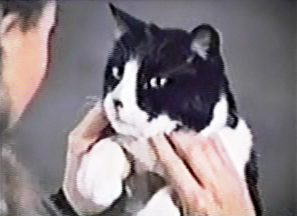
I can has Evoland?
The third episode introduces the final member of the party, Willaway, “a rebel scientist” (played by the inimitable Roddy McDowall).  Rather than the Bermuda Triangle, Willaway was lost in the Devil's Sea (another of Ivan Sanderson's vile vortices).  Actually, Willaway is the villain of the episode.  Instead of trying to find a way back to his own time (1963), Willaway has set himself up as the ruler of a time zone and surrounded himself with servile androids.  With regard to interacting with genuine humans, Willaway states, “Society and I do seem to have our problems.”  Also problematic is the fact that the androids belong to an alien community.  By taking over their androids, Willaway caused the community to flee to the swamps.  By the end of the episode, Willaway is deposed and the aliens occupy their rightful place.  Varian invites Willaway to join the party, introducing an interesting dynamic to the team.  When Willaway asks why, Varian reminds him he's from the future and says, “I know more about you than you do.”  Not to slight the capable performances of Eisenmann and Franklin, it was McDowall who made the series memorable.

What was my point?  Oh yes, The Fantastic Journey as a role-playing campaign.  In the show, party composition could easily change from episode to episode, similar to a campaign with an inconstant player roster.  Aside from a 'new' setting from week to week, there is the big picture to consider.  Do people appear in the time zones through random chance or is there some overarching logic at work?  “Evoland” suggests evolution.  Perhaps people are brought into the time zones for some grand purpose (or to serve penance, such as the case with Marcus Apollonius in the episode “Funhouse”).  Perhaps people are taken to the time zones to be tested and/or to improve themselves.  Perhaps Evoland is not just a location, but a state of being.  One one occasion, a red cloud envelopes and transports the party.  Perhaps there are clouds of different colors working at cross purposes.  In the surreal episode “Riddles,” the party encounters one of the mysterious “riders” that help guide travellers to Evoland.  There must be some organization, some intelligence that sustains the riders.

Sunday, January 10, 2016

The High School Role-Playing Game


Escapism is a primary attraction of role-playing games; however, Alma Mater bucks that trend, offering as a setting which is neither a fantastic realm of elves and dragons nor a far-flung star empire.  Instead, the game takes place “in North American high schools.”  'North American' is a key term; the game was developed and published in Canada.  The authors, Steve Davis and Andrew Warden, have no other gaming credits.  The publisher, Oracle Games, has no other gaming credits.  One of the illustrators, Owen Oulten, has no other gaming credit, but Erol Otus is the other listed artist.  Otus' art is distinctive and is especially creepy when depicting 'real world' scenes such as those in Alma Mater.  In fact, according to Lawrence Schick in his Heroic Worlds, Otus' art was “in such poor taste that the game was actually banned at GenCon!”  The authors, cognizant of the explicit nature of the art, urge that readers “not be shocked by the illustrations” and reminds of the back cover warning, “this is a game which deals with a mature subject area.”

Schick categorizes Alma Mater as a 'humor' system.  While it is certainly a difficult game to categorize, 'humor' may not be entirely appropriate.  Schick states, “Humor games tend to have loose systems,” yet Alma Mater 's system is rather detailed.  In the opinion of the authors, “The game is generally meant to be realistic, balanced with fun and excitement.”  Additionally, “We have tried to devise a game that simulates the modern high school student...”

The authors comment on their inspirations in the Acknowledgements:
In the creation of this game we used many sources of information.  We would like to thank movies like American Grafitti (sic), Animal House, Grease, Meatballs, and Prom Night as well as the television show The White Shadow, not to mention all of the students in North American schools who raised enough hell to make this game what it is.
The first printing of Alma Mater was in 1982, meaning that it predates the various John Hughes teen flicks.  Also, it was released a little too early to be influenced by Fast Times at Ridgemont High, the Porky's franchise, or the Square Pegs television series.  If the game failed to develop a following among the RPG community, it wasn't due to a paucity of genre-related media.

“The object of the game,” the Introduction tells us, “is to attain as much Social, Academic, and General Success as possible by playing a character through four years of high school.”  Unlike most games, there is a winner in Alma Mater :  “the character with the highest score is the winner.”

Page 42 has the following admonition:  “IMPORTANT:  Do not forget to roll for encounters for every class period or once every five minutes outside of the classroom...in addition to the encounters described in the day plan.”  The implication is that game time should be played out in considerable detail.  Playing four years worth of that level of detail is a formidable prospect.  Page 35 states that...
...the game demands a great deal of creativity on the parts of the players and the SchoolMaster.  If neither uses his imagination to enliven the situations, the game will quickly become like real school – DULL!
Note that the official title of the Game Master is “SchoolMaster.”

Success, of course, is measured by the standards of teen-agers and is quantified (as one might expect) in terms of 'points'.  Social Success is the same thing as popularity.  It can be accumulated by:  throwing parties, being invited to parties, gaining positions (“such as a club president or student representative”), participating in sports, winning sports awards, dancing, gaining a friend or lover, helping others, and being intoxicated.  Flirting, dating, and seduction grant points when successful, but cost points when unsuccessful.  Points are lost by being humiliated, being raped, perpetrating rape, becoming pregnant, causing pregnancy, and killing people.  The winner of a fight gets points while the loser (aptly enough) loses points.  Regardless of who wins or loses, the person who started the fight loses points and the other character gains points.  Also regardless of who wins or loses a fight, the more popular opponent gains points while the other loses points.  Characters only gain (or lose) Social Success if the causative circumstances are “publicly known.”

Academic Success is gained through grades and academic awards.

General Success is defined as “success that is neither social or academic.”  Given the definition, it seems appropriately named; however, General Success is earned only through illegal gains (“such as selling drugs”), stealing, and vandalism.  Furthermore, except for two character classes, General Success is subtracted from Social Success, meaning there is a net gain of zero points.

“Although Alma Mater was written with a modern American high school in mind,” the rules comment on variants:  different areas (“including countries – imagine Alma Mater in the U.S.S.R.”), different periods (“the 50's are a good example, but the '60s and '70s are also possible”), and different institutions (“private, elementary, or even university”).  The game designers do not recommend mixing Alma Mater “with other role-playing games” in terms of an entire campaign, but they make allowances for a one-time event (“it can be done, but it's gross!”).

Thursday, December 31, 2015

Mysterious Island


This year marks the 150th anniversary of a remarkable event that occurred here in Richmond.  Now, this last day of 2015 affords me a final opportunity to commemorate the anniversary and atone for my procrastination.  The event was simply the ascension of a balloon carrying five passengers. The remarkable aspects of the event arise from the circumstances of the voyage and the ensuing adventure of the passengers – an adventure so fantastic, so incredible that the world can only regard it as fiction.

These exploits were dramatized by Jules Verne in his L'Île mystérieuse (first published in 1874).  I use the word “dramatized” because Verne was more interested in telling a story instead of relating a factual account.  As is often the case in his works, Verne sacrificed accuracy for the sake of literary style.  Not that I blame him; if the final result would be labeled as fiction regardless, he might as well “improve” the story.  Of course, Verne was not responsible for all deviations from the truth; some changes were necessary for legal reasons and others were imposed by editors.

The balloon passengers were Cyrus Harding Smith, Captain of the Union Army, and his associates – Gideon Spillet, Boniface Pencross, Herbert Dunn, and the “servant,” Neb.  Please note that personal names were not immune to alteration in Verne’s narrative.  Verne also added a dog.  Anyway, in March of 1865, Captain Smith and company appropriated a military balloon to escape from Richmond.  Due to inclement weather, they had no practical control of the balloon.  As a result, they eventually arrive at a mysterious island.  Here we see  a profound departure from reality on Verne’s part.  Verne’s description of the weather is thus:
Few can possibly have forgotten the terrible storm from the northeast, in the middle of the equinox of that year. The tempest raged without intermission from the 18th to the 26th of March. Its ravages were terrible in America, Europe, and Asia, covering a distance of eighteen hundred miles, and extending obliquely to the equator from the thirty-fifth north parallel to the fortieth south parallel. Towns were overthrown, forests uprooted, coasts devastated by the mountains of water which were precipitated on them, vessels cast on the shore, which the published accounts numbered by hundreds, whole districts leveled by waterspouts which destroyed everything they passed over, several thousand people crushed on land or drowned at sea; such were the traces of its fury, left by this devastating tempest.
In essence, Verne presents a phenomenal storm that lasts more than week, afflicts three continents, and causes inestimable property damage.  This is a case of exaggeration.  In reality, the weather was not quite so dramatic.  Regarding March 1865, Robert K. Krick provides the following information in his Civil War Weather in Virginia :
Richmond’s residents saw a “splendid rainbow” on the night of March 15. The next night “a violent southeast gale prevailed . . . with rain.” Bright sun tempered winds still blowing through Richmond on the 18th, but the dawn of the 19th reminded a diarist of spring in the Garden of Eden. Warm and pleasant weather continued into the 21st, when blossoms appeared on apricot trees.
I had not realized that former residents of Eden were living in Richmond during the Civil War.  Perhaps the phrase “reminded . . . of” was meant to convey “inspired notions . . . of” rather than an actual recollection.  Regardless, Captain Smith and his companions likely ascended on the night of March 16 when there was a “southeast gale.”  In Verne’s version, the party leaves on March 20 and the storm is “from the northeast.”  Verne’s “aerial maelstrom” carries the balloon thousands of miles contrary to the jet stream in about seventy-two hours.  Verne must invoke such a preposterous storm because he chose to place the Mysterious Island in the Pacific.  I suppose there are many mysterious islands in the Pacific, but the Mysterious Island – the one where Captain Smith’s party found themselves – is in the Atlantic.  So why the switch in ocean?  I can’t answer for Verne, but I suspect the explanation (or at least a partial explanation) is that divulging factual information about something mysterious would tend to compromise the mysterious nature of said something.  Mysterious Island is mysterious for a reason and – to this day – the ‘powers-that-be’ have a vested interest in that reason and in maintaining the mystery.

You won’t find Mysterious Island via Google Earth.  Very few maps chart the island’s position and those that do are secreted in secure collections to which the public is not admitted.  A flat-out denial of the existence of Mysterious Island is not feasible, but it is easy enough to suggest that any given reference to it stems from fiction; thereby, the mystery is preserved.  I believe Mysterious Island’s official status (perhaps ‘official non-status’ is more apt) can be traced to an amendment to the Treaty of Tordesillas.  However, the only surviving copy of that amendment is in the Vatican’s Secret Archives; not the Secret Archives that everyone knows about, but the really Secret Archives.  Rumors that pre-human artifacts were found on the island (and that the Church wanted that knowledge suppressed) are unsubstantiated (yet not entirely disproved).

Eventually, Captain Smith and the others encounter Prince Dakkar (more commonly known as “Captain Nemo”), one of the most misunderstood figures of the 19th Century.  (Verne manages to depict him as both a misanthrope and a humanitarian.)  Once again, Verne’s account veers away from the actual circumstances. 

The events of Verne’s Vingt mille lieues sous les mers (published in 1870 but serialized starting in 1869) transpire after the Civil War.  When the story begins, the world is not yet acquainted with Prince Dakkar’s depredations.  However, in L'Île mystérieuse, the exploits of Prince Dakkar are well-known to Captain Smith and company even though they have been on the island since the conclusion of the war, ignorant of any subsequent world events.  In terms of storytelling, Verne didn’t want to weigh down the narrative with exposition from his earlier work.  Since the readers knew about Captain Nemo, then so should the protagonists.

In truth, Vingt mille lieues sous les mers (hereinafter Leagues) follows L'Île mystérieuse, not vice versa.  It was Gideon Spillet who ‘broke the news’ about Prince Dakkar to an astonished world.  Spillet accompanied Prince Dakkar during the events of Leagues and, since he was a journalist, he reported those events. Verne’s account is narrated from the point-of-view of his long-time friend Pierre Aronnax.  No mention was made of Spillet in Leagues due to a dispute over publication rights.  Spillet and Verne reconciled their differences by the time the latter wrote L'Île mystérieuse, so Spillet appears in that story.  Shortly after their reconcilement, Spillet met an untimely death.  However, Verne could not include Spillet in updated editions of Leagues because of complications with Spillet’s estate.  Those complications also prompted Verne to change the spelling of Gideon Spillet to the unabashedly French Gédeon Spilett.  American editions used the ‘Gideon’ spelling.

Prior to Prince Dakkar’s claim to the island, it had been used sporadically as a refuge for pirates (or, alternatively, a staging area for privateer activity).  In any event, I consider theories that conflate ‘Treasure Island’ with ‘Mysterious Island’ to be altogether fanciful.

The destruction of Mysterious Island in a fit of apoplectic volcanism is another of Verne’s inventions.  I guess it makes for a good story.  (SPOILER:  The dog survives!)  In reality, the island fared just as it had previously – largely unknown but occasionally called into some peculiar service.

During the Second World War, Mysterious Island was used as a base of operations by the Blackhawk Squadron.  This multi-national task force employed cutting-edge aviation technology against Axis threats, often of an outré variety.  During this time, Mysterious Island was known as Blackhawk Island.  Notwithstanding the legend of their comic book analogues, the Blackhawks disbanded shortly after the war.  Allegedly, this was done at Stalin’s insistence and was a source of contention at the Potsdam Conference.

Eventually, a colony was established on Mysterious Island.  Specifically, it was an involuntary retirement community for people possessing knowledge inimical to the status quo. Whether the island still hosts this colony is a matter of conjecture.  When inquiring about some things – such as the particulars of Mysterious Island – prudence should be exercised.  After all, questions are a burden to others; answers a prison for oneself.