50 YEARS AGO - February 1965
TALES OF SUSPENSE #62 (Marvel Comics)
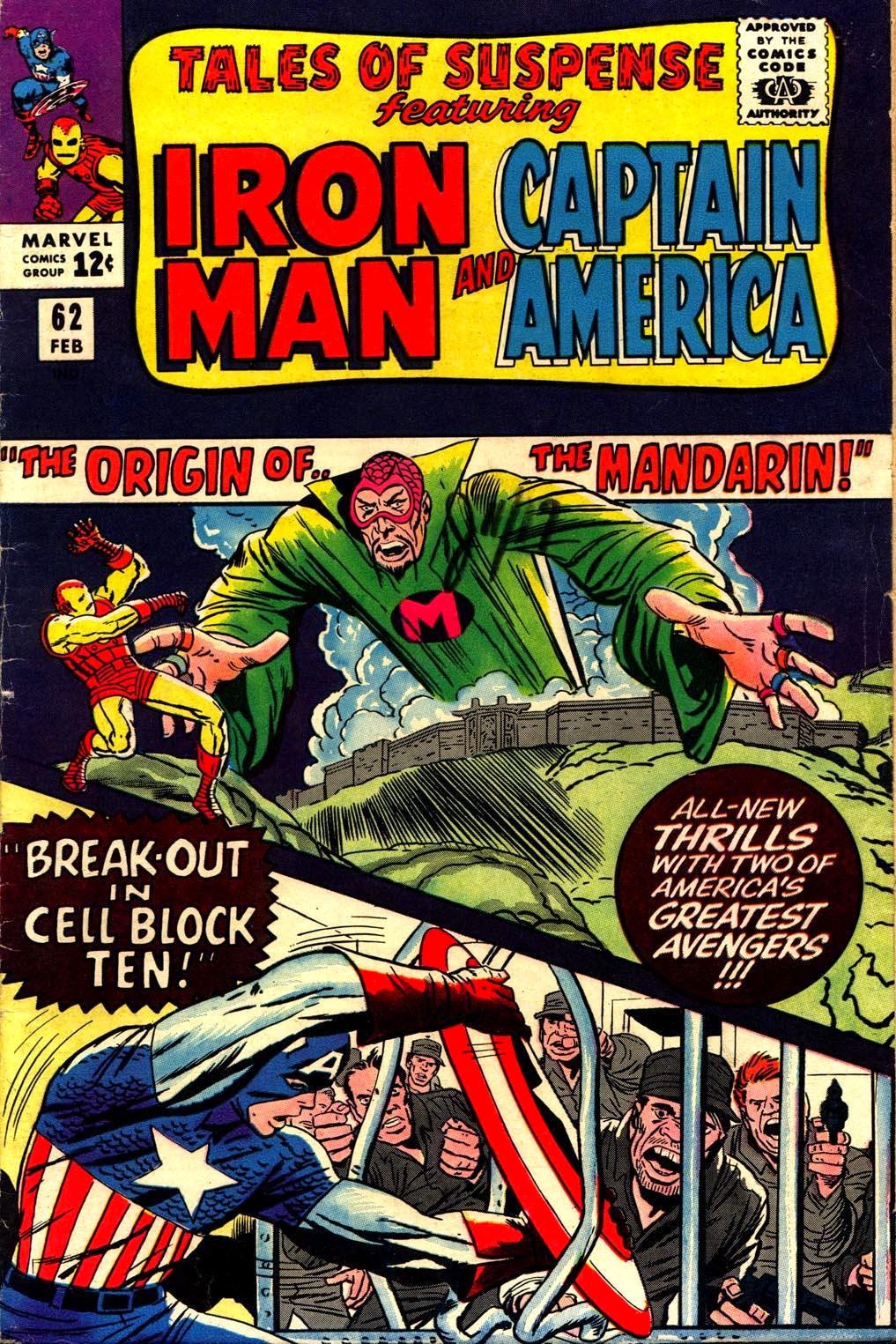 |
| Cover art by Jack Kirby |
"The Origin of the Mandarin"
By Stan Lee (w, e); Don Heck (p); Dick Ayers (i) & Sam Rosen (l)
Before he became a cinematic punching bag played by
Ben Kingsley (wha..?), the
Mandarin was
Iron Man's deadliest foe. A petty tyrant without title, a descendant of
Genghis Khan who stumbled upon ten rings of terrible power. This is the story that tells how the Mandarin found those rings and helped to establish the buck-toothed (as drawn by
Don Heck) post-WWII Asian stereotype as one of the top shelf villains in the nascent Marvel universe.
Stan Lee, in one of his famous and wonderful asides on the story's splashpage (in the Mighty Marvel Manner!) wrote: "Note: This tale was specially produced by mighty Marvel in answer to more than 500 requests for Mandy's origin!" Lee, Heck and company delivered and then some. Raised as a peasant, though of noble blood the young Mandarin travels to the dreaded Valley of Spirits against the dire warnings of his fellow peasants. His arrogance is already in fine form at such a young age: "Ignorant peasant! Know you that the Mandarin fears
nothing!" There he finds the fossilized remains of an ancient dragon.
Startled, the Mandarin falls into a thickly forested valley where he discovers an awesome secret. It turns out the dragon wasn't a dragon at all, but
Axon-Karr a
Makluan who came to earth centuries ago in a spaceship. Mandy discovers the ship was fueled by ... ten powerful and conveniently human sized rings. He quickly dons the rings and proceeds to conquer the peasantry in his village.
Stan Lee displays his unceasing sense of fun by pointing out the obvious when Iron Man says to himself: "First, there's the problem of
finding that
imitation Fu Manchu!" and then two panels later, "that's one of the hazards of being a lone-wolf type of adventurer! After a while, you begin to
talk to yourself!"
Stan Lee states it plainly: The Mandarin was the "yellow peril" embodied in a petty tyrant using advanced and unfamiliar technology to subjugate a complacent populace. This fear was borne of the cold war, the fear that foreign powers may surpass American weapons advancements secretly and under cover of iron curtained darkness to use them in a sneak attack.
It was a fear the British had felt some 50 years earlier and immortalized by British pulp author
Sax Rhomer in the form of the insidious
Dr. Fu Manchu. It's no coincidence that The Mandarin was invented and popularized at a time when the character of Fu Manchu was experiencing a resurgence in popularity of his own. In August of 1965
Hallam Productions (UK) and
Constantin Film (DE) would release
The Face of Fu Manchu, directed by
Don Sharp and starring the immortal
Christopher Lee in the titular role. The film was a mild success, but enough of one to spawn four sequels.
"Break-Out in Cell Block 10!"
By Stan Lee (w, e); Jack Kirby (p); Chic Stone (i) & Artie Simek (l)
In the second story, Captain America goes back in time to the same plot scenario from issue #60. It seems prolific production doesn't always lead to the most dynamic stories. As in issue #60, Cap thinks he's putting on a demonstration of his battle prowess, in this case for a prison warden. Little does he know he's really battling a cell block full of escaping prisoners, huh-ho!
"By the way," Cap says to the warden, "if I dind't know better, I'd swear these guns had been firing
live ammo!"
To his credit, Stan Lee,
did make mention of the similarities on the story's splash page: "Remember ish #60 when Cap thought he was giving a physical demonstration and didn't suspect he was really fighting a bunch of assassins? Well, some guys always learn the hard way!" If nothing else, it's proof of Stan Lee's method of writing during the "Marvel Age", that is, let the artist do all the work. If and when Lee caught them repeating themselves, point it out! With Lee's wry sense of observation, he could always make it look like the House of Ideas knew what it was doing. Really, Kirby was just drawing page after page of brawling because that's what he felt like doing. Stan Lee was famous for submitting plots to his artists that consisted of a single sentence on a post-it note: "Spider-Man fights Electro". It was up to Kirby or
Steve Ditko or Don Heck to create not just the pacing and layout but also the plot itself. Kirby and Ditko mastered the technique in seemingly never-ending epics that would stretch for a year or longer. In this early Captain America story (just the third solo segment starring the Star Spangled Avenger), Kirby's just enjoying himself and getting his legs under him. Just four issues later, he would re-introduce his own creation from the Golden Age, the
Red Skull and his new weapon, the
Cosmic Cube. Fans of the Marvel film universe will be familiar with this, no doubt.
WHAT ELSE WERE THE KIDS UP TO BACK THEN?
After reading this issue and having a good snicker, the comics loving youth of England no doubt hit up the local record store and noticed this long-playing gem:
THE ZOMBIES - BEGIN HERE
Representing the harder edge of the wimpier side of the British Invasion, there was a brief period that The Zombies enjoyed sustained chart action. This album was released at the crest of their wave. With "
Tell Her No" spinning incessantly on pop radio and reaching #6 on the Billboard chart,
Decca Records released The Zombies debut full-length album titled '
Begin Here'. Ironically, this was the beginning of the end for the group.
The album didn't fare as well as expected, hitting only #39 on Billboard's album charts, this at a time when 7" singles dominated record sales and albums were still seen as something of an overpriced novelty. It didn't register at all on the charts back home in the UK. There no telling today why that was. It's a great record, surprisingly tough in places for the normally silky-smooth quintet, while maintaining their signature pop sound. Essentially it gave record buying audiences what they might have come to expect by then: a mixed bag of cover songs and group compositions but it provides a solid listen from needle drop to run-off groove. Considering what the band and label might have expected given their success in the singles market, the album was a colossal flop.
The Zombies trucked on, releasing 10 more singles at home and abroad over the next two and a half years. All of them flopped, only one, "
I Want You Back Again" charted at #95 on Billboard. It was the first single release after the album and it was the last time the record buying public at large was caught thinking about them. The band broke up in late 1967.
But that's not the end of the story.
True to their name, The Zombies had a second life when new label
CBS Records posthumously released their second and final album, '
Odessey & Oracle', It's one of my all-time favorites, I recommend anybody with just an inkling for 1960's pop records should drop what they're doing and go listen to it. Anyway, The Zombies hadn't been a thing for over a year, but that didn't stop their newly released single "
Time of the Season" from rising, and rising, and rising in the charts all the way to #3, making it the second biggest hit single of their careers after "
She's Not There" which was famously covered by the band
Santana in the 1970's. [Sharp intake of breath] So in Spring of 1969 the band re-formed and released two more singles. Both of them flopped. The group disbanded and some of the members formed the progressively inclined
Argent, who you might remember from the song, "
Hold Your Head Up".
But in spite of all that, The Zombies's legacy is intact. "Time of the Season" is a classic, highly regarded in a wide-range of music circles, from classic rock fans to DJs, one of whom recently sampled the memorable bassline to score a hit pop single. The fact that the band's name so closely resembles the shape of their careers is skin-crawlingly eerie to me.
So, after the youth of Britain were finished devouring the latest imported issue of Tales of Suspense and utterly ignoring The Zombies new record, they found time to hit the cinema where they surely watched
Amicus Productions's Dr. Terror's House of Horror anthology film. And you can too, right here, right now. Enjoy and thanks for reading:
PS: don't mind the subtitles, the film is in English. It was directed by
Freddie Francis and stars
Christopher Lee and
Peter Cushing. You can find out more about it
at this location.