Followers

Showing posts with label Sepoys. Show all posts

Saturday, December 13, 2025

Sieges, Sowars and Sepoys-Basics


As previously mentioned I intend to do India 1857 inspired by David Louis Raybin's excellent Charge of the Light Brigade rules. 

I'm calling it Sieges, Sowars and Sepoys. This post is a marker for work that will appear next year.

New ideas often bring their own workload. I’m thinking here of rebasing. Charge of the Light Brigade rules (COTLB) is relaxed about basing. The key thing is to have the right number of figures per unit. I don’t see much rebasing coming my way consequent of Sieges, Sowars and Sepoys . Today I'm going to show you what I've done so far. Above main street in my Indian City.

As with my Crimean War Project I'm impressed by the visual impact units of this size make.

Here is the COTLB suggested basing.


Units of 24 infantry and 12 cavalry. But for the fact that most of my cavalry is already based like that I’d go for bases of 3. So, no basing issues.


I do need to expand my unit strength. Mostly I will cannibalise what I already have. No new big buys needed then. Except! I need a single based officer for each battalion. Do I have enough? We will find out.


I intend to work my way through my collection completing it to COTLB spec' regiment by regiment. At the end I will know what I need to buy if anything.


The pic's are of completed units so far.  The rest of my time has been spent in making a list of what I consider to be the defining characteristics of the combats of the period.  Of these there are two major grouping City Fighting and that on the battle field. We will consider both lists in due course. 


Let's finish with a true story from late in 1857. A Sikh Raja was holding a fort for the Great Moghul. He had been there for years. When the rebellion took hold he felt duty bound to declare for the Moghul. After that since there were no British near him he sat it out. There wasn't much to do.


Towards the end of the year the Rebellion was collapsing. The British sent an emissary. Where did the Raja stand? Would he surrender on Full Pardon? The Raja replied he would but there needed to be some finessing. The Raja wanted a British Force to threaten his fort and demand he surrender. He could then do so with honour having saved his subjects from the horrors of the sack. Those horrors were real enough and usually included massacre.


The deal was done. Everybody was happy. A force was despatched under a newly arrived British Officer. It was big enough to be taken seriously. News of the deal leaked to the British soldiers. The target fort was formidably fortified front and sides. The back though was not. Maybe the money ran out.


The Raja had intended that the British should surround him. Notice the weak back wall and demand surrender. All good.

Instead the British OC ordered an immediate frontal attack. He was obeyed. The Raja's soldiers were standing to. They opened up with steady fire. The British were repulsed with heavy losses. Night fell. In the darkness negotiations began. The Raja surrendered as agreed. The British OC was spirited out of the camp to prevent his murder by the outraged soldiery.


The fog of war is proverbial and the story illustrates it. What struck me was the effectiveness of traditional Indian soldiers with matchlocks behind cover. Optimum conditions granted, they had cover and the British had to come into range.  All the same. 

As far as I can ascertain the Raja's garrison was not Sepoys or Pathans or other Afghans. They were, I guess, the local warrior caste. As they were not privy to their Raja's diplomacy they did their best. It was enough.


Here we must note, Sieges, Sowars and Sepoys must make provision for more than  trained regular soldiers.  Sadhus, Ghazi and Wahabi have their place too. To them we must add the roaming bands of armed British Civilians.

Being a fan of JG Farrell's novel The Siege of Krishnapur I have always wanted a Residency for the table top. The Residency was where the British Resident or Collector Lived. The top local Colonial Official. Sarissa Precision have one. I might buy it.


Monday, January 8, 2024

India 1857 Musings


I found an interesting print of the war in India 1857.  A coloured lithograph from 'The Campaign in India 1857-58' and called "Mutinous Sepoys".  Points of interest include:

Two figures on the left wearing what looks like pale blue Company undress uniforms.  Are these artillery men or even dismounted cavalry men?

The red and green triangular flags in the background.  I have also seen images of these, often decorated, used as unit flags.

The red and green tack of the mounted soldier. Note too, he has been reading Captain Nolan and has ditched his unsuitable and restrictive Company uniform, kit and tack.  The poorly balanced and blunt British sword has been replaced with a sharp tulwar.  I recently read that for some units this had already been done officially as part of the learning from the Anglo-Sikh Wars.

One of the artillery men still wears his blue uniform coat.

The old Jemadar on his charpoy seems now in command.

As you can see it shows sepoys in a pre prepared position.  Presumably they are awaiting a British attack or besieging a British position.


It was enough revisit my paused Indian project above and below. 
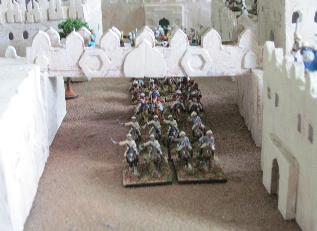
 

A good result all round as I have invested a fair bit in it.  Model cities are time consuming projects.


Some Irregular Miniatures sepoys above and below. I nearly did them 6 to a base but 4 seems to suffice.

Note the flag.  I needed some good Indian flags for the Bengal sepoys so I made some. They show Hindu deities.  Accurate?  Maybe, close enough I'd say.  Some units continued with their original HEIC Colours.   We will see them too.


I thought I'd do a bit more.  First, HM 5th Northumberland Regiment.  Figures from Dixon.


Madras Presidency 1st Regiment below. Dixon again.  Everyone does this one.  It's the blue caps.


The flags are from Adrian's Walls made by "Nevermore".  A talented guy, generous too, he used to offer them free.  Anyhow, they are a good buy, but you will need to scan and resize.  The reason being a slight discrepancy in flag sizes. Easy enough and something I do anyhow.  Then again, it may not bother you.


I have some ideas for rules for the period. Or at least the crucial command and control bit.  

It is a tricky conflict to get a handle on. W H Russell who had covered the Crimean War arrived for the second part of it.  He noted an irrationality on the part of some of his British interviewees.  This shows up in some of our sources.  

The Bengal Sepoys, Russell was told, were all cowards who ran and fanatics who would fight to the death.  His informants found no contradiction in this.

They were not "one of the manly races of India" yet their key role in fighting the Sikh War seems to have fuelled their decision to try to expel the British.  

They had apparently acted without reason.  However, we find their wages had been cut by half in spending power. Their privileged access to the Courts unilaterally curtailed. Their independent Princely State annexed. That might have had anyone reaching for their tulwar.

The wider Indian politics were complex too as befits a multi nation/confessional Sub Continent.  India is a big place and was bigger again back then.

Reading through the whole affair is a bit like trying to cut up water.  Some believe one thing, others another.


That said Amarpal Singh has now turned his attention to it. His newest book is called The Siege of Delhi.  As he is the scholar who clarified what much of what actually happened in the Anglo-Sikh Wars we might expect great things. Let us hope so. I'll likely do a review.  

I've already read Hibbert, Russell, Dalrymple and Murray and more on the subject.

Also, I picked up a copy of Saul David's The Indian Mutiny for the price of a glass beer.  More reading ahead.

Meantime I'll paint more units.  

I hope to bring you more as we go.  Next time though we are back to the Crimean War.


Wednesday, July 10, 2019

Getting The Sepoys Right


In 1857 huge numbers of Honourable East India Company (HEIC) Sepoys revolted against British rule, killed or drove off their British officers and set about establishing native rule.  This event has been generally known as the Indian Mutiny.  Latterly, it has attracted the appellation of the First War of Independence.  Neither the reasons for this seismic event or what to call it need detain us here.  I want to talk about Sepoys.

Sepoys were Indian recruits trained in British methods and using British equipment.  The Sepoy was usually from a moderately well-off background and might well come from a military family.  Soldiering in India was a respectable profession and the HEIC had its pick of physically suitable recruits.   

The anonymous Diary of a Sepoy makes clear a battalion of Sepoys fought just like any other British battalion.  That is to say a couple of volleys or so and then in with the bayonet.  As the author, somewhat smugly, tells us that was usually enough for any native enemies.  That the Diary is now assumed to be a fake written for propaganda purposes does not devalue its military evidence.  If it’s true, as seems likely, that the authors were British officers we can absolutely trust their description of how a British Sepoy battalion fought in India.


Mostly the Sepoys revolted by battalions rather than as individuals.  Consequently, all of their British commissioned officers being dead or fled, the most senior officer available to them was the elderly Subedar Major who was likely to be nearing the end of his service or those whose length of service had entitled them to the rank of Subedar (junior officer).  More actively the Havildar Major (Sergeant Major) could be expected to be in his prime.  There was no officer structure above this level unless the battalion attached itself to a native prince and recognised his/her authority.  

In the absence of any such higher authority the battalion itself decided how and when it would fight.  This meant they fought as a single battalion, rather than as part of a Brigade or Division.  In general engagements the disadvantages of this are obvious.  At it’s simplest if no appropriate Indian royal happened to be about there was no one to rally the battalion if it was discomforted.

That said the Sepoys lost none of their previous military skills.  Their shooting was as good  as it had been and their charge as fierce.  Their morale was generally good and sometimes as Russell tells us they fought to the last.  If the Havildar Major ordered a volley or a charge he was obeyed.


Let me add something important, Sepoy regular artillery nearly always outshot its British counterparts.   


Three fires to two was a common comment from British officers and the Sepoys were more accurate too.  It had been the same in the Sikh Wars.

All that said the Sepoys were not destined to prevail. There was often no chain of command when they fought.  Their armament was quickly revealed to be inadequate against the Minie Rifle equipped British.  The Sepoys knew this and attempted to counter it, once by rolling bales of cotton in front of them to cover their advance into Musket range. There was rarely a strategic plan and often no tactical one to direct their actions.

It seems to me that it's worth attempting to reflect the foregoing in gaming the period.  It would certainly give us more interesting games than simply saying Sepoys -2 for shooting, Melee and Morale.