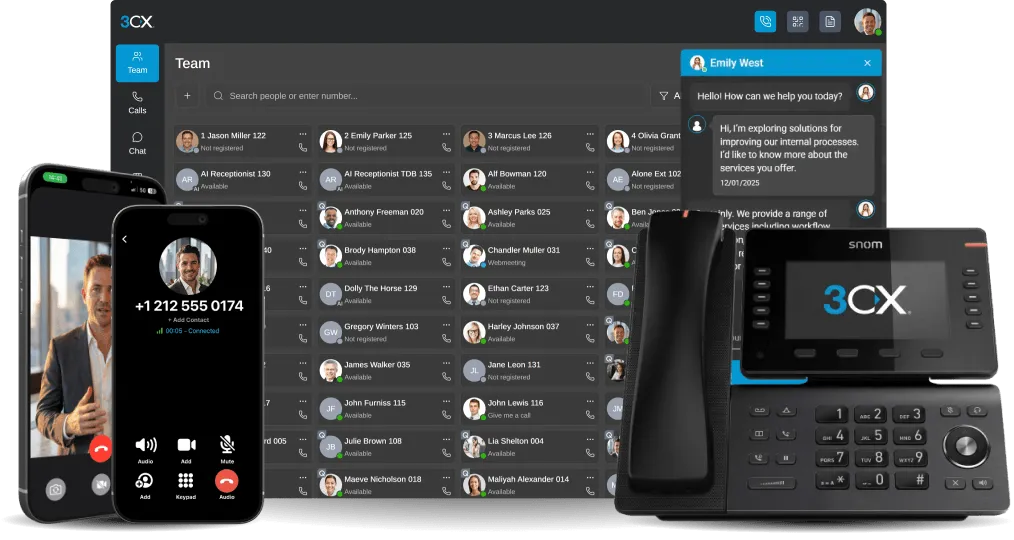
Traditional telephony is giving way to VoIP. Over the past two decades, internet-based calling has gradually replaced older phone systems for businesses around the world.
Voice and data no longer need separate networks. A VoIP PBX uses your existing IP network for calls, making your setup easier to manage, more efficient and simpler to scale.
Phone systems do much more than carry voice calls. As more providers move to IP telephony, businesses are switching to VoIP PBX systems for greater flexibility and features.
VoIP stands for Voice over Internet Protocol. It carries voice calls over IP-based networks rather than the traditional public telephone network, known as the PSTN.
FAQ Categories
VoIP & IP PBX Basics
IP PBX Features & Benefits
Cloud & Hosted PBX
Contact Center
Video Conferencing
Fax over VoIP
SIP & VoIP Phones
VoIP Protocols
Telephony Technology & Terms
VoIP & IP PBX Basics
IP PBX Features & Benefits
Cloud & Hosted PBX
Contact Center
Video Conferencing
Fax over VoIP
SIP & VoIP Phones
VoIP Protocols
Telephony Technology & Terms
VoIP & IP PBX Basics
Learn about VoIP gateways
A VoIP gateway bridges conventional telephone connections and an IP-based phone system, enabling calls between legacy equipment or networks and VoIP services.
PBX is a general term for a private business telephone exchange, while PABX emphasizes automated switching; in modern usage, the names are often interchangeable.
A STUN server helps an internet-connected device discover its public-facing IP address and port mapping when communicating through network address translation.
An Application Layer Gateway (ALG) inspects or modifies certain application traffic as it passes through a router or firewall; SIP ALG behavior can affect VoIP connectivity.
Primary Rate Interface (PRI) is an ISDN connection standard that carries multiple voice channels over a digital telephone circuit, often used with traditional business PBXs.
The Public Switched Telephone Network (PSTN) is the traditional interconnected telephone network used to route calls through public telephony infrastructure.
Voice over IP (VoIP) converts voice into digital packets and transmits calls over IP networks, including the internet, instead of relying solely on traditional phone lines.
An IP PBX manages calls over data networks, combining business calling features with easier scaling, administration, and potential cost savings compared with traditional systems.
An auto-attendant is an automated phone menu that greets callers and routes them to an extension, department, or queue without requiring a receptionist.
Automatic Call Distribution routes incoming calls among agents according to rules such as availability, skills, or queue order, helping contact centers manage call traffic.
Direct Inward Dialing (DID) assigns an external number to a person or department, allowing callers to reach it directly without passing through the main switchboard.
Intercom provides direct two-way communication, while paging broadcasts audio announcements to selected phones or groups, often used for internal coordination.
Interactive Voice Response (IVR) lets callers interact with a recorded menu using keypad input or speech so calls and inquiries can be handled or routed automatically.
Unified communications brings calling, messaging, meetings, and related collaboration tools together so teams can communicate through one connected system.
A hosted PBX runs on externally managed infrastructure, while an on-premise PBX runs on equipment maintained by the organization; each differs in control, maintenance, and cost.
A free cloud PBX option lets a business start with hosted calling and essential features without an initial software charge, subject to the provider's current plan limits.
A cloud contact center provides customer service tools, such as call distribution and multichannel communication, from hosted infrastructure accessible online.
A cloud PBX delivers business call handling from infrastructure hosted in the cloud, enabling remote administration and access through internet-connected devices.
What is a Hosted Phone System and how does it work?
A hosted phone system places core telephony functions on a remote server, allowing employees to make and receive business calls through connected phones or apps.
A virtual call center lets agents handle customer interactions from different locations through internet-based calling, call routing, and management tools.
A virtual PBX supplies phone system functions such as extensions, transfers, and call routing without requiring a traditional physical PBX at the business site.
Live chat gives website visitors a way to message a business in real time; the FAQ covers how it works and how organizations can use it for customer conversations.
This comparison explores call center software options and features to consider, such as call routing, agent tools, reporting, integrations, and deployment.
An omnichannel contact center connects customer conversations across channels so agents can retain context as customers move between phone, chat, and other touchpoints.
Hosting a webinar involves planning an online presentation, inviting attendees, setting up audio and video, and using meeting tools to deliver and manage the session.
Encryption turns communications data into a protected form so unauthorized parties cannot easily read it, improving privacy and security in online calls and meetings.
Desktop sharing allows a participant to show their computer desktop to others during an online meeting, making demonstrations and collaboration easier.
Screen sharing broadcasts a device's screen or selected application to other meeting participants for presentations, troubleshooting, and collaboration.
Secure Real-time Transport Protocol (SRTP) protects audio and video streams by providing encryption, authentication, and replay protection for real-time media.
Web conferencing lets people hold online meetings using audio, video, screen sharing, and other collaborative tools through internet-connected devices.
Remote desktop gives an authorized user access to another computer's screen and controls over a network, supporting remote assistance and administration.
Fax over VoIP can be sensitive to delay, packet loss, and audio compression, so supported gateways, codecs, and protocols such as T.38 can improve reliability.
VoIP phones can include physical IP desk phones, wireless models, and softphones, enabling calls over an IP connection rather than only traditional lines.
SIP trunks connect a business phone system to a telephony provider over IP, replacing or supplementing traditional telephone circuits for external calls.
Rich Communication Services (RCS) is an enhanced messaging standard that supports richer conversations, media, and interactive messaging features beyond basic SMS.
Real-time Transport Protocol (RTP) carries audio and video media streams across IP networks, typically working alongside signaling and control protocols.
Session Description Protocol (SDP) describes media session details, such as codecs, addresses, and ports, so communication endpoints can negotiate an audio or video session.
A codec encodes and decodes audio or video for transmission; different codecs balance bandwidth, compression efficiency, latency, and perceived media quality.
FXS ports supply the phone line signal to analog devices, while FXO ports connect to an existing analog telephone line, enabling integration with VoIP equipment.
Internet Protocol was originally designed for data networking. Once it became the global standard, it was adapted to carry voice calls over the same type of network too.
With VoIP, you can still use your existing phone lines. A VoIP gateway connects traditional PSTN lines to your VoIP system when you need extra reliability and availability.
A VoIP PBX makes it easier for employees to work from anywhere. It grows with your business, is simpler to manage than a traditional PBX and helps reduce administration costs.
3CX supports a wide range of hardware, so you aren't locked into one supplier or proprietary contracts. Explore our VoIP FAQs below for answers to common questions.