 Ginger Nutt's Christmas Circus (A Gaumont Animaland short, 1949)
Dir.: Bert Felstead
Cel Bloc Rating: 6/9
Ginger Nutt's Christmas Circus (A Gaumont Animaland short, 1949)
Dir.: Bert Felstead
Cel Bloc Rating: 6/9
It is time to go a little bit more obscure with our holiday cartoon selections. A few years ago, I posted a trio of other reviews for the Animaland cartoons produced by former Disney director David Hand when he left America in 1944 to start a new animation studio in Great Britain with Gaumont. There were only nine cartoons produced in the Animaland series overall, four of them featuring a squirrel character named Ginger Nutt.
The Animaland cartoons featured a wide variety of animals, with a few species having not been seen much in cartoons from other studios. Hand and his staff selected some characters slightly off the beaten path, though they did have oft-used creatures such as weasels, parrots, lions, cats, and of course, squirrels. But their first film, The Australian Platypus, not only featured a pair of those rather more obscure monotremes as the titular characters, but also gave a prominent role to another Australian pair, two wacky kookaburras, laughing like crazy throughout the short. In The Lion (Felis Leo), after some moments with a more commonplace elephant, we spend time with an African Cape Buffalo and its calf, a species which rarely gets encountered in cartoons.
Hand's more naturalistic approach to his animal films -- while the shorts were actually directed by Bert Felstead -- carried over from his time at Disney, where he made his name directing both Bambi and Snow White and the Seven Dwarfs. While the animals were anthropomorphized much in the Disney style to the greater degree in most of these Animaland shorts, once in a while Hand's team could get as wacky as something from Warner Bros. or Walter Lantz -- or at least try to get as wacky. In The Cuckoo, probably the strangest and darkest of the Animaland shorts, a truly unappealing lead character gets progressively more unappealing through the entire film, and pretty much ends up where he started.
 And in Ginger Nutt's Christmas Circus, they go for straight ahead slapstick. While the other three squirrel films -- Ginger Nutt's Bee-Bother, It's A Lovely Day (both 1949), and Ginger Nutt's Forest Dragon (1950, and the last Animaland film) -- rely more on the cuteness factor of its lead character and in establishing the animal community in which he lives, Christmas Circus shifts Ginger almost entirely to the background while numerous other characters -- in particular, a parrot and a weasel battling over entry to the circus Ginger runs -- get most of the camera time.
The film has a peaceful beginning, as we are shown a pleasant winter night with circus music beckoning in the background, as we see a sign pointing its way indeed "To the Circus". Birds swoop past the sign and over to a large evergreen shrouded by snow beneath a full moon, and we can make the shadowy outlines of forest citizens as they head towards the tree. We see numerous animals of many species piling through the door in the side of the tree, where a bright light shines from within. As the last of the animals enter, we can clearly see another sign reading "No Gate-Crashers".
A parrot named Boko congas his way, with accompanying music, through the snow on his way to the door, and he passes the sign without a thought. He disappears into the door, and then a split second later comes zipping uncontrollably back through the door at a high rate of speed. Boko smash hard into yet another sign stating, "Ticket Holders Only". Hanging upside-down by his feet, Boko slips into the snow below and then pops up out of it. He hears a noise off-camera, and shouts, "Rah! Here's the ticket!"


The camera cuts to Willie Weasel cutting a determined path through the snow, holding a red ticket out in front of him with one hand. When Willie reaches the circus, Boko is standing beneath a sign reading "Ticket Collector". There is an arrow underneath it pointing right, so Boko spins the arrow until it points down at his head. The weasel walks up to the parrot, who asks, "Ticket please?" Willie hands it unthinkingly to Boko, who inspects it and says, "Hmm... nice seat you've got!" Willie then traipses unknowingly into the circus without his ticket, and Boko runs over the poor weasel in order to get to the actual ticket booth inside before him.
 A lovely lady squirrel named Hazel, who happens to be Ginger Nutt's girlfriend, takes the ticket from the devious Boko, but when Willie walks up to her counter without one, she puts on the sternest countenance possible from someone running a circus inside a fir tree. "Ginger! Ginger!" she yells. "He's a gate crasher! Throw 'im out!" (It should be pointed out that most of the creatures have British accents. It's not all that important, but when one is used to seeing so many American cartoons, it is very noticeable.) From inside the tree, we see flashes of light and the sounds of a good deal of unseen violence, and then Willie comes flying uncontrollably out of the tree just as Boko did previously. The weasel smashes into the "Ticket Holders Only" sign, causing it to spin around several times. When it stops revolving, Willie is seen with his head and hands sticking through the sign as if he were being punished in stocks.
 A transitional wipe takes us back inside the circus, where Boko is seated amongst a large group of other birds. He pulls out a balloon and pops it, sending all of the birds scattering away, leaving him alone happily in the seating section, which naturally is comprised of tree branches, and therefore, for the birds.
 Circus fanfare plays. Ginger Nutt is seen acting as ringmaster upon a platform, and a parade begins to march into the center ring. An owl acts as parade marshall, followed by a tall, thin, Father Christmas figure with a human face. A small bird carries a bass drum several sizes too big for him, and just behind is the Cuckoo bird (mentioned earlier in regards to another film), who has about a dozen instruments strapped to his limbs and serves as a one-man band. The small bird can't see where he is going as he bangs his giant drum, and he tumbles and falls through drum. His clumsiness makes him land upon the train of Father Christmas' coat, and pulls it off his body. That "body" is revealed to be two creatures: a rabbit -- namely, Loopy Hare -- who is walking on his hands in a pair of boots while using his feet to hold up a mole named Dusty, who was wearing a human mask all along. Dusty Mole rushes back to angrily collect the Santa costume, and then puts it back on as he stomps out of the circus ring, much, much shorter than before.


 Meanwhile, Willie Weasel is attempting to get back inside the circus he should rightfully be attending. He sneaks up to a knothole in the big tree seemingly to peer inside, but then he squeezes his skinny head and streamlined body right through the small knothole. Boko sees him right way, and warns Ginger, "Hey, Professor! Look! A gate crasher! He's got no ticket! Throw him out! Throw him out!" Ginger turns to look with a scowl on his face, puffs up his chest, and heads towards Willie. We then see a repeat from outside of the crashing and noises that accompanied Willie the first time he was thrown out, but this time, he is sent flying towards a gate outside. He goes hard right feet-first through the door of the gate, but then is mystified how in the aftermath the door shows two holes where his feet went through, when the momentum of his body should have created just a single hole.
 Inside the circus, Dusty Mole pops up wearing a clown hat from out of the ground, holding a sign that reads "Kobber & Kate - The Kookaburras". Kobber and Kate roll into the ring on a pair of unicycles, laughing non-stop as they start to perform their tricks. A large clown hat drops down out of the sky and lands over the top of Kate. Kobber lifts it up, and Kate is seen taking a bath in the tiniest tub ever seen. The clown hat comes back down and is lifted a second time. Kate is now playing a tiny piano very quickly. A third time, and Kate sits laughing on top of a large pile of fruit eating a sundae.
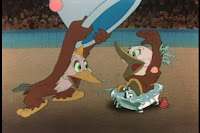

Kobber rings a bell on the hat, and Kate comes out through a door in the side. She runs around the hat, leaving Kobber to run inside the hat to disappear. She lifts the hat, and is confronted with a smaller hat. She lifts that, and a third, then a fourth, fifth, sixth, and seventh hat are each revealed. The seventh very diminutive hat spins around on the ground in circles, and when Kate lifts it, Kobber is now several sizes smaller than he used to be. He laughs crazily on an equally small unicycle and speeds around her. The unicycle cuts a hole in the ground, and then Kate falls through it to complete the routine.

Chester the Cat is presented as the next act, and the feline spins his way to the top of an extremely tall, striped pole, where he begins a high-wire act perched atop a red and yellow ball. He rolls out onto the wire easily, and yawns as he appears bored by his own act. Down below, Boko decides to cause more trouble, and starts to bark loudly. The cat freaks out, starts running wildly on top of the ball, and then falls hard to the ground, crawling out of the hole his body creates. The ball then hits him on the head and shoots sideways, and he falls back inside the hole. The ball continues to rocket out of the door to the circus, hitting Willie Weasel in the stomach and knocking him into another tree, where he ends up balancing himself upon the ball on a branch before falling down to earth.
 Zimmy Lion and Oscar Ostrich are announced by the mole as the next act, and they perform a variation on the old lion tamer routine. With Zimmy sitting inside a cage whipping his tail, Oscar enters the cage as Zimmy holds the door. Zimmy slams the door shut, but it falls off its hinges and onto the ground. The little ostrich is not thrown by this and continues his act. Oscar silently and "bravely" motions for the lion to open his mouth. Zimmy complies, and starts to put his mouth over the ostrich's head. It is quite noticeable that the lion appears to be lacking any teeth. Boko goes ballistic. "It's a fake! A swindle! I want my money back! I bet he's got no teeth!" "Indeed, I have!" says the lion, "Two!" The parrot demands that the lion show them, Zimmy sticks out two non-pointy teeth to the crowd. "Indeed he has two!" responds Boko, adding "Has two! Two two! Get it?" He chuckles, and again says, "Get it?" (Nope, Boko, I really don't.)
 One more act's name appears on a sign held by Dusty Mole: "Digger and Dinkum, the Platypusses" [sic]. Dinkum, the girl platypus, hits red and green balls with her tail down low, while Digger, the boy, hits them back to her with his tail while balanced on his hands. [I say hands instead of paws when discussing animal cartoons, unless the animal in question is clearly using his appendages in a natural manner.] Boko continues to be a jackass out in the crowd, screeching, "Platypuses? Platypuses? Pussies! Ack! They don't look like cats to me! Pussies! Cats! Get it!" He laughs once again, but Digger is not happy with the bird's annoying outbursts. Digger smacks several balls in Boko's directions, but the parrot ducks, and the balls each hit Willie Weasel, who was sneaking up on Boko, square in the face over and over. He stumbles backwards back outside the circus tree. Finally, the last red ball smacks Boko in the face, sending him spinning on his branch.


 The big finale is next. Most of the performers are balanced atop the ears and arms of Loopy Hare, who himself teeters on a unicycle. While Boko watches, he is unaware that Willie Weasel has returned. Willie grabs Boko, but the bird slips out of his feathers like it was a suit, and they remain in Willie's grasp as the now naked and pink parrot runs across the circus ring. He crashes into Loopy, sending all of the performers sprawling onto the ground, and Boko comes out riding the unicycle away. Ginger Nutt is even angrier now, and he heads towards Boko with his whip. Boko changes direction and crashes through the side of the tree, leaving a hole in his shape, but then rolls back through backwards as Willie stomps slowly towards him.

Willie chases Boko, and when he tries to grab the bird, he ends up taking the unicycle from Boko instead. Riding it now, the weasel continues to chase the parrot, and they zoom right past a massive cannon in front of a sign that reads, "Corny the Cannonball Crow". Corny himself stands next to the cannon, his mouth agape, and holding a match he was about to light for his act. Boko hides inside the cannon, and then comes out the other end to pull the now lit match down upon the fuse. Boko then returns and pulls the safety helmet from Corny's head and puts it on his own. Willie ducks inside the cannon to find Boko, but then there is a huge explosion!
 The pair of miscreants fly out through a hole created between the snow-covered branches of the giant circus tree, and they land softly on the snowy ground beyond. They come up ready for fisticuffs, but then Dusty Mole, wearing his Father Christmas outfit, pops up with a sign reading "Peace on Earth" in a fancy typeface. He grabs a hand from each creature and clasps them together. Willie and Boko decide to let bygones be bygones in the Christmas season, and smile and shake hands as bells are heard chiming on the soundtrack. When the mole ducks back down into the ground, Willie grabs the "Peace on Earth" sign and justly smashes it over Boko's head. Boko sees stars spinning around his head, and then the pair are caught within an "iris out" as Willie looks like he is about to land on Boko to continue the beating.
This is the second most violent of the Animaland cartoons, though The Cuckoo, the most outwardly violent, is far, far darker. And, apart from The Cuckoo, the expanded violence doesn't really fit this generally quite gentle series very well. The gags in Christmas Circus are never really all that funny (a couple are amusing), though the pacing does well to impart the sense of slowly building pressure to the climax. The animation, too, is well-turned, and I especially appreciate the detailed backgrounds and use of color. (These were the common high marks of the series throughout its brief run.) Of the individual scenes, while several characters are appealing, the kookaburras come off the best. Their clown act works very well, and would not be out of place in a Woody Woodpecker cartoon. For the most part, a first watch of this short can convince the viewer they are seeing a lost classic of sorts. I had that feeling myself when I first saw it a few years ago.
 But there are just far too many characters here crammed into one seven-minute short. Practically every character that appears in the Animaland series (though not quite all) is given screen time in this film. Most of the circus performers have their own films or are supporting characters in the Ginger Nutt films as a whole. As for Mr. Nutt, he gets totally lost in a short bearing his own name, appearing only when he needs to seem angry or leading into the circus. His girlfriend Hazel only has the one scene near the beginning, and the rest of the film is left up to the other characters. This points to how one-dimensional Ginger Nutt is in general -- he is never given much to do beyond act tough or to romance his girl in his films -- and so that he gets lost here is no surprise; it's just disappointing. It almost seems like Hand and his staff had no real faith in the character, though he was apparently merchandised by the copyright holders long after Mr. Hand had departed Gaumont (and animation at that).
 As for the Christmas connection, this is another short (as in Broken Toys) that only sneaks in the holiday right at the tail end of the story. Yes, the atmosphere is all wintery loveliness. The circus itself takes place inside a huge evergreen tree. But that is about it for setting a holiday mood (apart from the appearance of the Father Christmas costume) up until the mole pops out of the snow at the end of the picture to remind Willie and Boko of how brotherhood should be upheld. I guess if Animaland were really the province of just cutesy, family friendly characters, that might have been the end of it.
But then there is that wallop with the sign. Maybe just a few films in, the Gaumont animators were looking to expand beyond the simple animal stories and mix things up a bit. If so, I have to admire their gumption, even if they did it inside just another simple animal story. It is also the one moment where Christmas Circus does succeed in the more manic humor Hand and company are attempting elsewhere throughout the cartoon.
 It is also sort of the way this Christmas season feels to me. I am trying really hard to be involved in the festivities -- even knocking out post after post about Christmas cartoons -- but with everything going on in the world, the fact that I am still unemployed after nine months, and now trying to set up my own freelance business -- my head is spinning constantly. I am not in the best place in my head, and I tend to hide my true feelings to the faces that I see every day at home. On top of this, we have three Christmas trees in the house (the one Jen and I used everywhere on our own, and two that belong to Jen's mom). The house has been lightly decorated outside, but our neighbors are going full force with the over-the-top light displays and the generator-driven character balloons. The holiday season just pounds away at you, trying in a passive-aggressive way to force you to be as cheerful and joyful as everyone else is pretending to be.
It feels exactly like someone has smashed a "Peace on Earth" sign over my head. "You will be happy... or else!" It's the "Or else what?" that always pisses them off. And now they are coming in for the kill.
RTJ
*****
And in case you haven't seen it...