Pages

Showing posts with label moon. Show all posts

Thursday, October 19, 2006

Countdown to Halloween: Boo Moon (1954)

Boo Moon (Paramount/Famous Studios, 1954)
Dir: Seymour Kneitel
Cel Bloc Rating: 5/9

Paramount and Famous Studios jumped onto the 3D bandwagon in the early 1950s, as a great many studios and independent producers were quick to do as they searched for that always elusive, cinematic pot of gold. Taking their two most popular characters, the studio produced a pair of extra-dimensional cartoons in 1953; both, not coincidentally, were set in outer space (because, apparently, at least to movie producers, 3D is instantly identifiable with science-fictional settings): Popeye, the Ace of Space, with the spinach-popping sailor, and Casper the Friendly Ghost in Boo Moon, released into theatres on New Year's Day, 1954.

Apart from his non-stop, whiny search for friends, Boo Moon almost completely does away with the Casper formula: there is no crying for attention, and except for two opening scares on Earth, Casper doesn't go through the usual parade of possible friends turned horrified recipients of Casper's ghostliness. After frightening everyone out of the subway, the producers decide to give us a first taste of 3D thrills, and have Casper flight straight at the screen slowly. Just as his giant smiling face fills up most of the frame, Casper disappears.

Casper happens upon a salesman working the street with a telescope by selling views of the "Wonders of the Moon" for 10 cents a peek. At first, the salesman thinks Casper is just any other little boy, but a second glance has him leap up and then smash himself down into his shoes, while pulling his hat down on top of himself. The salesman then leaps towards the camera as Casper did before, and we see the large sole of his left shoe as he leaps out of frame. A frowning Casper peers through the telescope and sees the Man in the Moon smiling at him. From this brief slice of evidence only, and always desperate for a friend, Casper reasons that the moon seems to be a friendly place. The friendly little ghost undertakes a long, solo flight through space, using just his ghostly powers, to meet the Man in the Moon himself.

When he arrives, Casper is disappointed to find "nothing but rocks and holes," and his long journey has left him weary. Casper stretches, yawns, and lies down to sleep. As he does, tiny Moon People crawl out of the craters, declare Casper to be "a monster" and cage him on a wagon to bring him back to their Moon King. This visual allusion to Gulliver's Travels is incredibly apt, as it turns out, because the Moon King Luna, is played by none other than King Bomba himself from the Fleischer Studios feature-film adaptation of the Swift classic. It is not entirely apt, however, since Bomba played the king of Lilliput's rival, Blefuscu. (Fleischer Studios was notoriously bilked out of existence by Paramount/Famous Studios in 1942, and Paramount kept the film rights to all previously-owned Fleischer properties, including Popeye and their original Gulliver's Travels characters.) Essentially playing the same character, only facing a giant white ghost kid instead of a giant white man, Bomba/Luna is not pleased with Casper, and orders "the monster" to be sent away to the royal dungeons.

Conveniently for Casper (though he could fly out of the cage at any time owing to his non-corporeal form), the Moon Kingdom is attacked by large and vicious Tree Men, who are apparently pissed off about being on the moon when the casting call for The Wizard of Oz took place or something or other, and a violent battle commences. The diminutive Moon Soldiers launch large (or rather, small) balls of fire at a pair of the Tree Men: one is burned through the middle, and runs off pulling his two separated sections together; the other is burnt to about the width of a very tall blackened toothpick, and after his eyes pop open telling us he is still alive (no actual death apart from Casper in these cartoons), the charred stick hurries off in fear.
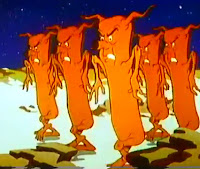
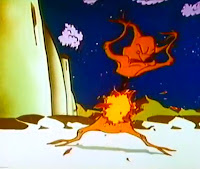

But the Tree Men won't be stopped. They run to a crater filled with water and suck up the liquid through their branches that serve as noses. The Tree Men squirt the water back at the castle and put out the fires creating the Moon People's only defense. The Tree Men finally break through the gates of the walled city and capture King Bomba/Luna. Casper finally gets in on the hero action, materializing through the ground of the moon, and pulling two roots of each tree under with him and tying them in bows, thereby literally rooting each tree in place. The Moon Kingdom is saved! 
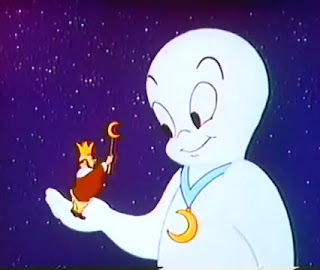
No longer afraid of him, King Bomba/Luna stands on Casper's palm and awards him with a medal and the title of "Sir Friend Casper." Even though he has finally made a large group of friend that trust him, Casper decides to take off to return to Earth, and as he leaves, the Man in the Moon winks at the audience.

Of course, we will never see these "Friends of Casper" again, just as we never see any of Casper's friends again when the next formulaic cartoon rolls around. Until Spooky and Wendy show up, that is. I have two theories:

1) Casper is actually a ghost who befriends and then murders these new "friends" in the space between each film. He is unable to retain any memory of having met or killing these friends; thus, his slate is wiped clean at the beginning of each film, and the repetitious cycle of each Casper film begins anew. Casper is a serial friend killer from beyond the grave.

2) Somewhere there is a Hollywood chapter of the Friends of Casper Anonymous, where abandoned "friends" of the "love 'em and leave 'em" spook meet confidentially to work through their anger issues over Casper. There is Bonnie and Johnny, Dudley Duckling, Wheezy the Elephant, and the ghost of little Ferdie Fox; every couple weeks a rocket lands and King Luna and the Moon People arrive to join in the group hate session, and Luna details an attack plan on whatever haunted house Casper is holed up in that week. The meetings always fall apart when it is decided that Casper is hardly worthy of such attention and rage, but they all agree wholeheartedly that only a truly pathetic individual would spend even a day discussing the life and crimes of a middling cartoon character, let alone five days in a row.

Oh, I think they must be talking about me.


And in case you haven't seen it...


[Editor's note: The text and photos for this article were updated on 12/9/2015.]

Thursday, April 20, 2006

Dancing on the Moon (1935)

Dancing on the Moon (A Max Fleischer Color Classic, 1935) 
Dir.: Max Fleischer
Animators: Roland Crandall; Seymour Kneitel
Cel Bloc Rating: 8/9

There are shots in Dancing On the Moon alone that make the entire Max Fleischer Color Classics series worthwhile. Long revered by cartoon fans for their unique visual depth, but top loaded with overly sentimental pap and cutesy pie characters, the Fleischers’ desire to match Disney's Silly Symphonies led to stagnation in the story department, and there are very few films in the series that actually approach the self-described "Classics" label. But everyone has their favorites in the series; I can quickly name three that I have adored for years, not so much because they are technically perfect cartoons in all categories, but merely because they are terrific (sometimes scary) fun and have held up for me over the years: Cobweb Hotel, Small Fry, and the 1935 film I am discussing here, Dancing on the Moon.


And as I said, there are shots that sum up that magical genre of science-fiction fantasy equally as well as any major film in the same genre. I'm not speaking of the “science” in so-called “science fiction”; I am talking about the fiction part: that dreamlike fantasy element that makes us eager to journey with Flash Gordon in his wobbling tin ship to battle evil galactic emperors; that causes us to wish we could leap a half mile into the clouds like John Carter on Barsoom; and which makes us long to catch a rocket and fly to the moon, just like the honeymooning couples in this film. Maybe Georges Méliès got to the place first cinematically in Le Voyage dans la Lune (A Voyage to the Moon) in 1902, but I have long felt that several of the scenes in Dancing are equally as memorable, if not also equally unlikely in conception.


The very first shot in the film is one of those memorable images. It is not a drawing of a rocketship, but rather one of the Fleischer Studio's ingeniously constructed three-dimensional props, which is mounted on a ramp pointing towards the skies. It is a dark and beautiful moonlit night, which is a good thing, since the moon is exactly where this rocket is heading, and it is supremely fortuitous to have a destination with itself as guide. The rocket is exactly the sort of vehicle one should wish to have for a trip like this, not that it could actually make it to the moon in reality, but, because this is a fantasy journey, it is the space-fantasy ideal of a Luna-bound rocketship. It is therefore perfectly suited to take the romantic-minded there, as well.


While the ship is festooned with signs offering a "Honeymoon Express to the Moon" and "Tonight - Dancing on the Moon - One Dollar Per Couple,” the leonine pilot, resplendent in captain's hat and coat, steps out of the side-hatch and sings his pitch to the couples with voice a-roaring and delightfully (like much of the singing in this film) off-key:

"Dancing on the Moon,
Your girl in your arms!
Far away from all the crowds,
Up above the silvery clouds!”

Then a line made up of willing couples strolls along toward the ship, gaily sing the second verse:

“Dancing on the Moon
With you in my arms!
Flying through the little stars,
Venus, Jupiter and Mars!"

The bridge to the song arrives courtesy of a recently wed bovine couple, who clutch each other lovingly as they croon:

"We'll soon be on the milky way,
Please don't hesitate
To close your eyes and sway
We're going to the pearly gates!"


A pair of adorably rotund penguins waddle up to finish the tune:

"Dancing on the Moon,
With you in my arms!
And our hearts will hum a tune
When we're dancing on the moon!"

Captain Lion greets each couple as they enter the ship. After pairs of honeymooning seals, elephants, and the just introduced penguins climb in, we are shown a frantically hurrying alleycat couple, who are obviously worried about making the ship on time. The tomcat practically drags his beauteous mate through the air behind him by the arm. There is a cut back to the ship, and after the giraffe and bear couples enter, the captain climbs in and the door starts to close behind him. The cats scurry through the darkness, desperate to catch the rocket, and when the door is nearly closed on the vessel, the groom leaps inside just in time, his hand still clutching the paw of his beloved, who dangles above the ground. The ship shoots up the ramp, the groom cat's grip slips, and his new wife is left on the Earth, angry and grousing at her mate. He promises "I'll be back soon, Wifey!”

It is in the ride through space that the film truly fulfills its fanciful promise. A shot through a portal in the rocket's nose allows us a spectacular, nearly 3D head-on view of the moon, with the cat pacing about sadly in the foreground, that I feel is the equal of many similar shots in more famous live science-fiction films. As the little cat plays a pitiful and lonely game of solitaire, the numerous couples snuggle and cuddle on a series of couches, and in the case of Mr. and Mrs. Love-bug, kiss each other shyly.

I haven't mentioned the fact that there is no mention of the lack of gravity in space, and it seems a silly thing to mention, when the animals next stick their heads out of the portholes on the ship, and therefore, break a handful of other scientific laws in the process. Who wants to worry about a body-exploding vacuum when you are on your honeymoon? Unless you are Tom Savini, no one does, and so, just do away with the glass on those windows from the start, and the laws of science will just have to adjust accordingly.

The animal couples stick their heads out into space and sing the title song again, this time only the second verse (with a slight variation in the first line) and the bridge. When they mention the various wonders of space, we see Venus, Jupiter, and Mars, with statuary of their representative gods displayed on their surfaces; likewise, as they sing of the Milky Way, a line of stars and cows drifts through the heavens. At last, the moon is fast approaching, and from the nose of the ship we get a P.O.V. shot with the moon dead ahead. As the ship prepares to land, a face appears on the surface of the moon and cheerfully greets the vessel with a very Kate Smith-like "Hello, everybody!"

When the ship finally lands, the couples head eagerly past a sign reading "Honeymoon Lane" leading into a wonderland of heart-shaped arches. The now stag groom cat mopes his way over to a moon-rock and sits down, bemoaning his loneliness and missing his beloved. The couples all find individual roosts in which to pitch woo to each other. The seals say “Kootchie kootchie koo!" to each other, and slap each other playfully; however, the slaps get harder and more competitive each time, and the cooed endearments harsher and meaner, until at last, Mrs. Seal wallops her mate hard enough to send him backwards onto the ground.

The giraffes wrap their necks about each other, and at the base of his wife's neck, Mr. Giraffe points out that "This is a good spot for necking!" (Oh, how shocking! My, my...) His wife's voice purrs out like Mae West and bids him to "Come up and see me sometime," which he does, and they do indeed neck with each other. Elsewhere, the cow playfully rings her bell each time that her bull plants one on her lips.

Mr. Bear launches into another verse of the theme song, as he waltzes about with his beloved. She picks up the second line, and then both complete the verse in tandem:

"Sway to the rhythm of my heartbeat!
There is nothing quite so heavenly
as the stars above
to a pair that's so in love!*
Honey, I just seem to be..."

Then, all of the couples join the bears in singing the first two verses of the song again, and they all dance hand in hand, revolving in time across the surface of the moon. Their dance leads them back towards the ship, but as they do, the sad little groom alleycat (who just moments before was entertaining himself with a game of cat's cradle) does a modified shuffle during a swell trombone solo, while spinning about almost in slow motion. (On a commentary on the Somewhere in Dreamland DVD, animation historian Jerry Beck mentions that it is probably the first version of Michael Jackson's "moonwalk" dance, and he is probably right). All of the animals climb aboard the ship for the return trip to earth, and the ship sputters its way into the void and leaves one magnificently filmed 3D orb for another. The ship lands, and the participants are greeted by a flying line of storks, each carrying a baby animal in a bundle.

It is this point where we get confirmation that "dancing on the moon" means far more than just actual dancing upon the moon, and makes it clear that the Fleischer boys apparently must have caught a previous rocket trip to the Planet of the Ribald Euphemisms. It turns out that "dancing on the moon" is somewhat akin to the old "submarine races" line on Happy Days; only here, once you "dance on the moon," you are greeted with a bawling child on your return from the heavens. The elephants receive a pachyderm child, as does each animal couple, etc. All except Mr. Alleycat, who is told "No!" by the stork, because after all, the cat was making like Billy Idol and only dancing with himself, and that is no way to end up with a kid. Mrs. Alleyat is not happy with this, either, and she pummels her husband on his return as the film fades out.

This film is truly endearing, and only those with the hardest hearts can resist its charms. While I am notorious amongst my friends as a hater of weddings, I have no problems with the act of marriage (for I am a great believer in romance); likewise, while I despise the crazed baby culture in which we seem to exist and on which we dote, I have nothing against those who wish to sensibly bring a reasonable amount of offspring into the world. So, it's all cuteness and light, filled with an enjoyable 1930s tune with a catchy refrain (which has sunk into my head for the last week), and some deep and memorable shots of rocketship fantasy gone mushily romantic. Sigh...

(This is the point where my girlfriend will remind me of how much of what a 13-year-old girl I can be...)

RTJ


*****

And in case you haven't seen it:


*Update 8/9/07: I initially asked for help with this line, as after about 6,000 rewinds (figuratively), it still made little sense to me. Barliesque and I had a conversation about it in the comments, where he thanked me for helping him with his own transcription, and where he recommended a solution to the "stars above" line. I had erroneously placed an exclamation point at the end of the preceding line, which made the following one make no sense to me. I have changed it according to his line of thought. Thanks, Barliesque! - RTJ]

[Note: This article was updated on 12/26/15 with a couple of text changes and new photos. Also, the girlfriend I mention in the text is now my wife. Though we will not be “Dancing on the Moon,” at least not to create the results shown in this film. And she still delights in reminding that, from time to time, I am a 13-year-old girl.]

Friday, March 03, 2006

Felix Finds Out (1924)

Felix Finds Out (A Pat Sullivan Comic, 1924, silent) 
Dir.: Otto Messmer
TC4P Rating: 7/9

An extremely impatient narrative, Felix Finds Out, released in 1924, seems to have committed to no certain plotline for the bulk of its length. It meanders here and there with only the slightest connection between its imaginative sections; it is only at the end does one realize that a) there is a purpose and goal in mind, and b) the film is, in essence, a shaggy dog story, and that the purpose and goal in mind is to get to a single punchline or concept, and that everything else that comes before it is just hay. This, of course, wins it a spot in my heart, which has an entire wing devoted to such trifles, including many stories and productions of my own, constructed in exactly the same freewheeling, ambling fashion.

Some would point at the film and its walking hot dogs, drunkenly personable moon, and human-like cat with the extremely prehensile and utilitarian tail, and describe the whole affair as being "surreal". This word is bandied out quite frequently, especially these days, when everything above and including standing on one's tippy-toes during urination is labeled "X-Treme"; similarly, it seems any random bit of weirdness is described as "surreal", as in "Wow, dude, that was surreal!" And they would be, generally, wrong in most circumstances. Merely weird or odd is not necessarily surreal, and as such, this film is not necessarily surreal. It never approaches the dreamlike state of which most surrealism is composed (at least, until the drinking scenes); while the film seems oddly contrived to fit three separate sections together, there is a common line of sense, mentioned through title cards representing the character's dialogue, that flows throughout the thing; and the switches between scenes are not that jarring as juxtapositions. There is a slight feeling of the film being composed of non-sequiturs, but by film's end, you realize that the filmmakers knew exactly where they were going and how they were going to get there. The true narrative path is actually just a slightly erratic line with a few charming bits of oddness thrown into the mix.

A kid named Willie is worried about completing his lessons in time for the school bell, but pal Felix the Cat discovers a nickel while Willie is busy studying. Willie decides they should buy a hot dog with the nickel. Felix is hungry (as usual) and agrees with him, and they run off to the hot dog stand. Once they spend their money, Willie at first refuses to share but then flips a coin to decide who gets the snack. The coin lands on its edge, so they decide to split it 50-50. The hot dog, laying on the ground during the proceedings, will have none of it. The hot dog barks loudly, stands up (who knew that they had thin little legs and feet, let alone that they could bark?), dances a hasty jig, bows to his pair of would-be devourers, and runs back to the hot dog stand from whence he came. He jumps back up on the counter and lays back down with his fellow hot dogs. (At this rate, the cart owner is never going to run out of supplies, but he is also never going to make a dime.)

Felix initiates a plan to capture all of the hot dogs by behaving in exactly the sort of way he never does: like an actual cat would. Felix lowers himself to the regular standards of his species and meows loudly and then struts in front of the hot dogs, who begin to growl and then give chase to Felix. Our hero runs into a doghouse, with the hot dogs fast on his trail, and they go in after him. A terrific though unseen battle takes place, and then Felix motions Willie to step into the doghouse. The two of them come out of the shelter with their happy stomachs full of the vanquished hot dogs.

The school bell then rings, and Willie suddenly realizes that he is in trouble for failing to learn his lessons. Once in class, however, Felix tries to help his pal out with his mathematics problems by sitting on the window sill and forming the answers with his amazingly talented tail. Luckily, both answers are of the single digit variety, so that Felix doesn't have to stretch his powers too much; unluckily, the teacher catches on to their little racket rather quickly. Because of this, Willie is given a tough homework assignment to do that evening. It turns out to be this question: "What makes the moon shine?" Finally, we understand the title of the film: Felix has to find out the answer to this question.

That evening, Felix goes to ask the Man in the Moon about the answer. The Moon is angry about being disturbed, and he frightens Felix at first when he moves in closer to the cat, but lightens up instantly because he is actually a jolly sort. Felix asks him what makes the moon shine, but the Moon only winks and laughs at him. Felix punches the Moon right in the nose, and the Moon drifts back up into the sky. Frustrated, Felix leans against a dead tree to ponder the question further;, but the tree begins to walk away! Felix follows the tree across the field, until the tree stops at a shack with a sign that reads "Try Our Moonshine". The tree knocks a branch on the wall, and then a window appears with a shady looking character in it. The tree asks for something with a dancing motion, and as the first window shuts and a second lower one opens, the man inside the tree costume pulls off his disguise and then ties it around his waist like an apron. He is clearly a bartender, and from out of the bottom window arrives a jug of moonshine. He picks up and kisses the jug, and then runs off.

Felix tries this same thing and is rewarded in the exact same way. He takes a swig from the jug, and almost instantly becomes drunk. He staggers and hiccups, and then a strange-looking, worm-like dragon briefly appears in his view. He takes another shot from the jug and is plagued by dots in his vision, and then the dragon reappears even larger and scarier than before. Felix takes several phantom blows at his non-existent opponent, but then something even weirder shows up: a large elephant (it would be pink, I presume, had the film been produced in color) with wings, and flashing, alternating stripes and dots. Felix tries to fight this aberration of nature, too, but the winged pachyderm disappears. He then staggers back to Willie's window, where the worried kid is still awaiting an answer to his homework. He asks Felix if he found out what makes the moon shine, and Felix responds, "Did I? I'll say I did!" He laughs uproariously, and the film irises out.

Silliness, but slyly innovative silliness from the early days of the cinema. It's amazing how much freedom Otto Messmer had with the character of Felix, who could prove to be most pliable to just about any situation in which they put him. There is no attempt in many of these films to affix any sort of coherent storyline to his adventures; mainly, situations are given simply so that the cat can pace and then think his way out of them. This is the true face of Felix the Cat, without a voice, and without a gimmicky magic bag of tricks; just a plucky cat with a sharp brain and an adaptable tail. (Why he needed a bag of tricks when he already had the tail is beyond me; I find the tail far more intriguing.) Cartoonists have tried to jam a lot more into some far less compelling characters. Felix, a major star already within the very adolescence of the American cinema, had everything you really needed…

RTJ


[This piece was edited and revised with new photos on September 15, 2016.]