Showing posts with label fusiliers. Show all posts

Thursday, 29 September 2022

Carts!

I have had these two carts for ages. I bought them from Warbases at Colours back in 2019. I thought it was time to finish them off.


As you can see, one is a water cart and the other is for ammunition. As I said, I bought them from Warbases, who also provided the horses, but you need to buy them separately, they don't come as a kit. I've got another cart from Warbases somewhere, which I'll make sometime but I don't currently have any draft animals for it. The tufts are from Gamer's Grass and the base texturing is AK Terrains Dark Earth gunk.

I decided to make the bases look like a spot of rough going, because it adds interest, hence the luxuriant grass and foliage.

I've posed them with Austrian pioneers here, but they will be useful for lots of different 28mm armies. Ammunition and water carts are useful support options in Sharp Practice.


Monday, 26 September 2022

The rest of my Austrian Fusiliers

Here are the last three groups of my Austrian Napoleonic Fusiliers;


So, I now have six groups of eight figures, which is a pretty large force in Sharp Practice terms once you have added in Leaders, skirmishers and possible support options.

Obviously I don't have to use them all in a game, but it does give me various options. For example, I could field two equal commands of three groups with a couple of leaders each and bulk things out up to around 85 points with different additions, perhaps some Grenzer skirmisher groups of six, or maybe Landwehr militia groups of ten. Cavalry would also be an option. It all depends on the scenario.

I am pretty pleased with how they look and that is it as far as like troops goes, but I've just started work on three groups of Grenzer.


Friday, 23 September 2022

More Austrians

Here are some more Austrians for my Sharp Practice project;


These are three NCOs, who will be Status I leaders in Sharp Practice and below are the three Pioneer figures I mentioned previously.


As I said before I'll have to find a use for these. I suppose I could use them as part of a work party for specific tasks, maybe just escorting wagons or as characters in a scenario. 

Finally, below is a third group of eight Fusiliers;


A note here about how I painted the white uniforms. The figures were all undercoated with Tamiya pale grey spray. The uniforms were painted in with slightly-diluted Vellejo ivory and once the figures were painted given a wash with Army Painter Quickshade acrylic Soft Tone, the stuff in the dropper bottles not the tinned one. This took the bright edge off of the ivory white and added depth around the belts and straps on the figures. I think it worked out pretty well.


Thursday, 22 September 2022

A new project! 28mm Napoleonic Austrians

I first had the idea of an Austrian force for Sharp Practice ages ago, back in 2019 but I didn't do anything about it until 2021, once I'd got round to buying an initial tranche of Perry figures. Even then, they sat around in a pile of other boxes until this summer. Here are my first completed figures;


I like to start off with leaders when I am working on a Sharp Practice project, so here are two company officers, the Hauptmann on a larger base with a standard bearer so he sticks out, an Oberleutnant, a separate Fähnrich (standard bearer) and a drummer.

Next, two groups of German Fusiliers (Perry doesn't do plastic Hungarian troops) so I was denied the chance to paint Fusiliers wearing nice sky blue Hungarian trousers.


My project will have a total of six groups of eight Fusiliers, officers and NCOs, all from the 57th Regiment, which had mauve (officially described as "pale red") facings and yellow metal buttons. I've been working on these solidly for two weeks now and are all painted. I'll do another couple of posts about them soon.

I actually bought two boxes of infantry and an extra command sprue, which gave me enough bodies to do a separate unit of Landwehr in four groups of ten if I field them as Militia or five groups of eight if I want to use them as an 1813-15 regimental fourth battalion, which was comprised of Landwehr. There will also be leaders, obviously. These are undercoated so I'll get round to them soon.

The command sprues also contain pioneers with aprons, so I have three of these too. I don't really have any specific use for these, but each company had one pioneer. I've painted them up and I'm sure I'll find a use for them, maybe in specific scenarios. 

I also bought some metal Grenzers to use as skirmishing troops. I have enough of those for three groups of six plus a couple of leaders. These are also undercoated and will be my priority now that all the Fusiliers are done.

In addition I have a box of Chevaulegers, which are glued together but not yet undercoated and another of Hussars (so pretty, I just had to get some). To round things off I bought some Eagle Miniatures Jägers which I will probably use as rifle-armed Landwehr Schützen. The figures aren't strictly accurate for Austria as they aren't wearing gaiters, but they will look fine when painted.

This has turned into a much bigger project than originally planned, but that is always the way, isn't it?


Wednesday, 15 January 2020

My first completed painting of 2020

I really had to get these done as my first painting task this year, because I need them for a weekend of 28mm Peninsular War Sharp Practice at the beginning of February.

First, 16 Portuguese Fuzileiros, in two groups of eight, with an Officer and a Drummer, representing troops of the 20th Regiment of Foot;


Accompanied by a group of eight Grenadieros, with an officer and a standard bearer.


The second officer is actually supposed to be a second standard bearer, but I really didn't need two of them and he looks fine as a junior officer. The reason that I have done a single group of grenadiers is that I have eight figures with short swords (four from the Warlord box and the four Front Rank ones), and these were only carried by flank company troops.

The figures are all from the Warlord plastic Portuguese Infantry box, bulked out with four additional metal figures from Front Rank, these are the rear four figures in the grenadier group.

People who know me generally know that I do not like painting Napoleonic uniforms very much, and these were no exception to that rule, but despite my mental moaning and groaning, these have come out OK, but I have noticed now, after varnishing that I forgot to put a small dab of blue on their shako cockades, but I can live with that.

I am also always unhappy while I am painting plastic figures, because they never really look any good until I get an ink wash on them and I've done some dry-brushing to bring out the details and textures of the figures.

Anyway, although these are unlikely to ever win any prizes for painting, they will look pretty good on the table as a useful addition to my Anglo-Portuguese army.

Monday, 7 October 2019

The encounter at the ford - 18th century imagi-nations Sharp Practice

This is a Sharp Practice game played out at the club yesterday between myself commanding the Syldavians and Martin taking the role of the Bordurian commander, using my 15mm Essex armies. 

I have decided to write this up as an excerpt from the memoirs of Captain (later Sir) William Huntley-Palmer of the 11th Dragoons, as recorded in the Melchett Archives of General Sir George Augustus Melchett (a.k.a. "M"), a relative and patron of Capt. Huntley-Palmer.

"In the Summer of 1754, while on my travels in Syldavia representing the government of His Britannic Majesty King George II, I spent several weeks in the province of Moltuja, in the valley of the River Moltus, upstream from the town of Birna. This fertile region was often raided by Bordurian forces coming into Syldavia via the mountain pass just south of the headwaters of the Mecava Potak Reka. I was travelling with my host in Birna, the Edler Franz von Felstad and my servant Domenico, and we took the opportunity to join a small Syldavian force sent to secure a ford across the Moltus."

I set out the table to represent the river in an area with corn fields, trees and a small village where the ford, actually the site of a long-collapsed mediaeval bridge crossed the river. Both sets of troops consisted of five groups of line troops, one of skirmishing light infantry and one of scouting cavalry.

"The Edler von Felstad suggested that we should view the encounter from the summit of a hill to the west of the village, where we would have an excellent view of the proceedings. Von Felstad had personal reasons for watching the proceedings as his son, a Fähnrich, that is Ensign of Horse in the Vranac Huzzars was commanding the Syldavian cavalry. In addition, the Hauptmann or Captain commanding the company of Fusiliers, a Venetian emigré called Marcello Loredan was a neighbour of the Edler. We watched as the Syldavians began to advance upon the village, which was known as Koruna Kmetija in the local language. The first troops to advance were Jägers from the Strelec Regiment. In the distance we could also see white-coated Bordurians advancing. Von Felstad informed me that white coats were worn by the various Freikorps in the service of the Autokrat Constantine of Borduria, all of whom were known for their lack of moral probity and aggressive and plundering ways."
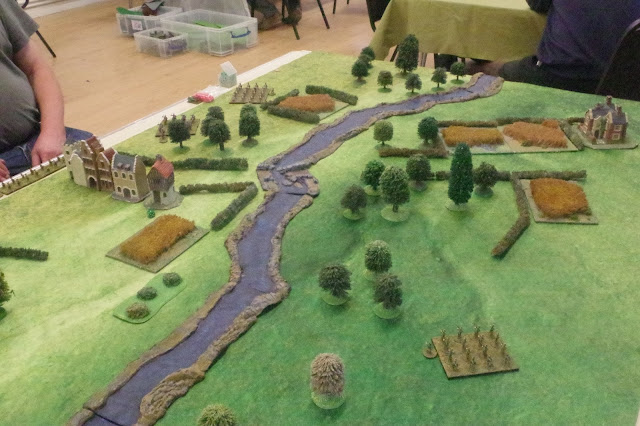


"Before long, the small company of Fusiliers from the famous Istow Regiment  began to advance, led by Hauptmann Loredan."


"As the battle unfolded, it became obvious that the Bordurians had seized the initiative, with their cavalry in position to charge any Syldavians who thought to cross the ford, which was also within the range of the muskets of the Freikorps and a company of Bordurian Jägers, whose skirmishers were equipped with rifles."


"Accurate musketry from across the river began to take its toll on the unfortunate green-coated Jägers, whose ranks were thinned as the balls hit home."


"However, the balance of power began to shift as Hauptman Loredan's fusiliers began to fire increasingly effective controlled volleys into the hated Bordurians across the river. I told the Edler that their control and accuracy was nearly as good as that of His Majesty King George's Foot Guards. Not really true, but my commission from General Melchett stressed that I should use praise and flattery wherever possible to gain the confidence of my Syldavian hosts."


"I noted with interest that the Bordurian Huzzars began to advance along the road towards the river. Surely they were not intending to cross into the hail of musketry?"


"I could only assume that their leader was a typical impulsive light cavalryman, such as those who fought with the Croats in the French service."


"I will admit that it was a stirring sight to see the Bordurian Huzzars, who I recognised as being from the well-known Freikorps Schtroumpf, gallop across the ford into contact with the Vranac Huzzars led by the young Fähnrich von Felstad. Initially pushing the grey-coated Syldavians back, the Schtroumpf Huzzars charged again, but were repulsed on the second attempt by the gallant Vranac troopers, who managed to kill the impetuous officer who had led his men to their doom. Musketry from short range from the Strelec Jägers lining the hedge took a further toll on the Freikorps riders who would take no further part in the proceedings."


"It seemed to me that the failure of the Bordurian cavalry, taken together with the weight of musket fire from the Istow Fusiliers was shifting the balance towards the gallant troops of my Syldavian hosts. Although both sides had suffered losses, the butcher's bill on the Bordurian side seemed to be rising at a faster rate. The Edler gripped my arm excitedly, says "My dear Captain Huntley-Palmer, I do believe that my son's intervention has swung the fight in our favour. I think that the Bordurians are obliged to withdraw." I murmured my agreement as I gazed across the field of honour. It did seem to me that the fusiliers of the white-coated Freikorps Schtroumpf were retreated through the woods, whence they had come only a short time ago. I offered my congratulations to the Edler and thanked him for the opportunity to see the Syldavian army in action. Privately, I thought that my next despatch to "M" would be of interest to Horse Guards, whose offices and clerks would apparently soon be housed in a new building**."


** The old Horse Guards building, which had become the administrative headquarters of the British Army was falling apart by the 1740s and a replacement building was commissioned in 1745. However, building works stretched out for about a decade after work first began in 1750.

Monday, 28 January 2019

A Most Despicable Place - Sharp Practice in the North American colonies

Over the weekend, I took part in a massive series of linked games of Sharp Practice set in the French and Indian Wars (part of the Seven Years' War), fought out between the French and their Huron allies and the British on the border between the French possessions and those of the British.

The basic premise was that the British had been repelled in an attack of Fort Frontenac and were seeking to find ways of striking back against the French. One story thread involved British forces trying to make their way back to safety following their failure in front of Fort Frontenac. Another was all about British forces trying to land troops from boats after crossing a lake and advance through French territory to carry out reprisal raids. The other main story line was all about French raiding forces trying to push out British settlers and destroy their farms and villages.

The weekend was played out at Bristol Independent Gaming and the whole jamboree was orchestrated by David Hunter, whose efforts have to be applauded, not only for the huge amount of work he put into the event, but also for his energy and good humour deployed in keeping the whole event moving along as a plausible narrative. 

Although the whole thing went down to the wire, the small advantage gained by the French on the first day was maintained until the end, in part by the victories gained by the Huron forces, which denied the British victories even though these wins didn't count towards the French tally.

On the British side, we saw a lot of line troops, including Grenadiers, supported by a few units of Light Bobs and colonial Rangers, while the French fielded a lot of Compagnies Franches de la Marine Light Infantry, Milice canadienne, some Huron allies and regular French line Fusiliers and a few Grenadiers. The French also had the use of a light cannon.

All the tables, which covered a wide range of terrain, looked absolutely fantastic and gave everyone a lot of challenges in how to best deploy and control their troops. I think that the most difficult table for the British was the beach landing one, which led to them struggling to get moving, which they eventually achieved after the third game of the four sessions played over the two days. The best thing about that particular scenario was that it allows both sides to actually fight an 18th century linear battle, although even here the skirmishers and light infantry had a big role to play.

It was good to catch up with some old faces and new ones too, especially those I knew from the Sharp Practice Facebook page, as well as Rickard Clarke and Nick Skinner (the actual TooFatLardies) who dropped in on Sunday morning on their way home from Crusade in Penarth on Saturday. I will surely treasure the photo of Sidney Roundwood that Rich gave me before he left.

Anyway, I will let the pictures speak for themselves.