IMDb RATING
5.4/10
1.8K
YOUR RATING
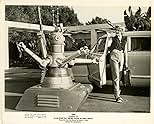
A security agent investigates sabotage and murder at a secret underground laboratory, home of two experimental robots.A security agent investigates sabotage and murder at a secret underground laboratory, home of two experimental robots.A security agent investigates sabotage and murder at a secret underground laboratory, home of two experimental robots.
- Director
- Writers
- Stars
- Awards
- 1 nomination total
Stephen Roberts
- Maj. Howard
- (as Steve Roberts)
Jean Dean
- Marna Roberts
- (as Jeanne Dean)
Andy Andrews
- Andy, a security guard
- (uncredited)
Al Bayer
- Helicopter Pilot
- (uncredited)
Billy Curtis
- Gog
- (uncredited)
- …
Alex Jackson
- Vince
- (uncredited)
- Director
- Writers
- All cast & crew
- Production, box office & more at IMDbPro
5.41.7K
1
2
3
4
5
6
7
8
9
10
Featured reviews
I saw this theatrically ...
... and there are unforgettable images which have stayed with me, especially the horrific scene as Dr. Hubertus (Michael Fox, perfectly cast) finds himself trapped within the test chamber with the slowly oscillating window wiper, and the growing panic that follows with the grim realization that his screams for help cannot be heard. And then that stare through the glass as his spectacles ice over ...
Look for "Gog". There have to be copies out there somewhere.
Slow-moving and talky sci-fi mystery
Something, or someone, is killing people at a super-secret, deep-underground, atomic-powered military research base that is overseen by 'Nuclear Operative Variable Automatic Computer' (NOVAC), a powerful electronic brain, and its hench-robots Gog and Magog (names of complex Biblical/Talmudic origins). This is the third of Ivan Tor's 'hard-science' OSI (Office of Scientific Investigation) series (preceded by 'The Magnetic Monster' (1953) and 'Riders to the Stars' (1954)). Typical of Tor's SF films, 'Gog' is very talky, as OSI agent David Sheppard (Richard Egan) is toured around the base and all the various gadgets carefully explained, but despite the po-faced attempts at technical credibility, most of the 'science' on display, as well as the story's resolution, makes little sense. The cast, like the script, is earnest and boring, and other then the cranky Dr. Zeitman (John Wengraff), none of the characters are very interesting. The film starts well, with the deaths-by-ultrafreezing of a scientist and (surprisingly) his pretty assistant, but bogs down as the investigation progresses. A number of scenes go on too long, notably the unconvincing simulated reduced-gravity demonstration and the endless stock-footage of jet fighters pursuing a mysterious high-altitude rocket plane. Most of the special effects are simplistic and unconvincing but the robots are refreshingly machine-like, rather than the clanking metal humanoids common in the genre at the time (although why, since they are designed to service the atomic reactor, they are equipped with flame-throwers, is a head-scratcher). The film is very much a product of its times, with a 'We need to get there first' attitude to space exploration - the epilogue is ludicrous. Tors deserves credit for trying to make 'real science fiction' movies, rather than just more giant bug or alien invasion flics, but unfortunately, 'real' usually isn't very interesting and does not stand the test of time as well as the less credible, but far more entertaining, monster movies. Why the film is named for one of the robots, who are relatively bit players, is puzzling.
"Science is never frightening."
There's a saboteur afoot at a secret government facility in the desert; a professor from the Office of Scientific Investigation and a female agent seek answers to the malfunctions which have resulted in the deaths of top scientists. Producer Ivan Tors, who also gets an original story credit, loved mixing science-fiction with science-fact, but perhaps gets too carried away here with his love of teaching science (the tour of the facility's many laboratories constitutes nearly half the film's running-time). While the exhibitions and scientific theories are certainly interesting, the technical jargon becomes monotonous. Nicely-produced on a low budget, and with some suspense near the finale, but--as a thriller in the sci-fi genre--it lacks a good old-fashioned charge of excitement. ** from ****
Confusing and frightening for a young kid
I was perhaps seven or eight years old when I saw "Gog" in the 1950s. The story was only somewhat comprehensible to me; although I understood that the laboratory was some type of research facility, it was unclear to me why things were going haywire. The jet flying overhead was a mystery: where did it come from, who was in it, and what was it doing?
The scientific devices were fun to watch, especially the "ray" weapon. Being unable to grasp the concept of sabotage, I didn't appreciate why the device was not operating as designed. But what had the biggest effect on me was the action of the robots. Their running amok in the lab scared me to death. Maybe I picked up on the terror of the lab's occupants.
The combination of confusion and fear made watching the movie (on TV) unpleasant but fascinating. It would be fun to see "Gog" now, knowing what I do about the plot, the actors, and the Cold War era in which it was made.
The scientific devices were fun to watch, especially the "ray" weapon. Being unable to grasp the concept of sabotage, I didn't appreciate why the device was not operating as designed. But what had the biggest effect on me was the action of the robots. Their running amok in the lab scared me to death. Maybe I picked up on the terror of the lab's occupants.
The combination of confusion and fear made watching the movie (on TV) unpleasant but fascinating. It would be fun to see "Gog" now, knowing what I do about the plot, the actors, and the Cold War era in which it was made.
GOG returns in 3-D for 1st Time in 50 Years!
"The Return of Gog" - sounds good doesn't it? Shot in 3-D, but unseen in that format for 50 years, GOG hit the big screen at the Hollywood Egyptian last weekend as part of a 3-D film festival. After its premiere in Hollywood, UA decided NOT to release GOG nationally in 3-D, setting the stage for a film which has been more read about than seen properly for decades. For, once its theatrical (non 3-D) release was completed, the film apparently was sold to TV in B&W prints which further robbed the film of its production lustre. Only in the last few years did a color print show up courtesy of Turner Television. And, now, a 3-D dual print (complete with intermission to change reels!) has been unearthed.
Sounds exciting?
Unfortunately, all this buildup is for a small, talky B-picture. It IS refreshing to look back at a time when SF films weren't just glorified Chase/Action films (ie: T3), but GOG is mostly banal. Still, there's a lot of gadgetry, political intrigue and genuine science (!) packed into its brief running time. The unseen enemy behind it all is clearly the old Soviet Union, setting the film apart from so many films which depict the science itself as evil or suspect.
Director Herbert Strock was there along with Joe Dante and Leonard Maltin. Dante interviewed Strock, who was still spry and proud of his film. Ironically, Strock (like Andre De Toth) has monocular vision and couldn't guage the 3-D effects himself. Indeed, Strock's decision to keep garish 3-D effects to a minimum also may have contributed to the studio's decision to forego a costly 3-D release. And even Strock was amused at a line in the film where someone is hospitalized by an overdose, "It was only a little radiation!"
Sounds exciting?
Unfortunately, all this buildup is for a small, talky B-picture. It IS refreshing to look back at a time when SF films weren't just glorified Chase/Action films (ie: T3), but GOG is mostly banal. Still, there's a lot of gadgetry, political intrigue and genuine science (!) packed into its brief running time. The unseen enemy behind it all is clearly the old Soviet Union, setting the film apart from so many films which depict the science itself as evil or suspect.
Director Herbert Strock was there along with Joe Dante and Leonard Maltin. Dante interviewed Strock, who was still spry and proud of his film. Ironically, Strock (like Andre De Toth) has monocular vision and couldn't guage the 3-D effects himself. Indeed, Strock's decision to keep garish 3-D effects to a minimum also may have contributed to the studio's decision to forego a costly 3-D release. And even Strock was amused at a line in the film where someone is hospitalized by an overdose, "It was only a little radiation!"
Did you know
- TriviaThe robots Gog and Magog were operated by little people.
- GoofsDuring the Air Force jet scramble, the aircraft shown are F-86 Sabre Jets, while most of the airborne shots are of rocket equipped Lockheed F-94C Starfires.
- Quotes
David Sheppard: [to Joanna who is in a hospital bed] The doctor says it isn't serious, just a little too much radiation.
- Alternate versionsMost TV prints in the US are in black & white.
- ConnectionsFeatured in The Saturday Afternoon Movie: Gog (1966)
- How long is Gog?Powered by Alexa
Details
- Release date
- Country of origin
- Language
- Also known as
- Gog, el monstruo de 5 manos
- Filming locations
- Production company
- See more company credits at IMDbPro
Box office
- Budget
- $250,000 (estimated)
- Runtime
- 1h 23m(83 min)
Contribute to this page
Suggest an edit or add missing content