IMDb RATING
5.4/10
1.8K
YOUR RATING


A security agent investigates sabotage and murder at a secret underground laboratory, home of two experimental robots.A security agent investigates sabotage and murder at a secret underground laboratory, home of two experimental robots.A security agent investigates sabotage and murder at a secret underground laboratory, home of two experimental robots.
- Director
- Writers
- Stars
- Awards
- 1 nomination total




Stephen Roberts
- Maj. Howard
- (as Steve Roberts)


Jean Dean
- Marna Roberts
- (as Jeanne Dean)
Andy Andrews
- Andy, a security guard
- (uncredited)
Al Bayer
- Helicopter Pilot
- (uncredited)

Billy Curtis
- Gog
- (uncredited)
- …
Alex Jackson
- Vince
- (uncredited)
- Director
- Writers
- All cast & crew
- Production, box office & more at IMDbPro
5.41.7K
1
2
3
4
5
6
7
8
9
10
Featured reviews
GOG returns in 3-D for 1st Time in 50 Years!
"The Return of Gog" - sounds good doesn't it? Shot in 3-D, but unseen in that format for 50 years, GOG hit the big screen at the Hollywood Egyptian last weekend as part of a 3-D film festival. After its premiere in Hollywood, UA decided NOT to release GOG nationally in 3-D, setting the stage for a film which has been more read about than seen properly for decades. For, once its theatrical (non 3-D) release was completed, the film apparently was sold to TV in B&W prints which further robbed the film of its production lustre. Only in the last few years did a color print show up courtesy of Turner Television. And, now, a 3-D dual print (complete with intermission to change reels!) has been unearthed.
Sounds exciting?
Unfortunately, all this buildup is for a small, talky B-picture. It IS refreshing to look back at a time when SF films weren't just glorified Chase/Action films (ie: T3), but GOG is mostly banal. Still, there's a lot of gadgetry, political intrigue and genuine science (!) packed into its brief running time. The unseen enemy behind it all is clearly the old Soviet Union, setting the film apart from so many films which depict the science itself as evil or suspect.
Director Herbert Strock was there along with Joe Dante and Leonard Maltin. Dante interviewed Strock, who was still spry and proud of his film. Ironically, Strock (like Andre De Toth) has monocular vision and couldn't guage the 3-D effects himself. Indeed, Strock's decision to keep garish 3-D effects to a minimum also may have contributed to the studio's decision to forego a costly 3-D release. And even Strock was amused at a line in the film where someone is hospitalized by an overdose, "It was only a little radiation!"
Sounds exciting?
Unfortunately, all this buildup is for a small, talky B-picture. It IS refreshing to look back at a time when SF films weren't just glorified Chase/Action films (ie: T3), but GOG is mostly banal. Still, there's a lot of gadgetry, political intrigue and genuine science (!) packed into its brief running time. The unseen enemy behind it all is clearly the old Soviet Union, setting the film apart from so many films which depict the science itself as evil or suspect.
Director Herbert Strock was there along with Joe Dante and Leonard Maltin. Dante interviewed Strock, who was still spry and proud of his film. Ironically, Strock (like Andre De Toth) has monocular vision and couldn't guage the 3-D effects himself. Indeed, Strock's decision to keep garish 3-D effects to a minimum also may have contributed to the studio's decision to forego a costly 3-D release. And even Strock was amused at a line in the film where someone is hospitalized by an overdose, "It was only a little radiation!"
Ivan Tors put the "Science" in Science Fiction
In my opinion this is one of the best films made by Ivan Tors. Tors created "Science Fiction Theater" for TV and made several SciFi films (like The Magnetic Monster) before this genre was really popular. He brought real science to the screen in plots that may seem dated today but afterall, it was 1954. In GOG, Tors brings in then brand new inventions such as jets, computers, robots, high frequency sound, cryogenics, sunlight as a weapon, electronic surveillance, atomic power and even man-made satellites (which would not become reality for 3 more years). To an audience unfamiliar with such things, it was exiting and scary. Especially scary when you were made to think such super weapons were under the control of a foreign power. The Korean War had just ended and the USSR was making aggressive comments about atomic war with us. This movie gave me nightmares for quite awhile.
-BullMoose
-BullMoose
NICELY DONE -- 1950's SCI-FI Flix
GOG is quite an extraordinary, obscure film -- it has hardly ever been rerun on any channel, however I was lucky enough to catch it in its entirety [I'd edited it perfectly - without commercials] about 10 years ago on TNT [Turner network] ... in COLOR! I have hung onto this little GEM and view it occasionally and I must say that I still find this movie to be highly enjoyable! I cannot understand why TURNER/MGM/ WARNER has not EVER released this film in ANY format [never on VHS, DVD or LASERDISC] ... with all of the CRAP [old and new] that is being dredged up on a daily basis for video [DVD] releases, the mind boggles as to why so many classic [and decent "B" flix] SCI-FI & HORROR films have still yet to be released [ex: BURN WITCH BURN, DAY OF THE TRIFFIDS, KING KONG, MIGHTY JOE YOUNG, WORLD WITHOUT END, INCREDIBLE SHRINKING MAN, TARANTULA, ROBINSON CRUSOE ON MARS, CONQUEROR WORM, THE POWER, ISLAND OF LOST SOULS, CURSE OF THE WEREWOLF, BRIDES OF DRACULA, GAMMA PEOPLE, LAND UNKNOWN, MONOLITH MONSTERS, VILLAGE OF THE DAMNED, DR CYCLOPS, MOLE PEOPLE, IT CONQUERED THE WORLD, UNINVITED, INNOCENTS, SON OF KONG, MARK OF THE VAMPIRE, EARTH VS THE SPIDER, DEVIL DOLL, BATTLE IN OUTER SPACE, INVISIBLE BOY, TOBOR, etc etc this long list goes on and on ...]! Anyway, GOG is right on the mark [and ahead of its time - 1956] with Cold War conspiracies, Nuclear testing, computer programming, Biblical references [GOG & MAGOG] and it is indeed a well-constructed film with an interesting espionage approach. ANDROMEDA STRAIN was obviously influenced by this film! The acting is downplayed to a rather scientific level, but is good and on par -- you will notice many veteran stock actors within the cast. Most of the previous User Comments in regards to this film are quite accurate and thoughful, and can be blended into a final strong and POSITIVE review. Indeed, SEE IT - ENJOY IT - pray for DVD!
Slow-moving and talky sci-fi mystery
Something, or someone, is killing people at a super-secret, deep-underground, atomic-powered military research base that is overseen by 'Nuclear Operative Variable Automatic Computer' (NOVAC), a powerful electronic brain, and its hench-robots Gog and Magog (names of complex Biblical/Talmudic origins). This is the third of Ivan Tor's 'hard-science' OSI (Office of Scientific Investigation) series (preceded by 'The Magnetic Monster' (1953) and 'Riders to the Stars' (1954)). Typical of Tor's SF films, 'Gog' is very talky, as OSI agent David Sheppard (Richard Egan) is toured around the base and all the various gadgets carefully explained, but despite the po-faced attempts at technical credibility, most of the 'science' on display, as well as the story's resolution, makes little sense. The cast, like the script, is earnest and boring, and other then the cranky Dr. Zeitman (John Wengraff), none of the characters are very interesting. The film starts well, with the deaths-by-ultrafreezing of a scientist and (surprisingly) his pretty assistant, but bogs down as the investigation progresses. A number of scenes go on too long, notably the unconvincing simulated reduced-gravity demonstration and the endless stock-footage of jet fighters pursuing a mysterious high-altitude rocket plane. Most of the special effects are simplistic and unconvincing but the robots are refreshingly machine-like, rather than the clanking metal humanoids common in the genre at the time (although why, since they are designed to service the atomic reactor, they are equipped with flame-throwers, is a head-scratcher). The film is very much a product of its times, with a 'We need to get there first' attitude to space exploration - the epilogue is ludicrous. Tors deserves credit for trying to make 'real science fiction' movies, rather than just more giant bug or alien invasion flics, but unfortunately, 'real' usually isn't very interesting and does not stand the test of time as well as the less credible, but far more entertaining, monster movies. Why the film is named for one of the robots, who are relatively bit players, is puzzling.
Interesting Choice Of Names!
Not a bad little movie, with a touch more suspense than most movies of this type. The names of the two robots that are controlled by.....,well you should see the movie for that, Gog and Magog, comes from the Bible, Rev.20:8. They are the two nations to be led by Satan in the final battle at Armageddon against the kingdom of God. Is Ivan Tors trying to tell us that the Soviet Union is SATAN? Well, it was 1954! Worth the time if you can find it.


Did you know
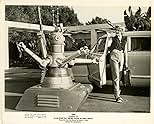
- TriviaThe robots Gog and Magog were operated by little people.
- GoofsDuring the Air Force jet scramble, the aircraft shown are F-86 Sabre Jets, while most of the airborne shots are of rocket equipped Lockheed F-94C Starfires.
- Quotes
David Sheppard: [to Joanna who is in a hospital bed] The doctor says it isn't serious, just a little too much radiation.
- Alternate versionsMost TV prints in the US are in black & white.
- ConnectionsFeatured in The Saturday Afternoon Movie: Gog (1966)
- How long is Gog?Powered by Alexa
Details
- Release date
- Country of origin
- Language
- Also known as
- Gog, el monstruo de 5 manos
- Filming locations
- Production company
- See more company credits at IMDbPro
Box office
- Budget
- $250,000 (estimated)
- Runtime
- 1h 23m(83 min)
Contribute to this page
Suggest an edit or add missing content