IMDb RATING
7.4/10
4.1K
YOUR RATING
When a toy manufacturer feels ignored and unappreciated by his wife and children, he begins to rekindle a past love when a former employee comes back into his life.When a toy manufacturer feels ignored and unappreciated by his wife and children, he begins to rekindle a past love when a former employee comes back into his life.When a toy manufacturer feels ignored and unappreciated by his wife and children, he begins to rekindle a past love when a former employee comes back into his life.
- Director
- Writers
- Stars
- Director
- Writers
- All cast & crew
- Production, box office & more at IMDbPro
7.44K
1
2
3
4
5
6
7
8
9
10
Featured reviews
Heaven does not allow everything.
Coming,in Sirk's career ,just after "All that Heaven allows" ,it looks like its twin movie.Unlike "Written on the wind" or "Imitation of life" or "Magnificent obsession" ,it's not melodrama.It's closer to realistic psychological drama.More than the lingering charm of a romantic past (Blue Moon/You saw me standing alone/Without a love of my own),Sirk focuses on the selfishness of the children.Remember in "All that Heaven..." how the son and the daughter could not admit that their mother (of the upper class) should fall in love with a gardener and how they bought her a TV set where she only could see the reflection of her loneliness.Here the boy's attitude is not far from that: a spoiled child -as his sisters are- ,only concerned by his studies and his love affair,he does not care if his papa has become a nine-to-five man ,useful only for the dough he brings home,a life no more exciting than that of the toy robot he sells.Barbara Stanwyck 's role recalls the 1953 effort "all I desire" : the return of the woman,be she legitimate or a former flame.But in "there's always tomorrow",one can notice one of the permanent features of melodrama though: the woman who turns her back on love and becomes a successful businesswoman (or star) (see also the end of "written on the wind" "imitation of life" or Stahl's "only yesterday")
Sirk at his best
Sirk aptly deals with basic family values and problems in a critical way, questioning the false appearance of stability and harmony of a typical American home. MacMurray's job in a toy factory provides plenty of interesting metaphors, often visual ones. In one scene Sirk even places 'Rex, the Walkie-Talkie Robot-Man' on the foreground, upstaging MacMurray and forcing a comparison between them. MacMurray's home, under the resemblance of a happy and harmonious family life, really seems like a big doll's house MacMurray being here a sort of male 'Nora'. The happy ending seems a bit awkward or phony, but it's what audiences were taught to expect back in the 50's; no other ending would have been allowed under the infamous Production Code, then still being enforced.
Classy drama for the Double Indemnity pair
Stylish drama acted expertly by super professionals. The powerful duo of Stanwyck and MacMurray excel when paired together and this is a fine example of that. Sadly this film is somewhat obscure, a shame since it really does examine in simple terms the crisis a man faces when he realizes he has fallen into a rut without being aware of it. Another winner from Sirk and perhaps even better then some of his more renown films, which are certainly enjoyable if sometimes over the top and a little lurid, since this drama is muted and closer to real life. The problems the film examines seem rooted in the 50's consumerism but by looking a little deeper they are revealed to be universal and timeless issues. This was the final pairing of Barbara and Fred, all their collaborations are worth watching, although The Moonlighter is rather sketchy, but this is the only one showing them as a mature pair and it's a pity they didn't have a chance to make perhaps one more when they had reached old age since they brought out the best in each other.
10Savor
An outstanding hidden treasure waiting to be rediscovered.
This film is one of the great Hollywood films yet so few have ever heard of. Not only does it rate with Douglas Sirk's better known films ("Magnificent Obsession," "All that Heaven Allows," and "Imitation of Life), but is as much a devastating a critique of the American Dream as other fifties movies like "Bigger Than Life." And unlike many melodramas which center on the emotional isolation and turmoil of the central female character, this one analyzes the pain of the main male figure (Fred MacMurray). The film's acting, direction, and script have a precision so well thought out that the effect--both at any given moment and overall --is absolutely astonishing. An incredible film crying out to be rediscovered.
Clifford the Robot Man
Pasadena toy manufacturer Fred MacMurray (as Clifford "Cliff" Groves) is wealthy and successful, but feels neglected by his busy family. His children are preoccupied with their own lives and loving wife Joan Bennett (as Marion) always finds herself committed to something other than time with Mr. MacMurray. He feels ignored, unappreciated and lonely. Enter former employee Barbara Stanwyck (as Norma Miller-Vale). Formerly plain, but now an attractive dress designer, Ms. Stanwyck arrives in Los Angeles on business. She's clearly interested in rekindling something with MacMurray...
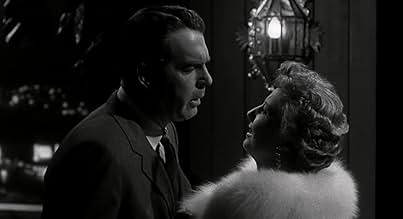
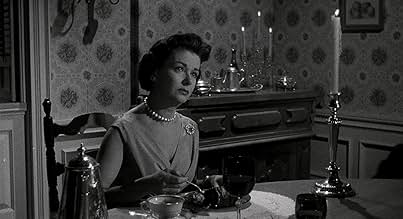
The best part here is that "There's Always Tomorrow" has director Douglas Sirk working in the 1950s, with his best photographer Russell Metty. This means artful shadows, stairways, windows and reflections. Such visuals, especially as they complement the story, are great. There is even a scene with Stanwyck's face shedding tears that are actually reflected raindrops; a technique said to have originated with "In Cold Blood" (1967). Quite possibly, this was done even earlier...
The cast is strangely unimpassioned. MacMurray and Stanwyck lack the level of spark they conveyed in previous collaborations. Perhaps this is the point. MacMurray has become like the toy robot he created. He's "Rex" the walkie-talkie mechanical man. Stanwyck appears to be hesitating an attempted seduction. While not the protagonist, she becomes the most interesting character. Completely and most maddeningly in the dark, Ms. Bennett acts robotically unaware of the threat to her supposedly perfect family life. Shaking things up is suspicious and literate son William Reynolds (as Vinnie).
******* There's Always Tomorrow (1/20/56) Douglas Sirk ~ Fred MacMurray, Barbara Stanwyck, Joan Bennett, William Reynolds
The best part here is that "There's Always Tomorrow" has director Douglas Sirk working in the 1950s, with his best photographer Russell Metty. This means artful shadows, stairways, windows and reflections. Such visuals, especially as they complement the story, are great. There is even a scene with Stanwyck's face shedding tears that are actually reflected raindrops; a technique said to have originated with "In Cold Blood" (1967). Quite possibly, this was done even earlier...
The cast is strangely unimpassioned. MacMurray and Stanwyck lack the level of spark they conveyed in previous collaborations. Perhaps this is the point. MacMurray has become like the toy robot he created. He's "Rex" the walkie-talkie mechanical man. Stanwyck appears to be hesitating an attempted seduction. While not the protagonist, she becomes the most interesting character. Completely and most maddeningly in the dark, Ms. Bennett acts robotically unaware of the threat to her supposedly perfect family life. Shaking things up is suspicious and literate son William Reynolds (as Vinnie).
******* There's Always Tomorrow (1/20/56) Douglas Sirk ~ Fred MacMurray, Barbara Stanwyck, Joan Bennett, William Reynolds
Did you know
- TriviaAcclaimed documentary filmmaker Errol Morris named it as one of his 10 favorite films in the 2002 BFI Sight & Sound Poll.
- GoofsNear the end, Vinnie is telling his girlfriend that he was wrong "about Norma and Cliff" in these exact words. But Cliff is his father; he wouldn't refer to his father by his first name.
- Quotes
Norma Miller Vale: Love is a very reckless thing. Maybe it isn't even a good thing. When you're young and in love, nothing matters except your own satisfaction. The tragic thing about growing older is that you can't be quite as reckless anymore.
- SoundtracksBlue Moon
(uncredited)
Written by Richard Rodgers and Lorenz Hart
Played on one of the toys and heard as a theme throughout the film
- How long is There's Always Tomorrow?Powered by Alexa
Details
- Runtime
- 1h 24m(84 min)
- Color
- Aspect ratio
- 1.85 : 1
Contribute to this page
Suggest an edit or add missing content