

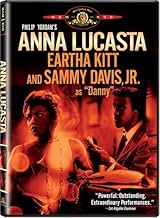
A young woman struggling with a sordid past finds that her biggest enemy had larger demons than she did.A young woman struggling with a sordid past finds that her biggest enemy had larger demons than she did.A young woman struggling with a sordid past finds that her biggest enemy had larger demons than she did.


Rosetta LeNoire
- Stella
- (as Rosetta Le Noire)
Wallace Earl Laven
- Secretary
- (as Eileen Harley)

- Director
- Writer
- All cast & crew
- Production, box office & more at IMDbPro
6.8789
1
2
3
4
5
6
7
8
9
10
Featured reviews
Watch it for its cast
At the core of Anna Lucasta is a creaky plot that isn't seen often today -- the decent man who falls in love with the irresistible prostitute (see also The World of Susie Wong, Breakfast at Tiffany's, The Owl and the Pussycat, etc.). However, instead of focusing on the man's dilemma, Anna Lucasta focuses on the prostitute's family and friends. The screenplay is by a distinguished playwright and screenwriter, Philip Yordan, who based it on his own Broadway play, so it does have its moments -- an occasional good line, striking monologue, or clever exchange of dialogue. But it remains stagy, and the director's infrequent attempts to "open up" the play with cinematic devices don't work well.
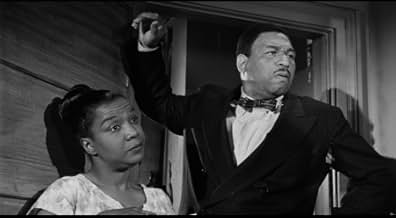
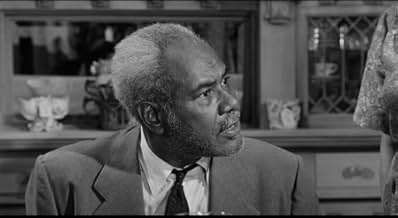
However, the movie is valuable because it preserves performances by prominent black stage actors who for the most part rarely appeared on screen, certainly not in major, non-stereotypical roles. Nearly every actor and actress in the film is given a moment to shine, and they all acquit themselves well, with the possible exception of the great actor Rex Ingram, who sometimes chews the scenery as Anna's drunken and vengeful father. The beautiful Isabel Cooley, in a small role as Anna's sister, is a revelation here.
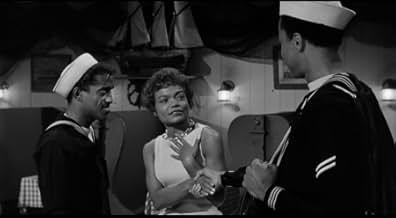
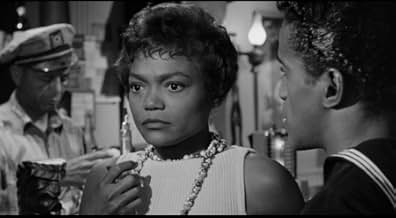
Eartha Kitt always plays Eartha, but her Anna more than adequately shows many facets -- on the edge of hard-bitten, but still yearning to be accepted as innocent and sweet, attracted to the fast life, but hurt and wounded and feeling unloved. And Sammy Davis' performance is much better than the reviews he received when the movie was released or on IMDb. He plays Anna's other suitor, who loves her in his own fashion, but who wants her as a companion for good times and partying, not as a wife. He's shallow, but he has a core of decency and concern for Anna, and Davis portrays both sides well. (Think of Sammy as Sportin' Life in Porgy and Bess, whom he would portray in the same year, but with depth.)
However, the movie is valuable because it preserves performances by prominent black stage actors who for the most part rarely appeared on screen, certainly not in major, non-stereotypical roles. Nearly every actor and actress in the film is given a moment to shine, and they all acquit themselves well, with the possible exception of the great actor Rex Ingram, who sometimes chews the scenery as Anna's drunken and vengeful father. The beautiful Isabel Cooley, in a small role as Anna's sister, is a revelation here.
Eartha Kitt always plays Eartha, but her Anna more than adequately shows many facets -- on the edge of hard-bitten, but still yearning to be accepted as innocent and sweet, attracted to the fast life, but hurt and wounded and feeling unloved. And Sammy Davis' performance is much better than the reviews he received when the movie was released or on IMDb. He plays Anna's other suitor, who loves her in his own fashion, but who wants her as a companion for good times and partying, not as a wife. He's shallow, but he has a core of decency and concern for Anna, and Davis portrays both sides well. (Think of Sammy as Sportin' Life in Porgy and Bess, whom he would portray in the same year, but with depth.)
I Want to Be Good
This second adaptation for the big screen by Philip Yordan of his 1944 Broadway hit is more interesting for the fact of it's existence than what it actually achieves. A chance for Eartha Kitt to prove her mettle as a dramatic actress as a tart with a heart; she doesn't even sing the song that accompanies the credits - instead that falls to co-star Sammy Davis Jr.
It strongly resembles the early Garbo vehicle 'Anna Christie' (she even says "I want to go home" at one point) even down unfortunately to the tinny theatricality of the piece. Too bad Kitt never played Mata Hari or Queen Christina.
Rex Ingram registers strongly as her ogre of a father; but James Edwards as usual is wasted.
It strongly resembles the early Garbo vehicle 'Anna Christie' (she even says "I want to go home" at one point) even down unfortunately to the tinny theatricality of the piece. Too bad Kitt never played Mata Hari or Queen Christina.
Rex Ingram registers strongly as her ogre of a father; but James Edwards as usual is wasted.
Catwoman in a quality film, 10 years earlier
Meowwwww... Eartha Kitt, ten years before she was Catwoman on "Batman"! This film not only co-stars Sammy Davis Jr, but that's also him singing the "Anna" theme. Things are pretty rough for Anna as the film opens. She's been tossed out by her family, even to the point of not have a place to sleep. But... just as things might be turning around for her, she runs into her old sailor friend, Danny, (Sammy Davis) and his pal Lester. Anna isn't sure if she likes either one of her options... her old sailor buddy that doesn't want to get married, or the "friend of the family" that is staying in town looking for work. Rudolph is played by Henry Scott, and it looks like this film is the only thing he ever did. and just when things are finally looking up for Anna, more people are running interference against her. Based on a play by Philip Yordan. He had just won the oscar for Broken Lance. "Anna" was first done by a white cast (1949), then later done by a black cast (1958). This is quite good, and i'm glad that Turner Classics is showing it. and now that I've seen THIS version, of course i want to see the 1949 Paulette Goddard version too. Highly recommended, if you can catch it.
Anna Lucasta
This features a powerhouse effort from Eartha Kitt in the title role. Ostracised from her family for her rather wild ways, she quickly falls into a life of easy money and virtue - eventually falling in with the savvy sailor "Danny" (Sammy Davis Jr.). The two have an on/off relationship to which he won't commit, so she keeps looking and meets the more respectable, would-be teacher, "Henry" (a rather underwhelming Rudolph Slocum) - who just happens to have $4,000. There might just be light at the end of her tunnel? Thing is, her drunken and rather cruel father "Joe" (Rex Ingram) is still determined to wreck things for his daughter - and even now married, things are still pretty messy and there looks like there is little scope for any redemption of that relationship. The story itself is really little more than a familiar family melodrama with a strong supporting cast. What makes this stand out is the chemistry between Davis and Kitt with the latter oozing charisma, even if her character isn't the most pleasant to hit the silver screen. There's some entertaining music and dance and some lovely cartoons right at the end and though probably not the greatest of stories, it is worth watching for the two at the top of the bill.
Kitt and Davis sizzle
Eartha Kitt sizzles in this film about a tough young woman who we first meet in a San Diego bar, fending off unwanted advances by sticking a cigarette into a guy's neck. She's just scraping by, having been thrown out of her house by her father. We gradually get the idea she sells herself to sailors, one of whom is the fast-talking Sammy Davis Jr., who appears here in his first acting role. She's taken back home by her father for ulterior reasons, and meets an intelligent young college graduate (Henry Scott). Can she 'make good' with the young man, despite the shame of her past?
Kitt is fantastic, and plays scenes of defiance, anger, out of control partying, tenderness, vulnerability, and grief all very well. She's a delight to watch, as well as to listen to, with that fabulous, silky voice. Sammy Davis Jr. more than keeps up with her with snappy, hip dialog and a short dance scene that shows just how light on his feet he was. The script has plenty of innuendo, and Kitt's look when Scott asks her what she did down in San Diego is priceless. "I didn't go to college," she purrs. But my favorite line is when Davis Jr. says in an impassioned tone, "You and me, we're real people, Anna. We're the real stuff. Many's the time we set the Earth on fire. You stick with me and we'll burn it up!" It's a great scene with a lot of emotion, and he is marvelous in it.
The supporting actors in the cast are reasonably good as well. Rex Ingram plays her alcoholic father who would probably win the "worst father ever" award if it existed, and Frederick O'Neal is her opinionated brother-in-law who is also pretty hard to like, though both do fine jobs. Georgia Burke is the sweet mother who never loses faith in her daughter, and it's nice to hear her singing around the house. Aside from her singing and the nightclub music, however, the background music in the soundtrack is pretty mediocre.
The film does have a low-budget feel to it, and the quality of print that I saw was unfortunately much worse than others from this time period. For the most part it's pretty ordinary filmmaking, but I did notice some subtle things in the background of a couple of shots that were interesting. In one, as Anna wrestles with her sad past, assuming it won't be good enough for her new suitor, she stands in front of a photography store window which has pictures of smiling people, including a large one of a happy baby. In another, as she's with her father, trying to reconcile with him (which is a surprise given his past treatment), a stitchery hangs in the background saying "God is Love."
It was very refreshing to find that the film had no stereotypes. While it's a dysfunctional family straight out of Tennessee Williams and therefore a bit extreme, the script could have been performed by an all-white cast without a single change. I loved seeing Eartha Kitt and Sammy Davis Jr., especially Kitt, and it's no wonder Orson Welles called her "the most exciting woman in the world." She is as gorgeous as she is talented. There are a couple of moments in the plot that stretch credibility, and it gets a little melodramatic for sure, but it's also highly entertaining and deserves a higher average rating for the star power.
Kitt is fantastic, and plays scenes of defiance, anger, out of control partying, tenderness, vulnerability, and grief all very well. She's a delight to watch, as well as to listen to, with that fabulous, silky voice. Sammy Davis Jr. more than keeps up with her with snappy, hip dialog and a short dance scene that shows just how light on his feet he was. The script has plenty of innuendo, and Kitt's look when Scott asks her what she did down in San Diego is priceless. "I didn't go to college," she purrs. But my favorite line is when Davis Jr. says in an impassioned tone, "You and me, we're real people, Anna. We're the real stuff. Many's the time we set the Earth on fire. You stick with me and we'll burn it up!" It's a great scene with a lot of emotion, and he is marvelous in it.
The supporting actors in the cast are reasonably good as well. Rex Ingram plays her alcoholic father who would probably win the "worst father ever" award if it existed, and Frederick O'Neal is her opinionated brother-in-law who is also pretty hard to like, though both do fine jobs. Georgia Burke is the sweet mother who never loses faith in her daughter, and it's nice to hear her singing around the house. Aside from her singing and the nightclub music, however, the background music in the soundtrack is pretty mediocre.
The film does have a low-budget feel to it, and the quality of print that I saw was unfortunately much worse than others from this time period. For the most part it's pretty ordinary filmmaking, but I did notice some subtle things in the background of a couple of shots that were interesting. In one, as Anna wrestles with her sad past, assuming it won't be good enough for her new suitor, she stands in front of a photography store window which has pictures of smiling people, including a large one of a happy baby. In another, as she's with her father, trying to reconcile with him (which is a surprise given his past treatment), a stitchery hangs in the background saying "God is Love."
It was very refreshing to find that the film had no stereotypes. While it's a dysfunctional family straight out of Tennessee Williams and therefore a bit extreme, the script could have been performed by an all-white cast without a single change. I loved seeing Eartha Kitt and Sammy Davis Jr., especially Kitt, and it's no wonder Orson Welles called her "the most exciting woman in the world." She is as gorgeous as she is talented. There are a couple of moments in the plot that stretch credibility, and it gets a little melodramatic for sure, but it's also highly entertaining and deserves a higher average rating for the star power.


Did you know
- TriviaOriginally a play written by Philip Yordan, portraying a Polish-American family, it was rewritten by American Negro Theater Director Abram Hill and director Henry Wagstaff Gribble for an all-African American cast.
- GoofsWhen Joe dies, his head drops to the right. When shown from another angle, he is facing left.
- ConnectionsVersion of Anna Lucasta (1949)
- How long is Anna Lucasta?Powered by Alexa
Details
- Runtime
- 1h 37m(97 min)
- Color
- Aspect ratio
- 1.66 : 1
Contribute to this page
Suggest an edit or add missing content