IMDb RATING
5.3/10
2.4K
YOUR RATING


In 1960, a military test pilot is caught in a time warp that propels him to year 2024 where he finds a plague has sterilized the world's population.In 1960, a military test pilot is caught in a time warp that propels him to year 2024 where he finds a plague has sterilized the world's population.In 1960, a military test pilot is caught in a time warp that propels him to year 2024 where he finds a plague has sterilized the world's population.



Arianne Ulmer
- Capt. Markova
- (as Arianne Arden)


John Van Dreelen
- Dr. Bourman
- (as John van Dreelen)
Boyd 'Red' Morgan
- Captain
- (as Red Morgan)
William Shephard
- Gen. York
- (as William Shapard)
James 'Ike' Altgens
- Secretary Lloyd Patterson
- (as James Altgens)
Russ Marker
- Col. Curtis
- (as Russell Marker)
Arthur C. Pierce
- Mutant Escaping from Jail
- (uncredited)
Malcolm Thompson
- Guard
- (uncredited)
- Director
- Writer
- All cast & crew
- Production, box office & more at IMDbPro
5.32.4K
1
2
3
4
5
6
7
8
9
10
Featured reviews
"Other Nations! Mutants! What Kind Of Talk Is This?!"...
During a test flight in 1960, Maj. William Allison (Robert Clarke) inexplicably goes BEYOND THE TIME BARRIER! Upon landing , Allison finds himself in the desolate, future world of 2024! Taken to an underground facility, Allison encounters what has become of the human race, after a plague of some sort.
Populated mostly by "deaf mutes", only two men possess the power of speech. Of course, all of the women are young and beautiful. The rest are mutants (bald guys). Will Allison uncover the truth about what happened to him, and about his new hosts? Will this leave him enough time to work on his romance with the lovely Princess Trirene (Darlene Tompkins)?
As with most sci-fi cheeeze of this vintage, BTTB is a rather slow affair. It's not altogether terrible, it's just... not overly engaging. In all fairness, the finale is pretty decent. In a shorter form, it could have made a great episode of THE TWILIGHT ZONE or OUTER LIMITS. Clarke plays what could very well be his best role, and Vladimir Sokoloff wears an awesome wig as The Supreme!...
Populated mostly by "deaf mutes", only two men possess the power of speech. Of course, all of the women are young and beautiful. The rest are mutants (bald guys). Will Allison uncover the truth about what happened to him, and about his new hosts? Will this leave him enough time to work on his romance with the lovely Princess Trirene (Darlene Tompkins)?
As with most sci-fi cheeeze of this vintage, BTTB is a rather slow affair. It's not altogether terrible, it's just... not overly engaging. In all fairness, the finale is pretty decent. In a shorter form, it could have made a great episode of THE TWILIGHT ZONE or OUTER LIMITS. Clarke plays what could very well be his best role, and Vladimir Sokoloff wears an awesome wig as The Supreme!...
For Sci-Fi Buffs Only
Beyond the Time Barrier (1960)
** (out of 4)
Sci-fi has a military test pilot (Robert Clarke) goes into flight during 1960 and moments later he lands his spaceship in a strange land. After walking around for a bit he's finally taken captive by a group of people who don't make much sense to him but before long he realizes that his little trip actually sent him through a time barrier and he landed sixty-four years after taking off. The world has been destroyed due to a plague so he tries to get back in time to prevent it. This is an ultra low-budget movie that has a few ideas going for it but unfortunately there's not too much that can be done in regards to the science fiction because the budget didn't allow for it. The "future" city looks just like any abandoned city of 1960 and there special effects just aren't all that convincing. Fans of Edgar G. Ulmer will probably say that his keen eye manages to take the low budget and do more with it than most would. I'll buy that to a certain level but there's still no question that the majority of the film is dialogue scenes that really just talk about stuff instead of us ever actually getting to see it. I thought Clarke was good in his leading role as the pilot turned hero. Clarke is always fun to see in these low-budget movies and he does a nice job with the part. Darlene Tompkins plays the love interest, a princess in the future and she too is good. Vladimir Sokoloff plays "The Supreme" and isn't too bad. Universal horror fans will be happy to see Jack Pearce's name pop up in the credits for the special effects. There's talk of mutants in the film but sadly those hoping to see the make-up legends work on them will be disappointed because they're just normal people in bald caps. Pearce does get to do a little make-up at the end but I won't reveal with what as it will give away a major plot twist. This twist is actually pretty good and I think the final five-minutes are actually quite effective.
** (out of 4)
Sci-fi has a military test pilot (Robert Clarke) goes into flight during 1960 and moments later he lands his spaceship in a strange land. After walking around for a bit he's finally taken captive by a group of people who don't make much sense to him but before long he realizes that his little trip actually sent him through a time barrier and he landed sixty-four years after taking off. The world has been destroyed due to a plague so he tries to get back in time to prevent it. This is an ultra low-budget movie that has a few ideas going for it but unfortunately there's not too much that can be done in regards to the science fiction because the budget didn't allow for it. The "future" city looks just like any abandoned city of 1960 and there special effects just aren't all that convincing. Fans of Edgar G. Ulmer will probably say that his keen eye manages to take the low budget and do more with it than most would. I'll buy that to a certain level but there's still no question that the majority of the film is dialogue scenes that really just talk about stuff instead of us ever actually getting to see it. I thought Clarke was good in his leading role as the pilot turned hero. Clarke is always fun to see in these low-budget movies and he does a nice job with the part. Darlene Tompkins plays the love interest, a princess in the future and she too is good. Vladimir Sokoloff plays "The Supreme" and isn't too bad. Universal horror fans will be happy to see Jack Pearce's name pop up in the credits for the special effects. There's talk of mutants in the film but sadly those hoping to see the make-up legends work on them will be disappointed because they're just normal people in bald caps. Pearce does get to do a little make-up at the end but I won't reveal with what as it will give away a major plot twist. This twist is actually pretty good and I think the final five-minutes are actually quite effective.
Better Than Average Sci-Fi
This film had a small budget; but it produced a fine atmosphere of futuristic gloom; especially with the black and white photography. The B actors all did a fine job, but the real star is the script and storyline; which I would classify as an A effort. A test pilot goes into the future by accident and arrives in the year 2024 (not too far from now lol), but in 1960, people were far more optimistic about space travel. They thought we would have colonies on the moon and Mars. Nope. We have chosen to wisely spend our money on national defense, instead. I really liked the twist ending which I will not reveal. Well worth watching.
Addicts of low budget sci-fi might dig it.
The legendary cult director Edgar G. Ulmer certainly had made better movies than this but that doesn't mean that this isn't fun to some degree. The main problem is that the (lack of a) budget shows: there's a lot more exposition here than action. But the actors are sincere, the visuals and atmosphere are decent, and there's a nifty twist ending that one might not see coming. The result is a minor but amusing effort that kills time easily enough.
Robert Clarke (also the producer of the movie), who'd previously starred for Ulmer in "The Man from Planet X", plays William Allison, an Air Force pilot who goes on an experimental flight. Somehow, he breaks the time barrier and ends up 64 years in the future, where a plague has decimated most of mankind and where various people hole up in an underground building dubbed The Citadel. The plague has caused various stages of mutation in people; some folk have become deaf-mutes, such as Princess Trirene (Darlene Tompkins); others are more sickly. The people of this future don't trust Allison, which just makes things more difficult for him as he seeks to find out how to get back to his own time.
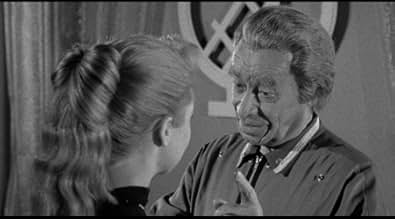
The supporting cast consists of performers such as Vladimir Sokoloff, Boyd 'Red' Morgan, Stephen Bekassy, John Van Dreelen, and director Ulmers' pretty daughter Arianne in a major supporting role as the dubious Captain Markova. Co-star Tompkins is positively gorgeous and may serve as a distraction for any viewers who are otherwise bored with the movie. (One can't completely knock any movie where female outfits of the future include miniskirts.)
This may be no classic of the genre but it does entertain, and only runs an hour and 15 minutes anyway.
The makeup effects are by the great Jack Pierce.
Six out of 10.
Robert Clarke (also the producer of the movie), who'd previously starred for Ulmer in "The Man from Planet X", plays William Allison, an Air Force pilot who goes on an experimental flight. Somehow, he breaks the time barrier and ends up 64 years in the future, where a plague has decimated most of mankind and where various people hole up in an underground building dubbed The Citadel. The plague has caused various stages of mutation in people; some folk have become deaf-mutes, such as Princess Trirene (Darlene Tompkins); others are more sickly. The people of this future don't trust Allison, which just makes things more difficult for him as he seeks to find out how to get back to his own time.
The supporting cast consists of performers such as Vladimir Sokoloff, Boyd 'Red' Morgan, Stephen Bekassy, John Van Dreelen, and director Ulmers' pretty daughter Arianne in a major supporting role as the dubious Captain Markova. Co-star Tompkins is positively gorgeous and may serve as a distraction for any viewers who are otherwise bored with the movie. (One can't completely knock any movie where female outfits of the future include miniskirts.)
This may be no classic of the genre but it does entertain, and only runs an hour and 15 minutes anyway.
The makeup effects are by the great Jack Pierce.
Six out of 10.
Interesting SF Despite Low Budget
I have always been fascinated by the philosophical aspects of space and time, for example, such as the possibility of time dilation. That is why movies such as "The Time Machine", "World Without End" (especially, "World Without End" being one of my all-time favorite SF films), and this one, "Beyond the Time Barrier" have a great deal of appeal.
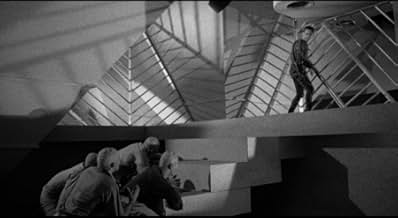
The highlights of the film and worth far more than the price of admission are the scenes in which Robert Clarke first breaks the time barrier up in space (in physics, this sounds like what is currently referred to as a "wormhole" in contrast to the older concept of time dilation) and the scenes after he touches back down to earth. The scene in which Robert Clarke observes the exterior of the futuristic city along with the pulsating solar energy tower is fascinating. (I first saw this when I was ten years old and never forgot it.) Also the scenes of Darlene Tomkins are also a delight for the eyes (especially the swimming pool scene - I never forgot this either). I also liked the triangular designs. They looked almost out of Die Blaue Reiter (The Blue Rider) Gruppe - the Munich Art School that specialized in abstract expressionism (producing such greats such as Klee, Marc, Kandinsky, others) or, perhaps out of the Bauhaus School of Architecture which produced such greats such as Ludwig Mies van der Rohe and others who pioneered modern futuristic design. For this, the art designer for the movie, Ernst Fegte should take a bow.
However, the overall plot is somewhat disappointing after Robert Clarke is captured. The idea that the human race can bring the earth to such a state in which it is perilous to walk the actual surface of the earth due to excessive radiation because the protective atmospheric screens had been decimated (the ozone layer in the stratosphere, for example) seems very dreary indeed (The scientist played by Istvan Bekassy mentions the ionosphere being contaminated by nuclear particles). Furthermore, what happened to the various animal and plant species ? Were they decimated, too ? Perhaps the writers could have planned a less dismal story. As the story progresses, the plot becomes even more pessimistic with the sterility of the population, the evil scientists, the barbarity of the mutants, the almost complete resignation to the eventual extinction of the human race as voiced by the Supreme, Vladimir Sokoloff, and the murder in the final reel of Trirene, his daughter, played by Darlene Tomkins. In general, the writers could have done a lot better, in terms of plot, theme, and characters.
Not the best, not the worst.
Worth watching for the art design and certain aspects of the story which make a person think.
6/10
Dan Basinger
The highlights of the film and worth far more than the price of admission are the scenes in which Robert Clarke first breaks the time barrier up in space (in physics, this sounds like what is currently referred to as a "wormhole" in contrast to the older concept of time dilation) and the scenes after he touches back down to earth. The scene in which Robert Clarke observes the exterior of the futuristic city along with the pulsating solar energy tower is fascinating. (I first saw this when I was ten years old and never forgot it.) Also the scenes of Darlene Tomkins are also a delight for the eyes (especially the swimming pool scene - I never forgot this either). I also liked the triangular designs. They looked almost out of Die Blaue Reiter (The Blue Rider) Gruppe - the Munich Art School that specialized in abstract expressionism (producing such greats such as Klee, Marc, Kandinsky, others) or, perhaps out of the Bauhaus School of Architecture which produced such greats such as Ludwig Mies van der Rohe and others who pioneered modern futuristic design. For this, the art designer for the movie, Ernst Fegte should take a bow.
However, the overall plot is somewhat disappointing after Robert Clarke is captured. The idea that the human race can bring the earth to such a state in which it is perilous to walk the actual surface of the earth due to excessive radiation because the protective atmospheric screens had been decimated (the ozone layer in the stratosphere, for example) seems very dreary indeed (The scientist played by Istvan Bekassy mentions the ionosphere being contaminated by nuclear particles). Furthermore, what happened to the various animal and plant species ? Were they decimated, too ? Perhaps the writers could have planned a less dismal story. As the story progresses, the plot becomes even more pessimistic with the sterility of the population, the evil scientists, the barbarity of the mutants, the almost complete resignation to the eventual extinction of the human race as voiced by the Supreme, Vladimir Sokoloff, and the murder in the final reel of Trirene, his daughter, played by Darlene Tomkins. In general, the writers could have done a lot better, in terms of plot, theme, and characters.
Not the best, not the worst.
Worth watching for the art design and certain aspects of the story which make a person think.
6/10
Dan Basinger


Did you know
- TriviaThis film and another Robert Clarke/Edgar G. Ulmer production, The Amazing Transparent Man (1960), which was shot at the same time and in the same location, were originally to be distributed by a company called Pacific International. Shortly after the films were completed, Pacific International went bankrupt, and producer Clarke lost all the money he had put into it. The films were put up for auction by the film lab that processed them in order to recoup its costs. Both films were bought by American-International Pictures for a fraction of their cost, and upon release they made the company quite a bit of money. Except for his salary as an actor for two weeks' work, Clarke never saw a dime from the films.
- GoofsAs the X-80 is gaining altitude, there is a shot of the plane supposedly in a steep climb. But the clouds in the background are obviously at the same sharp angle, revealing that the footage of a level flight has just been "tilted" optically.
- Crazy creditsThe opening credits scroll away from the camera, a rare style which later became popular from Star Wars: Episode IV - A New Hope (1977).
- ConnectionsEdited from The Indian Tomb (1959)
- How long is Beyond the Time Barrier?Powered by Alexa
Details
- Release date
- Country of origin
- Language
- Also known as
- Traspasando la barrera del tiempo
- Filming locations
- Production companies
- See more company credits at IMDbPro
Box office
- Budget
- $125,000 (estimated)
- Runtime
- 1h 14m(74 min)
- Color
- Sound mix
- Aspect ratio
- 1.37 : 1
Contribute to this page
Suggest an edit or add missing content