

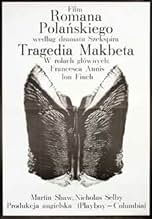
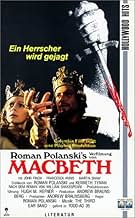
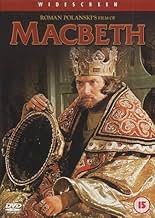
A ruthlessly ambitious Scottish lord seizes the throne with the help of his scheming wife and a trio of witches.A ruthlessly ambitious Scottish lord seizes the throne with the help of his scheming wife and a trio of witches.A ruthlessly ambitious Scottish lord seizes the throne with the help of his scheming wife and a trio of witches.
- Director
- Writers
- Stars
- Won 1 BAFTA Award
- 3 wins & 2 nominations total


- Director
- Writers
- All cast & crew
- Production, box office & more at IMDbPro
7.415.8K
1
2
3
4
5
6
7
8
9
10
Featured reviews
10gerlynga
Medieval accuracy, good Shakespeare
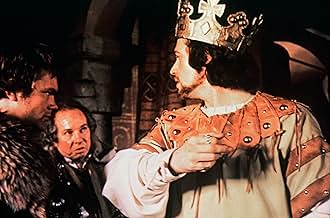
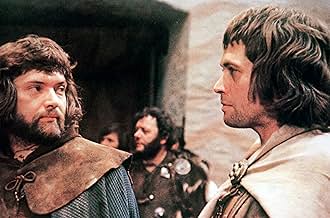
A few years after this was released in the USA, I convinced my high school English teacher to take our class to see it. (In the days before videos & vcr's, this involved renting a theater and print.) I was glad I did. It is certainly the most real and immediate filmed version of the play. The sets, costumes (or lack thereof), and casting all work to create an accurate depiction of "nasty, brutal, and short" 11th century life. And of course, there is the wonderful insight of Shakespeare's language to engage our modern sensibilities.
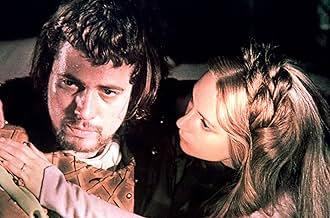
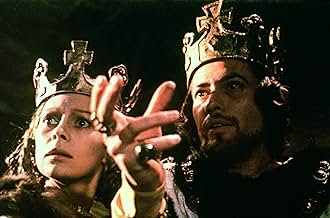
One can only thank Polanski for casting such relatively young actors as his leads. Kings lived and died young then, and had to be both excellent generals as well as administrators to succeed. Jon Finch is both athletic and impassioned enough to carry off the soldiering, and young and introspective enough to be moved by his wife both as a woman and co-conspirator. Of course Francesca Annis made a splash by doing the mad scene in the nude--but in medieval times, everyone slept in the nude, so it was certainly accurate to the times.
And as has been noted before, at least the castle keeps are cold, dark, and dirty. The communal sleeping arrangements, straw bedding, flaring smoky torches, seeping walls, and muddy yards all contribute to the historical accuracy of this production. The exterior of Bamburgh also works. And keeping with Shakespeare's light vs. dark metaphors, the mist, rain, and lowering skies combine to enhance the mood.
What happens in this "Macbeth" is as realistic as possible. So what happens offstage in the play, happens onstage in the film: the murders of Duncan, Banquo, Macduff's family. Murder is nasty and bloody and Polanski (having much experience of its results) makes sure we know it. Medieval Scotland was nasty and bloody as well, and if the film is accurate in depicting its setting, why not the action? And only Polanski has an ending that hints that violence and ambition didn't die with Macbeth's overthrow. All said, Polanski's film still has the most accurate medieval setting, engaging performance(s), and thrilling battles.
PS. For those interested in the real historical Macbeth, read Dorothy Dunnett's excellent biographical novel "King Hereafter". Dunnett is world renowned for her historical accuracy, and did much research to create not only a very plausible rendition, but a thoroughly interesting and entertaining story as well.
One can only thank Polanski for casting such relatively young actors as his leads. Kings lived and died young then, and had to be both excellent generals as well as administrators to succeed. Jon Finch is both athletic and impassioned enough to carry off the soldiering, and young and introspective enough to be moved by his wife both as a woman and co-conspirator. Of course Francesca Annis made a splash by doing the mad scene in the nude--but in medieval times, everyone slept in the nude, so it was certainly accurate to the times.
And as has been noted before, at least the castle keeps are cold, dark, and dirty. The communal sleeping arrangements, straw bedding, flaring smoky torches, seeping walls, and muddy yards all contribute to the historical accuracy of this production. The exterior of Bamburgh also works. And keeping with Shakespeare's light vs. dark metaphors, the mist, rain, and lowering skies combine to enhance the mood.
What happens in this "Macbeth" is as realistic as possible. So what happens offstage in the play, happens onstage in the film: the murders of Duncan, Banquo, Macduff's family. Murder is nasty and bloody and Polanski (having much experience of its results) makes sure we know it. Medieval Scotland was nasty and bloody as well, and if the film is accurate in depicting its setting, why not the action? And only Polanski has an ending that hints that violence and ambition didn't die with Macbeth's overthrow. All said, Polanski's film still has the most accurate medieval setting, engaging performance(s), and thrilling battles.
PS. For those interested in the real historical Macbeth, read Dorothy Dunnett's excellent biographical novel "King Hereafter". Dunnett is world renowned for her historical accuracy, and did much research to create not only a very plausible rendition, but a thoroughly interesting and entertaining story as well.
Murderous MacBeth
How does one do justice to one of the most nihilistic murderers in the history of drama? Even Richard the Third has a sense of humor. but once MacBeth buys into the witch's prophecy (which he doesn't have to do) - it's all straight to hell from there. Even his wife finally gets the idea that 'When you choose to ride the tiger, you don't get off' as one Confucian wit put it, long ago....
This is the film that put an end to the "high-school" Shakespeare that we all had to suffer through in the 1960s. That Shakespeare was dull, lifeless, meaninglessly conservative - everyone hated him. In America, we had heard about Peter Brooks, and about an all-nude MacBeth (which of course never happened, the reference was to the "out damn spot' scene, just as we see in this movie); and there were the legendary Orson Welles versions that were, unfortunately, wholly unavailable at the time. Then Zeffirelli made his Romeo and Juliet, showing Romeo's bare butt, even in the ad for the film, and we started getting the glimmer that Shakespeare had been a real person writing about other real people - then came Polanski's MacBeth.
I won't lie and tell you that this is the definitive MacBeth - or even that it's a really great movie - all of the actors seem like they are way over their heads in this material.
But Polanski's purely cinematic bravado pulls it off. Right from the beginning, watching a medieval warrior beat his opponent into a bloody pulp, we are drawn into a world where violence is the only truth we can believe - pretty much as MacBeth himself sees it.
From this point on, there was no turning back. The Shakespeare we inherit from this film may not be the one we want, but he is certainly a playwright of Elizabethan England (which the "high-school" Shakespeare never was).
That makes this film really important - at least until the definitive version actually gets made (and it hasn't, yet...).
This is the film that put an end to the "high-school" Shakespeare that we all had to suffer through in the 1960s. That Shakespeare was dull, lifeless, meaninglessly conservative - everyone hated him. In America, we had heard about Peter Brooks, and about an all-nude MacBeth (which of course never happened, the reference was to the "out damn spot' scene, just as we see in this movie); and there were the legendary Orson Welles versions that were, unfortunately, wholly unavailable at the time. Then Zeffirelli made his Romeo and Juliet, showing Romeo's bare butt, even in the ad for the film, and we started getting the glimmer that Shakespeare had been a real person writing about other real people - then came Polanski's MacBeth.
I won't lie and tell you that this is the definitive MacBeth - or even that it's a really great movie - all of the actors seem like they are way over their heads in this material.
But Polanski's purely cinematic bravado pulls it off. Right from the beginning, watching a medieval warrior beat his opponent into a bloody pulp, we are drawn into a world where violence is the only truth we can believe - pretty much as MacBeth himself sees it.
From this point on, there was no turning back. The Shakespeare we inherit from this film may not be the one we want, but he is certainly a playwright of Elizabethan England (which the "high-school" Shakespeare never was).
That makes this film really important - at least until the definitive version actually gets made (and it hasn't, yet...).
one of the mightiest adaptations from Shakespeare's :p
Vehement and inch-perfect approach of Roman Polanski towards Shakespeare's greatest play "Macbeth". Polanski's absolute narrative technique and profound direction set the heinous deed of Macbeth and his tragic fate with elegance.
He brilliantly represents all Shakespearean symbols on the screen--- especially the floating "dagger", apparitions in the witches' den. Jon Finch powerfully portrays the downfall of Macbeth while Annis appears vivid struggling with her greed and conscience. Vibrantly, one of the mightiest adaptations from Shakespeare's :p
8/10__:D
He brilliantly represents all Shakespearean symbols on the screen--- especially the floating "dagger", apparitions in the witches' den. Jon Finch powerfully portrays the downfall of Macbeth while Annis appears vivid struggling with her greed and conscience. Vibrantly, one of the mightiest adaptations from Shakespeare's :p
8/10__:D
Stunning, well performed and very bloody adaptation of the play.
To say that this adaptation is a bit of a bloodbath is a bit of an understatement, but you cannot deny that this film from Roman Polanski is quite possibly the definitive film version of Shakespeare's play, which is very complicated to even contemplate transcribing to screen. The cinematography is excellent, as is the script. It is true that there are a lot of disturbing scenes, chiefly Lady Macbeth's nude sleepwalker scene and King Duncan's death. Roman Polanski should be commended for how much he managed to get into the film, and he somehow made it all effective. Any scene with the three witches, the murder of Macduff's family, plus the part when Macbeth sees Banquo's ghost was very well done.(I saw an amateur production of this, and not only was it disappointing, but that particular scene was the worst aspect of it) The performances were brilliant, Jon Finch(who did start off uncomfortable) is great on the whole as the treacherous thane-turned-king, and Francessca Annis was nigh-on-perfect as Lady Macbeth. And Martin Shaw was excellent as Banquo. From the suitably eerie opening scene, to the superb climax, this is a near-perfect adaptation, there were just some bits that were really disturbing to watch, that deserves more recognition. 9/10 Bethany Cox
very good adaptation
Roman Polanski's blood-soaked version of Shakespeare's Scottish play was the video version of choice when we were studying this at school, in spite of it having a nude Lady Macbeth and witches (and Keith Chegwin in the cast - he's Banquo's son).
Jon Finch has the lead and he is exceptionally good. Even a dagger which really appears to float before him (an effect not needed) doesn't spoil things. Odd that he never really got good movie roles after this. His Lady M is Francesca Annis, a spider of a schemer, also putting in a good performance.
Less adequate are Martin Shaw as Banquo, Stephan Chase as Malcolm, and Sydney Bromley as the Porter, although Terence Bayler gives good value as Macduff.
Perhaps this Macbeth is the first one to be truly cinematic, something that even Orson Welles couldn't achieve with Scots accents and Scandinavian settings. It remains memorable long after seeing and, in its excesses, opens up the text for a new generation, and finally, sees the repellent murdering usurper get what he deserves.
(Incidentally for perspective, the book 'Macbeth - man and myth' by Nick Aitchison looks at the real historic facts in accessible coffee-table book style).
Jon Finch has the lead and he is exceptionally good. Even a dagger which really appears to float before him (an effect not needed) doesn't spoil things. Odd that he never really got good movie roles after this. His Lady M is Francesca Annis, a spider of a schemer, also putting in a good performance.
Less adequate are Martin Shaw as Banquo, Stephan Chase as Malcolm, and Sydney Bromley as the Porter, although Terence Bayler gives good value as Macduff.
Perhaps this Macbeth is the first one to be truly cinematic, something that even Orson Welles couldn't achieve with Scots accents and Scandinavian settings. It remains memorable long after seeing and, in its excesses, opens up the text for a new generation, and finally, sees the repellent murdering usurper get what he deserves.
(Incidentally for perspective, the book 'Macbeth - man and myth' by Nick Aitchison looks at the real historic facts in accessible coffee-table book style).


Did you know
- TriviaMark Dightam, who was eleven when he controversially appeared full frontally naked as MacDuff's son, was not allowed to see the film when it was released because it had been classified AA and he was under 14 at the time.
- GoofsThe lyrics to the song that Fleance sings at Macbeth's banquet for Duncan at Inverness are taken from the poem "Merciles Beautè" by Geoffrey Chaucer. In the context of the film this extraneously inserted song is itself an anachronism, as Chaucer lived in the fourteenth century and Shakespeare's "Macbeth" historically takes place in the eleventh century.
- ConnectionsFeatured in Aquarius: Two Macbeths/Hayward Gallery/Ravi Shankar (1972)
Details
- Release date
- Countries of origin
- Official site
- Language
- Also known as
- Bi Kịch Của Macbeth
- Filming locations
- Lindisfarne Castle, Holy Island of Lindisfarne, Northumberland, England, UK(Glamis Castle, Inverness)
- Production companies
- See more company credits at IMDbPro
Box office
- Budget
- $3,100,000 (estimated)
- Runtime
- 2h 20m(140 min)
- Color
- Aspect ratio
- 2.35 : 1
Contribute to this page
Suggest an edit or add missing content