

An impatient young stockbroker is willing to do anything to get to the top, including trading on illegal inside information taken through a ruthless, greedy corporate raider who takes the yo... Read allAn impatient young stockbroker is willing to do anything to get to the top, including trading on illegal inside information taken through a ruthless, greedy corporate raider who takes the youth under his wing.An impatient young stockbroker is willing to do anything to get to the top, including trading on illegal inside information taken through a ruthless, greedy corporate raider who takes the youth under his wing.
- Won 1 Oscar
- 9 wins & 4 nominations total





- Chuckie
- (as Chuck Pfeifer)


- Director
- Writers
- All cast & crew
- Production, box office & more at IMDbPro
Featured reviews
Great Performances in Tight Thriller
*** 1/2 (out of 4)
A second hand broker (Charlie Sheen) dreams of becoming the next Gordon Gekko (Michael Douglas), a major player on Wall Street, and eventually gets his shot to impress the big wig. Soon the kid learns that Wall Street is full of lies, cheating and greed and Gekko is willing to take him under his wing but soon he realizes that at some point enough is enough. It's been a while since I watched this film but I was really shocked to see how well it holds up today even though I'm sure many people would attack director Stone for making the Wall Street guys too much of a villain and perhaps adding too much of his conspiracy theories to trading. I don't think there's any doubt that Stone is using this film as a "warning" to those who give their last dollars to these major companies only to have bloodsuckers like Gekko come down and become richer while the poor become poorer. Some would argue this is overdamatics on the part of Stone but I'm sure there would be many who would say he was shining the light on evil greed. Either way this film holds up remarkably well thanks in large part to the terrific performances but also because the characters are so wonderfully written that even if you know nothing about trading it's likely you're going to know both Gekko and the kid. I think what's so remarkable about the film is that it really does play out like a Hitchcock thriller because you just know the kid is eventually going to get in over his head and while watching the thing you can't help but feel you're walking on eggshells as he becomes richer and richer yet he's too stupid to see the price he's going to end up paying. Tom Cruise appears to have become a respectable actor out of this period but I think Sheen gets overlooked as he certainly had a strong resume at this point of his career. He certainly brings that hot shot attitude to the role but he also has a vulnerability that works extremely well especially towards the end when he starts to see what he has done. Douglas, in an Oscar-winning performance, is downright masterful as the snake Gekko and you can't help but on one hand hate this guy but at the same time you can't help but want to be him with the power and attitude. Martin Sheen often gets overlooked in the film but a lot of the connection one has with the movie comes from him. John C. McGinley, Hal Holbrook, James Karen, Terence Stamp, Sean Young, James Spader, Saul Rubinek and Daryl Hannah add to their characters and deliver the goods as well. I think Stone's direction is a major point to the film's success as he perfectly handles the bigger picture of the greed of Wall Street but also the smaller relationships in the film. Again, the film works perfectly as a thriller but there's also a lot of heart and soul in the film thanks to the relationship between the father and son.
Do the Wall Street Shuffle...
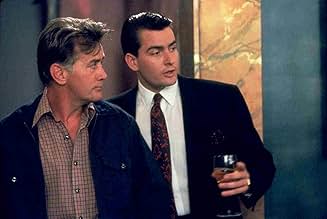
It will have to go some though to beat the shock and awe value of its prototype, with Douglas' larger than life personification of corporate greed, Gordon Gekko, dominating proceedings. Charlie Sheen is the young trader on the make, aiming to aspire, or so he thinks, to Gekko's status and success, trying so hard to please his idol that he not only ends up aping his appearance (slicked back hair, big suspender braces) but even betraying his idealistic union-man father by relaying insider knowledge on the latter's ailing airline employer to Gekko who then moves in to welsh on his workforce-friendly words to asset strip the company for massive personal gain. Sheen's Bud Fox character eventually has an epiphany, augured by the coincidence of real-life and cinema dad Martin copping a heart attack and turns on and indeed turns in his guru to the authorities to bring ultimate closure to the piece.
The film has its faults; I didn't quite buy into Douglas surrogate-father figure appeal to Sheen Jr., the coincidental heart attack of Sheen/Fox Sr is a bit too pat and some of the supporting characters come on like mere ciphers, including Terence Stamp as the UK magnate-cum-nemesis of Gekko and Daryl Hannah as a Gekko cast-off girlfriend/groupie who becomes young Sheen's trophy girl-friend. This leads to a larger criticism on the paucity of female characters in the film at all, but if you can accept that this is a man's man's man's world, to paraphrase James Brown, then this morality tale of its time still packs a punch, especially with the collapse of Communism and the surrender of the likes of Russia, China et. al to the addictive drug of big-bucks capitalism.
Stone's camera is constantly on the move, capturing the frenetic-ism of dealers on the trading floor as market frenzy takes hold, with the dialogue razor-sharp throughout, so many of the phrases of course having become clichés for that era, almost entering common parlance the language, such as greed is good, lunch is for wimps and more.
In the end, young Sheen would have done well to be careful what he wished for, but if he's the Little Red Riding Hood to Douglas' Big Bad Wolf, this particular out-sized fairy tale reaches its conclusion fittingly and satisfyingly, opening up a seamy, selfish world that you know is out there still, now more than ever.
Casualties Of Capitalism
There are two schools of thought when it comes to money. Some economists argue money is an expanding resource, and prosperity a rising tide that lifts all boats. For Gekko, the truth is simpler and more brutal: The rich get richer off the backs of everyone else. "Money itself isn't lost or made, it's simply transferred," he tells his young protégé Bud Fox (Charlie Sheen).
No question writer-director Oliver Stone feels the same way, as he presents this tale of wealth acquisition at its very apex, lower Manhattan circa 1985. In practically every frame showcasing the opulent world Gekko travels can be glimpsed beggars, fishermen, window washers, people who never will have access to the white-collar lifestyles their lowly status perversely enables for others.
For some, this zero-sum take of America clouds their enjoyment of "Wall Street" the movie. It shouldn't. You don't have to buy Shakespeare's version of history in "Richard III" to enjoy the morally bankrupt character at its center, and you don't need to adopt Stone's philosophy to enjoy Gekko.
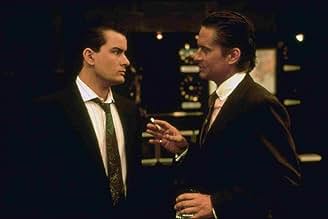
In fact Stone's attitude about the Street, presented here as a kind of Hogarth caricature, helps make the film so entertaining. He captures the scenes of floor trading and calls and puts in journalistic detail, but leaves room for the human equation. And he has fun, a lot of fun, especially with Gekko, a character who makes you laugh with his pithy comments even as he sets about using poor Fox as a human ashtray.
On an upcoming charity event for the Bronx Zoo: "That's the thing about WASPs. They hate people, but they love animals." On a rival: "If he was in the funeral business, no one would ever die!" To Fox: "You had what it took to get into my office, sport, the question is do you have what it takes to stay."
Fox wants to stay, and allows no SEC regulation to block his wayward path. Stone's father was a stockbroker, and so the director takes special care to show us that all Wall Streeters aren't bad. There's Hal Holbrook, almost too saintly and somewhat detached from day-to-day business of his brokerage house to the point he seems a slumming B-school don. John C. McGinley delivers a standout performance as a vulgar, greedy friend of Fox's who we nevertheless find ourselves sympathetic to, especially as Fox ditches him for Gekko.
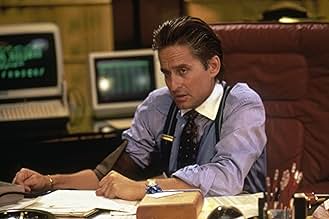
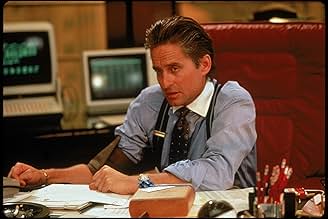
But of course it's really Gekko's world, as we watch him at his desk, punching telephone-line buttons and encouraging subordinates to "rip their throats out," checking his blood pressure with one hand while smoking a cigarette in the other. His centerpiece moment, his speech to the stockholders at Teldar Paper, is a compelling soliloquy not because it showcases his brutality but because it allows him a chance to explain his philosophy in a way that sounds logical, even honorable, until you think through the implications. That's Stone's screen writing at its best.
Sheen is also masterful in his role, playing the naive waif who wants to swim with the sharks and thus giving Douglas daylight to run. Too bad there's a tacked-on romance that never really works, in part because the character of Darien Taylor is not well developed, in part because Darryl Hannah hadn't yet met Quentin Tarantino. The ending is a bit too neat, and loses the subtlety that makes the rest of the film so good.
But the heck with subtlety when you have Gordon Gekko. Douglas is the reason for watching "Wall Street," and a terrific one. Just watch the way he looks at Bud, eyebrows raised to hold a pregnant silence, or enjoys the discomfort of his arbitrager-rival Sir Larry (a solid Terence Stamp). Stone knew what he had here, and makes the most of it. As a twisted morality tale, "Wall Street" is a thrilling, scenic ride down a dark and dangerous road.
Much more than a snapshot of the 80's
Many people associate this film with a liberal versus conservative viewpoint on business, a wild-west economy versus a planned economy and relegate this film to 1980's era nostalgia, like the now humorously giant cell phone Gekko is talking on as he walks along the beach. It is said that neither extreme works and that we've gradually settled towards something in the middle. However, the Gekkos of this world are smarter than that, and over the past 20 plus years they have set up an economic system that serves them well. What we now have is a situation where the haves and have-mores have a planned - almost Soviet - system in which the rules stratify them at the top. I cite the changes in bankruptcy law as exhibit A. The members of the labor force that serve them, however, are in the wild-west economy that was once advocated for everyone. Some will rise to the stratified top in this situation, but the vast majority will remain at the bottom shooting it out with each other - for scarce good jobs, good health care, education, etc. Thus, to me, Wall Street is just an opening chapter in the saga of how economic forces and attitudes toward them have changed, not the portrait of a 25 year-old fad that has come and gone.
High Quality Film, Disturbing Message
Gekko is a villain and an outlaw, but mostly he comes across to viewers as a worldly tough guy, a charming bully with a glamorous lifestyle. We see his high-class mega-office, his plush home and chic wife, his expensive paintings, his rapid-fire commands to his robotic lieutenants, his snazzy clothes and "in vogue" friends. Here and there we see his frustrations, but that only accentuates his toughness. We do not see him suffer, nor do we see the consequences of his selfish, Machiavellian behavior.
As a result, to viewers, especially to those youthful, bright, materialistic Americans with a smug, "can do" attitude, and disdain for ethics, Gekko is, unfortunately, someone to admire, a Wall Street role model.


Did you know
- TriviaIn the scene in which Bud Fox brings a birthday gift to Gekko's office, Gordon's secretary says 'Five minutes' in order to keep the unplanned meeting between Gekko and Fox as brief as possible. There are exactly 5 minutes in the movie from this moment to the moment in which Bud leaves the office.
- GoofsAt the beginning of the movie, Bud Fox and Marvin say Gordon Gekko was shorting NASA stock right after the Challenger explosion. The scene is set in May 1985, but the Space Shuttle Challenger exploded January 28, 1986.
- Quotes
Gordon Gekko: The richest one percent of this country owns half our country's wealth, five trillion dollars. One third of that comes from hard work, two thirds comes from inheritance, interest on interest accumulating to widows and idiot sons and what I do, stock and real estate speculation. It's bullshit. You got ninety percent of the American public out there with little or no net worth. I create nothing. I own. We make the rules, pal. The news, war, peace, famine, upheaval, the price per paper clip. We pick that rabbit out of the hat while everybody sits out there wondering how the hell we did it. Now you're not naive enough to think we're living in a democracy, are you buddy? It's the free market. And you're a part of it. You've got that killer instinct. Stick around pal, I've still got a lot to teach you.
- Crazy creditsBuilding illustrations are shown during entire end credits
- Alternate versionsIn the VHS release, instead of the correct 1981-1994 20th Century Fox logo, the 1953-1981 logo is used.
- ConnectionsFeatured in Siskel & Ebert: The Duxorcist/Walker/Manon of the Spring/The Dead (1987)
- SoundtracksFly Me to the Moon
Words and Music by Bart Howard (ASCAP)
Published by The Hampshire House Publishing Corp. (ASCAP)
Performed by Frank Sinatra
Courtesy of Reprise Records
By Arrangement with Warner Special Products
Arrangement by Quincy Jones (uncredited)
Details
- Release date
- Country of origin
- Official site
- Language
- Also known as
- El poder y la avaricia
- Filming locations
- 60 W. 75th St, New York City, New York, USA(Bud's first apartment building)
- Production companies
- See more company credits at IMDbPro
Box office
- Budget
- $15,000,000 (estimated)
- Gross US & Canada
- $43,848,069
- Opening weekend US & Canada
- $4,104,611
- Dec 13, 1987
- Gross worldwide
- $43,848,069
- Runtime
- 2h 6m(126 min)
- Color
- Sound mix
- Aspect ratio
- 1.85 : 1