
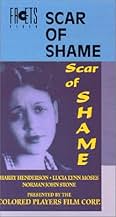
A black musician marries a woman facing abuse from her stepfather to rescue her. After the marriage, he refuses to introduce her to his mother, fearing his mother's disapproval of her lower ... Read allA black musician marries a woman facing abuse from her stepfather to rescue her. After the marriage, he refuses to introduce her to his mother, fearing his mother's disapproval of her lower socioeconomic status.A black musician marries a woman facing abuse from her stepfather to rescue her. After the marriage, he refuses to introduce her to his mother, fearing his mother's disapproval of her lower socioeconomic status.
- Awards
- 1 nomination total
Charles Gilpin
- Lido Club Gambler
- (uncredited)
Shingzie Howard
- Louise's Maid
- (uncredited)
- Director
- Writer
- All cast & crew
- Production, box office & more at IMDbPro
6.2500
1
2
3
4
5
6
7
8
9
10
Featured reviews
7tavm
The Scar of Shame was an interestingly good silent "race movie" drama
Since it's once again Black History Month, I thought I'd once again review various movies made by people of color for the occasion. This production of the Colored Players Film Corporation (which was co-founded by one African-American, Sherman H. Dudley, a former stage performer) was quite compelling as a cautionary drama though the melodramatic trappings do permeate. Still, there were quite some good performances by the cast of which one of them, a Lucia Lynn Moses, was quite alluring in going from a victimized girl to one trying to be more seductive. It's interesting finding out on this site she filmed this in Philadelphia while also commuting to New York as a chorus girl at the Cotton Club. I don't feel like revealing much else so on that note, I recommend The Scar of Shame.
Good if somewhat overly melodramatic
An all black silent film made exclusively for black audiences in the 1920s (back then theatres were segregated). Poor but beautiful Louise Howard (Lucia Lynn Moses) is beaten by her stepfather (William E Pettus) but dreams of a better life. She meets good honest Alvin Hillyard (Harry Henderson) and he falls in love with her. But her stepfather and evil Eddie Blake (Norman Johnson) aren't going to let her go without a fight.
Interesting from a historical standpoint and not too bad as a drama either. It does get overly melodramatic with a lot of eye-rolling speeches and gets more than a little ridiculous during it's last half hour but I was never bored. The acting is actually pretty good and it moves quickly. Also the cards telling us what's going on have some interesting designs. When Blake is introduced there's a wolf shown on the title card! So, a pretty good movie. Also interesting to see how blacks were shown and treated back then. A 7.
Interesting from a historical standpoint and not too bad as a drama either. It does get overly melodramatic with a lot of eye-rolling speeches and gets more than a little ridiculous during it's last half hour but I was never bored. The acting is actually pretty good and it moves quickly. Also the cards telling us what's going on have some interesting designs. When Blake is introduced there's a wolf shown on the title card! So, a pretty good movie. Also interesting to see how blacks were shown and treated back then. A 7.
Very Important Film
Scar of Shame, The (1927)
*** (out of 4)
Historically important race film (black cast for black crowds) is one of the best I've seen from this genre of films. A rich concert pianist (Harry Henderson) marries an abused poor girl (Lucia Lyn Moses) so that she can escape her abusive stepfather but this leads to tragedy as the girl doesn't know any life other than the ghetto. Sadly a lot of these silent race films are now lost but from the few I've seen I can see why they were controversial back when they were originally released. Like Within Our Gates, this film spends a lot of time bashing black people for their living conditions, alcohol and the "shame" of their race, which is interesting to see since this film was meant for a black crowd. I guess the producers knew black folks would be seeing these films so they wanted to push some sort of moral issue on them. What I also find interesting and somewhat hypocritical is the fact that these race films always put light skinned black people in the lead roles. In fact, if you just looked at the actors in this movie you'd never guess they were black and in several scenes it appears that the actors are wearing make up to make themselves look lighter. I've read a couple books by race experts and they said this was due to the producers hoping these films could sneak into white theaters (they never did).
As for the film itself, it's pretty much a remake of Griffith's Broken Blossoms bit it's still very powerful and memorable. The best thing about the movie are the performances, which match any of the actors appearing in Hollywood films at the time. The real highlight is the work of Lucia Lynn Moses, who while filming this was also working at The Cotton Club. She's an incredibly beautiful woman who uses those looks to bring out a certain sadness, which would touch anyone. She's does a remarkable job here and it's a damn shame that this was her only film. The film's final act is pretty predictable and far fetched but it still works pretty well. At times the film pushes its moral lessons a tad bit too strongly but this is still an important film that more people need to see.
*** (out of 4)
Historically important race film (black cast for black crowds) is one of the best I've seen from this genre of films. A rich concert pianist (Harry Henderson) marries an abused poor girl (Lucia Lyn Moses) so that she can escape her abusive stepfather but this leads to tragedy as the girl doesn't know any life other than the ghetto. Sadly a lot of these silent race films are now lost but from the few I've seen I can see why they were controversial back when they were originally released. Like Within Our Gates, this film spends a lot of time bashing black people for their living conditions, alcohol and the "shame" of their race, which is interesting to see since this film was meant for a black crowd. I guess the producers knew black folks would be seeing these films so they wanted to push some sort of moral issue on them. What I also find interesting and somewhat hypocritical is the fact that these race films always put light skinned black people in the lead roles. In fact, if you just looked at the actors in this movie you'd never guess they were black and in several scenes it appears that the actors are wearing make up to make themselves look lighter. I've read a couple books by race experts and they said this was due to the producers hoping these films could sneak into white theaters (they never did).
As for the film itself, it's pretty much a remake of Griffith's Broken Blossoms bit it's still very powerful and memorable. The best thing about the movie are the performances, which match any of the actors appearing in Hollywood films at the time. The real highlight is the work of Lucia Lynn Moses, who while filming this was also working at The Cotton Club. She's an incredibly beautiful woman who uses those looks to bring out a certain sadness, which would touch anyone. She's does a remarkable job here and it's a damn shame that this was her only film. The film's final act is pretty predictable and far fetched but it still works pretty well. At times the film pushes its moral lessons a tad bit too strongly but this is still an important film that more people need to see.
Pretty Good For It's Time
OK first of all let's face it. Some films during the silent era can be boring and painful to actually get into, but are more worth the watch for the visuals of what things were like back then. I personally like watching them because there aren't a crazy amount of them left and it is fun to fantasize what it would have been like back then. I always feel like there are not enough words to justify having words at all during the films. This film is a silent black film with a great story. It doesn't put you to sleep and it has some powerful silent acting along with a powerful story about class. (This movie is called a race film bc it was a film made for black people starring black people. It does not mean that this movie is about racial issues with other races, but about a couple who marries each other outside of their classes and how the female lead has a very difficult time adjusting to a higher class life.) It is definitely worth the watch. It is very sad how many very early films such as this did not make it through the years. Watch them and appreciate them.
One half the world doesn't know how the other half lives
Despite having an all African-American cast, this film doesn't deal explicitly with race, as its script could have been applied to white people, which is a nice thing for 1927. The film is in part about the dynamic between social classes, and has some good early scenes that deal with that. In one, we see the intertitle "One half the world doesn't know how the other half lives" while a poor woman is scrubbing the laundry over a washboard. Eventually it gets a little bit pushy in its message, which is for people to choose higher aspirations in life (education, the arts, steady jobs) vs. lower (gambling, drinking, violence), making it a simplistic morality tale, and one that is of course directed at the African-American community.
In that sense, it has everything to do with race, and says (1) look, we're people too, not the stereotypes Hollywood and white supremacist culture ordinarily portrays us to be (2) we can do better, that "Our people have much to learn." The plot and the love triangle which develops in the second half is more than a little melodramatic, but the screen presence of all three leads is undeniable (Harry Henderson, Lucia Lynn Moses, and Pearl McCormack), and had these actors been white they all might have been stars of the era. The film is pretty well made as well, making it a silent worth checking out.
In that sense, it has everything to do with race, and says (1) look, we're people too, not the stereotypes Hollywood and white supremacist culture ordinarily portrays us to be (2) we can do better, that "Our people have much to learn." The plot and the love triangle which develops in the second half is more than a little melodramatic, but the screen presence of all three leads is undeniable (Harry Henderson, Lucia Lynn Moses, and Pearl McCormack), and had these actors been white they all might have been stars of the era. The film is pretty well made as well, making it a silent worth checking out.


Did you know
- TriviaFilm scholar Donald Bogle called this movie quite possibly the best independent black film of the silent era.
- GoofsAfter Alvin leaves his mother's house, the butler reaches down to pick up the dropped key with his left hand, the next shot is a closeup of him picking up the key with his right hand. The next shot he is standing up with the key in his left hand.
- Quotes
Title Card: One half the world doesn't know how the other half lives.
- Alternate versionsThe Library of Congress Video Collection has a restored version of this film with a new piano score composed and performed by Philip Carli. Its running time is 76 minutes. A small missing section is summarized by an intertitle. Other restoration credits: Simmon, Scott ....... restoration producer Fleming, Dina T. .... restoration production co-ordinator McConnell, Allan .... restoration magnetic recording laboratory head Winther, James ...... restoration videotape transfer and editor Chrisman, Paul ...... restoration music recordist DeAnna, Gene ........ restoration titles
- ConnectionsFeatured in American Experience: Midnight Ramble (1994)
Details
- Runtime
- 1h 8m(68 min)
- Color
- Sound mix
- Aspect ratio
- 1.33 : 1
Contribute to this page
Suggest an edit or add missing content