Wild girls at a college pay more attention to parties than their classes. But when one party girl, Stella Ames, goes too far at a local bar and lands in trouble, her professor must rescue he... Read allWild girls at a college pay more attention to parties than their classes. But when one party girl, Stella Ames, goes too far at a local bar and lands in trouble, her professor must rescue her. Gossip linking the two escalates until Stella proves that she is decent by shielding an... Read allWild girls at a college pay more attention to parties than their classes. But when one party girl, Stella Ames, goes too far at a local bar and lands in trouble, her professor must rescue her. Gossip linking the two escalates until Stella proves that she is decent by shielding an innocent girl and winning the professor's respect.
- Awards
- 2 wins total
- Babs
- (as Adrienne Doré)
- Mazie
- (uncredited)
- Thelma
- (uncredited)
- Gwen
- (uncredited)
- Ed
- (uncredited)
- Jean
- (uncredited)
- Ann
- (uncredited)
- Pullman Car Passenger
- (uncredited)
- Party Guest
- (uncredited)
- Baolam
- (uncredited)
Featured reviews
Early Clara Bow Feature
Clara Bow and Fredric March
The first is the leading role of Clara Bow, the greatest sex symbol of American cinema in the 1920s, who here made the perfect debut to talkies, revealing a fiery, fluent, even devilish interpretation, with an energy and independence that makes us understand why she was the muse of men in the 1920s. A striking personality that completely dominates the film.
On the other hand, we have Fredric March, in only his second credited film (the first being The Dummy, a comedy from the same year, with Ruth Chatterton), who begins a brilliant career, almost at the same time as Clara Bow ends hers in 1933, whether due to her marriage in December 1931 to Rex Bell, with whom she would have two children in the following years, or due to schizophrenic crises, which would even lead to her hospitalization in the late 1940s.
The third interesting fact is the direction of Dorothy Azner, one of the rare female directors of the time, who had debuted in 1927 with the silent film The Queen of Fashion, and would go down in history as the first woman to direct a sound film (Manhattan Cocktail, in 1928, only partially spoken). The Wild Party was her first fully sound film. She would still direct 15 more films, until prematurely ending her career in 1943, at only 46 years of age.
The film is a romantic comedy, set in a girls' school, where a student and a teacher fall in love and begin a secret relationship, against the school's strict rules.
Bow Talks!
Bow's first "talkie" was not unsuccessful, although it is sometimes recalled as a failure. Perhaps, detractors are recalling Bow's subsequent talking features. Strangely, she became more unnatural, hesitant, and uneven in later films. Possibly, she was rattled by negative reviews. However, by 1931, Bow's performances became more assured. By then, unfortunately, it was too late for the huge audiences attending "The Wild Party" to appreciate her efforts.
"The Wild Party" is a more than respectable talking film debut; while undeniably silly, it was a fun "college youth" film. Bow wasn't going to be young forever, obviously; but, she could still carry out the college hi-jinks. March and the supporting cast perform well. And, Paramount assigned a woman, Dorothy Arzner, to direct the film.
Watch for one notably silent word "mouthed" the film. When Bow and the women are in the back seat of the car, they see March walking in the street, and Bow exclaims, "----!"
****** The Wild Party (4/6/29) Dorothy Arzner ~ Clara Bow, Fredric March, Joyce Compton
If you like the early talkies you'll like this one
The college stag dance with girls dancing with girls in which Stella and her two buddies enter the stag dance in a sort of conga line dressed in sequined bathing suits, raccoon skin coats, and high heels is truly an iconic moment in late 20's film. The story should hold your interest although there is nothing truly unique about it, and I thought that the acting and direction were quite good for an early talkie. Sure, Bow has a very noticeable New York accent, but it suits her in this and the other early talkie roles I've seen her in as it accentuates her brashness. Director Arzner keeps things moving by not letting a dead camera just hang there while actors endlessly speechify as is common in other films from this same year. As for the plot devices, there's a rowdy roadhouse, a near-attempted rape, a shooting, dorm fire-drills and head counts at embarrassing moments, and one of the girls falling asleep on the beach with a man at a party until 4AM and then losing the page of a letter in which she is writing about the incident. Wherever did that piece of paper go? I'd definitely recommend this to early talkie fans.
A sign of "Its" time
It often seems that no small number of people, out there, don't want to give the early days of Hollywood the credit it so richly deserves. And that's sad; as sad as, say, the somewhat dark story behind "It" Girl, Clara Bow--whose mother considered slitting the girl's throat when Clara declared her she wanted to be an actress.
(Fortunately that didn't happen. If it had, film fans of today might not have an inkling of a clue that, even way back then--in the days that would become infamously known as "The Great Depression"--girls just wanted to have fun.)
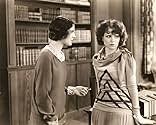
Clara Bow plays her role of mischievous college girl, Stella Ames, to-the-hilt. And a young, debonaire Frederic March as straight-laced college professor Gilmore is her perfect counterpart.
The way the two begin seeing eye-to-eye may be said to be expected, but not totally predictable--because the antics of Stella Ames and her sorority sisters provide just the right element of subplot. If there was any one flaw in this gem, it was that the sound quality was often so scratchy, I was unsure, now and again, what one actor or another had said.
Still, this in no way detracts from the film's overall quality. (One must taken into account, after all, that 1929 was the infancy of the "talkie" era). Come to think of it, I can
only imagine what a "wild party" '29 must've been for many Hollywood executives and stars alike--the huge stock market crash aside!
Did you know
- TriviaThis movie is credited with the first use and invention of the "Boom Mic." Dorothy Arzner had a tech put the microphone on the end of a fishing pole and had the tech follow the actors to capture the sound.
- Quotes
James Gilmore: Have you ever seen the college from here? It's beautiful isn't it? Have you ever thought why it's there? Fifty or sixty years ago, a great woman suffered and slaved to build it. She braved the ridicule of her friends and the abuse of her contemporaries to bring a true freedom to women. Others have given their best to it because they have the same ideals. And what has happened to their ideal? You and others like you have turned the college into a country club for four years. Four years that you don't know how to occupy better. You haven't the slightest idea what true freedom means. Instead, you jazz around glorying in sham freedom. Life to you is just one wild party. You have no aim. All you want is cheap sensation.
Stella Ames: It's not true.
James Gilmore: Now be honest, why did you go to that roadhouse tonight?
Stella Ames: [defiantly] Because I wanted to.
James Gilmore: [sarcastically] Superb reason. Because you wanted to. You fairly compel my respect. Because you wanted to. You risked scandal, expulsion; you involve me in a messy adventure that might cost me my job...
Stella Ames: I didn't ask you to come after me.
James Gilmore: Is that all it means to you?
[starts to depart]
Stella Ames: [pulling him back] I'm sorry I said that. Why do you hate me so?
James Gilmore: Hate you? How could I hate you when I would have killed for you?
[they embrace]
- Alternate versionsParamount also released this movie in a silent version with film length of 1848m.
- ConnectionsFeatured in Clara Bow: Discovering the It Girl (1999)
- How long is The Wild Party?Powered by Alexa
Details
- Runtime
- 1h 17m(77 min)
- Color