It is not always certain that by mixing comedians together you will produce laughter. The comics involved have to actually like or admire each other, or be willing to put up with each other's crankiness. GO WEST with the Marx Brothers had Buster Keaton write the script as a gag man. Groucho did not think too highly of Keaton's ideas, and embarrassed him at a script meeting. And though some of Keaton's gems still appear in the finished film (such as the gun that turns into a brush that turns into a gun) the film was one of the weakest the Marx Brothers ever made.
A better film, but also affected by dueling comic egos, was W.C. Fields and Mae West in MY LITTLE CHICKADEE, which jettisoned the script for a series of duels of one liners between the leads. But the one liners were equally funny, so the film remains a success.
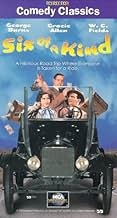
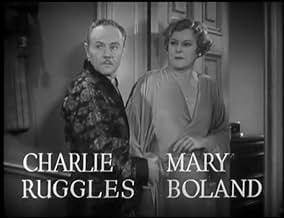
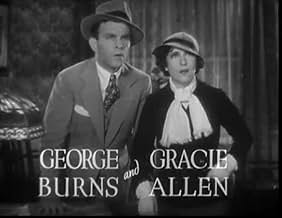
But SIX OF A KIND is an example of six film comics who worked well together. The reason is simple: it is really three comic teams working together: Charlie Ruggles and Mary Boland, George Burns and Gracie Allan, and W.C. Fields and Alison Skipworth. Ruggles and Boland were paired in about half a dozen comedies during the 1930s, usually with Boland as a somewhat bossy wife, and Ruggles as a nervous wreck of a husband. Fields (usually a single act) was paired three times with Skipworth (TILLY AND GUS and IF I HAD A MILLION were the other two times). Skippy always figured out how to control or counter the larcenous activities of her man - it the present film she takes action into her own hands with the stolen money that is being searched for (she knows that the local sheriff, Fields, is not the one to trust with this). As for Burns and Allan they manage to effortlessly involve themselves with the put upon Ruggles and Boland on their cross-country trip by car.
Ruggles quickly gets to realize what a mistake it was to agree to travel with Gracie - at one point she manages to cause him to fall off a cliff, and dangle from a branch. He is relatively helpless when she insists on 1) photographing him on his perch, and 2) correcting his grammar. The presence of George and Gracie's humongous dog ("Ran Tang Tang" is it's name) does not make travel arrangements easier for Charlie and Mary.
Fields has some choice moments. When he insists on shouting at the quartet, he says he's allowed to do so - he's the sheriff! He also explains, during a pool game, the improbable story of how he got his undeserved moniker "Honest John". You have to listen carefully to the tale, as it is interrupted with his attempts to play pool a few times (once getting accidentally beaned by a billiard ball), but it does show that there were items that even Fields would have had no reason to steal.
Oh, in the "Summary Line", I mentioned a forgotten actor named Bradley Page - he was the man who is responsible for the trouble that Charley Ruggles is suspected of. Bradley has to have a reason to leave town in order to catch up with the unwary Ruggles and Boland, so he telephones his girl friend. He tells her to call back his job and say that he has to leave town because somebody has died. There is a pause as he apparently hears a question shot back by the girlfriend. "ANYBODY!", he says - clearly annoyed. Although the bulk of the humor in the film is carried by the sextet of performers, Mr.Page happened to have the most amusingly unexpected line in the film.