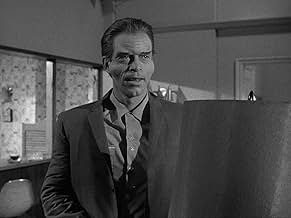
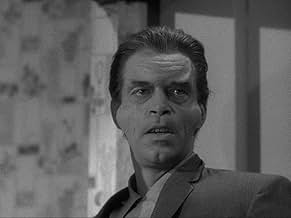
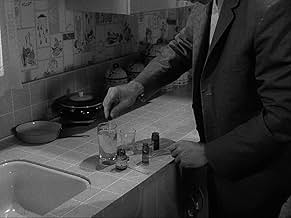
Trying to chemically tap into Man's full brain potential, a scientist recklessly experiments on himself. He indeed gains super intelligence and new abilities but at the cost of his morality ... Read allTrying to chemically tap into Man's full brain potential, a scientist recklessly experiments on himself. He indeed gains super intelligence and new abilities but at the cost of his morality and humanityTrying to chemically tap into Man's full brain potential, a scientist recklessly experiments on himself. He indeed gains super intelligence and new abilities but at the cost of his morality and humanity
- Night Watchman
- (as Owen McGivney)
- Control Voice
- (uncredited)
- Director
- Writer
- All cast & crew
- Production, box office & more at IMDbPro
Featured reviews
I am convinced that it was a very poor casting mistake to have paired the two actors in an episode which is actually about the facial transformation of one of the characters.
TO THIS DAY, I have to focus on which is which!
Besides that, this was a very engaging episode!
When "The Outer Limits" ran its two seasons, actual drug experimentation was at its apex. Timothy Leary had conducted his experiments with LSD just two years prior, and had mad his "turn on, tune in, drop out" statement, encouraging society to question authority and attempt to expand their world view.
Cockrell took this to the next level, by having scientists experimenting with these drugs, develop a new one that enhanced intelligence, overall physical strength, as well as expanding human consciousness.
Though other reviewers have stated that Cockrell and Oswald managed to make an entertaining anti-drug message, I don't see it that way. Most good science fiction prepares us for the pinnacles and pitfalls of what is yet to be. This episode followed the longstanding trope and did so in a thought provoking fashion.
I did think that, overall, "Expanding Human" treated the matter with a great deal of respect and seriousness. Just because the final scene seems to deliver an "anti-drug" message, in reality, I feel it delivers a "new frontiers have their risks."
Overall a very good episode.
The show begins with a weird primordial sort of man breaking in and stealing some chemicals. He's interrupted and brutally kills a guard with the strength of many men. Soon it becomes obvious that this is someone who has transformed himself into a super-intelligent, super-powerful and super-amoral man--and he's bent on killing again and again if needed. The clues lead to a group of men who have been dabbling into the concept of 'consciousness raising' (a term used by scientists like Timothy Leary when discussing the use of LSD).
All in all, a worthwhile episode even if it is a bit obvious in its underlying message as well as the story itself being a bit of a revised version of the old Robert Lewis Stephenson story. It's also worth noting that this show is one of the few of the era that actually showing a person bleeding. It was necessary for the plot but normally deaths were quite bloodless on TV during this era.
Did you know
- TriviaThis screenplay was inspired in part by Dr. Timothy Leary's experience as a clinical psychologist at Harvard University. Leary worked on the Harvard Psilocybin Project from 1960-62 (LSD and psilocybin were still legal in the United States at the time), resulting in the Concord Prison Experiment and the Marsh Chapel Experiment. The scientific legitimacy and ethics of his research were questioned by other Harvard faculty because he took psychedelics along with research subjects and pressured students to join in. Leary and his colleague, Richard Alpert (who later became known as Ram Dass), were fired from Harvard University in May 1963, the year before this show aired.
- GoofsThe scientists say that the super human version of Clinton predicted a casino Craps game by watching previous rolls of the dice. The scientists would know that not even a super human could do that (because each roll is independent). Only in a Black Jack card game in a casino can previous outcomes assist in future predictions.
- Quotes
Dr. Roy Clinton: Peter, the watchman wasn't going to live forever, you know, so what difference does it make whether it's twenty minutes or twenty years, since neither amounts to the faintest echo of the tiniest whisper in the thunder of time?
Details
- Runtime
- 51m
- Color
- Sound mix
- Aspect ratio
- 1.33 : 1
- 4:3