Showing posts with label Reviews. Show all posts

Monday, July 26, 2021

Throwing Bones


A bunch of us have launched a new co-authored review blog Bones of Contention. The introduction to the blog is here, and you can read the first review in my series, Ludic Dreams, here. I review two new zines from Zinequest 3 that presents systems for tracking NPC relations and ongoing shenanigans, A Small Entanglement of Flowers and Entanglements, and A Tangled Web. 

I'd like to say something about why we launched the blog and how we're thinking of the collective project. We launched the blog out of a sense that there was a problem with the culture of criticism and reviews in the retro-gaming scene. One basic problem with reviews that we face in our little DIY corner of the hobby is that most reviews happen in the form of boosterism, where people share stuff on blogs and social media because they're excited about it. Since this is a small scene, where almost everyone knows almost everyone else, at least at some vanishingly small degree of separation, this often involves friends lifting up the work of friends. Which is great, but it has its obvious limitations. Critical reviews in this mode are rare. If you give over your blog or a twitter thread to write a random critical review of something in this space, the results are hurt feelings (why did you give over your space to single me out?). So game design don't improve through criticism. 

Another problem is one of time. It would be nice to review things regularly. But who has the time, especially if one is also writing material or designing games, not to mention holding down a day job, and all the rest? Similarly, it would be great if more reviews were written as a result of playtesting. How can you have an adequate view of a game product without playing it? Again, problems of organization and time make this unrealistic, especially if you're running a home campaign already. 

Of course, there are some dedicated review sites (especially Questing Beast and Ten Foot Pole) that have been going for a long time that devote huge amounts of time and energy solely to reviews. But they are single-authored and so convey a single point of view. This point of view is often quite valuable, but it's just one established voice. So it would be nice if there were some new perspectives entering the conversation too. Another more politically delicate problem with some of these sites is that they are trollish sites (like Prince of Nothing) or have unmoderated comment sections that through the charming magic of the internet sometimes devolve into flame wars and trollish behavior (i.e. Ten Foot Pole). This makes retro-gaming a less welcoming space than it should be and does absolutely nothing to improve critical discussion and evaluation. 

Our solution to these problems is to create a dedicated review site that avoids boosterism for substantial reviews. Instead of being single authored, we draw on a large enough group of people to keep reviews coming, and do at least some playtesting. Our goal is to try to get at least one review up a week. We also tried to include a diverse group of people as reviewers who have interesting perspectives on games, most of whom are authors in their own right. We tried to include people who would be likely to present thoughtful and interesting reviews that might foster fruitful conversations. If you head over to the blog and meet the Skeleton Crew (as we're calling ourselves) you'll see some of the people involved. They're a group of people whose work I have respected for years, and with whom I'm very excited to be working.  

The idea isn't to create a single school of design, but rather for each contributor to maintain their own independent series of reviews from their own perspective. We will collaborate on some reviews, like our first review of the Isle of the Plangent Mage, but for the most part people will be selecting things to review and writing the reviews on their own. In short, the collective in question is a collaboration between otherwise independent reviewers. Don't think of Bones of Contention like this:

This is not our goal 

Our goal instead is to try to write reviews that provide information about and give visibility to products, but also say something interesting about retro or classic game design (for authors and DIY enthusiasts), each from our own perspective as authors and designers. We're also moderating comments in order to avoid the trollish comments and flame wars. I have moderated the comments here for a long time, without any loss in quality. (The worst thing to ever happen was I deleted a strange thread of comments in which Kent was making fun of a shirt I was wearing. On a typical day, the only thing I delete are solicitations for vampirism and sorcery.) 

Anyway, check the blog out here and give it a follow in your reader, RSS feeds, on blogger, or however people are reading blogs nowadays. 


Tuesday, December 22, 2020

Prison of the Hated Pretender [Review]


Prison of the Hated Pretender is a module published by Hydra Cooperate and written by Gus L. It is available here on DriveThruRPG for the low price of PWYW. It is designed as a first level starter adventure, intended to introduce new players and DMs to exploration based play. Obviously this review contains spoilers, so if you might play in the Prison of the Hated Pretender, you should probably stop now. Also full disclosure: I collaborate with Gus on Through Ultan's Door. (Although if you want to know why, this review explains it.)

Although it does present a starter homebase (a miserable little village called "Broken Huts"), the bulk of the module is taken up with the titular prison. The dungeon is designed to showcase and teach exploration-based play. Gus has an imagination for locations that I sorely envy as a DM and author. With him nothing is boring straight corridors and square rooms, or featureless caverns. In this case the prison is a ten room, four floor (including basement and roof) affair carved out of rock to look like the crowned head of the hated pretender. 


As they approach the dungeon, right away the players are presented with a meaningful choice, for they can simply walk in the front door, or they can climb a tree up to the eyehole windows on the second floor, or even scramble over the top of the head to a roof that is surrounded by the stone crowned pate of the head. The natural entrance to start with on the ground floor immediately introduces danger and adventure, since the first thing the PCs see is a sigil holding back strange entities within. 

The two opposed factions of the dungeon are interesting and evocative. No skeletons or orcs here! First, the Phantasms of Vengeance, celestial monstrosities that are drawn from the Celestial Thrones to our reality by the sanctified bones (and twice sacrificed souls) of the righteous victims of the Hated Pretender. The Phantasms take diverse otherworldly forms like animate stained glass, tangles of silver wings, or orbs of celestial light. While not very powerful individually, there are many of them, and they reform later if slain. Second, there is the hated pretender, a pitiful if dangerous revenant. Scatterbrained wreck of his former tyrannical self, his desires are pitifully simple: treasure, mortal food, and escape from the torment of the Phantasms of Vengeance. He too is recreated each night if slain. 


One feature of exploration based play the dungeon is designed to highlight is that combat is not its own reward, but something to be avoided where possible, and risked where worthwhile. Fighting through the Phantasms is a deadly fool's errand. While the Phantasms cannot be reasoned with, the Pretender can be spoken with and has interests and desires that allow for negotiation and a source of information about the environment. (The way he's described and drawn I think it would be easy to DM him, and the interactions would be memorable.) In neither case does effective resolution come mainly through combat. 

The whole dungeon is constructed like a puzzle, the solution to which hinges on piecing together the relation of the two different factions to one another and the prison. The key is the day/night cycle, since the Phantasms of Vengeance can only go where there is light, and as a result, the Hated Pretender sticks to darkness. There are campaign altering possibilities here, since the PCs can put the Pretender and Phantasms to rest if they figure out what's going on, or inadvertently free them if they blunder, with large effects on the setting. They can also an artifact to receive prophetic visions of the future with large ramifications, and there is rich (if hard to access) treasure in the dungeon too.   

I am hard pressed to think of a better, more immediately evocative and interesting introduction to exploration based retro-game play. The dungeon is a perfectly constructed little jewel-box of retro-game play. In fact, it's a kind of master class in how to design a dungeon in a way that builds the relation of factions and mysteries to be unravelled in at the ground floor. What's miraculous is that Gus does all this...with a ten room dungeon. 

The idea of the module as a kind of "class" is thematized by the inclusion of side bars that explain in plain terms what style of play is presupposed in the design of the dungeons. Gus the teach' explains why the factions are not "good guys" and "bad guys", why there is no presupposed way the PCs are expected to interact with the environment, and why combat is not a preordained outcome. There is also a conversion to 5E at the end, along with a couple more notes from the teach' on how to run this style of adventure in 5E. It's clearly intended as a bridge to retro-game play, offered in a friendly spirit to 5E. I don't know if it will find its way into their digital hands, but I hope it does. 


The cartography of the module is good, aesthetically pleasing but simple with most of the major features drawn clearly on the map. (Gus' cartography is always good.) The module also has handy extra maps, including one version that is blank (for screensharing) and one with a helpful cheat sheet on it. Gus has also developed a special notation that is meant to help synthesize information at the table, with light sources and traps mentioned up top, notable features bolded in the room's description, treasures italicized, and threats underlined. It's a system of information that I find is helpful at the table, except for large informationally dense rooms where my eyes cross, and I can't parse the different fonts and keep track of their meaning.  

In short, this a perfect low-level module to kick off a new campaign, or introduce players to retro-game play. Even us old hands can learn a thing or two about dungeon design from it. Oh yeah, and while you're on his DTRPG page, be sure to pick up his one page dungeon Star Spire too. It's a real pretty 1 page dungeon usable with any older edition of D&D or their retro-clones. It's a groovy little number that would fit right into a UVG campaign, for example. 


Monday, October 1, 2018

Reviews: Echoes of Fomalhaut


This is a review of the first issue of Gabor Lux's zine, Echoes of Fomalhaut. For those of you who don't know him, under the moniker Melan, Lux was a valuable contributor to early OSR conversations. He has exquisite taste if you like swords and sorcery running towards the weird. To get the flavor his imagination and bursting creativity, check out this thread about his creation of the undercity of Khosura. He has an English language blog primarily dedicated to reviewing old school modules. You can see a great recent interview with him on False Machine here. And now he has launched a zine.

While I have more nuanced things to say below, the basic message is: it's packed to the gills with fantastic stuff. It has the spirit of the best early Judge's Guild stuff and a quirky sword & sorcery flavor. If you like that sort of thing you would be a fool not to buy it. You can get print versions of the first two issues here and PDFs here. I gather the third issue is on the way soon.

The first issue has a random table of merchants, a section on house rules about morale, a massive selections of philtres and dusts, and no less than 3 adventures, including one, Beware The Beekeeper, with 49 numbered areas! Furthermore, the first issue comes with a large, folded player's map of an unnamed city, printed on nice vellum. Talk about value for your buck.


The table of merchants is wonderful. There are a total of 100 million possible combinations. Many results are themselves excellent adventure seeds, e.g. "A distracted judge pursued by a mummy is selling titles to a kingdom" or "a dull prostitute is selling snakes to ruin a competitor". Others are just very flavorful, e.g. "A paranoid vagrant is selling a shave, now on sale!" The next time I run the City State of the Invincible Overlord, I am absolutely using this table. The philtres and dusts are useful and flavorful as well. For example: "Dust of the Radiant Sun (400gp): a golden granule resembling finely crushed glass, the particles of this dust can be hurled into the air, where they stay afloat and become pinpoints of searing heat. Passing through a field of particles does 3d8 damage. The dust settles in 1d6 hours." Woah, how cool is that?

The biggest dungeon in the zine is Beware the Beekeeper. It is set in the Singing Caverns, so called because of the sound the winds make blowing through the three cave mouth entrances. It has a strong British Fighting Fantasy aesthetic. For example, one of the cave mouths into the dungeon is blocked by a door with three faces that can all be rotated for different effects. When I read the passage I just hear in my head, "If you twist the angry face, turn to page 243. If you twist the sleepy face, turn to page 12. If you twist the sad face, turn to 131. If you wish to retrace your steps and try another cave mouth, turn to page 44." On the first level, there are the chambers of a mad druid (the Beekeeper) accompanied by swarms of bees, a tavern run by orcs complete with menu options, and on a lower level, a bandit layer and some forgotten antique bathes. The dungeon is full of nice little touches, like this piece of treasure: "A discarded piece of brass hammered into the crude likeness of a fish is magical, and will make for a spear +2 if mounted on a shaft." I ran if for my son and his friends just the other day and it was fun.

This image by Russ Nicholson does not appear in the zine. But shouldn't it?

The zine contains two other adventure locales. The first is the Red Mound, a wonderful little adventure locale, with only a few places to visit, but each containing further adventure seeds. There's a potent but cursed sword, a hidden portal to someplace perilous, and a forgotten god whom one can serve. I like the idea of this kind of adventure locale, where it provides a series of flavorful hooks and seeds to be further developed by the DM. It would be a neat recurring feature in a zine, maybe called "Seeds of Adventure".

The last adventure, The Mysterious Manor,  is a bridge to the setting introduced in issue 2 of the zine. In fact, there are many bits and pieces of it that you won't know the full import of until you read that later issue. For this reason, I actually recommend reading it after you have read issue 2. My view is that this adventure, while containing some excellent material, is not quite as gripping as the other two. A pirate's gang of humanoid baddies have holed up in a mansion over the haunted crypts of an ancient family, the Bonifaces. The pirate's gang part is interesting, because Lux's humanoids have more varied and nuanced motivations than typical orcs, so negotiations or subterfuge will possible and prudent. Their cultist pirate boss is certainly cool. But still the upper levels didn't grab me especially, nor did the mystery of the haunting on the lower level. I had a little trouble imagining why a party would poke around here long enough to uncover the mystery, nor did the denouement seem as compelling as it might. Given how much other great stuff there is in the zine, this near miss is not a serious complaint.

A more serious if churlish complaint about the zine is that it has too much stuff in it. At certain point, through no fault of the material, it all blended together in my mind. This was abetted by the fact that the first issue is really committed to its zinish-ness: the type is tiny and uses a standard font; the layout is utilitarian; there is some decent (but not inspiring) new art, but not much, mixed with public domain images; and the maps, while pleasing in their design, and having a certain charm in execution, also look kind of scrawled.


The walls of tiny text, unmediated by principles of graphic design, eventually induce a sort of trance state that Lux works hard against with his quirky and delicious imagination. It's also true that the adventure locales in the first issue have nothing to do with one another, or with a common theme, and this also makes it hard to hold the whole thing in your head at once. It's hard to complain when someone is clearly focused on giving you as much usable and flavorful content as they possibly can without getting hung up on further distractions. But I wish Lux cared a little bit more about conveying his vision through artwork and layout.

The second issue suffers somewhat less from this problem, not because it's shorter--it's longer!--but because it is centrally focused on presenting a setting, and one city in that setting, Gont: Nest of Spies. So it has a kind of unity to it that focuses the mind. And Gont is a great city that channels the City State of the Invincible Overlord to excellent effect. But in the interest of actually having this review see the light of day, I'll have to save my thoughts about issue 2 for another time. In the meantime, buy this truly excellent zine now!


Tuesday, September 5, 2017

The Night Wolf Inn: A Review


The Nightwolf Inn is a campaign sourcebook by Anthony Huso for first edition AD&D. A strange inn with polished opulence has appeared at the edge of town. The place seems full of foreigners no one remembers having come through town. Inquiries from eager merchants reveal the rooms are available only for members of "the Excursionist Guild"; further confused queries reveal this to be some sort of secret society associated with the inn. With an apologetic smile, the concierge deftly pushes forward a neatly drawn up list, "Surely gentlemen, one of these other estimable local establishments will be up to your discerning standards."

But, if instead of fat merchants, a band of pell-mell miscreants should inquire, hardened mercenaries shoulder to shoulder with occult dreamers and jewel thieves, promptly a fee will be named and guild membership extended. For the inn is a deadly enigma, a perilous contest, a source of adventure and wealth without end to lure those hungry men and women who, while possessing rare talents, do not rate their own lives too dear.


There are two different sorts of adventure locale to be found in the Nightwolf Inn. The first are "the wilds" of the guest rooms. Guildmembers will be presented with a menu of rooms with intriguing names along with varying prices, often exorbitant, for a single night's stay. Within their rented suite they will find a small area with a bed and other furniture, and (usually) a remarkable item for use during their stay. The furniture exists in a safe zone superimposed on wilds that extend in every direction. For each room borders on another dimension just waiting to be explored.

Many of these room entries are quire good, briefly explaining the nature of the dimension, providing a description of the area immediately beyond the furniture, listing a few evocative adventure seeds, and providing an encounter chart. One room is in the belfry of a cathedral looking down on the streets of a perpetually nighted, demon-ruled city. The furniture in another rests on a swaying sea of green that is actually a biome on the top of an unimaginably vast forest. One leads to an alien archaeological dig, full of ancient horrors and mind flayer scientists; another to a strange swamp world that will suck travelers down to a tubular maze full of fetid vapors in the root system below. And so on. Some are gimmicky in a nice way, like a blank "Harold's purple crayon" world that the PC's can paint their way through. Others are drawn directly form AD&D's baroque planar mythology.

The other site of adventure is the inn itself. For, beneath the sun-soaked solarium, the tavern's rich menu, and the quiet competence of the staff, hints of something darker glister. It contains roughly three different dungeon sites for exploration: the the cellars, the area beyond a terrible black door, and the towers and rooftops. They are intriguing and deadly in a hardcore AD&D sort of way. Huso is a professional mapper, and all these areas, as well as the more mundane parts of the Inn are attractively mapped and lovingly described.  A clue that something very odd is going on lies in the fact that guildmembers are encouraged to explore the inn, and are told that they may keep whatever they find outside of the common areas.

This is a pretty map


The Nightwolf Inn exists in seven places in the campaign world simultaneously. When you exit the inn you return to wherever you entered the inn from. This means that the tavern of the inn will always be an interesting place to visit, with silk merchants and spice traders next to fur clad barbarians from the icy wastes, and whatever other weirdo cultures from the forgotten corners of your world. The existence of the Excursionist Guild guarantees from the get-go that there will be memorable rival adventuring parties a plenty, drawn from diverse cultures. This is all great fun, as it allows the DM to introduce delicious tidbits of meaningful flavor and world building without info dumps or massive encyclopedic information about the world. I mean, what better way to design a world organically than to start with rival adventuring parties from different cultures?

As players explore the inn and the wilds, and slowly progress through the ranks of the guild, it will become increasingly clear that the inn itself is a deadly puzzle to be solved for unimaginable gains. There is a gothic backstory, involving the hideous nature of the inn, the personal tragedy of its maker (now a lich), and the schemes of infernal beings. One nice feature of this campaign setting is that it somehow manages to combine delicious plane hopping madness with this rich gothic, almost Lovecraftian, background tapestry that can be unravelled by the players slowly. Solving the puzzle of the inn involves the use of black lenses across the wilds, and  trip to a cursed city buried in the stars. It's suitably metal and very challenging.
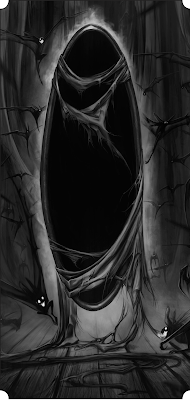
The Black Mirror: One Piece of The Puzzle

This product passes my very high bar of approval by delivering positive verdicts to the following questions: does a product make my mind spin with ideas? Do tables and adventure hooks begin to write themselves in my mind? Can I imagine running it with pleasure? Does it inspire a kind of longing to run it? Does it teach me something about what I could do in my own games? I'll tell you in a minute about how I would go about running it, what I would change, and so on. (I'm planning on using a toned down, less deadly version for the game I run for my son and his friends eventually.)

But first. This is not to say that the product is without problems. Indeed, part of my reason for writing this review is that this product is less likely to get the viewing that it deserves because Huso has put up some roadblocks. The first problem is organizational. There are some nice features, like collected maps at the back, handy tables, reference documents, and some player handouts, including tavern and room menus, which are all to the good. However, essential information is not presented in the book in a sequential order that facilitates a first reading. The backstory of the inn, necessary for understanding many keyed areas, is in an appendix, as is basic information about the guild. I was about twenty pages into the module before I realized that the heart of it was the dimensional wilds in the guest rooms. Luckily, this is easy to fix. Here's the order you should read the book in:

1. Foreward, Introduction, Basics of the Inn pp. 4-12 (stop reading at the key)
2. Joining the Guild 113-115
3. The Starry Curse and All the Secrets 153-157
4. Core NPCs and Staff 117-131
5. Then peruse the Wilds 83-112
6. Familiarize yourself with the layout of the 1st and 2nd floor common areas of the Inn 12-31
7. And finally, take a gander at the dungeons, including the Cellars 51-82, the Dark Passage 33-40, and Attic and Towers 45-49.

What Huso says in the foreword points to another issue, "You will see the creations of a teenage DM from the 1980s who hung on every word that proceeded from the mouth of Gary Gygax. And you will see those creations not as they were then, but tempered and polished by my 40-something-year-old-self, who has finally come full circle, finally returning to the table after many years of raising children, writing novels, and and doing other things. It is my sincerest hope that I have written something that Gary himself might look down on from whatever cloud he's on and smile."

Some traces of juvenalia remain that his 40-something-year-old-self clearly couldn't bring himself to temper, like an uber-powerful, super hot, half-elf bard npc called "Rain", and a manly concierge named "Jeeves Everbleed". But more to the point, this setting is written to be run with an (almost) strict by the book version of 1E AD&D pre-Unearthed Arcana. Almost all magic items and nearly all monsters are drawn from these sources.

On the one hand, it's fun to see what Gygax's masterpiece can do with all the bells and whistles. And since planar adventuring is the direction he was headed before his ouster from TSR, this setting has a nice decadent late Gygaxian what-might-have-been flavor to it. BUT there is something more than a little perverse about juxtaposing a setting with such an unshackled imaginative premise, pretty much built for a wild ride from the first session, with the strange by-the-book restriction on monsters included. I mean, there is some pleasure in seeing all the weirdos from Monster Manual II and Fiend Folio put in places where they actually seem to belong. But why go to the trouble of imagining the hell out of different dimensions and not imagine the hell out of the beings who live there?

On the other hand, this thing is in there, so that's cool

How Would I Run This?

The first thing I would do is take a look at the less expensive guest rooms that a lower level party could afford to visit (I, IV, VII, and X). The concierge will steer them gently away from IX as perilous, and will caution them about prematurely embarking on XVIII and XIX. For the four main starter rooms, I would write up mini hex maps for them, drawing on Huso's adventure seeds, supplemented by my own demented ideas. Of course, not all of Huso's pocket dimensions resonate equally with me. In creating my own dimensions, I would draw on planescrap for inspiration, and would doubtless give a weird reskinning to most of the MMII and Fiend Folio creatures in the encounter tables Huso provides.

I would run the inn and its dungeons pretty much exactly as written, because they're a lot of fun in a classic AD&D sort of way. I think this will provide a nice contrast with the more far out planar escapades provided by the wilds.

The second thing I would do to run this would be to decide what fictional seven locations the inn touches in the campaign. A name of the city or other region will suffice, along with a few sentences giving the flavor of the place. For example, "On the avenue of Thralls, city of Abishet, spice road metropolis. Slave trade, ecstatic drug cults." Or, "Outside the pilgrimage site to the ice womb of the Mother of Frozen Tears. Pilgrims are rugged hunters and tattooed berserkers of the icy wastes, but very polite."

The third thing I would do is figure out what rival adventuring parties belong to the Excursionist Guild. Huso has a great table at the end with 100 members of the guild, belonging to companies with names like "Graverobbers & Sundry", "Derelicts Anonymous", or "Crimson Leavings". This is a nice start. But if I were running this as the main focus of adventure, I would really play up the competitive nature of the Excursionists Guild. Rival adventuring parties would be the main factions and rivals, in addition to the inn master and his employees. I would write up seven or eight of these companies, at different levels of the guild, drawn from the six other campaign locations, and try to make them as distinctive and interesting as possible. This would be great fun, since coming up with rival adventurers is a joy in my experience. I would probably make the mystery of the inn a little bit easier to first get involved with, treating it as more of an open competition than a dim secret. I would make it a little bit harder to solve ultimately (not more deadly, just more pieces, and false leads). I would introduce several competing theories about what the mystery is and how to solve it, and assign these theories to different rival adventuring parties.

The fourth thing I would do would be to draw up random tables for the activities, successes and failures of the rival parties. This would cover when they were away from Inn, when they were off investigating this or that dungeon in the inn, or this or that guest room, and how successful they were. I imagine that the party will want to spy on other parties, and keep tabs on their movements--I imagine a lot of intrigue, shifting alliances, attempts at sabotage and so on.  Of course, a TPK for one of these groups will present an incredible (and perilous) opportunity to acquire their loot, and perhaps the knowledge they've acquired.

The fifth thing I would do is come up with a big table (or series of tables) for who is in the tavern of the inn, and events there. The bigger and more fleshed out these tables are the better. The inn is open to the public of seven different locations in the world, in addition to the rival adventurers in the Excursionist's Guild.

Finally, procedurally, the most important thing I would do in running the inn is make the players tell me in advance what they were going to do each session, falling back on Huso's written text to improvise where necessary. Eventually I would have enough material to be more or less ready to go without such forewarning, but in an interplanar sandbox, it would take a long while.

In Sum:

If an inter-planar sandbox with competing companies of rival adventurers set against the backdrop of a gothic mystery sounds neat to you, then you should definitely buy this. It's the kind of idiosyncratic, imaginative, product of love that only people with mad talents in a niche gaming community like ours can make. I think Gary's probably smiling.

You can get it here.
I will repost this picture of Gary as many times as I can get away with it

Sunday, January 22, 2017

The Nightmares Underneath: Review


My interest was piqued when +B. Portly flashed an image of a mysterious gorgeous tome on G+. Given the fact that I've been running a campaign set in the dreamlands for more than a year now, when I heard that this book was an OSR supplement about the nightmare realm bleeding through into reality, I felt I had to take a look. Unlike many other names in the OSR whose work I know well, I'm not familiar with +Johnstone Metzger 's ouevre. I bought his module Evil Wizards in a Cave a ways back, and it did not make much of an impression on me. So I wasn't sure what I'd be getting. I was delighted to discover that this book is very, very good--good along an unusual number of dimensions.

The book is aesthetically attractive as a physical artifact. You can order it as a hardcover from Lulu with a dust jacket that makes it look like an antique gilded tome. (Buyers beware, Lulu dust jackets have a tendency to curl a bit.) Within the text is laid out in an effective manner with baroque embellishments that don't interfere with the presentation of the material. The generous illustrations are mainly collages of heavily altered public domain images, including paintings. Some are (probably) original pieces drawn by Metzger. The alterations fit the setting and feel of the book. It does a wonderful job as I hope these images convey.


The setting of the book is distinctive and evocative. It is a world of high islamic civilization. The forces of law and reason have conquered the forces of chaos, including the idolatry of the pagans. It is less the wild world of the Arabian Nights, than the orderly civilization of the Abbasid Caliphate and the Ottoman Empire. Here the scholarly interpretation of the law and scripture reigns supreme, and there is great respect for art, science, and technology.

But beneath the bright sunlight of faith and reason, a dark inverted world grows. In cramped and claustrophobic spaces, incursions from the realm of nightmares spring. They are inhabited by horrors, that often draw in their wake strange and numinous creatures from the astral deep or the inhuman realms of faerie. They corrupt surrounding human settlements, feeding on their traumas, their obsessions, their sins, and their fears.


The players are the rare individuals who are drawn to these incursions, and who, for reasons unknown, are immune to their corrupting influence that destroys or bends ordinary people to its purposes. The party is a band of pariahs, perhaps murder hobos, self-seeking adventurers, who operate outside the normal social structures. Society tolerates them and makes space for them, not because it approves of them, but because they are its only defense against the darkness below. This is a pleasing and original take on a cluster of concepts from early D&D including the original opposition of law vs. chaos, as well as the assumption that the party will be a bunch of self-seeking treasure hunters operating outside of the bounds of ordinary social life.

These nightmare incursions tend to appear in wild and remote places, near enough to a human settlement to feed on its fears and desires, although they can also pop up in the middle of civilization. All possess an anchor, an object that is associated with great emotion, a human  heirloom, often quite valuable. The anchor is what ties the nightmare realm to the waking world--removing it causes the incursion to collapse. Each incursion is the seat of a Crown, a single type of nightmare embodying the theme of the incursion, a theme connected to its location and its anchor. The idea, which warms my heart, is that each incursion will be conceptually tight dungeon with mechanics, aesthetics, and foes suited to its theme.

For example, a nightmare incursion might exists in the ruins of a city decimated by the famine of a great siege. It has grown in the tunnels that the desperate residents clawed in their final attempts to escape the city. Among the few survivors, a corrupted cult has arisen, worshipping the nightmares that have extended the cramped tunnels into a strange inner space. In return for their sacrifices, the cultists are blessed with an insatiably hunger and the rich bounties of endless feasting. The mechanics of the dungeon would all be about desperate resource depletion, and the Crown would be some horror with a distended belly somehow representing the union of imagined gluttony and desperate hunger.

These incursions appear in inter-related clusters. The (level 1) incursions connect to the waking world, and most resemble it. But as one travels deeper in to further levels closer to the nightmare realm, one leaves the trappings of our reality further behind. For example, perhaps a great collector has gone missing. His heirs have noticed that several of his prize possessions are missing. In their search for these rare treasures they discover a strange and impossible tunnel in the back of one of his curiosity cabinets. They fear the worst. And they are right: the tunnel leads to a series of interconnected nightmare incursions, each representing the history of the relevant artifact, overlaid with the obsessive jealousy of the collector. The collector himself now resides in the deepest incursion as a host to the Crown of this level. His incursion is a glittering dungeon of intricate and impossible puzzle pieces arranged with the loving care of his possessions. It's strange traps and jeweled Escher spaces have attracted alien entities from the astral depths.

While I don't think it would be easy to crank out dungeons like this, the section on creating a nightmare incursion provides a lot of tools to help. Best of all, the bestiary contains a wonderful trove of Crowns that serve as excellent examples. The bestiary is really freaky and wonderful. The entities from the Astral Deeps and Fairie are just as good.

My favorite Crown from the bestiary, Wound Men.
This book is not a campaign setting. It is an entire game, complete with its own rule set intended to support play in this setting. (In this, it resembles the incredibly tight OD&D variant rules recently put out by +Gus L tailored closely to his Apollyon campaign setting.) Sure, I can come up with rules for hexcrawling in a verticle jungle if I have to, but the truth is that I'm not a rules guy--at the end of the day it's hard for me to get very excited about rules. I use the AD&D lite rules (LL AEC) because they're comfortable, and don't require me to keep track of very many things. But I enjoyed Metzger's rules. My impression is that like his pictures, they are a collage of existing rules from a variety of sources, artfully manipulated and altered for his purposes. I can really only scratch the surface here for you. Let me end by telling you about some of the rules.

Stats are renamed versions of the list we all know and love, 3d6 in order. The classes are flavorful and, although corresponding mostly to AD&D classes, are quite different in their execution. Every class can cast spells drawn from a single list, although not necessarily very well. Each also has a few mechanically elegant abilities. Clerics are replaced by cultists. They do not have a separate spell list, although they can turn the hated foes of their cult, drawn from a small list of the entities found in the setting (including mankind!).

When it comes to combat, variable weapon damage is used, but it's determined by the hit die of your class instead of the type of weapon. This is an elegant solution to the aesthetic ickiness of weapon restrictions. Although fighters (along with thieves) are worse spellcasters than other classes, they automatically do damage in combat. If they hit they do damage twice. Combat also uses a version of +Logan Knight 's Grit and Flesh, to track the difference between temporary damage and real lasting wounds.

The skill system is elegant. If you are trained in something that would actually require training to do, and have the proper tools at hand, then you must roll the relevant attribute or lower on a d20. If you either are untrained or lack the proper tools, then you must roll equal to or under one half the relevant attribute. There is no official list of skills, although the classes all come with a general description of what they are skilled in. The player is also encouraged to come up with a background for her character on creation. She is trained in whatever it makes sense for her to be trained in. This avoids the cumbersome non-weapon proficiency lists (or, heaven forbid, the skill system of 3x.) and keeps things nice and loose. It also encourages players to think about who their character is a bit before play.

Now this skill system might seem to put a lot of weight on attribute scores, especially in a 3d6 in order system. But every time you go up a level you get a chance to raise two attribute scores, one of which must be one of the two prime attribute scores of your class. If you roll higher than the attribute it goes up one or two points depending on how low it is. As characters advance in level, they have a decent chance to bring any low stats up to a reasonable level, and a fair chance to get a prime attribute up to a reasonably high level. I find the interaction of the skill system with the attribute increases a nice synergy. I haven't tried it, but I bet it would work pretty well in play.

Probably my favorite rules innovation in this game is a nice early domain game of institution building. As PC's begin spending money in town, they build up the institutions where their coin flows, whether it's a tea house, druggist, university, court, or a necromancer's guild. As the institution grows in stature, the player acquire contacts and gains more favorable interactions with them. There's also a chance that the institution eventually acquires the alignment of the character who funds it. I think this would be a lot of fun, and lead organically to intrigue and engagement with a richly developed setting outside the dungeon. There are also some fun rules for inflation and building resentment to the players.

In short, you should buy this book. It's beautiful. The setting is evocative. The core conceit of the dungeon as nightmare incursion is fun. The bestiary is nuts. And the rules are interesting.

You can find links here to a free version of the PDF (no art), or to buy the full version of the PDF, as well print copies in hard and softcover. Metzger has also released a free (PWYW) pdf of a sample module which can also be purchased in print. You can get find links to both here.

Sunday, August 31, 2014

The Road of Lost Tombs


The Road of Lost Tombs is a free adventure by Gus L. of the Dungeon of Signs blog. He is a prodigious creator, with over 12 free adventures available here. The module is inspired by Piranesi’s etchings of the Via Appia. These etchings represent the Via Appia as a phantasmagoria of cluttered and incongruous monuments and tombs. In the adventure, the road once was the major trade route connecting the Capital with outer provinces. Later it became the pilgrim’s way to the religious centers of the Empire. Now, having lost this function as well, it is an ancient road leading nowhere. But throughout its history it has served as burial grounds, accumulating the surreal pastiche of tombs and monuments depicted in its source material. The great achievement of the module is that in 42 pages Gus L. channels these etchings into something strange and wonderful that could serve as the centerpiece of an entire campaign.

The hook for the adventure is a familiar one. People have been disappearing from the Road of Lost Tombs. Until the troubles began, it served as the primary smuggling route along into the city. Hints suggest that it has something to do with the Red Massif, the tomb of an ancient sorcerer general and his slaves that lies 20 miles down the road. In the few miles just beyond the city walls the Road of Lost Tombs is a red light district. Beyond the reach of the law, its abandoned mausoleums and catacombs have been converted into whorehouses, black-market bazaars, and sword schools where ex-gladiators teach the finer points of bloodletting. The module includes a rich set of rumor tables about the trouble on the road.  They have separate entries for the bearer of the rumor and the rumor itself. This allows the society of the red light district comes to life by introducing a fine cast characters. There are some wonderful touches, including a guild of tomb robbers who are marked by the stone mask they must wear in public, and an ex-gladiator who sips water painfully through a grill that has been bolted to his head. In short, the red light district is the sort of place where adventuring scum should feel right at home—the seedbed of a thousand lawless adventure.

Further out, the road becomes a forlorn and dangerous place. The adventure provides a brief encounter table (d6) for the road that is evocative but a little thin. For the adventure, this is not a problem, since the trip to the Red Massif will take the PCs only a few hours on horseback, or a day on foot. The table includes the unquiet dead, and also a neat reimagining of owlbears as arcanovors who feast on magical trinkets scrounged from graves. I love the idea of owlbears as scavengers among the tombs, but was itching for a grottier version. If I were going to run this, I would probably treat them as filthy beasts, drinking putrid flesh, cracking dried bones, and rutting and rolling in the dust of tombs. 

The destination of their travels, the Red Massif itself is an enormous cube of red stone, pulled from the rock below through the sorcerer general’s puissant art. Gus L. provides a gorgeous map. (Even if you don’t want the adventure, you should download this map. Just staring at it for 5 minutes will give you all kinds of ideas.) Gus L.’s maps are among my favorites, up there with Benoist Poire’s rare achievements. The massif has four locations: the Necromancer’s Repose, The Court of the Robber’s Bride, The Chambers of the Sleeping God, and the Feast Halls.  Each of the locations is well crafted. 


The necromancer’s former abode is pleasantly quirky and low-key. (He was no great shakes, being primarily a re-animator of horses.) It is the sole location not connected to the others. The Chambers of the Slumbering God is delightful. The God in question is a yazata, a war titan, the greatest servitor and siege weapon of the sorcerer general. He lies curled up, his slumbering body taking up an entire cave through which the underground river on the map passes. His empyrean dreams of the Celestial Thrones have poisoned his resting place, and woe to those who manage to awaken him!   

The main action comes with the other two locations. The Feast Halls is the home to the Order of the Golden Feast, a truly hideous cult that has set up an inn in the massif to lure travelers into their clutches. The Order is a formidable adversary and the descriptions of their depredations are not for the faint of heart. They are highly organized with packs of paralysis inducing ghouls on leashes and eerie cursed hounds whose baying can be heard only at a distance owing to the ring of silence they radiate. The Feasters have some high level villains among them, and the Golden Ones—“elevated” Feasters who have become beast men perpetually in the frenzy of the hunt. Everything about them is deliciously awful. The Court of the Robber Bride is home to the other faction in the massif, the Dust Family. This scrappy band of brigands has its hideout in secret chambers of the massif. Outgunned, they are conducting a guerrilla war against the Feaster. They are led by Sister Dust, a Robber Bride—a human possessed by the avatar of a goddess of lawless thievery and social rebellion. The Robber Bride is a fascinating and capable character who will try to play the PCs against the Feasters through ruses and misdirection. (One small thing that mars this otherwise delightful locale in the massif are the names of the “Dust Family--“Chancibel Dust”, “Donald Dust”, “Morely Dust”, etc.--which seemed more at home in a Boot Hill adventure than in the twilight of the Roman Empire setting of the Road of Tombs.) 

This factional struggle at the heart of the Red Massif is masterfully designed. The PCs are walking into a situation that is like a tightly coiled spring. Depending on how they interact with the Feasters, they may be ambushed immediately, or may take up residence of the inn to be used against the Dust Family, or be poisoned by the evening’s meal. Or perhaps they will have an initial skirmish at the Inn, only to be approached by the Dust Family when they camp somewhere outside the Red Massif. There’s no saying how it will play out—it might go a dozen different ways in a dozen different games. The Red Massif is open-ended, presenting formidable challenges, capable and interesting factions, and numerous tactical possibilities to players who are good at this kind of thing.

I have one only one criticism of the Red Massif itself. The map, although excellent in every other way, represents the Red Massif as very small. As a result the factions are practically on top of one another. For me, this stretched my credulity a bit. The PCs could walk out the door of the inn, walk around the corner of the massif, and find the rather obvious secret door concealing the Court of the Robber Bride in 10 minutes. Similarly, somehow the Feasters have never explored the Necromancer’s Repose, supposedly because there are some skulls enchanted with a magic mouth that scare them away. (The Feasters have at their disposal an 8th level cleric, a 5th level fighter who can’t be killed by natural means, packs of ghouls, etc.) Now there is a long tradition of dungeon design in D&D with factions in implausibly close proximity to one another. This might even be said to belong to the genre, so it won’t bother some people. But I have an easy fix for those it does. Just look at the Piranesi etching that Gus L. presents of the Red Massif. 


If I were to run this module, I would present the Red Massif as gargantuan. Each side of the Massif is very long, much longer than on the map, and jammed packed with monuments and statues. Numerous arches lead to tiny courtyards, and dizzying steps lead up to tiny nooks, or to faux doors carved into stone. In that sort of riot of architectural over-design, the Red Massif would be a challenge to explore, and the factional co-existence would be more probable. I would probably cook up a d20 chart to cover exploration of a side of the massif in a pinch with entries like this: 

  1. A set of narrow steps lead up precipitously to a narrow nave, which is taken up with a statue of the sorcerer general’s chief eunuch. Its once jeweled eyes have been chiseled out, and some filthy bedclothes at the foot of the statue now serve as a nest of rats.

The best thing about this module, however, is not the Red Massif, or not the Massif alone. It’s the way in which the module left me wanting more; not to be given more, but to make it. Reading the module, I found myself with a keen appetite for cooking up a long and narrow hex crawl following the Road of Tombs and its environs for 100 miles or so outside the Capital. It would be replete with catacombs and barrow mounds, some repurposed as smuggler’s dens and others home to the disturbed and unquiet dead; with tombs of the ancients still sealed by their wards and defenses; with reclusive orders of tomb dwelling penitents, or colonies of lepers; with hags and necromancers; with shrines and temples to strange and forgotten gods; and everywhere, the owlbears rutting and feasting. Of course, for this sort of thing you would need an encounter table with 20 or 100 entries on it, perhaps divided by the regions through which the road passes. But this would be a delight to concoct; it feels like it would practically write itself. Maybe I should do it.

Thursday, February 13, 2014

AFS Magazine: Review


AFS Magazine is a print only zine put together by +Scott Moberly. So far there are four issues. They are attractive and distinctive looking, roughly A4, with a sturdy color cover, and functional spiral binding. Each issue costs $8.95, shipping included, although sometimes Moberly offers deals on purchases of multiple back issues. They can be purchased here. The vibe is sword and sorcery, and the assumed setting is (generally) Hyperborea. This provides a nice aesthetic consistency to the majority of contributions. Each issue contains one or two small dungeons, complete with maps, and one very short piece of classic sword and sorcery fiction. Interspersed throughout is the expected smattering of new classes, house rules, monsters, and random tables. All are enjoyable, but the magazine is clearly getting better with each issue. By issue 3 it's great. Issue 4 is insane.

The highlight of AFS #3 is a stunning adventure, "Kusu's Cove", by Benoist Poire. Poire is a talented map maker who drew the map for the Marmoreal Tomb of Garn Pat'uul in Gygax Magazine 3, and is currently working on the Hobbyshop Dungeon, both with Ernie Gygax. The full color map by Poire is wonderful. Here is an (intentionally imperfect) photo.


The map is complicated and visually stimulating. Just staring at it gave me all kinds of ideas. There are interesting changes of levels, submerged portions, an open layout, and helpful visual representations of the things found in various sites. The adventure that goes with it is fantastic in parts, although it suffers from pedantic presentation and lacks monster stats. The complex of ocean caves is a laboratory built long ago by the Hyperboreans to experiment with still more ancient Lemurian and Atlantean technologies. It has, of course, gone to seed, and is now failing dangerously, in the process corrupting its current primitive inhabitants. At its center are three elemental "cores" that connect to "the primordial depths between the worlds". They are as strange and frightening as Lemurian science should be. While this is the best thing in AFS #3, there is some other good material, including a great cult presented by Tim "Turgenev" Harding ("The Cult of Silence"), and a second complete adventure by Moberly, "Into the Black Kingdoms".

AFS #4 really takes it to the next level. Jeff Talanian, author of Astonishing Swordsmen and Sorcerers of Hyperborea, contributed "the purloiner", a new subclass of divine thieves that combine clerical spellcasting with standard thief skills, as well as an introductory adventure, "The Lamia's Heart", written ostensibly for a group of 0 level purloiners, although it could clearly be repurposed for any beginning group. In exchange for membership in an upstart Thieve's Guild, the PCs have been hired to steal a topaz called the Lamia's Heart from a fat merchant. Needless to say, everything is not what it seems. Both the adventure and the class have a wonderful sword and sorcery flavor, reminiscent of Leiber and Howard. The issue is chock full of other excellent entries. There's a great monster by Tim "Turgenev" Harding, the Gurondu, intelligent undead-commanding apes with a connection to the negative energy plane. Allan Grohe, Jr. (grodog) has an evocative reimagining of the Ring of Gaxx that first appeared all the way back in Eldritch Wizardry, as well as an unkeyed color dungeon map. There's a second adventure by Moberly, "Theme for a Jackal". The map here is much improved over the ones that appears with his adventures in earlier issues, a sturdy blue and white old-school number. The adventure is very flavorful, full of little quirky magic items, tricks and traps, and jackal men. Generally speaking, Moberly's adventures have a Judge's Guild feel to them that is likely to either attract or repel. Personally, it attracts, and I would use all of them, modulo my own inevitable tinkering. To round it all off is Chris Kutalik's blog entry on pointcrawling (a classic).

So my advice would be to buy the current issue, AFS #4. If you like it, and have the requisite funds, grab issue #3 and then work your way backwards from there. Earlier issues are good too, even if they don't rise quite to this level. But if you're like me, this review will leave you with one outstanding question: What the devil does "AFS" stand for? The website and magazine say nothing about this. So I asked Scott and here's what he said:

As far as your question - the answer may seem a bit odd. Originally I came up with the idea for a new gaming magazine that offered something completely different. No gloss, no crappy new art of elves and dragons, etc. Sort of an anti-establishment bend. AFS stands for 'Anti-Fascist Society" The magazine's original concept was for it to be an eclectic mix of old school gaming articles with some historical articles relating mostly to WW1 and WW2 mixed in. A spotlight on Tito and the Partisans, a spotlight on the hanging of Mussolini, the execution of Reinhard Heydrich etc etc. Nothing to do with current day politics. At the last moment the concept was scrapped for old school gaming and pulp literature but the name remained. Originally the appearance was to be more like an old black & white  punk rock flyer. Not sure if that's anything you want to relate to people - but that's the answer. 

Henceforth, AFS Magazine will always be known to me as the Anti-Fascist Society. Consider me a member.