Showing posts with label Al Fago. Show all posts

Wednesday, 2 August 2023

The Thing (#01 - #17) 1952 Complete Series [Charlton Comics Collection]

   Charlton, 1952 Series

Published in English (United States) United States
 Publication Dates: February 1952 - November 1954
Number of Issues Published: 17 (#1 - #17)
Color: Color
Dimensions: Standard Silver Age US
Paper Stock: Glossy cover; Newsprint interior
Binding: Saddle-stitched
Publishing Format: Was ongoing
Publication Type: magazine
Pages: 36     Indicia Frequency: bi-monthly

Tracking:
numbering continues with The Blue Beetle (Charlton, 1955 series) #18

Notes:
Cover title is "The Thing!" (with an exclamation mark).

Authors:
Pencils:
Al Tyler (credited as Albert Tyler) (signed), 
Bob Forgione (signed), Al Fago (signed as Al Fago), Collier (signed),
Martin (signed),Walter Gibson (sourced), Lou Morales (signed), Tex Blaisdell,
Inks:
Bob Forgione (signed), Al Tyler (signed), Al Fago (signed as Al Fago),
John Belfi (signed), Dick Giordano (signed), Martin (signed), Lou Morales (signed), Tex Blaisdell, Collier (signed),


Wednesday, 24 May 2023

Space Adventures v1 #01-#21 (1952-1956 ) Complete Series [Charlton Comics Collection]


Space Adventures (sometimes cover-titled Science Fiction Space Adventures, Space Adventures Presents Rocky Jones and other variations for particular issues) was an American science-fiction anthology comic book series published sporadically by Charlton Comics from 1952 to 1979. Its initial iteration included some of the earliest work of industry notables Steve Ditko, Dick Giordano, and Tony Tallarico, and at least one story by EC Comics mainstay Bernard Krigstein.

In 1960, a second iteration introduced the superhero Captain Atom by writer Joe Gill and artist Ditko, shortly prior to Ditko’s co-creation of Spider-Man for Marvel Comics.


First series

Space Adventures, a science-fiction anthology comic book from the Derby, Connecticut-based Charlton Comics, was initially published for 21 issue (cover-dated July 1952 – Aug. 1956). Issues #9-12 (Winter 1954 – Aug. 1954) were cover-titled Science Fiction Space Adventures. The following two issues were cover-billed Space Adventures Presents The Blue Beetle, and featured reprints of the defunct publisher Fox Comics’ superhero, from 1939. Issues 15-18 (March-Sept. 1955) carried the rubric Space Adventures Presents Rocky Jones, and featured that children’s television character in licensed TV spin-off stories. These were primarily illustrated by penciler Ted Galindo and inked by, variously, Dick Giordano, Ray Osrin, or Galindo himself. Giordano penciled at least one “Rocky Jones” story, “Gravity-Plus”, inked by Jon D’Agostino, in issue 18. Issues 19 and 21 reverted to Space Adventures, interspersed with another licensed tie-in, Space Adventures Presents First Trip to the Moon — a retitled reprint of writer Otto Binder, penciler Dick Rockwell and inker Sam Burlockoff’s adaptation of the movie Destination Moon, from Fawcett Comics’ 1950 one-shot of that name.

Space Adventures #10-11 (Spring-June 1954) contained two of Steve Ditko’s first half-dozen comic-book covers. Issue 16 (May 1955) features a six-page story, “Jealousy on Kano”, by artist Bernard Krigstein, one of EC Comics’ acclaimed creators in one of his small handful of non-EC stories during that publisher’s 1954-55 heyday.


Second series

The numbering for Space Adventures was taken over by the Charlton war comics series War at Sea, which ran from #22-42 (cover-dated Nov. 1957 – June 1961). Space Adventures began again with issue 23, skipping the number 22, after taking over the numbering of the Charlton version of the former Fawcett series Nyoka the Jungle Girl.

This second series ran 37 issues (#23-59, May 1958 – Nov. 1964). The first issue only was cover-titled Space Adventures Presents Space Trip to the Moon and contained a second reprinting of Fawcett’s 1950s movie adaptation Destination Moon, this time with the first page deleted. Subsequent issues showcased much work by artist Steve Ditko, and at least one story by EC Comics veteran John Severin, as well as by such Charlton Comics regulars as Vince Alascia, Rocke Mastroserio, Charles Nicholas, and Sal Trapani.

Writer Joe Gill and artist Ditko introduced the space-age superhero Captain Atom in a nine-page story in issue 33 (March 1960). The character starred through issue #42 (Oct. 1961), except for skipping #41, with all stories drawn by Ditko except for two of the three in that final issue. The character would return later in the decade, and eventually be sold to DC Comics after Charlton’s 1980s bankruptcy; a version continues as a DC superhero as of 2010.

Space Adventures, which had continued all through the superhero’s run to include anthological science-fiction stories, reverted to all-anthology for issues 43-59 (Dec. 1961 – Nov. 1964) — all without Ditko, who by now freelanced exclusively for at Marvel Comics, where from 1956 he had become an established presence on that company’s science fiction/fantasy comics, and would, in 1963, co-create the popular superhero Spider-Man.


One-shot publication

The title returned as a one-shot science-fiction anthology that continued the old series numbering and was published as Space Adventures Presents U.F.O. issue 60 (Oct. 1967). This featured early work by such later notables as writer Denny O’Neil (using the pseudonym Sergius O’Shaughnessy), and artists Jim Aparo and Pat Boyette.


Third series

The next version began again with an issue #2, with Charlton considering the previous one-shot as the first issue of a relaunch. Space Adventures vol. 2, #2-8 (July 1968 – July 1969) featured work by writer O’Neil (again as O’Shaughnessy), and artists Alascia, Aparo, Boyette, Mastroserio, Nicholas, and a returning Steve Ditko who by now had left Marvel Comics and was concurrently freelancing for both Charlton and DC Comics. Artists Sanho Kim and Sam Glanzman each contributed at least one story.


The series returned for five reprint issues, #9-13 (May 1978 – March 1979), the first four of which were all-Ditko reprints of, primarily, Captain Atom stories. The final issue reprinted Charlton’s Outer Space vol. 2, #1 (Nov. 1968), featuring Ditko and other artists.


Charlton, 1952 Series 
Published in English (United States) United States 

Publication Dates: July 1952 - August 1956
Number of Issues Published: 21 (#01 - #21)
Color: full color 
Dimensions: Standard Silver Age U.S
Paper Stock: Glossy cover; Newsprint interior
Binding: Saddle-stitched
Publishing Format:Was ongoing
Publication Type: Magazine
Pages: 36    Indicia Frequency:  bimonthly

Tracking:
numbering continues with War at Sea (Charlton, 1957 series) #22

Notes:
The title continues in Space Adventures v2 (Charlton, 1958 series).


Authors:

Script: Walter Gibson,

Pencils:
Lou Morales, Al Fago (signed) [as Fago],Frank Frollo,Albert Tyler,
Art Cappello,Dick Giordano,John Belfi (signed),Frank Frollo,
Stan Campbell (signed),

Inks:
Lou Morales (signed) [as Morales],Frank Frollo,Dick Giordano,
Art Cappello,John Belfi (signed), John Belfi,
Stan Campbell (signed),Vince Alascia (signed),

Letters: Jon D'Agostino ?,


Sunday, 12 February 2023

Punchy and the Black Crow #10- #12 (1985 - 1986) Complete Series [Charlton Comics Collection]


 Charlton, 1985 Series
Published in English (United States) United States

Publication Dates: October 1985 - February 1986
Number of Issues Published: 3 (#10 - #12)
Color:  Color
Dimensions: Standard Modern Age US
Paper Stock: Glossy cover; Newsprint interior
Binding: Saddle-stitched
Publishing Format: Was ongoing
Publication Type: magazine
Pages: 36        Indicia Frequency: bi-monthly

Authors:

Script: Joe Gill ?
Pencils & Inks:  Al Fago
Color :  Wendy Fiore (signed)
Letters: Jon D'Agostino, Charlotte Jetter,


Friday, 11 October 2019

Eh! (#01 - #07) 1953 - 1954 Complete Series [Charlton Comics Collection]


Charlton, 1953 Series
Published in English (United States) United States


Publication Dates:  December 1953 - November-December 1954
Number of Issues Published:  7 (#01 -0 #7)
Color:  Color
Dimensions:  Standard Silver Age US
Paper Stock:  Glossy Cover; Newsprint Interior
Binding:  Saddle-stitched
Publishing Format:  Was ongoing
Publication Type:  magazine
Pages:  36   Indicia Frequency: bi-monthly

Authors:

Script
Al Fago ?, 
Pencils
Dick Ayers ?, Dick Giordano (signed), 
Fred Ottenheimer (signed)
Inks
Dick Ayers ?, Dick Giordano (signed), 
Fred Ottenheimer (signed)
Letters
typeset, Jon D'Agostino,


Link⇲⇲

Wednesday, 3 October 2018

Tom Cat #04 - #08 (1956 - 1957) Complete Series [Charlton Comics Collection]


Publication Dates: April 1956 - July 1957
Number of Issues Published: 5 (#04 - #08)
Color:Color  Dimensions:Standard Silver Age US
Paper Stock: Glossy cover; Newsprint interior
Binding: Saddle-stitched
Publishing Format: Was ongoing
Publication Type: magazine
 Pages 36     Indicia Frequency Bimonthly

Authors:

Script:  Clem Colbert,  Al Fago
Credits Job #: S-1204
 Pencils: Al Fago (signed),  Frank Johnson? 
Inks: Al Fago,  Frank Johnson?
Letters: Jon D'Agostino 

Tracking:

numbering continues from Bo (Charlton, 1955 series) #1 - #3
numbering continues with Atom the Cat (Charlton, 1957 series)#09 - #17


Sunday, 29 October 2017

Atomic Mouse #01 - #52 (1953 - 1962) Complete Series. The Charlton Comics Story Part 05 [Charlton Comics Collection]


Atomic Mouse
Charlton, 1953 Series

Published in English (United States) United States

Publication Dates:  March 1953 - February 1963 
Number of Issues Published:   52 (#1 - #52) 
Color: Color 
Dimensions: Standard Silver Age US 
Paper Stock:  Newsprint 
Binding: Saddle-stitched (except #26, which is Squarebound) 
Publishing Format: Was Ongoing 
Publication Type:  magazine
Pages 36     Indicia Frequency:  Bi-Monthly

Authors: 

Script:  Al Fago
Pencils:  Al Fago (signed)
Inks:  Al Fago (signed)
Colors:  ?

Note: 
Overstreet has listed #53-54, but there is no evidence they actually exist.


Atomic Mouse may have been a funny animal, but he was the most successful superhero Charlton Comics ever published. His … 54 issues, which came out between March, 1953 and June, 1963, put him way ahead of Thunderbolt, Nature Boy, E-Man (even counting post-Charlton appearances), Captain Atom (same) and even The Blue Beetle (a surprisingly long-lived character, but only for other publishers). Not one of those guys was ever in print continuously for over ten years, like Atomic Mouse was.


He was Charlton's first funny animal superhero, but far from the last. A year later the company inherited Hoppy the Magic Bunny (formerly Marvel Bunny) when Fawcett settled the Superman/Captain Marvel lawsuit with DC, and got out of the comics business. Then there were Atomic Rabbit, Atomic Bunny (who were sort of, at least, two different guys), Atom the Cat, etc. In later years, the publisher even took a turn with Thunderbunny. But as a creation of Al Fago, whose Frisky Fables had entertained young readers for years, Atomic Mouse is probably the best remembered.


Atomic Mouse got his super powers by ingesting U-235 pills, provided by Professor Invento — a double no-no by today's standards, involving both drugs and radiation. But at the time they seemed innocent enough; and they did enable him to protect the citizens of Mouseville from the evil Count Gatto and his inept sidekick, Shadow (no relation).

Like Li'l Genius, Timmy the Timid Ghost and his other contemporaries at Charlton, Atomic Mouse ran his course and disappeared, leaving no cartoons, Little Golden Books, big little books or other paraphernalia in his wake. With those other '50s Charlton characters, he was revived in reprint form during the mid-1980s; but that, too, ran its course and went away. Now, the publisher itself is no more.

Unexpectedly, tho, Atomic Mouse has been re-revived anyway. In 2001, Shanda Fantasy Arts brought out a black and white comic featuring a mixture of reprints by Fago and new stories by Mike Curtis, Charles Ettinger and other modern practitioners of the funny animal arts. In this version, he was a comic book character within the comic book, transported into comic book "reality" through judicious application of comic book science, to protect the city of Rodentia from all that may threaten it.


 Placing the old material next to the new makes a striking contrast. For one thing, in the old stories, the title character has the proportions of a funny animal (large head in relation to the rest of his body), while the new ones show him built like a superhero (smaller than average head). Still, there he is — Atomic Mouse, of all the unlikely characters, having brand-new adventures in the 21st century.

Maybe there's still hope for Super Rabbit, Fearless Fly, The Terrific Whatzit and Wiggles the Wonderworm.

[www.toonopedia.com]


The Charlton Comics Story  Part 05

Bullseye logo, used from Sept./Oct. 1973

Final years


By the 1980s, Charlton was in decline. The comic book industry was in a sales slump, struggling to reinvent a profitable distribution and retail system. Charlton's licensed titles lapsed, its aging presses were deteriorating towards uselessness, and the company did not have the resources to replace them. In 1981, there was yet another attempt at new material, with a comic book version of Charlton Bullseye serving as a new-talent showcase that actively solicited submissions by comic book fans,and an attempt at new Ditko-produced titles. A number of 1970s-era titles were also reprinted under the Modern Comics imprint and sold in bagged sets in department stores (in much the same way Gold Key Comics were published under the Whitman Comics branding around the same time). None of these measures worked, however, and in 1984 Charlton Comics suspended publication.


In 1985, a final attempt at a revival was spearheaded by new editor T. C. Ford with a direct-market Charlton Bullseye Special.But later that same year, Charlton Comics went out of business;Charlton Publications followed suit in 1991, and its building and press were demolished in 1999.


Editor Robin Snyder oversaw the sale of some properties to their creators, though the bulk of the rights was purchased by Canadian entrepreneur Roger Broughton. He would produce several reprint titles under the company name of Avalon Communications and its imprint America's Comics Group (ACG for short, Broughton having also purchased the rights to the defunct American Comics Group properties), and announced plans to restart Charlton Comics. This did not occur beyond its publishing a number of reprints and changing his company name to Charlton Media Group

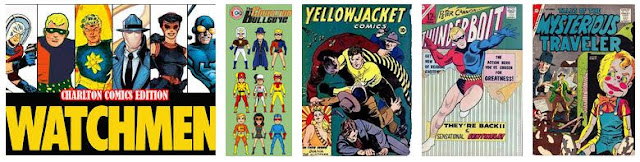
Most of Charlton's superhero characters were acquired in 1983 by DC Comics, where former Charlton editor Dick Giordano was then managing editor. These "Action Hero" characters were originally to be used in the landmark Watchmen miniseries written by Alan Moore, but DC then chose to save the characters for other uses. Moore instead developed new characters loosely based on them. The Charlton characters were incorporated into DC's main superhero line, starting in the epic Crisis on Infinite Earths miniseries of 1985.
Fan revivals


In 2000, Charlton Spotlight, a fanzine devoted to Charlton, began publication.

The Charlton Arrow launched in 2014 from Charlton Neo and published through Mort Todd's Comicfix, the comic includes stories featuring Charlton characters and titles not owned by DC. In May 2017, AC Comics announced that they had entered into an agreement to bring print versions of Charlton Neo's comics to the direct sales comic shop market, starting with Charlton Arrow #1 in September.

THE END


Related Posts Plugin for WordPress, Blogger...