Mostrando postagens com marcador Feldman. M (1926-1987). Mostrar todas as postagens

domingo, 21 de abril de 2024

JOHN ADAMS Conducts Orchestra Of St. Luke's With Dawn Upshaw · Paul Crossley — American Elegies (1991) APE (image+.cue), lossless

Charles Ives
The Unanswered Question (Late Version)    4:49
Five Songs
Thoreau 1:49
Adapted By (Text) – Charles Ives
Down East 2:23
Lyrics By – Charles Ives
Cradle Song 1:21
Lyrics By – Augusta L. Ives
At The River 1:14
Lyrics By, Music By – Robert Lowry
Serenity 1:52
Lyrics By – John Greenleaf Whittier
Arranged By – John Adams
Soprano Vocals – Dawn Upshaw

Ingram Marshall
Fog Tropes

Morton Feldman
Madame Press Died Last Week At Ninety

John Adams
Eros Piano
Piano – Paul Crossley

David Diamond
Elegy In Memory Of Maurice Ravel

Conductor – John Adams
Orchestra – Orchestra Of St. Luke's

sexta-feira, 27 de outubro de 2023

MORTON FELDMAN : String Quartet No. 1, Structures, Three Pieces (FLUX Quartet) 2xCD (2014) Feldman Edition – 12 Series | FLAC (tracks+.cue), lossless

Volume 12 in Mode's Feldman Edition features the FLUX Quartet in performances of three of Morton Feldman's exploratory yet contemplative works for string quartet. The two-CD package offers the imposing String Quartet No. 1 (at an hour and a half, it is divided between the two discs), the brief Structures, and the Three Pieces for String Quartet, a work of only slightly greater duration than Structures. Feldman's processes are quiet different in each work, with the String Quartet No. 1 offering the most elaborate changes of textures and sonorities in a sustained meditation that is quiet, deliberately paced, and almost static in its alternations of chords and silences. The short, pointillistic gestures in Structures seem superficially to resemble the sparse activity of the string quartet, though it is much more fragmentary and airy in feeling. The Three Pieces, composed soon after Structures, more closely resemble it in its aphoristic style, and both works seem quite close in spirit, if not technique, to the music of Webern. Mode's recording is quite clear and close-up, so even the softest pitches can be heard, though the proximity makes the scratchiness of the bowing a little too apparent. Blair Sanderson         Tracklist + Credits :

quarta-feira, 11 de outubro de 2023

MORTON FELDMAN : Triadic Memories (Sabine Liebner) 2xCD (2005) FLAC (tracks+.cue), lossless

Tracklist + Credits :

MORTON FELDMAN : Violin and String Quartet (Peter Rundel, Pellegrini Quartet) 2xCD (2002) FLAC (tracks+.cue), lossless

Tracklist + Credits :

MORTON FELDMAN : Three Voices (For Joan La Barbara) (2019) FLAC (tracks+.cue), lossless

Three Voices for Joan La Barbara is something of an avant-garde love fest. The poet Frank O'Hara wrote a poem called "Wind," which he dedicated to composer Morton Feldman. Feldman in turn wrote Three Voices, based on the text of "Wind," which he dedicated to vocalist/composer Joan La Barbara, who performs the work in this recording. The end result of all this mutual goodwill is a riveting piece of music. The three voices in question perform a cappella, beginning with a wordless vocal pattern that gradually articulates itself into fragments of the O'Hara poem. Like most of Morton Feldman's mature work, Three Voices for Joan La Barbara rewards the attentive listener with an astonishing range of rhythms, textures, and emotions.
Performed by the artist for whom it was written and produced to New Albion's meticulous standards, this can safely be regarded as the definitive record of one of late 20th century composition's small gems. Peter Nappi      Tracklist + Credits :

ALVIN LUCIER, MORTON FELDMAN : Chamber Music (Charles Curtis, Anthony Burr) (2019) FLAC (tracks+.cue), lossless

Tracklist + Credits :


MORTON FELDMAN : Rothko Chapel / Why Patterns? (UC Berkeley Chamber Chorus, The California EAR Unit) (1994) FLAC (tracks+.cue), lossless

This CD presents two of Morton Feldman's most fascinating compositions, and both are given fine performances. In its tableau structure and austere treatment of melody, harmony, and color, Rothko Chapel is a musical analog of the paintings of Mark Rothko, displayed in the Houston chapel where this piece was premiered. Feldman's sonorities are soft and frequently recede into silences that are carefully spaced throughout. The music is often sparse, especially in the unaccompanied phrases for the viola and the isolated passages in the percussion. Yet when Feldman's harmony is at its densest, as in the choir's sustained block chords, the effect is mysteriously shimmering and not at all harsh. Somber and reflective, Rothko Chapel is best heard in a quiet room without distractions. Why Patterns? is less dependent on stillness for appreciation, though the intricately woven lines of flute, piano, and glockenspiel may induce a similarly contemplative feeling. The independence of the parts leads not to chaos, but instead creates constantly shifting textures and relationships, freely recycling the patterns without recourse to an externally imposed method. Feldman's intuitive approach to pitch structures and linear flow lets the music pursue its course naturally, without the mannered gestures of serialism or the accidents of improvisation. Blair Sanderson    Tracklist + Credits :

quarta-feira, 4 de outubro de 2023

MORTON FELDMAN : Routine Investigations (Ensemble Recherche) (1994) FLAC (tracks+.cue), lossless

 These five works, written between 1970 and 1976, date from that critical period in Morton Feldman's career when the composer began notating rhythm precisely (as opposed to his earlier experimental work with graphic notation and the floating sonorities of the Durations series) and reintroducing melody, especially in "The Viola in My Life," a series of four works (the first two of which are included here) written for violist Karen Phillips. Barbara Maurer's execution of these delicate wisps of melody trailing off into space is exemplary, as are all the performances by Freiburg's Ensemble Recherche. Each of these extraordinary works creates its own personal universe in terms of both material and instrumentation, from the romanticism (lowercase r) of the "Viola" pieces to the ghostly percussion of "For Frank O'Hara" (which contains that most rare of events in Feldman's music, a shattering fortissimo crescendo on snare drum -- once heard, never forgotten), and apart from setting the stage for his long late (post-1981) pieces, they together offer irrefutable proof that Feldman almost single-handedly restored intuition to American experimental music. As Kyle Gann astutely notes in his brief accompanying essay, "Feldman rescued subjectivity from bad faith." Essential listening. Dan Warburton       Tracklist + Credits : 

MORTON FELDMAN : Atlantis (Radio-Sinfonie-Orchester Frankfurt Conducted By Lucas Vis) (2000) APE (image+.cue), lossless

Tracklist + Credits :

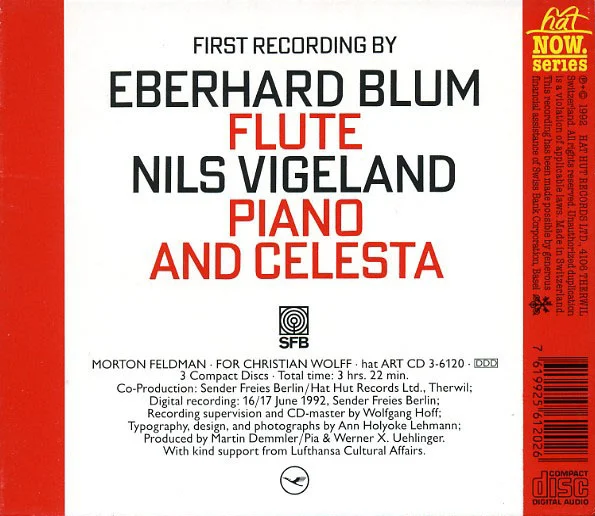
MORTON FELDMAN : For Christian Wolff (Eberhard Blum, Nils Vigeland) 3xCD (1992) FLAC (tracks+.cue), lossless

Late in his life, New York School composer Morton Feldman was prolific. This piece, written less than a year before his death stands, with "For Philip Guston" and his two string quartets (one of which is six hours long), as a statement on the relationship of music as sound, how they interact with one another and separate into different entities over extended periods of time when notions of rhythm, pitch, timbre, etc., are dispensed with. But Feldman was an exacting composer when it came to dynamics. Basically, there weren't any; all of his late music, of which "For Christian Wolff" (written for another member of Feldman's circle, the composer by the same name) is a prime example. Almost three and a half hours in duration, the work is composed in 12 movements, where one ends and another begins is anybody's guess. The piano and celesta are scored for pppp, and meant to be played back just above the level of silence. This spaciousness and constant but sparse activity is meant to allow for other sounds to enter the composition that would normally be heard. When Feldman would tour with his works, he was very aware -- usually jovially -- at just where an audience member would cough during a performance. Often just one instrument is playing one single note, responded to by the other instrument playing its same note for long periods of time. They gradually evolve into the piano or celesta playing chords in brief clusters while the Flute is playing an almost unheard trill. Eberhard Blum and Nils Vigeland were both supervised by Feldman in the debut performance of this work. They were his students and collaborators who understand implicity the rigors of performing his work, which is, for the listener, almost overwhelming in its ambiguous, haunting beauty. To listen to the entire piece, on a 5 CD changer, is, for the listener, a transformative experience; it's a chance to encounter our own view of sound and its (lack of) varying forms. There is plenty of room for listeners to roam around inside "For Christian Wolff," specifically, because for the performers there is no room for variation from this demanding, unfolding of the score. As is the case with most of Feldman's late work, it can be ignored as background music, or it can be entrancing as a journey into a hidden universe; profound and mystifying. Thom Jurek    Tracklist + Credits :
MORTON FELDMAN : Crippled Symmetry (Dietmar Wiesner, Markus Hinterhäuser, Robyn Schulkowsky) 2xCD (1994) FLAC (tracks+.cue), lossless

 Tracklist + Credits :

MORTON FELDMAN : Patterns In A Chromatic Field (Rhan de Saram, Marianne Schroeder) 2xCD (1995) FLAC (tracks+.cue), lossless

 Morton Feldman's gargantuan Patterns in a Chromatic Field is, of all his works, his most self-explanatory. Over 105 minutes, Feldman constructs a sound world where half-tones are given free rein of expression outside the realm of keys assigned. A chromatic scale is 12 half-tones in an octave on the piano. But to Feldman and his performers here -- the truly gifted Marianne Schroeder on piano and Rohan DeSaram on violoncello -- the entire notion of chromatic harmony itself is the playing field. This is one of Feldman's most active works, where clusters and patterns of chromatic architecture emanate from outside other structures -- chords in major and minor keys -- employed as decoys. They are there simply to displace them and establish chromatic harmony as dominant in the relationship between tones in the Western overtone scale. There are periods where one of the instruments will drop out, such as near the middle of the first section when Schroeder all but disappears, leaving DeSaram to continue in chromatic regimen -- until she re-enters like a ghost, sparingly, playing the very chords he's been outside of the entire time. They are a referent to what was, not what is. All solidity in musical concept here falls away into repetitions of notes and oddly angled chords that simply "don't belong." Over the long period of time Feldman has given to familiarize them to the pattern system, they take on their own notion of stark yet pronounced beauty. And while it is true that there is no melody in this work, there does develop, in the manner in which Feldman engages his field of language with chromaticism of scale and harmony, a "melodic sensibility" in the spaces where conflict and non-engagement take place. This is, in the Feldman canon, a work of tremendous rigor and effort to sustain ideas within a restricted tonal environment and create a wider, freer musical language from it was -- a new watermark for a composer who had already crested many. Patterns in a Chromatic Field is among Feldman's most significant and enduring works, and perhaps more Thom Jurek      Tracklist + Credits :