Showing posts with label western fiction. Show all posts

Tuesday, September 13, 2022

Some western and historical fiction awards


The Western Writers of America Spur Awards (winners and nominees): https://westernwriters.org/winners/

...and the Owen Wister and other awards: https://westernwriters.org/the-owen-wister-award/ (and others accessible in that column)

The Walter Scott Prize for Historical Fiction (work published in the Commonwealth and Ireland): https://www.walterscottprize.co.uk/about-the-prize/resources/

The Western Fictioneers Peacemaker Awards and shortlists:

The Scott O'Dell Award for YA and children's historical fiction:

The ARA Historical Novel Prize (ARA is the commercial sponsor) for Australian and New Zealander work: https://hnsa.org.au/the-2022-ara-historical-novel-prize/
"A range of sub-genres are eligible, including historical mystery, historical romance, alternate history, historical fantasy, multi-time, time-slip, and parallel narrative novels."
2020 (the first) Winners and short/longlisters: https://hnsa.org.au/the-2020-ara-historical-novel-prize/

Wednesday, January 26, 2022

SSW/FFB: First Installment: WESTERYEAR edited by Edward Gorman (M. Evans 1988); THE NEW FRONTIER edited by Joe R. Lansdale (Doubleday 1989); DREAMERS AND DESPERADOES edited by Craig Lesley and Katheryn Stavrakis (Dell 1993)


Some of the titles of the stories collected in these volumes use, for critical purposes, epithets.

WESTERYEAR edited by Edward Gorman (M. Evans 1988; G. K. Hall 1990)
Introduction * Edward Gorman (in) ** (**noting originally published in this volume) --and each item below with a headnote by Gorman
The Sun Stood Still * "Max Brand" (Frederick Faust) (ss) The American Magazine December 1934
Fenimore Cooper’s Literary Offenses * "Mark Twain" (Samuel Clemens) (ar) North American Review July 1895
The Return of a Private * Hamlin Garland (ss) The Arena, V.3 N.1 (January?) 1891
The Idyl of Red Gulch * Bret Harte (ss) Overland Monthly December 1869 
The Lonesome Road * "O. Henry" (William Porter) (ss) Ainslee’s Magazine September 1903
One Dash—Horses (aka Horses) * Stephen Crane (ss) The New Review #81, February 1896 (and newspaper syndication in the U.S. in January of that year)
The Streets of Laredo * "Will Henry" (Henry Allen) (ss) Western Roundup--a WWA anthology editorially attributed to Nelson Nye (Macmillan 1961)
The Hard Way * Elmore Leonard (ss) Zane Grey’s Western Magazine August 1953
Mago's Bride * Loren D. Estleman  ** 
All the Long Years * Bill Pronzini **
The Damned * Greg Tobin **
Wolf Night * Bill Crider **
Liberty * Al Sarrantonio **

Trains Not Taken * Joe R. Lansdale (ss) RE:AL: Regarding Arts & Letters Spring 1987
Whores in the Pulpit * Thomas Sullivan **
Guild and the Indian Woman * Edward Gorman **
A Cowboy for a Madam * Barbara Beman **
One Night at Medicine Tail *  Chad Oliver **
The Time of the Wolves * Marcia Muller **
Hacendado * James M. Reasoner **
The Battle of Reno's Bend * L. J. Washburn **

Index revised and corrected from the WorldCat Index, with links to ISFDB, the FictionMags Index and other databases. Page numbers differ between the two editions.


THE NEW FRONTIER edited by Joe R. Lansdale (Doubleday/Double D 1989)
(Doubleday 0-385-24569-6, May ’89, $12.95, 180pp, hc) Original western anthology of 18 stories and a poem with an introduction by Lansdale and an afterword to a “lost” "Max Brand" (Frederick Faust) story by William F. Nolan. At least four of the stories are also fantasy.
Slightly augmented from the currently offline Locus Index.
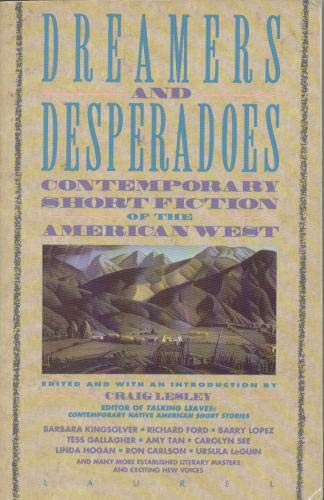

DREAMERS AND DESPERADOES edited by Craig Lesley and Katheryn Stavrakis (Dell/Laurel 1993) 

1 * Introduction(s) * Craig Lesley and Katheryn Stavrakis (in)
15 * Sweetheart * Kathleen Alcalá (ex) Mrs. Vargas and the Dead Naturalist Calyx Books 1992
Iliana of the Pleasure Dreams / Rudolfo A. Anaya --
Heartwood / Rick Bass --
The Snowies, the Judiths / Mary Clearman Blew --
Bigfoot Stole My Wife; I am Bigfoot / Ron Carlson --
Paraiso: an Elegy / Rick DeMarinis --
Winter of '19 / Ivan Doig --
Science Meets Prophecy / David James Duncan --
Cry About a Nickel / Percival Everett --
Optimists / Richard Ford --
Girls / Tess Gallagher --
Personal Silence / Molly Gloss --
Nebraska / Ron Hansen --
Friends and Fortunes / Linda Hogan --
A Family Resemblance / James D. Houston --
Rock Garden / Jeanne Wakatsuki Houston --
The Flower Girls / Lawson Fusao Inada --
Death by Browsing / Karen Karbo--
I Could Love You (If I Wanted) / John Keeble --
Why I am a Danger to the Public / Barbara Kingsolver --
Do You Hear Your Mother Talking? / William Kittredge --
Nevada Dreams / David Kranes --
Eggs ; Absences : Cicadas ; Growing Tomatoes / Alex Kuo --
Sleepwalkers / Ursula K. Le Guin --
Mint / Craig Lesley --
The Interior of North Dakota / Barry Lopez --
The Woman Who Would Eat Flowers / Colleen McElroy --
Dropping Anchor / Valerie Miner --
Idaho Man / John Rember --
Slaughterhouse / Greg Sarris --
Whitney and Tracie / Carolyn See --
Emerald City: Third & Pike / Charlotte Watson Sherman --
It's Come to This / Annick Smith --
Sea Animals / Tom Spanbauer --
The Room / Katheryn Stavrakis --
Pragmatists / Robert Stubblefield --
Migrants / Elizabeth Tallent --
Double Face / Amy Tan --
Boat People / Joyce Thompson --
Talking to the Dead / Sylvia A. Watanabe --
The Indian Lawyer / James Welch --
Buried Poems / Terry Tempest Williams

Slightly corrected (and soon to be augmented) from the WorldCat index.


***Stupid publisher tricks: 
Westeryear--the first edition jacket from M. Evans (immediately above); even G. K. Hall's generic large-print-line wrap (at top of post) is a step up.

The New Frontier--jacket copy referring to Neal Barrett, Jr. as "a new discovery" in 1989, a quarter-century or so into his career; also, a jacket at least as generic if not quite as clumsy as the Evans cover for the Gorman book or D-day's package for Lansdale's previous western originals anthology, Best of the West.

Dreamers and Desperadoes--managing to leave co-editor Stavrakis's name off nearly every aspect of the packaging, save the title page, though at least the table of contents does include her introduction. Also not quite stupid but perhaps not the best choice: the reasonably handsome cover for this trade-paperback original apparently doesn't photograph too well, at least on most of the photos and scans I've seen. Hence the current slightly blurry image above...and the cover isn't the easiest to read even in the handheld presence of the potential reader (poor color choices for legibility).

And none of these received the publisher push they deserved by any means, even if the Gorman did get a second edition for large-print readers.

Contents:
Westeryear's stories are, to say the least, an interesting mix of classics and contemporaries of classics, and new fiction from some of the best writers in western fiction (among work in other fields) active at time of assembly...a quality it shares with the Lansdale and Stavrakis/Lesley  volumes...even if each book has its own share of work that might fall on either side of the line established some years back by the Western Writers of America, porously between western fiction and fiction of the west (both of which they embraced). 

And then there's the Twain essay, perhaps the most famous KTF review in at least the US canon, and persuasive enough to me at age nine that I never sought out too much of Cooper's fiction, and what little I did seemed to conform to the Clemens assessment. Twain goes to a few lengths to ensure you can read his survey for humor, but nonetheless it tells, and enrages Cooper fans to this day. Editor Gorman himself isn't beyond pointing out the warts in the older reprints he offers here, or in the other work by their contributors, in his headnotes, but the stories do help add a certain perspective and none of them are difficult reading, and clearly are part of the development of the range of western fiction all the relatively contemporary writers included in all three volumes have drawn upon and reacted to. 

"Max Brand" (Frederick Faust)'s "The Sun Stood Still" is a good example of his graceful, tense writing; Gorman notes that its wit and appreciation of life as it was lived by the everyday people of the old West wasn't as widely shared by his peers (nor some of his successors), giving his work more of a contemporary if not quite timeless quality than that of many who wrote for the pulp magazines and higher-budget and yet still prone to tropism "slick" magazines in the first half of the previous century. For those who want even early western fiction to lack subtlety and a certain dramatic verisimilitude, even when the mythos of western fiction was already being employed (not too much in this decidedly unglamorized account of farmhand life), Brand doesn't help their case too much.

Hamlin Garland made a poor showing for himself (with the help of those hoping to Reach Yet Instruct Our Youth) with such widely-distributed work as his poem "Do You Fear the Force of the Wind?", unless one was looking for simpleminded machismo. But a similar devotion to simpleminded machismo on the part of, say Hemingway or Mailer (and far too many others, even if these two more flagrantly than most) didn't stop them from having a certain dalliance, at least, with social justice causes, and Garland particularly in his early career was throwing in with agrarian socialists, Populists, progressives and other troublemakers, and his fiction about, particularly, the travails of Civil War veterans and others trying to make a life in the hardscrabble, highly Gilded Age-distorted farming country of the Midwest (perhaps a bit too much like today's), struck a chord, and that's on offer with "The Return of a Private"; it's not subtle, but, as Gorman notes, Garland had an excellent eye for the small details and challenges of life.

"The Idyl of Red Gulch", being as it is a Bret Harte story, tries to couch itself as a fable perhaps a bit too much more than is good for it, but nonetheless gets across a fine account of how even in the far western U. S., the unfortunate prejudices can shoot through society once it asserts itself as post-pioneering country. Definitely romanticized, but also making its points. 

"The Lonesome Road", being as It is an "O. Henry" story, is also not quite a fable, but doesn't, unlike the Harte, call attention to its attempt at being of Great Import with every line, but rather more casually and mildly humorously gives the account of two old hell-raising friends, one of whom has now settled into a happy marriage and a more quiet life, finding themselves together having to deal with old adversaries. An interesting weighing of what makes for an actually good life, with a  rather straightforward account of what a chaotic, unromantic thing a gunfight tends to be. Gorman is particularly annoyed in his headnote about how readily Porter's work these years is condescended to as glib and mechanical, and this story helps make his case (and, fwiw, the Doubleday/Anchor folks are still branding their best stories of the year annual in his memory).

More to come. (More distractions as other parts of the ever-collapsing  house and life demand attention, not least the cat. Don't buy a century-old house. Just don't. Unless you have the money, skill or both to keep replacing everything.)


Friday, November 16, 2018

Friday's "Forgotten" Books: Lee Hoffman: TROUBLE VALLEY (Ballantine, 1976)

I don't know about you, but sometimes I read authors in a jag. I read most of Kurt Vonnegut's then-available novels in a string over a couple of months in the latter 1980s, having read only The Sirens of Titan (his best sf novel), Galapagos, and Cat's Cradle and the essay and short story collections beforehand, and it was time to dig in. That's how I know Bluebeard is the best of his contemporary mimetic novels, although Rosewater and the near-past historical Mother Night give it a run. I read about half of Theodore Sturgeon's collections, before the "Sturgeon Project" complete short-fiction reprints began, in the same way, having read most of the rest of Sturgeon's work sporadically over the previous two decades...and Sturgeon and Vonnegut share more than the mutual paternity of Kilgore Trout...a deep and knowing and rarely naive humanism runs through their work. As it does through the work of Ms. Lee Hoffman, RIP in 2007 and not hardly forgotten herself in several circles, but her books, if Amazon can be trusted, are almost all out of print...there's a pricey large-print edition of Wild Riders out, and another title coming soon in a LP edition, and her collection of essays In and Out of Quandry might still be available directly from NESFA Press, some examples of her personal journalism from her groundbreaking 1950s fanzine and elsewhere. But I read the simple majority of her 17 western novels in a jag in 1994, having read her impressive sf short story "Soundless Evening" in Again, Dangerous Visions as a kid, and having known she'd written some other impressive fantastic fiction, but was perhaps best known literarily for her western fiction...her fourth novel to be published, and first hardcover, The Valdez Horses (Doubleday, 1967), had won the Spur Award from the Western Writers of America, and had been (apparently acceptably if unexceptionally) filmed a decade later as a project for Charles Bronson and Jill Ireland. Haven't seen the film, but read the book...in fact, take on all her novels, and note how she starts out as good as anyone could want (she had already been a veteran not only of sf fan publishing, but an assistant editor at her ex Larry Shaw's magazines, and a notable zinester in the folk-music scene), in lighter or darker modes from book to book, but by her mid-1970s novels, of which Trouble Valley is one, she had achieved a practiced grace and a lean manner of slipping in the compassionate detail that helped spoil me for lesser western fiction...the protagonist of this one is not only doing his damnedest to end the conflict with his aggressive neighbors, but to do it as amicably as possible, and Hoffman delivers more tension and less melodrama, more detail to character and realistic description of human interaction than almost anyone else working in the field...this book (and its mates) read like less eccentrically-detailed Joe Lansdale westerns, or Bill Pronzini's without the slightly formal stiffness that can creep into his historical work when he lets it. Ed Gorman and Loren Estleman are in her league, too, which gives you some idea...and at least two other, much better-selling, largely in-print western writers couldn't come close to what she could do. But that shouldn't surprise anyone.

The Lee Hoffman Site:
http://www.gary-ross-hoffman.com/Lee/


Lee Hoffman posts on Sweet Freedom

As always, thanks to Patti Abbott for sustaining the Friday Books lists. Buy Ed Gorman (and MH Greenberg)'s new volume of best of the year crime fiction to get a sense of what she can do. [Not so new as it then was in 2008, when this redux post was first published, and the book managed to not include Patti's story, even though it was on the table of contents, as I recall...Greenberg was going through an even rougher patch than Ed was.]

(Possibly "forgotten" music audited while writing this one: the George Russell Smalltet: Jazz Workshop [1956, RCA]...the album where Bill Evans learned about modal improvising from Russell, so he eventually could teach it to the Miles Davis group, and they did Kind of Blue as a result. Jazz Workshop's better.)

Friday, January 26, 2018

Friday's "Forgotten" Books and more: the links to the reviews and more

This week's books, unfairly (or sometimes fairly) neglected, or simply those the reviewers below think you might find of some interest (or, infrequently, to be warned away from)--certainly, this week we have no shortage of not at all forgotten titles. Patti Abbott will host again next week.

Rest in Glory: Ursula K. Le Guin, Julius Lester, Dallas Mayr.

Walter Albert: The Alienist by Caleb Carr

Yvette Banek: The Ponson Case by Freeman Wills Croft


Bernadette: Fierce Kingdom by Gin Phillips


Les Blatt: The Secret Adversary by Agatha Christie; The Sunken Sailor by Patricia Moyes


John Boston: Amazing: Fact and Science Fiction Stories, February 1963, edited by Cele Goldsmith

Brian Busby: The Heiress of Castle Cliffe by May Agnes Fleming 


Bill Crider: The Winter is Past by Harry Whittington

Martin Edwards: The Deadly Dove by Rufus King


Peter Enfantino, Jack Seabrook and Jose Cruz: EC Comics, September 1954

Barry Ergang (hosted by Kevin Tipple): The Case of the Sleepwalker's Niece by Erle Stanley Gardner


Will Errickson: The Tribe by Bari Wood (among her other work); Dallas Mayr (aka Jack Ketchum)

Curtis Evans: The White Cockatoo by Mignon G. Eberhart

Elisabeth Grace Foley: The Caine Mutiny by Herman Wouk 


Paul Fraser: Astounding Stories, February 1938, edited by John W. Campbell, Jr.

Barry Gardner: Night Prey by "John Sandford" (John Camp) 


John Grant: Malice by Keigo Hagashino (translated by Alexander O. Smith); Beware the Young Stranger by "Ellery Queen" (in this case, Talmage Powell)

Rich Horton: Lavinia by Ursula K. Le Guin; Rainbow's End by Vivian Radcliffe; Planet of No Return by Poul Anderson; Star Guard by Andre Norton; Rocannon's World by Ursula K. Le Guin; The Kar-Chee Reign by Avram Davidson


Jerry House: An Earth Gone Mad by Roger Dee [Aycock] 


TracyK: Death Wears Pink Shoes by Robert James

Colman Keane: Crime Syndicate, January 2016, edited by Michael Pool and Eric Beetner

George Kelley: The Great SF Stories (1964) edited by Robert Silverberg and Martin Harry Greenberg


Joe Kenney: Logan's World by William F. Nolan

Margot Kinberg; Killer Instinct by Zoë Sharp


Rob Kitchin: Blood Curse by Maurizio de Giovanni

B. V. Lawson:  Mrs. Knox's Profession by Jessica Mann


Ursula K. Le Guin: early writing 


Evan Lewis: The Killer Angels by Michael Shaara


Steve Lewis: "Dyed to Death" by K. G. McAbee; The Blind Side by Patricia Wentworth


Brian Lindenmuth: Iron Men and Silver Stars edited by Donald Hamilton 


Gideon Marcus: The Magazine of Fantasy and Science Fiction, February 1963, edited by Avram Davidson

Todd Mason: The Dark Side edited by Damon Knight (et al.); SF Horizons edited by Harry Harrison and Brian W. Aldiss

Steven Nester: Hollywood and LeVine by Andrew Bergman 


James Nicoll: Hammer's Slammers by David Drake

John F. Norris:  The Other Passenger by John Kier Cross


John O'Neill: The Machine in Shaft Ten by M. John Harrison

Matt Paust: Present Danger by Stella Rimington


James Reasoner: "Ki-Gor--And the Temple of the Moon-God" by "John Peter Drummond"


Jack Seabrook and Peter Enfantino: DC War Comics 1971 

John Self: The Ice Palace by Tarjei Vesaas (translated by Elizabeth Rokkan)

Steven Silver: "Lost Paradise" by Catherine L. Moore 

Victoria Silverwolf: Fantastic: Stories of Imagination, February 1963, edited by Cele Goldsmith (featuring Le Guin's "second story")

Kerrie Smith: The Murder at Sissingham Hall by Clara Benson


Kevin Tipple: Mexico Fever by George Kier


"TomKat": The Vampire Tree by Paul Halter (translated by John Pugmire)


Prashant Trikannad: Merrick by Ben Boulden


Friday, April 14, 2017

FFS: Small-Town Law Week: Bill Pronzini: "The Hanging Man"; Howard Rigsby: "Dead Man's Story"; James Shaffer, "The Long Arm of the Law"

Howard Rigsby: "Dead Man’s Story", (ss) Argosy Aug 27 1938, as “I’ll Be Glad When You’re Dead”; The Mysterious Traveler Magazine Nov 1951

James Shaffer: "The Long Arm of the Law" [probably] New Western Magazine [v12 #1, August 1946]; Pocket Reader Series [#124, Western Stories, 1950] UK

Bill Pronzini: "The Hanging Man", (ss) Ellery Queen’s Mystery Magazine Aug 12 1981

Patti Abbott wanted a special emphasis this week on small-town sheriffs and police, which I suspect is going to lean heavily toward Bill Crider fiction, and well it might. I might just add a fourth story to this post of just that sort myself, but until that time, I took a bit of a different tack, and picked out three stories, one I'd loved when I first read it forty years ago, one which I'd not yet read by one of my favorite crime and western fiction writers, and one which was as new to me as its author. And none is precisely about either a sheriff or a police officer, though all of them involve one degree or another of men of those professions; no women in the jobs, since one is a contemporary story (for the time it was written and published) set in Florida in the 1930s, one is a California historical set in the time of the fading of the "traditional" west, in the first decade of the 1900s, and one is apparently set in what was still Wyoming Territory, sometime I'd guess in the 1880s. 

"Dead Man's Story" (apparently Rigsby's preferred title) is an utterly engaging dialect story, told from the point of view of Panama City, Florida-area Game Warden Joe Root, a native of the area and a tough man with a strong sense of duty, who knows and loves his job. In fact, his sense of duty is so strong that when he finds a wealthy tourist from Up North poaching deer out of season, neither bribery nor being shot multiple times will deter him from getting his man, eventually with an assist from another Warden and the County Sheriff of both their acquaintance. It's a borderline horror story that Manly Wade Wellman could've written about as well, but probably not much better, either. Robert Arthur reprinted it in his The Mysterious Traveler Magazine (a literary spin-off from his Mutual Radio anthology series) and later in Alfred Hitchcock Presents: A Month of Mystery (Random House, 1969), which has the slightly macabre distinction in relation to the story of being the last AHP: volume Arthur would edit before his death. I first read it in '76 or '77 in my new copy of the Dell second edition, published in '76 as AHP: Dates with Death...it seems a bit odd to be able to page through this paperback, in reasonably good shape, that has traveled with me for forty years. 

James Shaffer was a very prolific writer of western fiction in the 1940s, with a thick population of stories cited in the FictionMags Index from 1942-52, whose work I've not read before, as far as I know (he shouldn't be confused with the author of Shane, Jack Schaeffer).  I know nothing more about him, but he wrote at least this rather clever story, involving one Johnny Mason (not the reason I selected this one, but mildly amusing to me), a somewhat reluctant 27yo retiree from being a range detective for the quasi-private Western Cattlemen's Protective Association's Cheyenne office; he's also an extremely skilled and/or fortunate gambler, who's won enough recently at poker to allow him to put in his notice, but his old boss manages to rope him into taking a new assignment, by letting him know that the game's afoot out along one of the rail lines, where a rancher has died...possibly by accident, at least apparently so...and yet the beneficiary of his sizable insurance policy has refused to accept the check, and two letters had been sent
to the Association's office, apparently written by the decedent: one on the day before his death, asking for assistance with criminal activity against him, and one reversing that request...sent the day after his death. Mason comes to town and investigates, brushing up against the kind of corruption you might expect in a railroad cattle town in the 1880s, with a fixed trial among other adventures awaiting several of the characters, including Mason; Elmore Leonard could've written this one better, and did in various ways (notably in the source story for the television series Justified), but Shaffer's work here is fine and almost completely fair-play detection (he withholds one crucial fact till he's ready to have Mason lay it out). There's a very good chance this one first appeared in the Popular Publications/ Fictioneers pulp New Western for August 1946, but the FMI folks haven't been able to confirm that; the story is in the index by name because of its reprint  in a British magazine that ran various sorts of theme issues, and apparently was no more explicit in citing its source than the book I've read this in, Damon Knight's Westerns of the '40s: Classics from the Great Pulps, published by Bobbs-Merrill in 1977, an anthology comprised of stories Knight remembered fondly from his years of working on Fictioneers pulps as one of the staff editors. 

Bill Pronzini's story is typically understated, and deals (as will surprise none of his readers) with a mysterious murder in a small Northern California town, Tule River, at the turn of the 20th century when the community hasn't yet gained its first automobile. For a police force Tule River has two volunteer sheriff's deputies in Carl Miller and Ed Bozeman, who theoretically work under the anti-professional riding sheriff, a fellow who drops in occasionally from the county seat to have the era-appropriate version of too many donuts at the local eatery. A drifter, who it turns out had been soliciting work around town, is found hanged early one morning. Carl and Ed cautiously put matters together, and find things are a bit more disturbing than they feared. Had Bill Pronzini started his career a decade or so earlier, the Gunsmoke producers, at least for the radio series if not for the tv version as well, would've been wise to have him on staff.  I read this one in the unabridged 1989 Reader's Digest Association reprint of The Arbor House Treasury of Great Western Stories (1982), edited by Pronzini and Martin Harry Greenberg, who was known to insist that his writer co-editors include one of their own works. Unlike most instant remainders, which (as a remainder, rather than though possibly from a library sale) I suspect is how I acquired this one, the RD folks published theirs on acid-free paper...I'm noting how my copy of a more typical instant remainder, published in its only edition, I believe, by Random House subsidiary Gramercy in 1995, John Tuska's fat best-of-the-magazine anthology Star Western, is showing clear signs of not being able to last forty years as anything but a pile of acidic dust.  Ah, the life of books...off to look at everyone else's choices for this week. 


Friday, May 13, 2016

FFB: NIGHT FREIGHT by Bill Pronzini (Leisure Books 2000)

Bill Pronzini is another writer I've been reading for nearly all my literate life...I've reviewed some of his books as we've gone along here, mostly as an editor, since he's been impressively prolific and consistently good to brilliant in that capacity as well as in being a writer and critic/historian since starting out professionally with a sale to Shell Scott Mystery Magazine in 1966, of a story he disparages as merely a bad pastiche of Hemingway, and makes a point of Not including in this volume ("You Don't Know What It's Like" and no, I don't, and apparently won't till I find that 11/66 Shell Scott issue). But his second published story, in SSMM's more durable stablemate Mike Shayne's Mystery Magazine in 1967, is the title story for this collection, a story he introduces with a mixture of diffidence and pride, wondering in his headnote to the story if he should rewrite it for inclusion here, as he'd updated it for inclusion in anthology, and deciding that its "rough edges" add to its vigor (Bill Crider is among those who approve of the No Tamper/No Update policy for good writers looking back at their early work). Pronzini's early stories were among the standouts of the Harold Masur and Robert Arthur Alfred Hitchcock Presents: anthologies I read when very young, and the first back issues of Alfred Hitchcock's Mystery Magazine I picked up around the same time (1974), first from the public library (ah, a public library that subscribed to and circulated fiction magazines; I cue Crider again: "I miss the old days"). Through one or more of these venues, I first read "The Pattern," which Pronzini feels might be overrated among his work; I'm fonder of it than he.

Among what's notable about Pronzini's work is how transparent his style usually is; he rarely goes out of his way to draw attention to the way he's relating his narrative, which is almost always in the most straightforward and lucid prose he can offer; his protagonists usually have sharp observations about what goes on around them, but only rarely do they get to expound on the nature of life or otherwise make a pitch for a philosophical outlook in the course of whatever relatively tense business they're about in their stories. He does have his fun, including such memorable comic work as "Another Burnt-Out Case" (Fantastic, October 1978, in collaboration with one of his frequent partners, Barry  Malzberg); his most sustained set of work is about the not-really Nameless Detective, who eventually finds himself, in the late works of the series, addressed as "Bill"...but that bit of self-referential detail took a while to emerge (amusingly, he and his wife, writer Marcia Muller, have patterned their most prominent characters after themselves in many ways, and have enjoyed collaborating on stories where those characters interact). 

The  stories in this volume, packaged in the Leisure horror line (Leisure being one of the last paperback houses to maintain a horror line, and seeking to gain a bit of attention thus, even to the extent of offering a book club subscription service) are an interesting mix, not shrinking from collecting again some of Pronzini's most brilliant work, such as "Strangers in the Fog," even when they'd appeared in one of his too-infrequent previous collections (in that case, his first, Graveyard Plots from 1985); while it's at least as much a collection of suspense stories with no supernatural horror content, and leads off with one of the few stories of his own Pronzini is willing to allow is a hardboiled crime fiction ("Stacked Deck," a short novella from The New Black Mask, 1987), and as a collection was put up for the Horror Writers of America Stoker Award (this year's about to be awarded this weekend as I write). I was surprised at how many of these stories I'd managed to miss, one way or another, over the years before picking this up...Pronzini's work has been too often, if not taken for granted, at least been issued by houses that have had some tough times staying afloat...Leisure is a mere shadow of an imprint now, having been a marginal firm throughout its decades, many of his Nameless novels saw their first paperback editions from the quickly-doomed Paperjacks line, etc....and while it's not been difficult in the online era to find his work, he hasn't been as prominently published, nor as recipient of awards as he might be, over the course of his career. (He mentions having been on the jury that considered his "Strangers in the Fog" for the Edgar Award for best short story of its year, and feeling he had to vote for its most prominent rival, denying himself an Edgar...an award he wouldn't receive for some time later, a few years after the first publication of this book.) This, of course, hasn't stopped sophisticated readers of crime, western or his other fields of fiction from seeking his work out...and, of course, it shouldn't stop you, either. This volume, and Graveyard Plots, and The Best Western Stories of Bill Pronzini collection, among others, await you, particularly if you're mostly familiar with his Nameless stories or not at all, and I recommend you take them up sooner rather than later.

From ISFDB:

  • Publication: Night Freight
  • Author: Bill Pronzini
  • Year: 2000-05-00
  • ISBN: 0-8439-4706-3 [978-0-8439-4706-9]
  • Publisher: Leisure Books
  • Price: $5.50
  • Pages: 345

Please see Patti Abbott's blog for more of today's books, and I'll be gathering the links for the next two Fridays...please don't hesitate to let me know what I'll foolishly overlook in the course of compilation!