A still from the classic comedy Chalti ka Naam Gaadi, wherein a signboard in the motor-repair shop asks the manic Kishore Kumar to “play safe”:
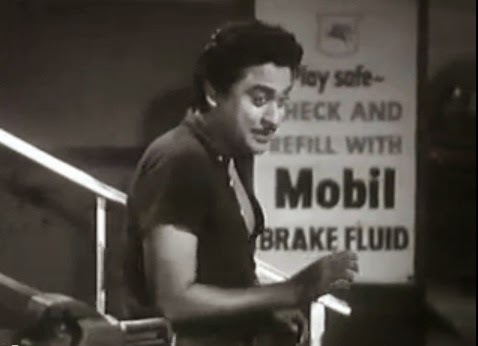
When I first saw that ad in the background of another shot, I thought it was for fuel, and this seemed inappropriate – surely this man, of all people, needs no external source of energy. But then I realised it was for brake fluid, which made sense – it’s as if the very set is beseeching him to slow down. Many a doughtier wall (not to mention writer, director or co-performer) must have made similar requests over Kishore Kumar’s career, to no avail.
In an essay about the “ugliness” of the male actor in Hindi cinema, and how this reflects life, Mukul Kesavan observed, “The first thing that strikes the eye gazing upon India is that the men can be nearly as ugly as sin […] Indian heroes look the way they do because desperate male audiences pay money to watch men like themselves succeed with beautiful women […] Hindi cinema is unfairly dismissed as escapism: it is, in fact, a great reality machine designed to remind Indian men of their good fortune and to reconcile Indian women to their fate.”
 The piece is tongue in cheek, but even where it contains patches of real social observation, I don’t think you can apply it to one of the most unusual romantic pairings in Hindi-movie history: Madhubala and Kishore Kumar. Here’s the rub: in so many of the scenes these two did together, even with her ethereal presence on the screen, it is difficult to take your eyes off him. The clichéd way of describing them would be “the sublime and the ridiculous”, but it’s really more like “sublime and sublimer”.
 To clarify, I don’t think Kishore Kumar was bad-looking at all, though there may be a psychological component to this (from early childhood, I have associated the man with so many wonderful things – initially as a singer, later as an actor – that my reptile brain would probably raise its drawbridge against the very suggestion that he was “ugly”). But one may safely concede he wasn’t anywhere near as beautiful as Madhubala. Someone who knew nothing about the two of them might, if they saw a still photo of them together, think of court jesters and fairy princesses, if not gargoyles and damsels.
It’s when that still photo resolves itself into the moving image that one discovers that the jester unbound is really the centre of the frame, while Madhubala is more often than not happy to be the gorgeous foil. And a good example of this is in the Chalti ka Naam Gaadi song “Main Sitaron ka Tarana” (a.k.a. “Paanch Rupaiya Baarah Aana”). The scene is built on a brilliant juxtaposition: the beautiful woman who poses like a classical statue worthy of adoration, a Galatea waiting for her Pygmalion; and the crackpot who is concerned with the practical business of getting the money she owes him. First Renu (Madhubala) glides about the room singing the self-exalting lines “Main sitaaron ka taraana, main bahaaron ka fasaana / leke ik angdaai mujhpe daal nazar bann jaa deewaana” and then Manmohan (KK) struts into the frame like a cockerel, giggling dementedly like Mickey Rooney’s Puck in the 1935 version of A Midsummer Night’s Dream. Just watch:
Within the context of the film, this fantasy sequence is one of the breeziest depictions in 1950s cinema of the rich-girl-poor-boy theme, with its contrast between the privileged heroine who can afford to forget her purse in a garage and the hard-working mechanic who must get his mazdoori no matter what. Also note that it is presented as Manmohan’s dream as he lies sleeping in the back of Renu’s car: there is a subconscious recognition that she is an attractive woman, but at this early stage he is heavily conditioned by fear of his stern elder brother and the need to get his 92 annas. This will extend into their relationship later, where she is the desirous one taking the initiative, making romantic overtures, while he doesn’t quite articulate to himself what is going on between them.
I was surprised at how well Chalti ka Naam Gaadi held up after all these years, despite the fact that the film has an almost obligatory “serious track” about big brother Brij Mohan (Ashok Kumar) and his tragic thwarted romance – and such tracks can be the kiss of death for a lunatic comedy. But part of what makes that work is that the eldest of the Ganguly brothers plays his role dead straight right from the beginning.
 “Ashok Kumar was a charming man, but he had the physical presence of a cupboard wearing a dressing gown,” Kesavan writes elsewhere in that same essay. It’s a funny line, but not one I can agree with: AK was often miscast or made poor choices, especially from the late 1950s onward, but he was one of the giants of our cinema and I think he had wonderful presence in his better roles. Chalti ka Naam Gaadi may contain one of his most underappreciated performances (something that often happens when an actor associated with dramas or social-message films appears in an “inconsequential” comedy). He offsets the clowning about of his younger brothers, playing the straight man without ever becoming a foil (he is too canny and too much in control for that – that role falls to middle brother Anoop) and this adds layers to the chemistry between the siblings.
I love little touches such as the one where Brij, apologising to Renu late in the film, says “Main boxer hoon, mera dimaag bhi boxer…” and then trails off. There are other “dramatic” moments like this that stop just short of becoming maudlin or dragging the film down, simply because the acting makes the characters believable irrespective of whether they are being funny or serious (or both). And of course, because Kishore Kumar is such a force of nature in nearly every scene he is in that some “brake fluid” is always welcome.
“Ashok Kumar was a charming man, but he had the physical presence of a cupboard wearing a dressing gown,” Kesavan writes elsewhere in that same essay. It’s a funny line, but not one I can agree with: AK was often miscast or made poor choices, especially from the late 1950s onward, but he was one of the giants of our cinema and I think he had wonderful presence in his better roles. Chalti ka Naam Gaadi may contain one of his most underappreciated performances (something that often happens when an actor associated with dramas or social-message films appears in an “inconsequential” comedy). He offsets the clowning about of his younger brothers, playing the straight man without ever becoming a foil (he is too canny and too much in control for that – that role falls to middle brother Anoop) and this adds layers to the chemistry between the siblings.
I love little touches such as the one where Brij, apologising to Renu late in the film, says “Main boxer hoon, mera dimaag bhi boxer…” and then trails off. There are other “dramatic” moments like this that stop just short of becoming maudlin or dragging the film down, simply because the acting makes the characters believable irrespective of whether they are being funny or serious (or both). And of course, because Kishore Kumar is such a force of nature in nearly every scene he is in that some “brake fluid” is always welcome.
Here’s a paradox. A panel discussion about humour, populated by people who are funny for a living, may very possibly not be funny itself. Because it involves analysing and intellectualising something that is often analysis-resistant. Understanding the workings of comedy, and the many ways in which different people respond to it, is no easy task. No wonder Isaac Asimov once wrote a short story, “Jokester”, suggesting that humour is part of a psychological experiment being conducted on us by Godlike extraterrestrials, to study human behaviour the way we might study rats in a laboratory.
Anyway, here is the funniest thing that happened during a humour-related talk I participated in at a Chandigarh lit-fest last year: a very angry man – an acquaintance of the deceased comedian Jaspal Bhatti – bobbed up and down in his seat, banged on the chair in front of him, shook his fists at us panelists, and declaimed through a quivering moustache, “I tell you, Bhatti was NOT a comedian! He was a starrist!”
Clarity alert: he meant “satirist”. But what was really amusing was the moral indignation on display – how keen he was to defend his friend’s sullied honour, and how convinced that the very word “comedian” was a gruesome insult (though Bhatti himself, I am sure, would have had no objection to being described thus). Just a few minutes earlier, the author Krishna Shastri Devulapalli and I had been speaking about how comedy is often a thankless, underappreciated job; about literary awards rarely shortlisting funny books; about the Oscars’ reluctance to nominate comic performances even though most actors will tell you comedy is so hard to do. And now here was someone from the audience unwittingly demonstrating the point – comedy was flippant, he implied, while “satire” was respectable because it suggested social conscience and purpose.
 But any sort of comedy, if well done, has a clear-sightedness that most other modes of expression don’t have. “Humour assaults us with a slice of truth,” says a character in Manu Joseph’s The Illicit Happiness of Other People. A case can be made that if you simply look at the world and record what you see, you automatically become a comedian. During our session, Devapulalli read out a passage from his novel Jump Cut in which a man named Selva – originally from a village, now living in Chennai – is required to visit a fancy store selling women’s undergarments. As Selva gapes at a pair of flimsy panties, he considers the much more durable elastic on his own underwear, “which could be cut out to make a slingshot that could kill a squirrel at twenty paces if the need arose”. A thong seems to him like a hyped version of the “komanam” worn by old men in his village. Here is an example of a funny passage that is merely showing a particular man in a situation far removed from his everyday experience. We know the kind of store this is, we can picture the “black pant-suited” salesgirl who is described as having the same glassy expression as a mannequin, and even this seemingly lowbrow situation provides food for thought: the urban reader is allowed to temporarily step outside of himself and look at things through the perplexed eyes of someone who has not grown up in a world of high-priced brands, plush malls and supercilious salespeople.
Humour can be tied to nihilism – tossing a banana peel under the feet of human self-importance, mocking the idea that there is order in the world – but it can also facilitate empathy. The Illicit Happiness of Other People is about a sad man trying to understand why his 17-year-old boy killed himself, while Jump Cut is a story about another father-son relationship, as well as an ode to the “little person”, in both life and in a cut-throat movie-making industry. These synopses don’t sound funny, but both books understand that the profound and the ridiculous coexist in our lives, and they make the reader laugh while letting us stay emotionally invested in the protagonists.
Having had firsthand experience of Krishna Shastri's sense of humour in Chandigarh, I was surprised to find that Jump Cut wasn’t as full of wisecracks and clever one-liners as I had imagined it might be (not that there’s anything inherently wrong with that sort of book). What unfolds instead is something more measured, where the idea isn’t so much to be “funny” from one paragraph to the next as to provide a light, slanted take on an essentially serious premise. The book has a prologue, set in 1992 Madras, where a boy named Ray and his sister watch the preview of a film that their father has worked on. The card they have been excitedly waiting for appears on the screen. “It says ‘Story, Screenplay and Dialogue by Vasant Raj’ in big letters that fill the screen, the drum-roll underlining their importance.” That’s the father’s name on the screen, thinks the reader, but then comes the deflating coda:
At the bottom of the screen, in barely readable letters, is the legend:
Associate: Raman
Then it is gone.
As this opening should make clear, there will be a tinge of melancholia throughout this story, even if it is largely hidden beneath the warm, good-natured tone of the writing. We never really get to “meet” the anonymous Raman in the narrative’s present tense, but the early chapters in which the adult Ray uncovers things about his deceased father are interspersed with short diary entries written by the dead man over the years: entries that reveal something of the inner world of a man who must have been taciturn and unobtrusive – a father who notices that his teenage son has a crush on a girl and also knows that he must never let on that he has noticed; a widower who drily notes that “the editor of real life can be quite abrupt” as he recalls how suddenly and randomly his wife was taken from him.
Jump Cut touched a chord for me because I have been thinking about the hidden or unnoticed cogs in the filmmaking process (some recent posts: on the documentary The Human Factor, about the neglected musicians who played in orchestras for Hindi-film composers; and about the actor MacMohan, who played Sambha in Sholay), and I liked the divide the book sets up between the grand, “filmi” narrative and the mundane, unglamorous way in which things usually happen in the real world.
That said, the real world can make fiction seem feeble at times. A few months ago a writer and stand-up comedian wrote a blog post about being asked to stop a show midway because he was “mocking Indians” in front of a non-desi audience. (The provocation? Relatively innocuous, and accurate, jokes about Indian drivers honking at traffic signals.) Reading that post, I pictured all the “serious men” huffing and puffing, getting all hot under their collar and chastising the poor comedian for offending their sentiments and for being “unpatriotic”. In a world where skins keep getting thinner, being funny for a living can be tricky. But the ability to laugh at yourself and at your holiest cows is one of the essential steps on the road to growing up, and this is a lesson well learnt in the company of skilled comedy writers – so what if they don’t win all those big literary awards.
[Here is a related post about "tasteless humour", with an anecdote I had thought of using at the Chandigarh lit-fest - the Punjabi audience may have appreciated it - before chickening out]
When I interviewed writer-director Kundan Shah for the Jaane bhi do Yaaro book a few years ago, he mentioned learning one of the principles of movie comedy while watching silent films at the FTII – how to “build a gag on a gag on a gag on a gag on a gag on a gag until you have a pyramid of gags”. Watching the 1923 Harold Lloyd-starrer Safety Last! (on a newly acquired Criterion disc-set), I thought again of those words. The film, with its multiple gag-pyramids – which add up to form one giant pyramid – is testament to how much thought, effort and practice can go into little moments that achieve nothing more “consequential” than making people laugh, or gape, or do both things at the same time.
 I came to Safety Last! much later than I should have, but like so many others who haven’t seen the film I knew it by its most famous image: the scene where Lloyd (playing his stock character, the bespectacled everyman known here as The Boy as well as Harold) hangs for dear life from the face of a building clock. That scene is a cornerstone of the film’s biggest “pyramid” – circumstances having forced the hapless Harold to climb a 12-storey building for a publicity stunt – but there is so much more to Safety Last!. Watching it was a reminder that good silent-film comedy – with its sight gags, set-ups, incredible feats of timing, balletic physical movements, and minimal reliance on inter-titles – was one of the purest expressions of “pure cinema”. And that Keaton and Chaplin weren’t the only masters of those underrated arts.
In the best cases, even the inter-titles (which performed a functional role in most silent movies) would be used to clever effect. Consider the grim one that opens this film, and the shot that immediately follows it:
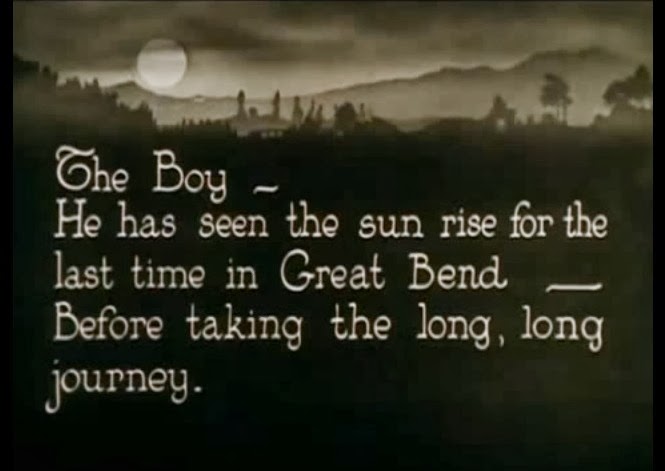
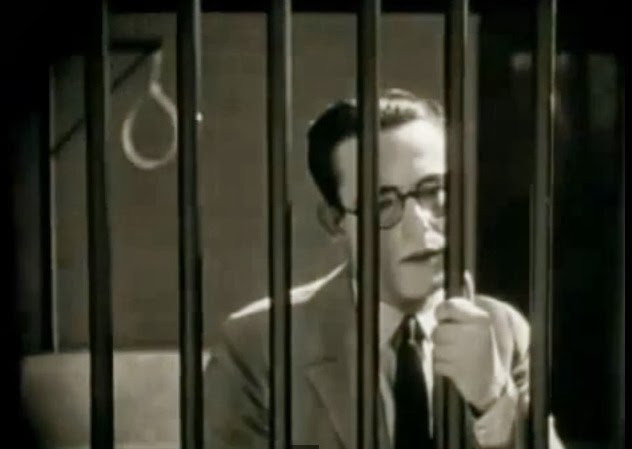
The camera then draws back to show two weeping women – the Boy’s mother and girlfriend – on the other side of the bars. A policeman and a priest enter the frame too, and the meaning of the scene appears clear from these elements – but of course it’s a set-up, the first of many fine sight gags: it turns out that they are all at the railway station, the “hangman’s noose” is really a loop used to attach mail for passing trains to pick up, and the Boy is only going to the big city for a job.
Once this has been revealed, it would be understandable if the film slowed down for a bit to establish the situation and the characters. Yet, after only a brief interlude – where Harold and his girlfriend Mildred (played by Lloyd’s real-life wife Mildred Davis) express their hopes for the future – the gags continue with a seamlessly executed scene where Harold, rushing to catch the train, picks up a pram with a baby in it instead of his suitcase. In itself, this is nothing special – a staple comedy-of-errors scene – but it is the necessary build-up to the final visual gag of this sequence. The baby’s mother catches up with him just as he is about to climb aboard, the mix-up is sorted out, but the distracted Harold doesn’t realise that the train has started moving away. Without looking, he stretches his arm out behind him …and ends up on a passing horse-cart instead. Discovering his mistake, he runs after the train and leaps on, by now a receding figure, but with enough presence of mind left to wave a second cheery goodbye. Fade out.
A description like this is no substitute for watching the two-minute scene play out, of course. It is a marvelous line of comic sketches, building on – and running into – one another: an opening shot that catches us off balance before allowing us a little chuckle of relief,  then the mix-up culminating in the agile physical comedy. And in between all this, an important “serious” moment – a close-up of the lovers before they part – that suggests what is at stake for the main character: what the Big City, with its tall buildings, office politics, expensive food, menacing clocks, and rich shoppers bullying overworked salespeople, will mean for him.
The film has many more such sequences, leading up to that super finale where Harold climbs the building unaided, in pursuit of a 1000 valuable dollars. This is one of the great ascents in any movie, right up there with King Kong – also a visitor from the boondocks trying to make sense of the city – climbing the Empire State Building 10 years after Safety Last! was made. (Or this opening scene from another great silent film, King Vidor’s The Crowd, where a camera “climbs” a skyscraper.) The gags in this last act literally build as Harold climbs from one floor to the next, facing a new challenge each time. It is heart-in-your-mouth thrilling, but – without detracting from the “fun” – it is also emotionally resonant for anyone who has come to sympathise with the Boy (easy to do; Lloyd is a natural and likable actor). Here is a scene that literalises the idea of the small-town boy as social climber. As critic Leonard Maltin and archivist Richard Correll point out in the Criterion commentary track, not only do the obstacles pile up in the final sequence, they get tougher and more outlandish. (A vagrant badminton net? A mouse running up his pants leg? A photo shoot somewhere on the 10th floor, involving a man with a gun?)
Which means this could be an image of the upwardly mobile professional climbing the ranks in a cutthroat world, with the stakes constantly increasing: the danger of falling and losing everything becomes more pronounced the higher he goes. This lovely, light comedy – while consistently being a lovely, light comedy – is up there with any of the more serious-minded examinations of what can be lost and gained in the move from a “simpler” way of life to a more competitive one; a worthy companion piece to other silent classics of the time like Greed or Sunrise or The Crowd, which offered the big city as a place where you might lose your footing (or your soul).
 I watched Safety Last! alone, on DVD, with a prior idea of what the film was about, and I was still deeply stirred by it (the orchestral soundtrack by Carl Davis from 1989 goes very well with the film too), so I can't imagine what it must have felt like to unprepared audiences in a theatre in the pre-CGI era – people who had never been exposed to such stuntwork in a movie. Even today’s viewers might find their mouths hanging open when a dazed Harold swaggers about on the very edge of the roof after being struck by a weather-vane. No wonder the last shot – with the Boy back on firm ground and in the safety of the Girl’s arms – brings such a sense of release. It is a little like King Kong with a different ending, one where the ape and the blonde are reunited for ever on the rooftop. But is this a happy ending exactly? Even a thousand dollars may not go a very long way, and if the city is going to keep throwing up such challenges perhaps the young man may have been better off with his head in that noose after all.
P.S. two shots from films about a struggler in the city. A tram sequence in Safety Last! with hordes of men clinging to the outside of the vehicle and to each other, like bees to a hive:
And Kishore Kumar on a bus in Naukri 30 years later:
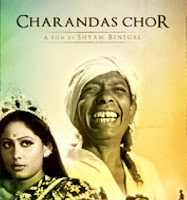
Given that Shyam Benegal is one of our most respected directors, I’m a little surprised by the under-the-radar status of his second feature film, the 1975 Charandas Chor. This version of Habib Tanvir’s famous play about an honest thief was done in collaboration with Tanvir – before the play itself had acquired its final shape – and I think it is one of Benegal's most enjoyable movies and one of Hindi cinema’s sharpest satires. But it is often overlooked, perhaps because it was made for the Children's Film Society and therefore seen as being geared to a non-adult audience. I have read Benegal profiles that refer to Ankur, Nishant and Manthan – cornerstones of the Indian New Wave – as his first three films, with no mention of Charandas Chor. (See the second sentence of this Wikipedia entry, for starters, and the “Feature Films” subhead.) Even Dibakar Banerjee – a voracious movie-watcher and a big Benegal fan – had not seen the film when I spoke with him last year, though he was certainly familiar with Tanvir’s play. (Banerjee noted that the play contained a precedent for the Oye Lucky! Lucky Oye! theme of a thief’s career becoming a comment on the society around him.)
The neglect notwithstanding, Charandas Chor is a notable film on many levels. It represents a rare meeting between cinema and folk theatre (with vital contributions by musicians and actors of the Chhatisgarhi Nacha troupes who worked with Tanvir) and is a document of one of our most significant modern plays in a nascent, transitional form – but it is also recognisably a film, cinematically imaginative and dynamic. It was one of Govind Nihalani’s most impressive early outings as a cinematographer, as well as the feature debut of the young Smita Patil, as a beautiful princess who is besotted by the bumpkin Charandas.
 Despite the seriousness of its themes, its form is that of a playful entertainment from the very first image, a medium shot of a doleful-looking donkey, its tail apparently wagging in tune to the folk-song on the soundtrack. While this animal plays a functional part in the narrative (it belongs to a dhobi who will become Charandas Chor’s sidekick), the ass motif is integral in a wider sense: many of the side-characters, including a “chatur vakeel” (clever lawyer), are depicted in illustrations as donkeys that Charandas will get the better of (or expose as hypocrites). The film's episodic structure is quickly established too, with Charandas (Lalu Ram) encountering the dhobi Buddhu (Madan Lal), who wishes to become his chela. The scene employs the language of an enlightened guru addressing his disciples: asked to impart his gyaan of thievery, Charandas replies, "यह कला है, बेटा - बड़ी साधना से मिलती है।" (“This is an art, son – it requires practice and rigour.”)
 But this being a parable about the duplicities of social structures – including the ones rooted in class and religion – we also meet a “real” guru who, as Charandas observes, has an even more efficient money-making gig going. “आपका धंदा बैठे बैठे, और आमदनी ज़्यादा" (“You sit and do nothing, but earn more than me”) he tells the sadhu with genuine reverence in his eyes. This lampooning of authority figures extends across hierarchies: for instance, a view of temple idols shorn of their ornaments (making them look bald, comical and most un-Godly) is echoed by a shot of three unclothed policemen drying their uniforms by the riverbank. Through most of these episodes, the chor maintains his essential dignity and his moral compass while the “law-abiding” world is revealed as hollow, rotting or plain naked.
There is so much to enjoy here, for children and adults alike. There is Nihalani’s black-and-white photography (inferior Orwo film had to be used due to import constraints of the time, but the occasional graininess goes well with the subject matter and the bucolic setting) and his imaginative use of zooms, particularly effective in chase  sequences that evoke the silent cinema's Keystone Kops. Also the Nacha music, which continually comments on the action, and wonderful lead performances by village actors from Tanvir’s Naya Theatre, including the emaciated Madan Lal – one of Tanvir’s favourite actors – who played Charandas on stage but plays Buddhu in the film.
Inter-titles are used like chapter heads, and Tanvir himself reads them out in his nasal voice, fumbling over big words the way a child might. ("बुद्धू का चोरी के दाव... दावपेंच सीखना।") In a funny little cameo, he also appears as an absent-minded judge who might have dropped in from Alice in Wonderland, holding large scissors and a walking stick instead of a
sequences that evoke the silent cinema's Keystone Kops. Also the Nacha music, which continually comments on the action, and wonderful lead performances by village actors from Tanvir’s Naya Theatre, including the emaciated Madan Lal – one of Tanvir’s favourite actors – who played Charandas on stage but plays Buddhu in the film.
Inter-titles are used like chapter heads, and Tanvir himself reads them out in his nasal voice, fumbling over big words the way a child might. ("बुद्धू का चोरी के दाव... दावपेंच सीखना।") In a funny little cameo, he also appears as an absent-minded judge who might have dropped in from Alice in Wonderland, holding large scissors and a walking stick instead of a  gavel***. And there is the casual drollness of such exchanges as the one where Charandas, miffed by the princess’s show of largesse, proudly tells her “मैं चोरी करता हूँ, दान नहीं लेता" (“I steal, I don’t accept alms”) while the sadhu standing behind her pipes up "दान लेना तो मेरा काम है, बेटी" ("Taking alms is what I do").
*****
A few months ago I briefly spoke with Benegal about Charandas Chor, particularly the divergence between his version and the one that Tanvir finalised for the stage. One important difference was the ending: in both film and play Charandas is put to death, but in the film a humorous epilogue shows him plying his roguery in the afterlife, where he steals Yamraj’s buffalo and presumably sets off on a fresh round of adventures. (This narrative circularity is of course common to many myths or fables; one might also recall the last scene of Oye Lucky! Lucky Oye!, with the rake coolly strolling into the far distance as a TV news reporter blathers on.) But Tanvir’s later modifications to the play made it bleaker and more hard-hitting, with a conclusion that allowed his hero to maintain his integrity – to die for the truth he holds so dear, while the world around him continues on its merry path. “He turned it into a sophisticated tragedy,” Benegal told me, “whereas my film was a moral story done as a comedy for children.” The playwright also opted for a sparer, more minimalist idiom, removing the part of Buddhu along with other extraneous elements, including that zany courtroom scene.
 But film and play have one important thing in common: Tanvir and Benegal were both influenced by Brechtian alienation, wherein the audience is asked to be intellectually aware of the issues raised in a story, rather than becoming emotionally immersed in it or “forgetting” the constructed nature of what they are watching. In her book Habib Tanvir: Towards an Inclusive Theatre, Anjum Katyal observes that Tanvir made atypical use of Indian folk music: while our folk theatre tends to use songs in a didactic way (explicitly telling the audience what is good or bad), Charandas Chor follows the Brechtian technique of having two songs express contradictory ideas (e.g. one might say “Charandas is not really a thief, he is a good man, there are bigger thieves in society” while another goes “he is a dangerous thief, protect yourself from him”) and letting the viewer weigh each stance and consciously work out his own attitudes.
Many of Benegal’s later films, notably Arohan (which begins with Om Puri directly addressing the camera, speaking about the subject of the film and introducing the other actors) and Samar, would use similar distancing techniques. One sees it also in Nihalani’s directorial ventures such as Party or Aghaat, where self-conscious, expository dialogue takes the place of naturalistic conversation. The film of Charandas Chor doesn’t do this to the same degree (it was, after all, made for children and needed something resembling a conventional narrative flow) but it does draw attention to the storytelling process through its titles, illustrations and voiceovers. At one point the images on the screen even shake and rupture – as if there were an error in the projection – and Tanvir’s sharp voice asks “Kahin film poori toh nahin ho gayi?” In its own way, this entertaining “children’s movie” is very much a companion piece to the meta-films in the new art cinema of the 70s and 80s.
P.S. For anyone interested in Tanvir, the English version of his unfinished memoirs (translated by the multi-talented writer, historian and dastangoi Mahmood Farooqui) has just been published. I haven’t yet read it, though I intend to (it only covers Tanvir’s life up to the 1950s, I think). Anjum Katyal’s study of his life and career, mentioned above, is strongly recommended too.
P.P.S. A few months ago I discovered that Charandas Chor was on YouTube in a good print, and despite my reservations about watching movies on a computer screen I grabbed this available option. Unfortunately the YouTube video was removed a few weeks ago. But perhaps this indicates that a fresh print of the film will soon be made available on DVD. One can hope.
*** The stammering judge in Charandas Chor is probably an extension of the role Tanvir played in the 1948 IPTA comedy play Jadu ki Kursi, which also had Balraj Sahni in an acclaimed lead performance.
I have written before about the Criterion Collection DVDs and their use of imaginative artwork to pay homage to great movies. Last week I learnt that the Satyajit Ray classics Charulata and Mahanagar will soon be out on Criterion, but equally pleasing was a glimpse of the cover design for Ernst Lubitsch’s brilliant 1942 comedy To Be or Not to Be. The picture on the DVD package juxtaposes a famous image from Hamlet - the glum prince, primed for a soliloquy, holding Yorick’s skull in his hand - with a figure dressed in a smart Nazi uniform, so that the skull covers the Nazi's head. This image of fascism defeated, or made buffoonish, by theatre nicely catches the mood of a film about a Polish acting troupe outsmarting Hitler’s men. It also reminds me of what the critic David Thomson said: “If one side is making To Be or Not to Be in the middle of a war and the other is not – you know which side to root for.”
 No intention of spoiling Lubitsch’s film for anyone who hasn’t seen it, but just as an appetiser, its opening sequence involves the apparent appearance of Hitler – alone – at a market corner in 1939 Warsaw. As he hesitantly surveys the shops and residents gape at him, a breathless voiceover – resembling nothing so much as a baseball-match commentary – goes:
“He seems strangely unconcerned by all the excitement he's causing. Is he by any chance interested in Mr Maslowski’s delicatessen? That’s impossible! He’s a vegetarian. And yet, he doesn’t always stick to his diet. Sometimes he swallows whole countries. Does he want to eat up Poland too?”
More digs at the leader follow in the next few minutes: an actor (the man who was pretending to be Hitler in that opening scene) responds to salutes with a “Heil Myself”, and a little boy speculates that if a brandy took the name Napoleon, perhaps Hitler “will end up as a piece of cheese”.
Of course, To Be or Not to Be was scarcely the only Hollywood film of its time to lampoon the Fuehrer. One of my favourite “Hitler cameos” occurs in Preston Sturges’s 1944 comedy The Miracle of Morgan’s Creek, about a small-town girl who gives birth to sextuplets, a national record. As news spreads across America and the world, we see the dictator's furious reaction and a headline from a German newspaper reads “Hitler Demands Recount!” Tangential though the scene is to the film, it links Hitler with terminology associated with voting and democracy, presented here as a symbol of America’s moral superiority over Nazi Germany.
 Around the same time, the good folks in animation were making more direct propaganda films such as the pleasingly titled Herr Meets Hare (in which Bugs Bunny accidentally tunnels to Germany while trying to find Las Vegas, and speaks incomprehensible faux-German in a shrill, Hitler-like voice), Donald Duck in Nutzi Land (the peevish Donald finds himself working in a Nazi factory, which makes him even more ill-tempered than usual) and The Blitz Wolf, which begins with the assertion “The Wolf in this photoplay is NOT fictitious. Any similarity between this Wolf and that (*!!#%) Hitler is purely intentional.”
Not all these films draw positive responses today. People are often affronted by Nazism being treated lightly in a Hollywood movie (or cartoon!), especially one that was made at a time when the very real horrors of the concentration camps were underway far across the Atlantic. One argument goes that it amounts to trivialising the Holocaust, and some things, we are told, should simply not be joked about. Well, I disagree in a broader sense with that idea – I don’t think any subject, however ugly or distasteful, should lie outside the purview of humour – but in this case the nature of the comedy serves an obviously desirable function: it strips a pompous, self-important figure of his dignity.
 Recently there was a comparable scene in Quentin Tarantino’s Django Unchained, where a meeting of the Ku Klux Klan, the white-supremacist group, turns into farce when the members find that they can’t see properly through the little slits in their white hoods; and these are the very costumes that they think make them look so awe-inspiring! The scene drags on too long, but one can’t fault its intention: undermining evil by making it banal, then ridiculous, so that by the end the group is more klutz than klux. (Incidentally, the real history of the KKK has an equivalent for this. In the 1940s, the author William Stetson Kennedy infiltrated the group and passed on its code-words for use in a children’s radio programme about Superman; as little children – including the children of mortified Klan members – began using the “secret words” in their games, the group’s air of mystery was diluted.)
It is useful to have good satirical depictions of this sort in cinema, because there have already been films – powerful and influential and superbly made films – that have depicted evil in grand terms. Two that readily come to mind are Leni Riefenstahl’s Triumph of the Will – a  document of Nazi rallies that begins with a stirring scene where Hitler is framed as a deity surveying his land from his plane before descending to make his speeches – and D W Griffith’s silent epic The Birth of a Nation, which portrayed the KKK almost as knights in shining white armour. The movies served different functions: Riefenstahl’s was explicit propaganda, made for the National Socialist Party, while Griffith – a Southerner who grew up with assumptions that we would consider very illiberal today – was possibly making an honest effort to capture the realities of a particular time. But their ability to sway audiences, to make violence and intolerance seem appealing, can’t be denied; think of Birth of a Nation audiences in 1915 watching new techniques such as fast-paced cross-cutting, which made the climactic action more rousing.
 What films like To Be or Not to Be do is to provide a counterpoint by puncturing that balloon, and I’m thankful for them every time I see how fashionable it is for a certain demographic of Indian youngster (this includes a lot of management students, incidentally) to posture and claim fondness for Hitler’s Mein Kampf – a book that has long been a bestseller in India – or to express admiration for his “leadership qualities”.
That said, good comedy can have morally ambiguous consequences too, as can be seen in the viral popularity of the “Downfall spoofs” on the internet. Using a scene from the 2004 film Downfall – a serious treatment of Hitler’s final days – where the dictator becomes unhinged as he realises defeat is at hand, these videos rewrite the English subtitles to make it seem like Hitler is ranting about sundry inconveniences and oddities of the modern world: thus, “Hitler finds out that Twitter is down again” and “Hitler discovers that Oasis have split up”. Many of the results  are hysterically funny, but you might wonder about the implications: what does it say about us when a mass-murderer becomes a fellow pilgrim in expressing rage at relatively minor things? Empathy can be a tricky thing: these videos make Hitler one of us, and remind me of another exchange in To Be or Not to Be, when the director of the play expresses doubt about the effectiveness of the actor playing the dictator: “It’s not convincing. To me he’s just a man with a little moustache.” The actor replies: “But so is Hitler.”
[Did a version of this for my DNA column]
[Here's my latest column for Forbes Life, on some favourite literary satires and black comedies]
Humour at its core is accuracy, the novelist Manu Joseph said in a recent interview – when you’re uncompromisingly precise about something, it becomes funny. The best satirists have always known this, but it is also one reason why satire itself can be such an imprecise category in art. There will always be books and films that you can immediately identify as satirical because their tone is unmistakeable: even the most naïve readers and viewers will “get” it. But there are equally cases of understated works where one is not always sure of the line between plain realism and tongue-in-cheek comedy – or if such a line even exists.
 Besides, real life usually stays a step ahead of the most acerbic spoofs; even when a satirical work is intended to be over the top, a time may come a few decades or even just a few years later when some of its content appears relatively commonplace. Discussing his 1968 novel Raag Darbari – a modern classic of Hindi literature, about corruption and factionalism in a small village named Shivpalganj – the writer-bureaucrat Shrilal Shukla noted that one of the criticisms directed at the book was that “it didn’t say anything new – it just described what everybody knew already”.
Even if this were true, it would take nothing away from Shukla’s incisive yet good-natured account of life in a place that the narrator likens to the all-encompassing Mahabharata: “What was to be found nowhere else was there, and what was not there could be found nowhere else.” Gillian Wright’s 1992 translation of the novel captures its many droll sentences and throwaway observations (“the theory of reincarnation was invented in the civil courts so that neither plaintiff nor defendant should die regretting that his case had been left unfinished”), of which there are so many, in fact, that it seems a waste to read this book over just one or two sittings. The experience has to be savoured, stretched out.
The story, filtered partly through the gaze of a visiting city boy named Rangnath, gradually reveals the self-deception in nearly every aspect of Shivpalganj’s life. A slothful sub-inspector mulls the great burden of his responsibilities: “There was so much work that all work had come to a standstill.” Doctors and engineers are in short supply, we are told, because “Indians are traditionally poets”. When politicians come to the village to make speeches, we learn that “a speech is really enjoyable only when both sides know that the speaker is talking absolute nonsense” – when some overenthusiastic speakers begin taking themselves seriously, the audience develops indigestion.
Two decades after Raag Darbari was published, another bureaucrat wrote a novel about a young civil servant posted in “a tiny dot” somewhere in the Indian hinterland. Upamanyu Chatterjee’s English, August was rightly hailed as a milestone in modern Indian-English writing, but true  satire fans – especially those with high tolerance for scatological content – should set themselves the task of rediscovering his other work. None of them are as consistently funny as August, but they all have passages that measure up to its heights. Consider the opening of his 2010 novel Way to Go where a man named Jamun comes to a police station to report that his 85-year-old father has vanished, the local constable interrogates him, and what ensues is funny not so much in a laugh-out-loud way but in a chuckle-hopelessly-to-yourself-until-you-choke-on-your-own-phlegm way. As bureaucratic procedure takes centre-stage (a recurring theme in Chatterjee and in much Indian satire), time and common sense are suspended. The conversation is shaped by the bizarre order in which the questions are printed on the form; there is no indication that the constable is capable of making a sensate connection between what he is asking and the information that has been supplied to him. Soon Jamun is in a practically comatose state, reeling off sentences mechanically. When he replies “Such was not the case in the present instance” to a question, the constable nods approvingly – at last they are speaking the same language.
 In fact, satire often thrives on a premise where two people discuss an urgent matter but fail to get anywhere because, for all their eagerness to understand each other, the gap between their beliefs and cultural reference points is unbridgeable. Aubrey Menen’s extraordinary 1947 novel The Prevalence of Witches contains just such a conversation between a village headman and an English administrator named Catullus. The former is patiently trying to explain how a witch goes about her spiteful work (witches being an accepted fact of life in the imaginary British Indian region of Limbo, populated by people who have no use for modern education or scientific thought), why she must be interrogated in a very precise fashion – by hanging her upside down and beating her – and why she may “choose” to be either alive or dead; the latter is making an honest effort to understand what is being said.
One might think Menen’s intention is to mock easy targets: the superstitions of “primitive” people. But The Prevalence of Witches is equally mindful of the hypocrisies of those who think of themselves as modern, and the often-dubious building blocks of what we call civilisation. Reading it, one understands why Menen’s equally forthright retelling of the Ramayana (“Despite following his moral and political preceptors with devotion, Rama finally managed to recover his kingdom, his wife, and his common sense”) has been one of India’s most high-profile banned books for decades.
****
Humour is most effective, it is often said, when its shafts are pointed upwards: its targets should be those who are more powerful and privileged than the humorist. It is in this context that one must consider the 19th century social reformer Jotiba Phule’s scathing attacks on the caste system and on the Brahmin way of life. Phule’s tract Gulamgiri (Slavery) reveals him as an abrasive, first-strike radical, not above expressing strident views if it made a larger point about social hypocrisy.
 The graphic novel A Gardener in the Wasteland, written by Srividya Natarajan and drawn by Aparajita Ninan, tells the story of Phule’s life and work with a panache that the man himself would have approved of, beginning with a passage that likens 1840s Poona to the lawless American Old West: “it was a hellhole of a town. A mob runs it: a Brahman mob”. Decadent, hoodlum-like Brahmins (“Pass the Gangajal, will you,” one says to another, crudely probing his ear with his finger) lord it over the “lower castes”. Subtlety is beside the point here: this is satire that sets out to wound and shock, as a way of getting its back on centuries of oppression. Righteous anger fuelled Phule’s skewering of the creation myth about the four castes being born from Brahma’s mouth, arms, groin and legs (did Brahma menstruate in all four places, was his sarcastic response) and his irreverent deconstructions of the Vishnu avatars.
In any case the line between “cutting” and “outright nasty” can be as thin as the line between those classic categories Horatian and Juvenal satire – what matters more is the execution. It is also worth noting that the best judges of such works are not those with weak stomachs or an easily offended aesthetic sense. When Jonathan Swift wrote his famous essay “A Modest Proposal”, proposing that poor people might sell their infants to serve as food for society’s rich (“a young healthy child well nursed, is, at a year old, a most delicious nourishing and wholesome food, whether stewed, roasted, baked, or boiled”), some readers were outraged because they took the suggestion at face value; others were offended because, though they understood Swift’s intent, they didn’t much care for the tastelessness (pun unintended) of the thought.
Among modern works, Bret Easton Ellis’s American Psycho turned many readers off with the grisliness of its narrative about an attractive young investment banker who is also a psychopath (or deeply delusional), but the book was a startling indictment of a consumerist society, and its narrative form was vital to its effect (it’s another matter that barely 20 years after its publication, parts of it already seem dated!). This is equally true of some of the work of Chuck Palahniuk, notably Fight Club, which uses  unsettlingly staccato language and narrative misdirection to comment on such aspects of modern life as hyper-masculinity and the inability of people to connect with one another, or with themselves.
At the same time, mere shocking isn’t enough. Another graphic novel, Lie: A Traditional Tale of Modern India – written by Gautam Bhatia and drawn by the Rajasthani miniaturists Shankar Lal Bhopa and Birju Lal Bhopa – has much going for it: it is an unremittingly dark work that satirises many aspects of modern Indian life, notably the class divide and the apathy of politicians towards their constituencies. The many little vignettes include a just-born baby girl being deposited into a movie-hall’s trash can with the family-size popcorn bag, and a state chief minister flying over a drought-ravaged area in an aircraft that has been retrofitted with a swimming pool and a shopping arcade. But the book is often heavy-handed and there is a disconnect between content and form; the drawings are barely given the space they need.
Too much anger can also undermine the effect of a good literary satire. “I sat down to pass moral judgement. I was not wise enough then,” Mahesh Elkunchwar noted several years after writing his play Party, a coruscating satire of Bombay’s intellectual circles. The play is about a party held at the house of arts patron Damayanti Rane, the guests including writers and poets at various stages of their career: fat cats made complacent by fame, lean hangers-on desperately aspiring for it, sermonising faux-liberals. Over the evening details of character emerge, epiphanies are experienced and the conversation converges on an absent figure, a poet named Amrit, who is fighting the cause of exploited tribals. This enigmatic man becomes a catalyst for our understanding of these partygoers – their feelings about him run from hero-worship to indifference to contempt – and for a penetrating examination of the artist-human being divide.
 The play (which was also the source material for one of our cinema’s most skilfully crafted chamber dramas, Govind Nihalani’s 1984 film) was born out of Elkunchwar’s reflexive response to encounters with famous people who were all talk and little action. It remains a hard-hitting work in some ways, its central theme still very relevant, but one can see why he thought it was facile in its judgements. It might be said that one characteristic of good satire is that rather than taking the easy way out by deriding individuals, it allows us to see the conditions and systems that can make well-intentioned people pathetic or loathsome. And so, to two of my favourite political satires that achieve this.
To say that Mohammed Hanif’s debut novel A Case of Exploding Mangoes is a novelised treatment of the final days of Pakistan’s Zia ul Haq would be to convey little of its skill and comic richness. The dictator’s story – told in the third person – alternates with the voice of a junior officer named Ali Shigri, which, in its irreverence and blithe disregard for the supposed dignity of the Army, resembles that emblematic modern satire, Joseph Heller’s Catch 22. But the most engaging sections of Hanif’s book are the ones that deal with Zia’s growing paranoia and childlike dependence on his inner circle. Though placed at the centre of some lowbrow comedy, Zia is also, in a strange way, humanised: there is something poignant about his desperate need for attention and his speculating that he might be ruling a ghost country. It would be a stretch to say that he becomes a sympathetic figure, but there is some ambivalence in our response to him.
 If Hanif’s book is political satire with elements of magic realism, the Czech writer Karel Čapek’s 1936 novel War with the Newts belongs partly to the still-nascent genre of science fiction (Capek coined the term “robot”). This imaginative and playful work centres on the discovery – near a Sumatran island – of an unusually intelligent species of marine newts or salamanders. An enterprising captain teaches the creatures to use tools and to speak, and as news of their existence spreads the world responds in a variety of ways. Secret temples for worship arise, various existing doctrines are re-moulded to accommodate the new animals, and fashionable youngsters on Californian beaches bathe in sea-creature costumes (“three strings of pearls and nothing else”). At the same time more practical-minded businessmen breed the newts in the millions and put them to work – this in turn leads to much speculation about newts’ rights and what languages they should be made to learn first; and there are references to the political and social realities of the time, such as Nazi Germany’s treatment of Jews.
This funny, far-reaching novel of ideas is a comment on human hypocrisies, the hegemony of some groups over others and the whimsical, often ludicrous ways in which our civilisation has been organised. Čapek doesn’t single out any system for attack (both capitalism and communism are grist to his mill, for instance), but his book is a critique of systems in general, and how decadent any of them can become. It carries within it a view of the very long picture, vindicating the idea that no other genre does clear-sightedness in quite the way that satire does.
[Two earlier Forbes columns: true crime and popular science]
The title of Anik Dutta’s Bhooter Bhabishyat – a massively popular Bengali film from earlier this year – translates as “Future of the Past”, and appropriately enough it begins with juxtapositions between what we think of as “old” and “new”, “modern” and “traditional”. The very first shot is a close-up of a woman, dressed in an elegant sari, heavily made up and bejewelled, who appears to be from a non-contemporary setting (or at least a very orthodox one). But the frame is held for barely a couple of seconds before she raises a cigarette to her lips and a cellphone rings off-camera; she picks it up and goes “Hi! Ki Khobor? What’s up?” while a girl in casual shirt and jeans appears behind her to attend to her hair. A film, probably a period drama, is being shot – the woman is the lead actress and the crew bustles about a crumbling 250-year-old north Calcutta mansion with modern cameras and other equipment.
 There will be many such contrasts throughout Bhooter Bhabishyat, the main plot of which begins with young people scouting the same old house for another film. A writer-director named Ayan (Parambrata Chatterjee, who was so good as Vidya Bagchi’s courtly “saarthi” in Kahaani) works on a script – in English – on his Apple laptop, then gets distracted and plays some classical music on the same device. Sounds from different eras run into each other continually: there is a transition, later in the film, from "Auld Lang Syne" to Rabindrasangeet to contemporary pop music; the ringtone on Ayan’s phone is the otherworldly voice of the bhuter raja that Satyajit Ray himself recorded for Goopy Gyne Bagha Byne. (Incidentally Ayan refers to his hero Ray as “Joy Baba Manik-nath” – the first time I had heard this term of endearment, though for all I know it's popular in Bengal.) And a 360-degree pan shot of the desolate house is accompanied by an incongruous soundtrack that brings its former days of glory – festivals, entertainment shows – to our ears.
The idea that the past and the present are constantly interacting with (or brushing abrasively against) each other is central to this tale of the supernatural, which is also a light commentary on inexorable “progress” and on modernity’s neglect of old things. This premise is spelled out with delightful economy during an opening-credits sequence that involves animated ghostly eyes and background music in the electronic-distortion mode of the ghost scenes in Goopy Gyne Bagha Byne.
“Calcutta is now a concrete jungle,” the ghost-voices sing as the titles appear. “Heritage is disappearing, promoters are taking over the land, even the intellectuals are silent. Where will all the ghosts go?” And then, in a neat meta-touch, “We have made this film to protest.” The appealing conceit is that the movie we are watching is a sort of magical projection, financed and sponsored by marginalised spirits to raise awareness of their plight.
 Over the next two hours we see how this idea plays out. It involves Ayan, the young director, encountering a genial middle-aged man (played by Sabyasachi Chakraborty) who tells him a possible story for his next film – a story about a group of ghosts who live in this very mansion. Most of what we see from here on is a visualisation of this tale: we are introduced to these relics of the past, including an 18th century zamindar, a gora sahib from the East India Company, an actress-singer from the 1940s and a generic buffoon who continues visiting the local fish-market in his spectral state because he can’t overcome the Bengali habit of bargaining. There are also two young people who died very recently – a musician named Pablo who wears a Che Guevera T-shirt and a bubbly girl named Koel (Mumtaz Sorcar, granddaughter of PC Sorcar) who killed herself in the name of love. As someone says late in the film, “Ojeeb collection hai.”
The back-stories of these ghosts – originally from different time periods and socio-economic strata, now living in a shared purgatory – facilitate references to environmental and social issues, from global warming to rich youngsters mowing down pavement-dwellers in their SUVs. The relentless destruction of flora, we learn, has left a tree-dwelling ghost as much of a refugee in death as he was in life. An ancient ghost recalls his granddaughter who had died of the “black fever”. But this lot certainly knows how to live it up, and their jollity emerges in full force during an anachronistic fashion parade where they dress up in outfits they wouldn’t have got to wear when they were alive.
 Entertaining though this set-up is, it also leads to a slack midsection containing a little too much tomfoolery and the sort of ensemble comedy that actors must dread – where they have to stand around in a group, speaking in turn, while those saddled with the task of listening struggle with the appropriate reaction shots, nodding their heads or rolling their eyes meaningfully; the effect can be like a hurriedly prepared college play. Also, don’t expect this “ghost world” to be a properly worked out universe with rules that clearly distinguish it from our own. Apart from their ability to teleport and walk clean through walls, there is little to separate these spirits from regular people: they go for picnics, they have cellphones, they use a social-networking site called Spookbook to contact other members of the living dead, and – most puzzlingly – they can get out and interact with real-world people whenever they want to (though they continue to shed the occasional tear when they recall those whom they have left behind).
All these qualities come into play when their existence is threatened by a mall-builder who we know must be evil because he – gasp – quotes Tagore in a dubious, self-serving context; this terrible man plans to erect a “Five-Star Plaza”, a mini-Singapore, where the haveli now stands. Personally I failed to understand why the ghosts are so troubled by this development (why can’t they just live in the mall like millions of real-world zombies everywhere do?) but such questions are beside the point because this plot turn leads  to more fun and games. Feeling just as bullied as Mr Khosla cheated of his precious plot of land in Khosla ka Ghosla, the ghosts must – like the characters in that film – perform a subterfuge to foil the builder’s plans. This involves the participation in a guest appearance of Saswata Chatterjee – Kahaani’s Bob Biswas – as another, much more flamboyant hitman.
****
Most of these shenanigans are enjoyable enough, but what I found more interesting about Bhooter Bhabishyat is that it is also a homage to a cinematic past, sprinkled with filmic references, many of which I’m sure I didn’t get given my weak knowledge of non-Ray Bengali films (I did get that the frequently rhyming dialogue was a tribute to Hirak Rajar Deshe). A ghost extols the virtues of Truffaut, Fellini and Bergman but admits to not knowing anything about contemporary brats like Wong Kar Wai and Tarantino (ghosts can’t watch new films on their cellphones or laptops?). Taking Ayan through the ghost story and its protagonists, the storyteller uses phrases like “Now cut to 1970s Calcutta.” They ponder the technical challenges of recreating different periods and settings: I might have to use a sepia tone for this sequence, the young director muses, and we could do that one in classic black-and-white.
 Through all this, one sees a deep love for a medium that can accommodate vastly different modes of storytelling, from the politically charged cinema of Mrinal Sen (“with handheld cameras and jerky movements”) to the magnificently imaginative ghost dance in GGBB to commercial elements that many of us reflexively dismiss as vulgar – comedy that takes the form of crude puns or stand-alone “humour tracks”, for example. And Bhooter Bhabishyat affectionately draws on these many modes by incorporating them into its own narrative. Thus one scene simulates a moonlit romantic song from a 1940s movie while another shows stark footage of police-Naxal encounters in the early 1970s, and there is even a head-banging rock number filmed in the frenetic style of a modern concert. There is lowbrow wordplay (“massage” used for “message”, a secretary who says “hard-dicks” for “hard-disk”) and there is an item number with lyrics that may or may not contain sexual innuendo (if a seductress sings “Mere ang ang mein aag lagaai diye” to a horny man, it might seem like it can only mean one thing – but what if she is the ghost of a woman he had set fire to?).
 All of which means that this film about a bunch of happy-go-lucky spooks can also be seen as a film about its own conceptualisation and execution. Near the end, Ayan says that though he personally finds the ghost story very interesting, it would be difficult to pitch such an “absurd” premise to a producer. Within the narrative, this problem is sorted out through the convenient appearance of priceless coins from the East India Company days. But let’s hypothesize that the real-life director Anik Dutta faced the same problem as the fictional Ayan, and didn’t have access to hidden treasure. Perhaps, then, the solution was to shoot his film not as a straight (therefore square) ghost story but as a meta-movie that constantly acknowledges its own craziness. If so, it was a terrific idea, and though the ghost sequences have their ups and downs there is much else in Bhooter Bhabishyat for a movie-buff to appreciate.
P.S. As a viewer who has had some ghastly experiences with subtitles in the past, I was relieved to find that the subtitling on this DVD was done with care and some wit. Even to the extent of discerningly playing about with word-meanings so that a joke or innuendo would translate across languages. At one point the dialogue involves a confusion between the words "antar-baash" (undergarments) and "antar-jaash" (which, a Bengali friend tells me, can be roughly translated as "inner concerns"). The English subtitles use "lingerie" and "lingering doubts".
[A post on Goopy Gyne Bagha Byne is here]