
The main plot-mover in Avinash Das’s excellent new film Anaarkali of Aarah is an incident that begins as a show of buffoonery but grows into something dark and nasty, even as we go from chuckling to shifting uneasily in our seats. Anaarkali (Swara Bhaskar), the star of a small-town troupe, is singing and dancing for her admiring audience when Dharmender (Sanjay Mishra), a very drunk and very smitten vice-chancellor, clambers onto the stage. At first he behaves like any number of over-enthusiastic men at this sort of show, briefly making a spectacle of themselves before staggering back into the audience. But he doesn’t back off: he goes from begging for Anaarkali’s personal attentions – in the manner of a pitiful, Devdas-like swain – to pawing and assaulting her.
Much of the scene’s effectiveness comes from how it toys with our perceptions: this flailing middle-aged man, barely in control of his movements, doesn’t fit our general ideas of what a menacing sexual predator might look like (Mishra, wonderful actor though he is, has a screen personality that seems better suited to playing savants or eccentric sidekicks); and Anaarkali, who has just performed a raunchy song in a garish costume, all gyrations and winks at her mostly male fans, doesn’t - initially at least - look like an imperiled woman.
Yet that is the very point, and it’s what makes the scene so discomfiting. In the space of a few seconds, the power equations shift: we see that Anaarkali, so assured when she is performing of her own will, embracing both her art and her sexuality, has suddenly had that control wrested from her (Bhaskar shifts gears from fiery self-possession to vulnerability with consummate ease); and that Dharmender, a man with political connections in Aarah, is a very real threat to her autonomy and livelihood.
 It is one of many fine moments in a story about social hegemonies and the many subtle and not-so-subtle ways in which sexual oppression plays out. After last year’s Pink, which affirmed the “No means No” mantra in the context of a young urban woman being sexually harassed – with the film underlining that it doesn’t matter how she dresses or how hard she parties – Anaarkali of Aarah tackles the theme in a different setting. But in the process, we are reminded that ideas about “loose” or “available” women transcend the rural-urban and class divides. In the south Delhi of Pink, these perceptions might be directed at an office-going girl who lives away from her parents in a PG accommodation and goes out with boys late at night; in the Aarah of Das’s film, it might be a woman in a “not very respectable” profession that invites the male gaze and seems to hold out a promise of more than just looking.
And in both these stories, the woman says: yes, I’ll do this and this and this if I choose to, but that doesn’t mean you can assume I’ll do this as well.
It is one of many fine moments in a story about social hegemonies and the many subtle and not-so-subtle ways in which sexual oppression plays out. After last year’s Pink, which affirmed the “No means No” mantra in the context of a young urban woman being sexually harassed – with the film underlining that it doesn’t matter how she dresses or how hard she parties – Anaarkali of Aarah tackles the theme in a different setting. But in the process, we are reminded that ideas about “loose” or “available” women transcend the rural-urban and class divides. In the south Delhi of Pink, these perceptions might be directed at an office-going girl who lives away from her parents in a PG accommodation and goes out with boys late at night; in the Aarah of Das’s film, it might be a woman in a “not very respectable” profession that invites the male gaze and seems to hold out a promise of more than just looking.
And in both these stories, the woman says: yes, I’ll do this and this and this if I choose to, but that doesn’t mean you can assume I’ll do this as well.
Pink was a good film, but I thought Anarkali of Aarah was sharper and more focused overall, largely because it keeps its lens fixed throughout on a compelling woman protagonist. Bhaskar’s performance and Anaarkali’s centrality to the narrative (the film’s men, though well written and acted, orbit around her) make this a more overtly “lady-oriented” film (as censor-board chief Pahlaj Nihalani would reproachfully say) than Pink, with its grandstanding male lawyers and male judge, was. The first scene – a tragedy from Anaarkali’s childhood – prepares us to meet someone whose life will be tinged with melancholia, but this doesn’t happen. Instead of being crippled or dispirited by the past, she derives strength from memories of her mother – a woman who probably had less agency and fewer choices than Anaarkali does, but who managed to retain her dignity and self-worth even in a tough situation.
After a very taut first half – including a tense, masterfully staged scene where Anaarkali, accompanied by her partner Rangeela (Pankaj Tripathi), goes to meet Dharmender – the film slackens a little. To a degree, this has to do with the protagonist’s shift to a new setting and the need to lie low for a bit. (I was reminded of the post-interval change in tone of Nagraj Manjule’s Sairat, which has a comparable narrative arc.) But the pace picks up again as the story moves back to Aarah (you have to go home to stare down old demons) and towards a stirring climactic scene where what might seem on the surface to be “just” a lowbrow dance performance becomes an exhilarating reclamation of sexuality and choice.*** And the buildup to this Big Moment is paved with some lovely scenes in a minor key, such as a brief meeting between Anaarkali and Rangeela at the courthouse when the affection between them is palpable despite everything that has happened.
It could be pointed out that like the young women in Pink, Anaarkali too eventually needs a man to help her pull off a final coup (which has the feel of a deus ex machina). But the assistance in this case feels more incidental; one gets a stronger sense that events have flown from the force of her own personality, her upbringing, her unwillingness to keel over in a situation where many of us would think that was the safest, most practical option.
 I don’t know how much this film has been directly influenced by real-life events, but it seems particularly topical in the current climate. An early scene is reminiscent – in its depiction of how “fun and games” can cross a line and become lethal – of the recent shooting of a dancer at a wedding party near Bathinda. (And again, lest you think that this sort of thing happens only in “backward” places, remember Jessica Lal.) But on a broader note, there is also the ongoing farce of the “anti-Romeo” squads in Uttar Pradesh which infantilize young women who have boyfriends, telling them they need to be careful “for their own good”, even if that means staying shut up at home until their parents find a socially approved groom. This suppressing of female sexuality (or requiring that no such thing should exist) goes hand in hand with the assumption that women who don’t fit the good-girl mould are fair game and shouldn’t complain about harassment. Against this background, how satisfying it is to see a scene - even if it feels a bit like wish-fulfillment - where a woman looks a powerful man in the eye and tell him that whether he thinks of her as a randi or something “a little less than” a randi (a reference to an earlier dialogue) or as a housewife, he mustn’t touch her without permission.
------------------------------------------------------------------------
*** The
climactic scene can also be viewed as a comment on the subject-gaze
relationship. Earlier in the film, Dharmender crudely broke the Fourth
Wall by encroaching on Anaarkali’s performance; now, as he sits next to
his wife and daughter, she pays him back in the same coin, stepping off
the stage, dancing around him and fracturing his personal, domestic space
I don’t know how much this film has been directly influenced by real-life events, but it seems particularly topical in the current climate. An early scene is reminiscent – in its depiction of how “fun and games” can cross a line and become lethal – of the recent shooting of a dancer at a wedding party near Bathinda. (And again, lest you think that this sort of thing happens only in “backward” places, remember Jessica Lal.) But on a broader note, there is also the ongoing farce of the “anti-Romeo” squads in Uttar Pradesh which infantilize young women who have boyfriends, telling them they need to be careful “for their own good”, even if that means staying shut up at home until their parents find a socially approved groom. This suppressing of female sexuality (or requiring that no such thing should exist) goes hand in hand with the assumption that women who don’t fit the good-girl mould are fair game and shouldn’t complain about harassment. Against this background, how satisfying it is to see a scene - even if it feels a bit like wish-fulfillment - where a woman looks a powerful man in the eye and tell him that whether he thinks of her as a randi or something “a little less than” a randi (a reference to an earlier dialogue) or as a housewife, he mustn’t touch her without permission.
------------------------------------------------------------------------
*** The
climactic scene can also be viewed as a comment on the subject-gaze
relationship. Earlier in the film, Dharmender crudely broke the Fourth
Wall by encroaching on Anaarkali’s performance; now, as he sits next to
his wife and daughter, she pays him back in the same coin, stepping off
the stage, dancing around him and fracturing his personal, domestic space
[Did this review for The Sunday Guardian. When writing about film, I often – too often perhaps – bring up Manny Farber’s “termite art-elephant art” formulation. Well, here’s a novel that I thought might be classified as good termite art]
-----------
Among the many carefully observed moments in Parvati Sharma’s novel Close to Home is one where the protagonist, a young woman named Mrinalini, is entertaining her maid’s little daughter Anjali with cartoon films. They are in Mrinalini’s room – her husband Siddhartha is also around – sitting together on the bed in front of the laptop, when the maid Beena comes in to check on the child. Mrinalini craned her neck to look up at Beena; mother and daughter had the same smile: willing to be pleased, then delighted. “See,” said Mrinalini, “it’s a cartoon. Sit?” She wasn’t sure where Beena would sit and counted on her declining the offer, which she did.
 The notable things about this episode, and the larger scene it is situated in, include the suggestion that the class barrier separating the two sets of people in the room doesn’t quite apply to the little girl yet; Anjali, barely three and hence not a card-carrying citizen of one of the many countries adults create for themselves, can casually make the bed her own (though Siddhartha is a little concerned that she will get her heavily oiled hair on the pillows), but it would be an immediate, noticeable transgression if her mother were to sit on it. The scene also depicts the mixing and mashing of backgrounds and cultural reference points in a world where one can shift from watching kung-fu pandas (“too much in English” for this little girl) to watching an animated Ganesha (wherein an upper-middle-class woman might feel self-conscious when a servant’s child commands her to “do namoh” to the cartoon God) or listening to a bhajan about the infant Krishna. And there is the description “willing to be pleased, then delighted”, which lets us imagine Anjali and Beena, so happy to be in the unusual position of watching shiny images on a computer in this room – but also allows us to reflect that maybe this is just Mrinalini’s perspective, born of self-congratulation.
This slim, sharp book centres on a woman trying to fill a blank screen, at work and in life. As a writer, Mrinalini stresses over the empty word-files on her computer. As a person, she wants to prove – to herself and to others – that she cares, that she can make a difference, and perhaps that confronting discrimination in the real world is more meaningful than writing about it. But being well-off carries its own traps. Even with the best intentions, you may have to deal with the possibility that the poor aren’t just an amorphous mass of eyes brimming with tears of appreciation for the little things you do for them, the favours and kindnesses you dole out at your own convenience; they are just as complex as you are, they have their own capacities for resentment or pettiness, or for wanting more than you think they should be satisfied with. The ayah whose child you are self-consciously looking out for isn’t always going to be the grateful supplicant, she might turn out to be a shrill-voiced bitch who rants about you behind your back, accusing you of using her daughter as a toy. And there could be some truth in that charge.
These are some of the things this book “is about”, but to list them like this makes Close to Home sound ponderous and doesn’t adequately convey what a fun, fast-paced read it is. (It took me just three or four hours to finish it.) The seven chapter heads are lines that come together wittily to make up a little poem – the sort where “Jangpura Ext” can be made to rhyme with “vexed” – and the main narrative has its own rhythm and flow. It begins with a chapter set before Mrinalini is married – she is smoking a joint with her roommate Jahanara, who confesses her love for her. Here as elsewhere, Sharma uses long sentences with unfussy, elegant flair. (Mrinalini was so obviously delighted by this – the dotcom, though unstinting by way of motivational talk and pizza lunches, offered little real excitement, and Siddhartha only called on Sundays – and so eager with her questions and generous in her felicitations, that Jahanara, who had tensed after uttering the words I think I’m gay, had uncoiled and unfurled and unthinkingly discovered, in the time it took them to roll another, that she only ever wanted to tell Mrinalini all her secrets and fears, and the strength of her feeling being what it was, it must be, it had to be, reciprocated.) There is an eye for detail, for pithy observations about behaviour and body language – whether in a description of a character laughing “from fear and happiness”, or a long, seemingly indolent chat between two people where layers of desire, insecurity and awkwardness are revealed. (Mrinalini indulges Jahanara a little, they banter and speculate about a fantasy future together, it seems like harmless fun but the frothy surface is misleading, and it all ends with Jahanara accusing her friend of being insensitive. This is the set-up for much of what follows.)
Though an easy read, Close to Home is in some ways a hard-to-classify book, and this is true of its characters as well – which is probably part of the point. Mrinalini and Sidhartha are well-meaning people, potentially non-conformist in some ways (he gives up a job in banking – though shortly afterwards he lets his father settle him in a government job), but there is something synthetic about their conversations, the hip self-awareness mixed with naiveté. They are so lovey-dovey, so much in tune all the time, articulating their thoughts so clearly even when they disagree – and you just know they will have fantastic make-up sex (“I’ll make your world spin, baby”) just a few hours after a nasty, crippling fight – that I found them a bit annoying. But it would be too easy to say this book invites us to judge them wholesale, even though some passages seem to play out that way. One subplot has their tenant Brajeshwar, also an author, writing an “ethnographic memoir” in which he casts them as a bubble-gum couple who have superficial conversations about important things, and even patronisingly gives them the names of the lead characters in Dilwale Dulhaniya le Jaayenge. There is some truth in this description, but counter-perspectives are immediately presented too, and we get to see the gaps in Brajeshwar’s own understanding (and later, his vulnerabilities as well).
All of which means that this story about the troubled relationships between the advantaged and the disadvantaged, and how philanthropy is so often about the giver rather than the beneficiary, should cut close to the bone for any privileged reader (and by “privileged” I mean anyone who has the means and ability to read this book in the first place) – even someone whose first instinct may be to see Mrinalini as a shallow dilettante. Possibly she is, but then possibly the best of us are too, forever struggling with the question that makes up the final chapter head: “Do you choose good or bad, or merely all right?"
My friend Ajitha – fearsome Harper Collins editor, scourge of established and aspiring writers everywhere, grammar pedant who, even during drunken conversations, grabs at faulty sentences as they issue from your mouth, rips them asunder and watches their innards drift to the carpet – gifted me Chester Brown’s graphic memoir Paying for It a few months ago. It has been one of my favourite reads of the past year and I have wanted to write about it for a while, but it is a difficult book to articulate one’s feelings about (plus the thought of having to write a grammatically flawless post was too much jittery-giving and imbroglio-making, as a Srishti author would put it before Ajitha manicured his typing fingers with red-hot pliers).
 Still, here goes. Paying for It is Brown’s no-holds-barred, warts-and-all account of his years as a “john” – a man who regularly visits prostitutes. This phase of his life began in 1999, a couple of years after his girlfriend Sook-Yin ended their romantic relationship and shifted her new boyfriend into their flat, a situation that, to Chester’s own surprise, didn’t make him feel jealous or negative at all (it even improved his relationship with Sook-Yin in some ways, causing him to wonder why people idealise romantic love over other forms of love). But he had his sexual needs to think of too. Initial diffidence, nervousness about risks and dangers, and uncertainty about how to even contact sex-workers were soon overcome, and such trysts became a regular part of his life. What follows is a dispassionate, almost anthropological record of his encounters with all the women he paid for sex over the next few years.
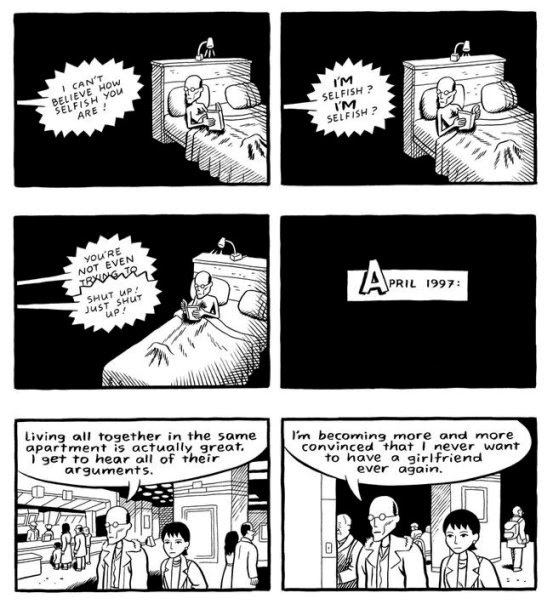
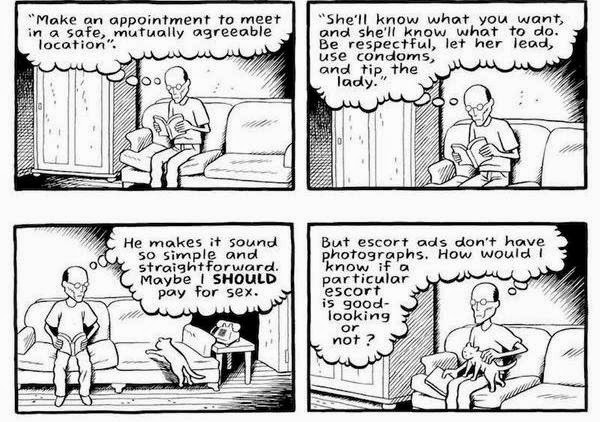
Given its subject matter, this book can easily cause indignation or offence. There is no skating around the objectification of women, for instance – that’s what a john does when he scans advertisements and decides whether he wants someone with big or small breasts on this particular day, a brunette or a blonde, an 18-year-old or someone more experienced. Or when he gets online and reads “reviews” of prostitutes written by other johns. In most of the panels that show Chester’s first meeting with a woman, his thoughts are along the lines “Not as beautiful as Gwendolyn but still attractive, and what a body – she is stacked!” or “A bit on the chubby side – bad teeth – not ugly but not really good-looking either.” Some of this will be unpalatable if you think there’s something inherently wrong with paid sex or that it is synonymous with exploitation, but none of it means that Chester  treats the women as rubber dolls rather than as human beings with feelings. (On one occasion, when he comes close to doing this, he is told off and is quick to acknowledge his insensitivity.) They talk at length, he develops an emotional connect of sorts with the women who are warm and friendly to him; there is a clear reciprocity in the relationships. And over the course of this book he repeatedly makes the point that most johns are regular guys, not the violent or psychotic caricatures you see in films (or at least no more violent or psychotic than most guys in conventional relationships are capable of being).
The drawings themselves are minimalist, always in compact rectangular panels, and usually little more than “pictures of people talking” (to use a phrase that often describes formally unambitious films or graphic novels). This has mixed results. At a practical level it allows Chester to preserve the anonymity of the prostitutes by not showing their features in vivid detail. And it encourages the viewer to focus on the text – Chester’s constant introspecting, his discussions with the women (which add up to a wide-ranging view of the prostitute-john relationship) or with his puzzled friends (including fellow cartoonists Joe Matt and Seth: the conversations between these three make up some of the drollest bits). But the style is sometimes almost  too low-key. I get that this wasn’t intended to be an erotic book, but on occasion there is a disconnect between images and text, as when Chester tells us a particular encounter was amazingly good yet the pictures are silent, faraway views of seemingly impersonal coitus, and the page as a whole has all the soberness of a Pinter play. “She is adorable! This is going to be great!” he thinks to himself when he meets an attractive prostitute; another panel has him sitting on a bed, thinking “I feel all giddy and excited.” Yet in these drawings and elsewhere his face is a straight line, there is no more expression on it than on Dilbert’s face during a boardroom meeting.
Much of this probably has to do with Brown’s unusual personal traits, his apparent ability to have a good time (however he defines it) while simultaneously dissecting his own feelings and reactions: even right in the middle of sexual intercourse, a part of him appears to be observing, analysing, filing things away. (In one particularly funny scene, Chester, sitting alone at his table, feels a “tiny twinge of happiness” and later sifts through his recent memories to try to understand what caused that little twinge.)  Perhaps this quality is also what allows him to matter-of-factly make revelations that may gross out some readers; at one point he gets the impression that he is hurting a woman during sex and mulls that this is a slight turn-on for him (but then decides to get it over with as fast as possible). Such passages can be discomfiting but they are truthful too, more truthful about people’s dark impulses – and about the relationship between fantasy and reality – than many writers would care to be, especially in an autobiographical work.
But then, as Robert Crumb writes in his Introduction to this book, “Chester Brown is not of this planet. He is probably the result of one of those alien abductions where they stick a needle in a human woman’s abdomen and impregnate her.” The photo of Brown at the back of the book shows someone who might be well cast as Mr Spock’s much smarter big brother in Star Trek. It is a face that suggests unfathomable reserves of wisdom as well as emotional impassivity. The head is oval, the features smooth and effete (you may be reminded of REM’s Michael Stipe or the actor John Malkovich), the thin lips are curved in a way that could mean he is amused or profoundly sad or both at the same time.
A further observation, from Chester’s friend Seth:
I often jokingly refer to Chet as “the robot”. In posing a question to him I might quip “Perhaps I should ask a person who has actual human emotions instead.” The truth is, Chester seems to have a very limited emotional range compared to most people. There does seem to be something wrong with him. He’s definitely an oddball.
(At which point I began wondering why Ajitha had so pointedly given me this book. But I’ll let that pass.)
 By the time you’re halfway through Paying for It, you’ll gather that Chester is capable of examining very complex issues with a robotic objectivity that doesn’t come easily to most of us (and in the process perhaps he oversimplifies some of those issues too, not fully accounting for how tangled and messy human emotions can get when it comes to such subjects as love and sex). In a series of end-notes and appendices, he lists and addresses the arguments against prostitution, makes the case that it should be decriminalised but not
legalised (the latter would make the profession subject to regulation
and lead to the uncontrollable growth of the black market, with the
result that some prostitutes won’t have legal recourse if they are
abused or exploited) and discusses related problems such as human trafficking and sex slavery. In a particularly provocative appendix that may have you alternately agreeing and disagreeing with him as you read each new sentence, he argues with the definitions of “choice”, “consent” and “violence” presented in Sheila Jeffreys’s book The Idea of Prostitution. And he often draws on the libertarian view of property rights and personal freedoms.
By the time you’re halfway through Paying for It, you’ll gather that Chester is capable of examining very complex issues with a robotic objectivity that doesn’t come easily to most of us (and in the process perhaps he oversimplifies some of those issues too, not fully accounting for how tangled and messy human emotions can get when it comes to such subjects as love and sex). In a series of end-notes and appendices, he lists and addresses the arguments against prostitution, makes the case that it should be decriminalised but not
legalised (the latter would make the profession subject to regulation
and lead to the uncontrollable growth of the black market, with the
result that some prostitutes won’t have legal recourse if they are
abused or exploited) and discusses related problems such as human trafficking and sex slavery. In a particularly provocative appendix that may have you alternately agreeing and disagreeing with him as you read each new sentence, he argues with the definitions of “choice”, “consent” and “violence” presented in Sheila Jeffreys’s book The Idea of Prostitution. And he often draws on the libertarian view of property rights and personal freedoms.
What allows him, ultimately, to be clear-sighted about these things (whether or not you agree with everything he says) is his view of romantic love as something that is not in itself an ideal to aspire to, and his disapproval of the institution of marriage. Consider this exchange – which I think is one of the most central in the book – with a prostitute who calls herself “Edith”:
Chester: Love is about sharing, caring and giving. Romantic love is about owning, hoarding and jealousy. I think it’s the exclusionary nature of romantic love that makes it different from other kinds of love […] I think it encourages a certain type of thinking: the desire to own another person.
[…]
“Edith”: But there ARE some couples who are right for each other.
Chester: Yes, but people change over time. I’m not the same person I was 10 years ago, and I’m VERY different from the person I was 20 years ago. So, yeah, there are romantic couples who are absolutely right for each other at this moment in time, but those two people are going to change, and it’s tremendously unlikely that they are going to change in exactly the same ways. It’s much more likely that they’ll change into people who are unsuited to each other … no matter how compatible they were at the beginning of their relationship.
“Edith”: Yes, but you can TRY to continue to understand your partner. And if you love him or her, you’d be willing to make that effort.
Chester: Yeah, effort. Romantic love is work. Call me lazy, but I don’t want to do the work.
“Edith”: If I met the right guy, I’d be happy to do the work. It takes work to get anything worthwhile in life.
It may be notable that Brown gives “Edith” the closing word in that exchange. He comes across as rigid at times, but if you look closely he is constantly revising or reassessing his own views over the course of this book: for example, he goes from proclaiming that “the romantic love ideal is evil” to discovering that he isn’t against romantic love in itself, he has a problem when it leads to what he calls possessive monogamy. And the theme that people change over time, and that those changes must be acknowledged, surfaces in other contexts too. Take this conversation between Chester and Seth:
Seth: If you could have looked into the future [as a teenager] and seen that you would become a whoremonger, wouldn’t you have been horrified?
Chester: Oh yeah, definitely. So?
Seth: Well, don’t you owe it to the person you were then to live the life he would have wanted you to lead?
Chester: I wanted to be a paleontologist when I was a kid. Do I owe it to my younger self to drop my career as a cartoonist and go to university to study paleontology?
Extending that thought, perhaps he will feel differently about these issues in a few years from now, and write another book that contradicts this one. Even if you conclude that Chester Brown is an extraterrestrial, the signs are that he is a sensitive, thoughtful extraterrestrial with a larger capacity for self-examination than many so-called humans have. That in itself makes Paying for It well worth reading, and reading again.
-------------------
[Some earlier posts about graphic novels: Alan Moore's Watchmen, the Pao Collective anthology, Jotiba Phule the Gardener in the Wasteland, the Obliterary Journal, Ambedkar in Gond art, Tezuka's Buddha series, Craig Thompson's Blankets, Marjane Satrapi's Embroideries, Kashmir Pending, and a story about the Indian comics industry]
Watched Hitchcock’s Notorious for the umpteenth time the other day, captivated as always by its almost flawless construction, unmatched elegance and fluidity, and the stunning performances by the three leads. Noting again how the film’s sympathies rest with the Ingrid Bergman character Alicia vis-à-vis the manipulative men in her life (this has always seemed very obvious to me, though I know people who disagree), I was reminded of the many allegations of misogyny in Hitchcock’s work. And this super interview of Camille Paglia, who rambles magnificently about Hitch and his artistic impulses.
I love her passion for the subject, even when I disagree with little specifics. This bit is notable, and I think it cuts to the heart of a major divide in “film reading” and how we tend to make up our minds about whether a movie is misogynistic (or racist, or whatever):
I’ve been very vocal about my opposition to the simplistic theory of ‘the male gaze’ that is associated with Laura Mulvey (and that she herself has moved somewhat away from) and that has taken over feminist film studies to a vampiric degree in the last 25 years. The idea that a man looking at or a director filming a beautiful woman makes her an object, makes her passive beneath the male gaze which seeks control over woman by turning her into mere matter, into “meat” – I think this was utter nonsense from the start. It was formulated by people who knew nothing about the history of painting or sculpture, the history of the fine arts […]
Hitchcock obviously had a complex and ambivalent attitude toward women. […] Any artist is driven by strange forces. The whole impulse in art-making is to untangle your dark emotions. There is some huge conflict and inner war in every major artist. And yes, the sexual battlefield is where those things were going on in Hitchcock. But look at his own life: From what people have been able to conclude, his actual sexual practice was fairly limited. He remained a virgin until he was 27, when he married, and he did produce a daughter. There’s some suggestion that perhaps his marriage was not particularly physical. He was almost a kind of priest or monk. The Jesuit-trained Catholic impulse in him was very strong. And if his film eroticism was voyeuristic, well, that’s what we want, for heaven’s sake, in a painter or a filmmaker! We want someone who lives through the eye.
The full interview is here. I also recommend Marian Keane’s piece “A Closer Look at Scopophilia: Mulvey, Hitchcock and Vertigo”, a riposte to Laura Mulvey’s thesis that the camera in Vertigo represents an active, controlling male gaze (which in turn implied that the film is “on the side of” the James Stewart character Scottie). A large part of Keane's essay can be found here, on Google Books.
Incidentally Paglia made related observations in an interview for this book on screen violence. An excerpt below:
Interviewer: I agree he was a great director, but he was nakedly misogynistic...
Paglia: I don’t accept this. That is an absurd argument. We’re talking about a man who made films in which are some of the most beautiful and magnetic images of women that have ever been created. I mean, for heaven’s sake, to call that misogynistic, when we think of Grace Kelly in To Catch a Thief, when we think how fabulous Janet Leigh is in that shower scene, we think of Kim Novak in Vertigo [...] what I’m saying about all of the great artists from Michelangelo to Botticelli to everyone else is that in the fascination with these goddess-like figures of women there is an ambivalence, a push-pull in it, a complexity of response, but to stress the negative in Hitchcock...? I think you need far more complex terminology to deal with people who achieve at the level Hitchcock did. The women he created, for heaven’s sake, have absolutely dominated the imagination of late twentieth-century cinema. Everyone’s imitating it, everywhere, to this day.
Last year’s National Award winner for Best Feature Film in English, Unni Vijayan’s Lessons in Forgetting – an adaptation of Anita Nair’s 2010 novel – is playing in exactly four halls in the Delhi region this week. One of those is the ultra-luxurious PVR Director’s Cut in Vasant Kunj. You might well question the decision to screen a low-profile, relatively low-budget film – with potential word-of-mouth appeal – in a venue where the tickets are priced at Rs 1200 each, but that’s a subject for another piece.
 Though this is a well-intentioned film with a certain visual flair, I had problems with it – much of the English dialogue wasn’t convincing to my ears, the story was diffused and a crucial lead performance was stiff and impassive. However, one thing I did find interesting and want to discuss here is how the narrative structure leads the viewer down a winding path, making us confront our attitudes to things like personal morality and the gap between “modern” and “traditional” lifestyles – issues that have been central to much of the discourse around sexual harassment recently, including the many outrageous statements about rape that continue to be made by people in positions of authority, and the voyeuristic attention directed at the “westernised” woman whose behaviour and dressing sense are seen as directly related to the bad things that happen to her.
(Plot discussion to follow, but no major spoilers) Very early in Lessons in Forgetting, we learn that a 19-year-old girl named Smriti had a terrible accident (though it might also have been an attack) on a beach in the town of Minjikapuram, Tamil Nadu: having suffered brain damage, she is now in a vegetative state at home, and her father Jak (Adil Hussain) is trying to understand what happened, while also learning things about the person she was. In one of the first scenes, a doctor at the hospital where Smriti was taken puts on a show of conditional sympathy. Yes, this is such a terrible thing, "but, you know, this Western culture..." and then his voice trails off, but he begins again: “I’m not blaming anyone, but when girls are let loose...” And he tells Jak that tests indicated his daughter had “been with” more than one man shortly before the tragedy.
Jak is stunned. He knew Smriti was leading a fairly independent life, that she was part of a theatre troupe and had gone on this trip with friends, including boys. But there are some images and ideas that his mind can’t directly process. And so it is apt that the narrative now resorts to stylised imagery, with a sand-art animation sequence that is one of the very best things in the movie.

As the opening credits play, the animation shows us a father and his little daughter on a beach; he playfully throws her in the air, she flies away from him (literally, for she has sprouted wings) and mid-flight she begins to turn into a adult woman, her hair growing longer, her breasts filling out. In the frank and daring cartoon visuals that follow, we see this young woman having sex with a man, then possibly participating in an orgy too – and this image looks like a throbbing brain, perhaps suggesting that much of what we are seeing represents the febrile imagination of the father, pondering what his “little girl” might be doing, with other men, with more than one man. Here is a loving, protective dad who also has a sliver of male sexual jealousy in his reptile brain, as so many loving, protective dads do.
 Or at least, that’s how I interpret the sequence. The story of this father’s quest to understand his daughter’s life – and perhaps to reclaim or redeem her – also reminded me a little of Ethan Edwards’ obsessive search for his “defiled” niece in The Searchers (and of another film, Paul Schrader’s Hardcore, in which George C Scott plays a man looking for his daughter who may have joined the porn industry).
Frankly, Adil Hussain’s bland, one-note performance as Jak doesn’t allow these comparisons to be sustained beyond a point, but what follows is still intriguing. Jak meets some of Smriti’s friends and discovers that she had been sexually intimate with more than one boy in her group. Through their stories (presented in inter-woven flashbacks) we learn that she was promiscuous and possibly a little flighty and irresponsible in how she treated the people she was close to. The boys themselves have clearly been scarred by their involvement with her: one has become a depressive alcoholic, another has taken quick-fix solace in religion but doesn’t seem to be at peace, and while all this is presented very simplistically we get the point.
To an extent, these scenes define our initial attitudes to Smriti. We are seeing her mainly through male eyes (and of course I can’t separate my own maleness from what I’m writing here) – as a free-spirited girl with showy eyebrow piercings, riding a scooter in a short skirt, flitting from one guy to the next without always being mindful of hurt feelings; and later, walking about a little imprudently in torn jeans in a small, conservative town, standing out from the other members of her group, constantly drawing attention to herself.
But late in the film, there is a subtle shift in perspective. The character comes into her own, the male gaze is supplanted, and vital gaps in the story are filled in by a sympathetic older woman who knew Smriti. We learn that she was plucky and good-hearted, with a conscience and an insufficient sense of self-preservation (“Don’t run away from the things that terrify you,” her father told her when she was a child – advice that he will have cause to regret later), and that what eventually happened to her was not only grossly disproportionate as “punishment” for her (real or imagined) faults, it is also a direct result of the compassion that stems from her “modern” upbringing.
 The film's intensity meter rises in these final sequences: the slackness of the earlier scenes gives way to greater pace and urgency, and more convincing performances by Maya Tideman (as Smriti) and Raghav Chanana (as her last boyfriend Soman). And it builds towards an unflinchingly disturbing sequence where male group aggression takes on a carnival-esque form, with undertones of the faux-righteous double-think that lies behind so many cases of sexual assault: “Let’s teach her a lesson.”
Given how effective that ending is – and how powerful and lovely that animated sequence in the beginning was – it’s a pity that so much of the midsection of Lessons in Forgetting is trite and uninvolving, the dialogues and the acting rubbing against each other in awkward ways. “They? They who? I thought this was an accident,” Jak says when he hears for the first time about people who had scores to settle with his daughter. Each word is enunciated clearly in Hussain’s refined voice, but there is little tension behind them; this isn’t so much a grieving father wanting to uncover the truth as a student in an elocution class. (It’s just as well that the residents of Minjikapuram are allowed to speak their own dialect rather than a stilted version of English, which so afflicts much of the film.)
I was also puzzled by some of the decisions made while adapting Nair’s novel. In the book, Jak is one of two central characters, the other being a middle-aged woman named Meera, who works for him and is going through a personal crisis of her own. The film chooses to focus on the Jak-Smriti story, which is fine – but it is done in a half-baked way so that Meera (Roshni Achreja) continues to be nominally important, a sort of second lead, without ever becoming a fleshed-out character. We get only fragments of her life and it feels like bits and pieces have been carelessly left out (her teenage daughter, for instance, appears to be shaping up to be an important counterpoint to the Jak-Smriti story, but then simply fades out of sight). Watching the scenes about Meera and her family, I felt like the film had originally been an hour longer but had had an unseemly encounter with a chopping block.
 Still, the good bits in Lessons in Forgetting reminded me of the good bits in two other flawed but interesting films I saw in the last few months: Jalpari: The Desert Mermaid and Listen... Amaya. The link with the former is clearer – both Lessons in Forgetting and Jalpari deal with female foeticide, with a well (or a pool) of dark secrets harboured by small, self-contained communities, and both link gender discrimination with a damaging imbalance in nature. (In Jalpari, the village that is determined to stop producing women also has a serious water scarcity; Nair’s book uses cyclones as an important metaphor, one that isn’t really explored in the film.)
The more tenuous similarities with Listen... Amaya have to do with the relations between children and single parents who are very close to each other: if the latter can be over-protective and reluctant to loosen the strings, children can be just as insecure about the idea of their parents having a sexual side. In this context, I felt Lessons in Forgetting may have been a better-realised film if it had explored the bond between Jak and Smriti at fuller length, letting us see how a certain type of parent-child relationship can be a little like walking gingerly across a beach littered with very sharp shells – and how it can affect the subsequent choices and actions of both sets of people.
Still, the good bits in Lessons in Forgetting reminded me of the good bits in two other flawed but interesting films I saw in the last few months: Jalpari: The Desert Mermaid and Listen... Amaya. The link with the former is clearer – both Lessons in Forgetting and Jalpari deal with female foeticide, with a well (or a pool) of dark secrets harboured by small, self-contained communities, and both link gender discrimination with a damaging imbalance in nature. (In Jalpari, the village that is determined to stop producing women also has a serious water scarcity; Nair’s book uses cyclones as an important metaphor, one that isn’t really explored in the film.)
The more tenuous similarities with Listen... Amaya have to do with the relations between children and single parents who are very close to each other: if the latter can be over-protective and reluctant to loosen the strings, children can be just as insecure about the idea of their parents having a sexual side. In this context, I felt Lessons in Forgetting may have been a better-realised film if it had explored the bond between Jak and Smriti at fuller length, letting us see how a certain type of parent-child relationship can be a little like walking gingerly across a beach littered with very sharp shells – and how it can affect the subsequent choices and actions of both sets of people.
In light of the Delhi gang-rape and its aftermath, here’s a round-up of some of the more interesting pieces I’ve been reading. But first, anyone who hasn’t yet watched this video of a superb, rousing talk by Kavita Krishnan, secretary of the All India Progressive Women’s Association, please do (English translation here).
- Peter Griffin’s “The Problem is Us”. An excellent but far from comforting post, a reminder that some attitudes are so deeply embedded in the social fabric that significant change can happen – if it does – only at a painfully slow rate.
- Amulya Gopalakrishnan makes a similar point: “We can try to change the assumptions of a rape culture, by making sure girls and boys grow up with healthier gender roles, by making sexuality less repressed and dark than it is. These are all long-haul projects, the patient task of families and schools, and less emotionally satisfying than attacking Manmohan Singh.”
Prayaag Akbar’s “Why you shouldn’t call Delhi our rape capital” – a reminder of the dangers of journalistic shorthand, and how it can constrict our understanding of important issues.
Deepanjana Pal’s “The Great Young Hopeless”, about the nature and implications of the rage being expressed. (“Gathering in a public place, shouting slogans, feeling that sense of fraternity and shared passion–it feels so much better than sitting at home as though trussed by invisible ropes.”)
Shuddhabrata Sengupta’s “To the young women and men of Delhi”, an impassioned call to action for the country’s youth, with a reminder of some of the cultural contexts surrounding rape in our society.
Nilanjana S Roy’s reporting of – and thoughts on – the protests at Raisina Hill: notes from day 1; photos from day 2; at the heart of Delhi, no space for you.
******
And a personal note about something that might not seem too central to the larger issues being currently discussed. One thing that has puzzled me about many of the columns/online discussions I have read recently is the perfunctory repetition of the idea that rape only has to do with power or control; that it has nothing to do with sex. Now of course, there’s no denying that power/control/subjugation are key factors, especially in a feudal society deeply divided across caste and class lines, where rape is often used as “punishment” or to put someone “in their right place”. And there is no question that for the victim, rape is emphatically not a sexual act or anything close to it. (It’s a pity this even has to be said, but it does. Just read a few randomly picked lines from Tehelka’s exposé of police attitudes, in which cops confidently state that the woman was a willing participant in many case of sexual harassment.) But why this need to convince ourselves that this is also, always, the case for the rapist?
For example, the Sengupta piece I linked to above summarily states that “the rapist’s intention is not sexual pleasure”, and then goes on to frame “sexual pleasure” in the warmest, most idealistic terms (“the ONLY way in which pleasure can be had is through the reciprocity of desire, through love, through erotic engagement, not through taking away someone’s agency by force and without consent”). One understands his imperative: to define sex only in terms of consensual sex that brings happiness to both (or however many) participants – as something beautiful and life-affirming. But might this be a little misleading, and not fully cognisant of the different ways in which men (or some men) and women might experience sex? Personally I think this particular aspect of the issue is more pragmatically expressed by Samrat in his piece “The Urge to Rape”:
The male sexual urge does seem to operate in a different way than the female [...] The rapes are not necessarily done to demonstrate power [...] They are probably done because, take away the restraining hands of law, faith and social decorum, and the beasts that reside deep in men assert themselves in those whose internal checks are flawed. Such men then do what they feel the urge to do. It is a physical and psychological thing. And this is not to say “men will be men”, but to say “men can be animals”.
That last sentence is a very important one. Perhaps a good reason why so many well-meaning people over-stress the rape-is-not-about-sex theory is to avoid worsening a situation where blame is so often placed on women for dressing provocatively. (In India, this attitude is widespread among even educated, apparently cosmopolitan people.) Or to avoid implying that the “uncontrollable urges” of men make rape inevitable. But I don’t see why such conclusions have to follow from an upfront, unblinking look at the complexities and variances in human nature.
In this context, an excerpt from the “Gender” chapter of a favourite book, Steven Pinker’s The Blank Slate:
I believe that the rape-is-not-about-sex doctrine [...] is preposterous on the face of it, does not deserve its sanctity, is contradicted by a mass of evidence, and is getting in the way of the only morally relevant goal surrounding rape, the effort to stamp it out.
Think about it. First obvious fact: Men often want to have sex with women who don’t want to have sex with them. They use every tactic that one human being uses to affect the behaviour of another: wooing, seducing, flattering, deceiving, sulking, and paying. Second obvious fact: Some men use violence to get what they want, indifferent to the suffering they cause [...] It would be an extraordinary fact, contradicting everything else we know about people, if some men didn’t use violence to get sex.
Pinker touches on Susan Brownmiller’s vital 1975 book Against our Will, which helped change (mostly for the better) many attitudes towards rape, but which also spread the idea that rape is “nothing more or less than a conscious process of intimidation by which all men keep all women in a state of fear”. Essentially, Brownmiller said that patriarchial structures and the resultant social conditioning were the cause of rape – that it had nothing to do with anything inherent in human nature. It is this notion that Pinker sets out to question, while also stressing that this does not in any way mean giving a criminal a green chit:
As for the morality of believing the not-sex theory, there is none. If we have to acknowledge that sexuality can be a source of conflict and not just wholesome mutual pleasure, we will have rediscovered a truth that observers of the human condition have noted throughout history. And if a man rapes for sex, that does not mean that he “just can’t help it” or that we have to excuse him, any more than we have to excuse the man who shoots the owner of a liquor store to raid the cash register...
For a much fuller understanding of Pinker's position and the positions he is arguing against, do read the whole chapter – and the book, if you can. (Note: there is also a Camille Paglia quote in there, which might raise the hackles of many people debating the issues around sexual violence. Paglia does stir pots quite vigorously, and I don’t think I’ve ever read anything by her without feeling a tinge of discomfort, even when I’ve agreed with her basic thesis. Some of her not-always-politically-correct views on rape are similarly discomforting.)
[Also see: this post by “a retired call girl” who, I imagine, knows a thing or three about the darker manifestations of sexuality]
Update: two more links that may be relevant: Rapists Explain Themselves and Live Through This.
---------
P.S. This is of course a very complex subject and I’m not trying to disentangle the issue of power/control from the issue of sexual gratification – just to suggest that the two things usually operate together, with one or the other being more dominant depending on the context. For instance, soldiers clinically using mass-rape as a “weapon” in wartime is a very different situation from a horny boy date-raping a girl after a certain amount of heavy-petting; but I'm inclined to think that the male sexual urge (however warped it might be, and however much it discomfits us to think of it as sexual) does play a – proportionally very small – part in the former case too.
Anyway, I'll be patronisingly chauvinistic now and give a woman the last word. After writing this post, I had an email exchange with Nilanjana about the subject, and here is some of what she said:
You only need to talk to rapists to recognise that both parts of the act of rape--the domination, and the sexual act itself--bring them great satisfaction. Bluntly, in that brutal gangrape, only the woman was raped. Her friend was beaten up, and under different circumstances, men have also raped men to assert their dominance--prison, police stations and war zones are often theatres for male rape--but that didn't happen here. Their focus in terms of sexual assault was the woman; their focus in terms of violent, non-sexual assault is the man. Brownmiller wrote her book in the late 1970s, after Serbia and Bosnia, and she had a key moment of recognition: rape was not an individual act, but far more often a collective assertion of power by groups of men. At that time, it was particularly important to recognise that women raped in war, for instance, were not being raped out of lust: they were being raped as an act of extreme violence, in line with other acts of violence.
[...]
Perhaps you have to contend with the idea that there are two kinds of what we call "rape". One, which Brownmiller and more recently Hudson and Den Boer speaks about, is rape used as a tool of power, as a way to assert caste, community, tribe or clan dominance. It is, in that sense, impersonal: any Dalit woman will do, any woman who steps out of line and "dishonours" the family can be used, any woman who is seen as property to be annexed will do as the object of rape. Often, in these cases, the rapists also have the tacit or open approval of the community, and will face no social censure or punitive action at all. Any lust the men feel is incidental to their role in these assaults, which is the role of the punisher, his authority sanctioned by the clan.
The other, and this has to be acknowledged, is an act of extreme sexual violence. It may have domination at its roots, but it also has pleasure, however ugly, as its goal.
[...]
Another thought: don't underestimate the rage and the deep anger that accompanies rape, often as powerful and as important as sexual pleasure. In many cases of "close friends and family" rape, the act is intended as a punishment in exactly the same way as it is in caste rapes and some war rapes. The punishment is meted out to the woman who's out of line, or who has strayed away from her (male) protector. I think we do talk far too much about sexual urges, and not enough about how a sense of righteous anger--or sometimes absolute open rage, how dare this woman be free?--is the driver.
Thinking – in light of the latest Delhi gang-rape – about the many subtle ways in which misogyny is perpetuated and absorbed into a culture, I remembered a passage I recently read in an interview of the filmmaker Onir (this is from Anna MM Vetticad’s book Adventures of an Intrepid Film Critic, which I reviewed here). The back-story is that Onir’s sensitive film I Am had run into censorship problems simply for touching on such subjects as child abuse and homosexuality. Here he is on the double standards in what is seen as acceptable for a mass audience and what isn’t:
Recently I was watching this so-called, feel-good, keep-your-brains-at-home, fun big film, and I was thinking that I’m facing so much trouble with the Censor Board over I Am, yet in this film I was watching, the Board cleared a scene in which a young boy is crying and the mother says: “Maine toh beta maanga tha, beti mil gayee.” (“I asked for a son, but got a daughter instead.”) In a country like India, you pass that uncensored?
Cut to the next dialogue, friend explaining the art of how to get the right person in your life: “Har ladki ek bus ki tarah hoti hai. Chadh jaao, utar jaao, chadh jaao, uttar jaao. Ek toh aisa bus hai jo ghar le jaayega, ussko miss mat karo.” (“Girls are like buses. Get on, get off, get on, get off. Just make sure you don’t miss that one bus that gets you home.”) I wanted to throw up. And this gets a U certificate?
I think it's safe to assume that both scenes Onir mentions above were played for laughs, and that they probably did draw unthinking chuckles from a large number of the people who watched them. But even if it was a “keep-your-brains-at-home” film, such dialogue has a way of creeping, meme-like, into the reptile brains of some of those viewers and informing - or confirming - their worldviews. Perhaps we should expect nothing less in a country where senior members of a Censor Board (apparently educated men and women among them) dole U-certificates to such scenes even as they excise a mere hint of consensual gay sex on the grounds that “Oh my God, the look between those two men will make viewers uncomfortable.”
[Did a shorter version of this review for The Sunday Guardian]
 “She looks both triumphant and afraid,” writes Lois Banner, describing a nude photograph that a young model named Norma Jeane posed for in 1949, “With one arm extended and a hand in her hair, she looks as though she might be climbing up a wall – to achieve an exciting future or to escape a threat.” The photo – “A New Wrinkle” – is included in Banner’s Marilyn: The Passion and the Paradox and her description is spot on: framed against a lush red velvet curtain that seems like it might swallow her up, Norma Jeane – the future Marilyn Monroe – could be from one of those classical paintings of rape where the subject is presented (invariably by a male painter) as both seductress and quarry. But of course, Banner’s words also suggest Monroe’s tempestuous push-pull relationship with her own myth – with the stardom that made her universally desired as well as conflicted and depressed.
“A New Wrinkle” was an early version of Marilyn the ethereal pin-up girl (the picture – which she posed for because she needed money – caused a stir when a conservative, early-1950s Hollywood learnt of its existence), but Banner’s grounded approach is more accurately reflected in the first two images included in the book, which are atypical for a Monroe biography. One is a drawing of witches and other grotesque figures that Marilyn  said she saw in recurring nightmares; the other is an autopsy sketch, which coldly depicts the scar from a surgery to remove endometriosis, a gynaecological condition that afflicted her for much of her life. Bald, flat-chested, anonymous, mannequin-like, the figure in the autopsy drawing is a morbid reminder that the Marilyn Monroe persona was often a blank slate, a repository for other people’s fantasies – and that the woman behind it has remained an enigma for generations of fans, critics and biographers.
“I was drawn to writing about Marilyn because no one like me – an academic scholar, feminist biographer and historian of gender – had studied her,” Banner explains, admitting that she had once dismissed Marilyn as a sex object for men but later felt impelled to re-evaluate her, and to wonder if a proto-feminist lay beneath the dumb-blonde image. Her book emphasises the many contradictions in the life of a girl who had low self-esteem and a speech impediment, but who succeeded in “manufacturing” a confident alter ego. (In high school, Norma Jeane described herself as “the mmm girl” – a play of words that encompassed both her stuttering over the letter M and the effect her physicality had on the boys in her class.) It is a portrait of the sex symbol posing for the famous subway-grate photograph with her skirt billowing up, but also the story of the woman who, later that same evening, had a violent argument with her husband Joe DiMaggio, who was incensed by the sight of “several hundred men looking at her crotch”.
Among other paradoxes, Banner notes that while Marilyn was a “goddess” on the outside, universally desired for her body, on the inside she had a hormonal disorder that caused extreme menstrual pain and may also have made it difficult for her to have a child. Though a symbol for unbridled female sexuality, she may have learnt how to perform an exaggerated version of femininity by watching a man (the female impersonator Ray Bourbon). She often played po-faced characters, the butts of other people’s jokes, but was known to have a wry sense of humour in real life (someone as wacky as Jerry Lewis was impressed by her knack for absurdist comedy, and even Groucho Marx, with whom she worked in a lesser film titled Love Happy, described her as a combination of Mae West and Little Bo-Peep). Marilyn modeled herself on earlier movie temptresses such as Clara Bow, Jean Harlow and Marlene Dietrich, but also strove to haul herself out of her ditzy image by turning to high literature (from Thomas Wolfe to Dostoevsky and Balzac), performing Molly Bloom’s closing soliloquy from Ulysses on stage, and stating a desire to play Lady Macbeth and Grushenka in The Brothers Karazmov; and in the process she sometimes resorted to the intellectual poseur’s strategy of reading selectively rather than reading well. (“When she browsed the shelves in Pickwick’s bookstore, she’d find an interesting paragraph in a book, memorise it and then go on to find another book.”)
 It’s a fascinating story, with enough material to fill dozens of books – as indeed it has over the decades. The Passion and the Paradox has all the essential biographical information, from a childhood that was spent being shunted around foster homes (Banner gives more space to Marilyn’s early life and to the personalities of the many women who raised her than most previous biographers have done) to the final years: the bouts of depression, the overdependence on painkillers, the liaisons with the Kennedy brothers and the build-up to her mysterious death. But the “psychological” Marilyn is here too. Banner analyses her actions and choices and how they intersected with the larger world around her. In an effective structural decision, she includes a ruminative 30-page midsection titled “The Meaning of Marilyn”, which temporarily breaks the narrative as well as the fourth wall between author and reader.
In so doing, she situates the Monroe persona in the context of its time – “the ultimate blonde in a nation both fascinated by sexuality and uneasy about it, involved in both an ongoing sexual revolution and a conservative reaction against it”. (As one of Marilyn’s husbands, the playwright Arthur Miller, once wrote, America at the time “was still a virgin, still denying her illicit dreams.”) She makes special note of the function that Marilyn’s star-making roles may have served in a diffident, post-WWII era – the fact that she was regularly paired opposite older men or unremarkable Plain Joes may have been a subliminal ego-booster for the “regular” American guy. And she presents a nuanced view of the apparently all-American girl who could – perhaps due to her own troubled childhood – relate to marginalised people: reading Leftist literature during a time of the Communist witch-hunts; identifying with the black hero of Joyce Cary’s novel Mister Johnson.
This is a compendious biography – reflective, scrupulously researched, moderately well written – though it isn’t aimed at the reader who is principally interested in Marilyn’s films. I get the impression Banner isn’t much of a cineaste: there is a formalness in her descriptions of even major movies (The Asphalt Jungle “fits into the genre of film noir, a postwar category generated by Cold War fears and influenced by German Expressionism that highlights social corruption and often features an evil, seductive vamp”). But otherwise, her distinct voice is a reminder that good analytical biographies can tell us much about the personal concerns and biases of the writers. “I was intrigued by similarities between my childhood and hers,” she writes; she was born a little over a decade after Marilyn, grew up in a geographically and culturally similar milieu, won beauty contests as a young girl and (according to her) had the opportunity to aim for movie stardom, but chose a different career path. Consequently, there is the hint of a doppelganger perspective (or at least a “what if” perspective) here – one that offers a thoughtful counterpoint to some of the earlier biographies and theses.
 For example: in a capsule review I recently read of Some Like it Hot, David Thomson – an intelligent, sensitive critic – proposes that Marilyn was naive, unaware of how her screen persona was being used by director Billy Wilder; but this book presents evidence to suggest that Marilyn didn’t like the fact that her character Sugar Kane was a foil for the two male characters in the story and that she wanted Sugar to have a more distinct personality. (Years earlier, while shooting Gentlemen Prefer Blondes, she had insisted that her character speak the line “I can be smart when it’s important, but most men don’t like it.” By the time Some Like it Hot was made, she definitely had her hackles up when asked to play a stereotype.) And as Banner herself notes, because Marilyn’s first husband Jim Dougherty said she was a virgin when they married, some male biographers dismissed her claim of being sexually abused as a child. This is a non-sequitur – sexual abuse doesn’t necessarily entail penetration – but it tells us something about the simplistic way in which a certain kind of man may view sexual assault or women’s “purity”.
I had a minor problem with the occasional bombast of Banner’s claims. Her Prologue is characterised by sentences like “Significant among my discoveries about Marilyn...”, “Revealing and analysing her multiple personas is a major contribution of mine...” – and later, “I will excavate the layers that lie underneath [her childhood], probing the texts and counter-texts...” Stretched beyond a point, this is tiresomely self-aggrandising language, and these claims – suggesting grand epiphanies and solutions – turn out to be contrary to the spirit of the book itself. For instance, Banner makes much of the question “Was Marilyn a feminist?” and then addresses it in a perfunctory, open-ended way in her Afterword. There is nothing wrong with this open-endedness – in fact, it affirms the author’s honesty, her willingness to acknowledge that a complex life cannot be easily explained – but why make the question sound so central in the first place? Especially when this book’s real strength lies in the attentive, well-rounded way in which it raises questions about Marilyn’s life and psyche, examining them from various angles but also permitting them to hang in the air if necessary – much like the girl in that photo, frozen on the cusp of becoming one of the great icons, and sacrificial lambs, of a cultural zeitgeist.
[An old post about MM is here]
In an essay titled “The Murderous Gays”, the academic-critic Robin Wood recalled being an adolescent in 1940s England, romantically attracted to other men and unable to fathom what he was going through – until he came across the word “homosexual” in a book about Tchaikovsky and realised with amazement that there must be others like himself in the world. But even then, the idea was so radical, so removed from his everyday life, that Wood grasped it only at a theoretical level: “It didn’t occur to me that I might ever meet (or perhaps already know) such people.”
 Wood went on to discuss the obsessive identification he felt with one of the lead characters in Hitchcock’s Rope – a film that is today acknowledged as having a strong gay subtext, though the theme could not be explicitly dealt with on screen at the time. He observed: “Despite the fact that I knew I was gay myself, it never occurred to me that the characters in the film might be; it was, at that time, literally unthinkable. If I couldn’t believe, emotionally, in the existence of other homosexuals in real life, how could I believe in their existence within a Hollywood film?” Yet there was something that made him gravitate subconsciously towards the film’s vulnerable anti-hero Brandon.
People who are marginalised because of their sexuality have always had to seek mainstream acceptance to get the rights and freedoms they need for a dignified life. Anyone familiar with the history of LGBT rights knows that this is a grim struggle, marked by small victories and big setbacks. But Wood’s essay is a reminder that sexual minorities often have to come to terms with their own feelings first – they have to gain the self-confidence that they deserve respect however “different” they might be from most other people. For those living in very orthodox settings, where all manner of societal pressures and facades are constantly operating on them, this is a particularly complex process.
 This is one of the many things that makes the life-story of the hijra writer-activist A Revathi so remarkable. Revathi’s memoir The Truth About Me – translated from Tamil by V Geetha – is about hard-earned wisdom that came not from exposure to books but through personal experience. It’s the story of a boy named Doraisamy who realised early in his life that he felt like a girl inside, and wanted to be female. One especially poignant passage has Dorai dressing up as a girl for a festival dance and then finding himself reluctant to shed his female clothes afterwards: “As I re-emerged in my man’s garb, I felt that I was in disguise, and that I had left my real self behind.”
But how does a child – the youngest of three brothers who are expected to quickly grow up and take on men’s responsibilities – in a small and provincial Indian village even find the language to express these feelings? It can be misleading to even use the word “conservative” to describe Doraisamy’s family’s attitude to his sexuality, because that word might imply a choice – the considering, and rejecting, of a more broad-minded outlook. But for Dorai’s parents, the idea of their son becoming a woman would have been outside the very bounds of imagination.
And so, Dorai (soon to be Revathi) ran away in despair. Even the first train ride seemed like an impassable hurdle (“Oh, my mother, the train was so long! Where was I to get in?”) but she negotiated the two-day journey from Salem to Delhi. She found people like herself, slipped into the crannies where social outcasts make their own spaces, forming private kinships and rules of conduct. Eventually she underwent the painful and potentially life-threatening operation that meant a formal break from Dorai's maleness, and changed her name.
This is a hard-hitting story, often difficult to read – and all the more so because the writing is no-frills, as if a lengthy interview with Revathi were being transcribed and translated simultaneously. She now works with the human-rights organisation Sangama, and her hardships are far from over – though she wants to be a full-time activist, sex work is almost necessary for someone in her circumstances to earn a proper living. But by the end of the book, one gets the satisfying sense of having met a protagonist who beat difficult odds and became comfortable in her own skin. That’s worth a lot of trouble.
[A version of this piece appeared in my Sunday Guardian column. Also see: this obituary I wrote of Robin Wood for Business Standard early last year]