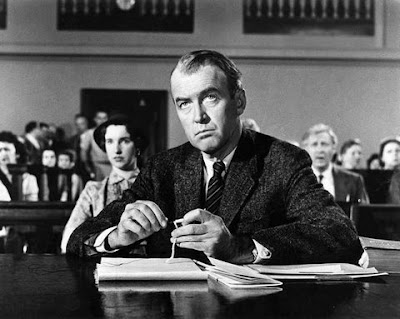
We drove down to Hyde Park under Turner skies, those azure clouds that drift in from the lake and give Chicago the character of a maritime city.
Down to Hyde Park to see
Anatomy of a Murder. I'd never seen the film projected before, or even in widescreen, having only watched it from a pan-and-scan VHS. I don't know if it was the projection, or the fact that so many years have passed (and so many more Premingers have been seen by me) since I last saw it, but my impressions of the film this evening are completely different from what they were yesterday.
I have to resist the urge -- talking, thinking, writing, typing -- to call the film
Anatomy of a Relationship. Maybe it's because the Moullet title is better -- it rolls off the tongue more easily (though there's a certain beauty to the word
murder being so harsh, interrupting every sentence you put it in) -- but also because it's a good Preminger title but very much a joke for Moullet (a better title would've been
Memoirs of My Nervous Illness). Anatomies, geographies, studies -- these are all good descriptions of the Preminger
framework, a word that seems truer in respect to the director than
style.
Anatomy of a Murder, which had for years seemed to me like a very good entertainment made within Preminger's particular sensibility, now appears, alongside
The Human Factor, as one of two key films for understanding the director, the easiest ways to get to the heart of Preminger. What distinguishes it from so much of his other work is that, whereas most of Preminger's other films treat all of their characters as "subjects,"
Anatomy of a Murder presents the idea of a Premingerian hero. We find it in James Stewart's character.
Preminger's dream, I think, was to read life the way Stewart and Arthur O'Connell read law: precisely, fervently, but with time for some jazz, a few drinks and a few jokes (and Preminger could be very funny, not least of all here). I've come to believe that out of all directors, Preminger was probably the one least interested in truth. His interest lay in fact, like a scientist's; this is why his direction always seems like a sort of science. We like to believe in a certain scientific idealism, that the scientist or the researcher is looking for truth, but really what they're looking for is fact, an observation that can be backed up by a rule. The jurist has the same interest. Law was a good match for Preminger; he was interested in the courtroom for its ability to establish facts, not (like, say, André Cayatte) in its ability to make decisions based on those facts. The verdict in
Anatomy of a Murder isn't important at all; it comes quickly, with very little fanfare. Preminger doesn't even savor Stewart's moment of victory (the decision isn't even his -- it belongs to the non-characters of the jury), and he starts a dissolve to the next scene right after the jury foreman says "not guilty."
Its the ability to construct a description, to make out of the mess of life a sentence or a paragraph or a widescreen shot that's heroic to Preminger. It really doesn't matter whether Stewart wins the case or not (he ends up not getting paid anyway) or what the case is really about (this is a courtroom drama largely without twists, at least not in relation to the main case); what matters is the way he argues, sometimes denying or ignoring truth, in order to create something clear.