Showing posts with label Racism. Show all posts

05 December 2013

The Jolson Story


United States - 1946
Director - Alfred E. Green
RCA/Columbia Pictures, 1986, VHS
Run Time - 2 Hours, 9 Minutes

27 May 2013

The Wild Pair


United States - 1987
Director - Beau Bridges
Media Home Entertainment, 1988, VHS
Run Time -1 hour, 29 minutes

As a late entry into the 80’s buddy-cop cycle that was turned up to 11 by one Eddie Murphy, The Wild Pair is yet another white-cop/black-cop combo, but it is also another local-cop/federal-cop pairing. Yet neither of these “ironies” is mined for its humor. Baby-faced Beau Bridges plays FBI agent Joe Jennings with enough suave confidence and pig-headdedness, and Bubba Smith plays short-fused Narc Benny Avalon with sufficient pathos to be convincing, but given that by this late date the context has been standardized, it’s not surprising that their performances are also comfortably standard. Together they foil a criminal endeavor perpetrated by a fairly run-of-the-mill array of semi-inept punks and nominally-sinister kingpins and all ends more-or-less happily. As a result, The Wild Pair is both predictable and unsensationally flat, an otherwise forgettable flare-up of Action’s most chronic case of sub-generic herpes.

And yet, beneath this placid, run of the mill surface is a not so subtle current of transgression just waiting to drag you under. The Wild Pair could have gone the way Hellbound  and Cop and ½ eventually did (following precedent), making Benny into a Jim Crow stereotype to compensate for the film’s flaccid storyline. But Benny is not the comic relief to Joe's more serious (and hence we are led to surmise more important and worthy of our identification) quest/project. His physicality, in it's unusualness (to the film) is certainly hard to ignore, and (as with obesity, shortness, boobs etc.) simply must be exploited by the conventions of low comedy (Police Academy) reliant on physical idiosyncrasy for narrative engagement. What humor there is in The Wild Pair (and there aint much) is dependent on Smith's being huge, not on his “acting black" and fulfilling those standards that make white viewers feel safe liking him.

This works because while Jennings is technically on the other side of the tracks, the film is not about his discomfort and the sort of coming to terms for which white audiences need irony and stereotype to feel vindicated. It makes sense then that Benny is the character with depth, history and personality while Jennings is a two dimensional milquetoast (despite Benny’s pointed questioning: “Do you drink your own bath water?” “Sometimes.”) It is after all his neighborhood, his friends and ‘his’ kids who are being subjected to the terrorism of drugs and political violence perpetrated by a racist white conspiracy that goes right to the top levels of government.

Thanks to Ronald Reagan’s little war, drugs and junkies were as necessary to 80’s cinema realism as punk-rockers, but it was his predecessor Richard Nixon who initiated the War on Drugs, clarifying that it was really about black folks, you just couldn’t say it was. At the same time, the CIA really was deliberately introducing narcotics into black neighborhoods to undermine the Black Power movement. (Not surprisingly this was also the same time that the NRA was for gun control; to prevent armed Blacks.) To be sure, there’s a black guy in there peddling drugs in The Wild Pair. It’s easier to dismiss all of this conspiracy stuff if they do it too, but I choose to see his name “Ivory” as somewhat more than accidental. As my friends over at Comeuppance Reviews said in their write-up of The Wild Pair, “it’s all there,” to which I would add; IF you choose to see it. It may appear too convenient to find all this baggage in a forgotten crime dramedy, but after realizing that The Wild Pair has already subverted the staid norms of its genre, its allusions to history appear much more deliberate. The Wild Pair may not be the most original buddy-cop flick out there, but for rocking the narrative boat, it does have the most to say.


17 December 2012

Bad Medicine

Bad Medicine: 
Natives Helping White Folks Clean up their
Spiritual Dirty Laundry since 1492

There is no shortage of films in which white folks play at being The Other. Playing at being Japanese or Chinese is certainly not limited to Mickey Rooney, nor Latino/Mexican to Marlon Brando and Telly Savalas. Still, it is not often that we think of white folks breaking out the Red-Face and play at being 'Injuns.' But it wasn't uncommon. The assumption that 'Others' cannot sufficiently portray themselves (or more accurately cannot act the way white folks need them to be in order to justify various forms of racism) is not a distinction meted out to any group exclusively.

If the examples of Blackface are many, replaced only by stereotypes sufficiently disguised to maintain the illusion of superiority, then Redface is hardly any different. From the stony-faced war-chiefs of the 30's an 40's, Redface gradually gave way by the 1960's to more acceptably romantic notions of a people somehow closer to the Earth and like, in tune with the spirits man.
And that's a power that us white people need to expropriate. In the world of cinema, there is nothing worse than helplessness in the face of sheer supernatural terror, or aimlessness in the wake of cultural banality. Fortunately Indigenous peoples have provided us with a convenient release valve for all our Anglo-Saxon spiritual hangups. Whether helping us find meaning in our privileged but ultimately hollow lives or defeating wacky demons of our own creation comes the White Man's spiritual savior: The Medicine Man.

Roughly paralleling the 'Magic Negro,' the movie Medicine Man imparts some kind of Earthy spiritual knowledge or healing upon the bereft white man. Like the Magic Negro who uses soul, rhythm or a clever ruse, the Medicine Man uses sacred smoke, animals or a fetishized notion of extra-natural powers, something mysterious and beyond the comprehension of urbane whites. In most cases, like his black analogue, the Medicine Man is mysterious, arriving physically from nowhere, i.e. a spirit, or historically from nowhere. In either case this 'pastlessness' makes stereotypes easy to swallow because it dissociates them from any historical subjectivity but the immediate-white-present. After imparting his knowledge the Medicine Man inevitably moves on (literally and/or just from the script), disappearing as "mysteriously" as he came. All he asks in payment for his services some symbolic and often trivial token and the satisfaction of having helped. This reiterates the infamous and oft repeated assumption that Native peoples don't understand "true" (acquisitive) value and is quite fortunate because a deeper relationship might require that we white folks actually change ourselves (and our racist assumptions) rather than our (temporary) circumstances and gosh, that's really hard. Our need to fetishize and objectify Indigenous peoples (and other Others) says far more about us than it does them.

Here is an ongoing list of fortuitous Medicine Men (and Women I suspect we shall discover) who have helped us white folks clean up our dirty laundry, without having to clean up much else, throughout the years:

The Manitou
Director - William Girdler 
Syrian born actor Michael Ansara portrays John Singing Rock, a member of an unnamed Plains tribe who helps Tony Curtis defeat an evil Medicine Man that emerges from Curtis' girlfriend's neck in this woman-hating horror film from 1978.
Medicine: Prayers and 'charms'
Token Payment:Tobacco


Poltergeist II
Director - Brian Gibson
Creek actor Will Sampson played Taylor, the Medicine Man whose butterfly summoning power helps the Freeling's defeat spooks a second time around in 1986. Sampson, who died the following year, had played Native Americans in a number of famous roles including those in Outlaw Josey Wales and One Few Over the Cuckoo's Nest.
Medicine: Sacred Smoke
Token Payment: A beat up station wagon


Forest Warrior
Director - Aaron Norris
A tired looking Chuck Norris played McKenna in the 1996 film Forest Warrior. The character is actually a Scotsman who "went native" and whose spirit now protects Mt. Hood, Oregon. When a group of kids go up the mountain to play in their tree-house, spirit-McKenna transforms into various animals and helps them defeat a group of nefarious loggers. While not technically a Medicine Man with magic spells, the use of assumed native atributes to help white folks is clear. The noble savage and super warrior being venerable tropes of USAmerican frontier literature and cinema. McKenna's round-housing spirit-power helps the kids to become stand up for themselves and become mature.
Medicine: Warrior spirit
Token Payment: Satisfaction in having helped


Free Willy
Director - Simon Wincer
In the 1993 film Free Willy and its two sequels, August Schellenberg plays Randolphe Johnson, a Haida Indian who teaches the hero Jesse a tribal song that helps the troubled product of multiple foster homes to communicate with the titular whale, teach it tricks and learn to love someone other than himself.
Medicine: A Haida prayer-song
Token Payment: Satisfaction in having helped


Director - William Clark
This little gem from 1995 features the iconic Russel Means as the ghost of Jim Thorpe helping young Craig overcome his parental hangups in order to achieve high-school football stardom. The film itself is something of a Karate Kid clone with the familiar training sequences and nasty rival sports star, in this case played by Jake Busey. Although the relationship is nominaly reciprocal, Means' Wa Tho Huck character is definitely a 'mysterious Native American elder' whose primary role is to help Greg before vanishing. Despite his historical foundations, the film character remains a wandering spirit.
An emerging trend in these films appears to be the white-boy's missing father figure whom the Medicine Man temporarily replaces until the boy can become a man on his own or, as in Windrunner, forgive/reunite with his own (or new, see Free Willy) father.
Medicine: Warrior spirit/confidence
Token Payment: A Superbowl ring (which he gives back of course) 

Band of the Hand
Director - Paul Michael Glaser
From the maker of Miami Vice comes this gorgeous time-capsule of mid 80's television and raw stereotype. Stephen Lang plays Joe Tegra, a Vietnam Veteran and member of the Miccosukee tribe of north Florida. When a group of young delinquents is dumped in his care in the Everglades, he trains them in survival and guerilla warfare before returning to Miami to confront the drug cartel. Joe himself doesn't appear mysteriously though he has zero back-story, but he is the recipient/teacher/savior of the five punks. Nor are the punk kids, recipients of his Medicine, exclusively white but they are all introduced via back-story.

Nevertheless, Joe still disappears from our narrative with nary a reward.
This begs the question, what if the Medicine Man doesn't use "Medicine" (i.e. indigenous 'magic' or 'sprituality') Joe for example, and McKenna and Wa Tho Huck all impart a warrior knowledge more in keeping with the legendary tracker/hunter icon of legend. Actually, Joe really epitomizes this with his 'Nam Vet guerilla stylings, demonstrating that regardless of the metaphysical quality of the gift, the Medicine man imparts secret knowledge in service of the protagonist. That the latter is not on the surface literally white is largely moot, Band of the Hand being a case in point. Our vigilante heroes fight (ethnic) criminal drug users in the service of (white) law and order, feeding a mythology of racist stereotypes in abject denial of real life drug use statistics. No matter, the Medicine Man can help save white culture writ-large from it's own cognitive dissonance. 
Medicine: Warrior spirit/confidence
Token Payment: Satisfaction in having "saved" the boys

And that, until the next update, is Bad Medicine. We'll post more as they hit the radar screens...

I highly recommend the excellent documentaries Imagining Indians and Reel Injun, both films by indigenous filmmakers about the cinematic portrayal of Indigenous Americans. The latter is presently streaming at Nitflex.
There is also a fantastic article on the total erasure of Indigenous peoples from Hollywood cinema (and USAmerican "history") at Tequila Sovereign.
By all means if you dear reader know of any film in which a Native medicine man or woman helps white people get over themselves, let me know, I want, no, NEED to catalogue it here. And finally, in case I haven't been clear enough; This project, whatever it amounts to, is not meant to disrespect or insult indigenous peoples. Its purpose is to point out white use of stereotypes and appropriation of native cultures in furthering our own agenda, that is as a project of expropriation and colonialism. This is intended as an anti-racist project.


11 July 2012

Collision Course


United States - 1989
Director - Lewis Teague
HBO Video, 1992, VHS
Run Time - 1 hour, 39 minutes 

It might be sadly noted that Collision Course merely caps one phase of the ongoing buddy-cop cycle. Coming as it did at the end of the 80's, it would seem to mark the end of the era when the formula could legitimately be taken at least somewhat seriously. Within a couple of years, the genre would be actively autocannibalizing in a frenzy of self-referential degradations that boggle even the most callused mind.

But, by brazenly condemning itself to near-instant obscurity with a plot lifted from an all too brief moment of history, Collision Course happily embraces its fate. As the American auto industry was breathing the last of its hegemonic gasps, racial tension in the USA was at its feature-length comedy finest. So fine that it could afford to hire the likes of Pat Morita and Jay Leno for a little stereotype-pantomiming and good-natured bigotry double-act routine. While primarily concerned with this crude, groan-inducing send-up that Leno is so suspiciously good at, the film does actually dip its pen oh so briefly into real-life before skimming its way to the manichaean Oriental conspiracy toilet.

The welcome addition of battle hardened second-stringers Ernie Hudson and Soon-Tek Oh make the going a little more bearable too. Hey, you've got to look for the good stuff in every one of these things as they flicker across the screen. By the time it was released in the US some three years after completion, Collision Course would would be even more esoteric, ushering in that new cycle of buddy cops that would be the lifesblood of my own blessed generation in the years to come.

08 December 2011

Enlightened Racism in Rise of the Planet of the Apes

After a brief interruption in service, Paracinema is back in action. My critique of Rise of the Planet of the Apes, after stirring some controversy has been updated and is also back in action. You can read it in its entirety HERE and if you so desire, join in the dialogue.

Those of you regular LVA visitors will recognize my rhetorical style, extended somewhat further here because Planet of the Apes is one of my favorite franchises. I did a lot of research for this writeup including watching a number of other films and revisiting some other writers who offer critical analyses of race, pop-culture, politics and of course cinema.


29 August 2011

Ninja Vengeance


United States – 1988
Director/Writer/Producer – Karl Armstrong
Columbia Tristar Home Video – 1993
Run Time – 1 hour, 27 minutes

A young man passing through a small Southern town accidentally finds himself at the wrong end of the law. He was just looking for the worldly knowledge and experience that his ninja master (Stephen K. Hayes) babbles incoherently about in numerous homoerotic flashbacks, but cest la vie.

Instead, what he finds is a wealth of white guilt from which he must absolve both himself, and white audience members. A Black kid is killed by racist cops/Klan members who realize that a drifter is the perfect scapegoat. Fortunately our Magnificent Singular Amigo Samurai just happens to have brought his Ninja motorcycle and ninja instructional manuals along for the big fight.

Despite all onscreen visual evidence he does indeed transform into the titular Ninja and take vengeance. However as I mentioned before, the purpose for this is not to bring racist murderers to justice, but to absolve himself of guilt! I presume the yin-yang is used here as a metaphor for separate but equal. For shame!

Watch Ninja Vengeance right now, streaming at NitFlex!

Also read this article on "combat reality training" by Ninja Vengeance co-star and real life ninja Stephen K. Hayes in this spring 1986 special issue of Ninja Magazine


That's Hayes on the right.


25 July 2011

Arena


United States - 1989
Director - Peter Manoogian
RCA/Columbia Pictures Home Video, 1991, VHS
Run Time - 1 hour, 37 minutes
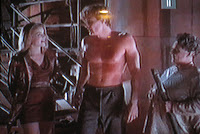
The list of mostly forgettable science-fiction popcorn films produced by Charles Band’s Empire Pictures in the ‘80’s is for the most part an unchallenging intellectual vacuum. In many cases that is what makes them so mindlessly entertaining. With a naïve innocence that can only come from sincerity and a (relatively) low budget, Arena is a shining example. It doesn’t require any mental acrobatics or ask any hard moral questions, but it was a little better made than most of the Empire Pictures catalog. Arena is at some six years distance, clearly riding on the coat-tails of Star Wars. It is not surprising then that in addition to its Empire pedigree, Arena should suffer from many of the same philosophical shortcomings as its source material.

With nowhere else to go after losing his job on a space-station somewhere in the universe, Steve Armstrong (Paul Satterfield) bunks with his former coworker Shorty in the slums. Here he meets a destitute bum, the last human champion of the Arena, an intergalactic boxing competition that has been dominated by aliens for the last five decades. He anoints Steve as the next human champion of the Arena making him quite literally the Great White Hope in space.
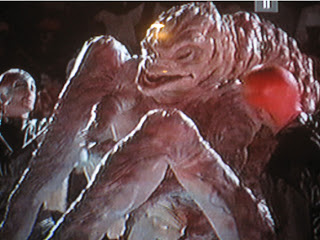
The man in the Sloth suit is future director Steve Wang

There are two categories of aliens that populate Arena and highlight Steve’s messianic status. Both are visibly differentiated from the protagonists. The first are helpers, house-aliens who are silly and or dumb but totally harmless. To remove any ambiguity, the second group, Steve’s rivals, are not only visibly different but especially hideous, making them even more clearly unsympathetic and evil, and giving the good aliens excuse to support the collective restoration of a properly ordered hierarchy  without appearing overtly Uncle Tomish. Steve’s final opponent, the present champion Horn is also a cyborg. As such he is not only a direct threat to and reaffirmation of human physical purity, but a confirmation of the physical corruption and immorality of the non-human which has to “cheat” in order to win. And in fact, that’s precisely what Horn’s manager Rogor does when it becomes clear that Steve is going to beat his fighter.

Jade (Sharri Shattuck) a sultry nightclub performer (Shattuck actually performs several of Richard Band's songs) and Rogor’s lapdog is sent to seduce and poison Steve before the championship fight. Yet despite a romp through the futuristic spacy mylar sheets in Jade’s cat-box, her eroticism does not bode well for the normative settled family relationship. Instead, there is Quinn (Claudia Christian,) a reserved, practical woman carrying on her father’s legacy as a boxing manager. It is with her faithful encouragement and training that Steve will restore hetero normative values to the universe. Can there be any doubt that our ubermensch will succeed in setting all of this straight when the distinction between right and wrong is so clear-cut?
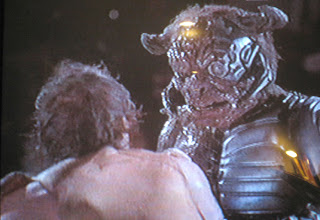
The ultimate Buck?
Despite all of this 50’s era conservative paranoia, Arena is still enjoyable for a number of reasons. The practical special effects provided by Screaming Mad George are better done than most of Band’s films. Arena is also distinctly more working-class than its big budget franchise predecessor. Boxing, which is really all the Arena fights are, has always been viewed as a proletarian sport. Related to this is my final assertion that Arena’s settings capture perfectly the appeal of the mundane. From the diner of the opening sequence, to the slums where Steve is verbally identified as the hero (it’s always been visually obvious), to the contest itself where order is restored, Arena is fiction made tangible. Without throwaway details like burned eggs and garbage, it would be just another space movie. Narrative details that speak to perceived experience are what make good fiction. Unfortunately that’s why audiences rarely question such obviously reactionary symbolism when couched in throwaway sci-fi fluff.


This beautiful VHS insert comes from Japanese VHS Hell, go visit 'em!

23 August 2010

Night of the Sharks


Italy – 1988
Director – Tonino Ricci
Media Home Entertainment, 1990, VHS
Run Time – 1 hour, 27 minutes

Whether or not he intended it, writer/director Tonino Ricci managed to revive explicitly in Night of the Sharks many of the cinematic tropes that had become taboo yet implicit in popular Euro/American film by the time this was made. It immediately evokes an era when overt racial characterization was the norm, with ethnic characters that are so cartoonish that they seem to belong more in an American film of the 40’s or 50’s than of the late 80’s. It’s as if the practiced subtlety of Hollywood prejudice was profoundly lost in translation. Perhaps Ricci (who also co-wrote) thought that if he was just more blatant audiences would like it that much more. Because of a few moments of sloppy editing I get the impression this film was longer and gorier at one point but was cropped to retain what must have been perceived as the more appealing elements in a trimmed running time. At 87 minutes, a poor mix of action and intrigue steeped in crude racism barely warrants the title “Night of the Sharks”.

Life in the affluent U.S. is difficult. One must toil and toe the line to keep even a modicum of dignity and stability, and a lifetime of struggle rarely results in anything more than terminal averageness. That is why Latin America and the Caribbean are so appealing. It is untroubled by the modern complexities of civilization, making it desirable, nigh on imperative that Northerners take advantage. Domination isn’t a matter of intent then, it’s simply the natural state of things because those Others are in need of leadership and guidance. Of course, no matter how hard they try they can never quite achieve parity. It is a well worn assumption that the Global South is an impoverished and backwards fruit ripe for the gringo picking. If you want something or want to make something for yourself, Latin America is the place to go. It is escape and opportunity all in one. All of this is simply the backdrop however for Night of the Sharks' peculiar Italian take on the transnational cultural politics of the Americas.


The anonymous* locals in this case fit the bill perfectly. Lazy, shiftless men sit around waiting to fight gamble or drink, both at the slightest provocation. The local woman Juanita in particular is the idealized exotic subject, never quite acceptable in polite white society, but desirable and always, always available to satisfy the protagonists needs no questions asked. Dave (Treat Williams) likes to spend his time in a sleepy beach village drinking beer, sleeping with Juanita and laughing at the bufoonish antics of his buddy Paco (Antonio Fargas). Paco also serves as Dave’s foil, being both black and Latin (Panamanian to be exact) and dressed awkwardly to the nines in a baggy white suit. His is the quintessential “coon” character, cowardly, lazy and constantly pulling inept attempts at “refinement,” all which serve to reify Dave’s superior cultural status over and over again.


Dave’s reverie of self-satisfaction is soon wrecked by the arrival of a series of painful reminders of his former life. His brother James shows up from the States with a load of stolen diamonds and a bunch of hired goons trying to get them back. Shortly after James is killed leaving Dave with the diamonds, Dave's ex-wife Liz also shows up to to make things even more difficult. Liz repeatedly tries to deny Dave the expression of his masculine independence, something Juanita surely never did. However, she is reassuringly white and thus poses no threat. Juanita suddenly vanishes from the script, nowhere to be seen.

The remainder of the story are Dave's confrontations with these external reminders; quibbles with Liz, trying to keep Paco in line and one prolonged shootout with the goons sent to recover the diamonds. But the plot does actually feature a shark, the one-eyed “Cyclops” with whom Dave has a longstanding rivalry. Cyclops makes his presence felt in important if peripheral ways. Dave and Cyclops’ relationship is really more symbiotic than antagonistic to tell the truth because Cyclops never goes away and is never defeated. It is Dave’s lingering sense of identity and past, a perpetual threat of return to anonymity. Dave has tried to escape, and he won this battle, but no matter how easy his exile may be or how much he tries to justify it, it is always there waiting in the reef for another chance to bite him in the ass.

* NotS was filmed in the Dominican Republic

This gnarly screencap of Janet Agren's Liz getting recycled by Cyclops only lasts about .5 seconds on this VHS version so I think it was sloppily censored. I don't know what would make someone think that cheesy gunfights and Jim Crow should be left in instead. Maybe they knew their target audience better than I give them credit for.
\
 An amazing poster by prolific Italian artist Symeyoni, from Wrong Side of the Art


Poster that became the VHS box, this comes courtesy of Movie Poster Shop
. The artist's signature is "S. Dewey", but I cannot find anything else on or by this person. Any tips would be appreciated.

04 June 2010

I Crossed the Color Line/The Black Klansman


United States - 1966
Director - Ted V. Mikels
A.K.A. The Black Klansman


The fourth film from the one and only, vehemently independent corpse grinder Ted V. Mikels. At 81 ol' Ted is still crankin' out the sleaze.

I Passed For White


United States - 1960
Director - Fred M. Wilcox

The last film from decidedly non-prolific Wilcox whose prior film was the extremely classic Science Fiction epic Forbidden Planet of 1956. This type of undetected infiltration of white America film was particularly popular during the Cold War when everybody was a potential Soviet agent. I've read several university "studies" written at the time which claim that hundreds of illegal Mexican immigrants crossing into the U.S. at El Paso, Texas each day were actually Communist agents.

01 March 2010

Home Of The Brave


United States - 1949
Director - Mark Robson

If you did a cursory search for this movie title on the web, all you would find is the 2006 film of the same name starring Sam Jackson, Jessica Biel and 50 Cent. The original film is somewhat more difficult to find since it went out of print on DVD, but there are VHS tapes floating around out there.
If you're interested to learn more of the unique history of black film, please check out Separate Cinema for lots more images and information.

 
A lobby card from The Poster Palace

08 February 2010

Gumby and the Wild West


Gumby and the Wild West
United States
Director - Art Clokey
Avid Home Entertainment, 1991, VHS
Run Time - 1 hour

This volume is a mixture of anything remotely referring to the mythical American west and a few that don't. A confusing mix of naive racism and naive empathy and Gumby's usual childlike association with fantastic nonsense. I cannot find exact dates for any of these episodes. Amazon has this tape listed as "volume 4", though I can find no such label on the cassette or box. As with Gumby Magic, I think it's just an arbitrary designation particularly because the tapes with actual volume numbers are released by F.H.E.

Episodes:
The Kachinas
• The Glob*
• School For Squares
• Goo For Pokey
• The Golden Iguana
• A Groobee Fight
• Hidden Valley
• Tricky Ball
• Ricochet Pete

*features the same public domain music that is featured prominently in Night of the Living Dead.

21 October 2009

Limit Up

Boy was I lucky, a couple of years ago when I ordered a copy of the Anna Nicole Smith movie To The Limit the seller accidentally sent me Limit Up. Easy mistake to make, but when informed of the mishap they still sent me To The Limit and let me keep Limit Up at no extra charge!

United States – 1989
Director – Richard Martini
MCEG Virgin Home Entertainment, 1990, VHS
Run time – 1 hour, 28 minutes

In the long history of European contact with the African continent and New World the darker races have always held a frightening mystique for the white man. Unable to trust or to resist them, the dark “other” is conveniently blamed for Whitey’s own moral weakness.
Begin with naïve white girl Casey (Nancy Allen of Robocop), a country lass of sorts unfamiliar with the ways of the city. The city in question is Chicago where the Mercantile Exchange and its mountains of grain cry out to be traded with excessive gesticulation. And our country girl yearns to gesticulate, but this match made in heaven is stopped short by the subtle name and arrogant patriarchy power of alpha-male trader Oak (Dean Stockwell of Quantum Leap & Blue Velvet)

Thus, pity is suitably conjured in the forces that be and Casey’s very own Magic Negro is summoned from the inner-city ether. But Nike is no ordinary Magic Negro, she is the first self referential Magic Negro, possessing the amazing ability to manifest herself as any of the myriad racial stereotypes that lie at the very root of her inception. Thus, the last of Casey’s innocence is shed at the behest of a fast talking mammy. But Nike offers more than just broken hope, she also offers the possibility of redemption. At the price of Casey’s soul.


Surprise! Nike is actually an evil Magic Negro in the employ of a Dixiecrat Satan who sometimes likes to upset the status quo, but only in slow, plodding barely discernable steps. Casey can enjoy a little success turning the man’s world upside down, but adding the adjective white in front of man’s world and you’re upsetting the quo a little too much. America just isn’t ready for that. So Casey’s dreams are semi-realized, not through hard work and perseverance, but by superstition and reliance on a time tested hierarchy of racial dominance. Upon reaching the top of the heap Casey decides that Nike’s usefulness is at its end and declines to fulfill her side of the bargain.

And that’s okay since based upon no particular ability or work of her own Casey is now successful, famous and solidly rooted in the dominant class. She can learn her lesson with a little good natured ribbing from her new maid, Nike (see back cover).
Yep, we were just kidding, Nike really is just a regular old Magic Negro. After a brief stint of housecleaning she returns to the slums to stand around the barrel fire with her boss God, (Ray Charles, no shit) and plot their next dastardly social retrenchment.


A couple of VHS boxes I borrowed from Living On Video

27 July 2009

Braddock: Missing In Action 3


Chuck extends his disdain for Asians beyond adults and applies it to their offspring in this VHS cover from the compulsive VHS fiend Scandy Factory

United States - 1988
Director – Aaron Norris
Media Home Entertainment, 1988, VHS
Run time - 1 hour, 41 min.

I know you've been jonesing for the conclusion of this epic series just to get it over with, so here it is. Aaron Norris' first feature film after years of serving as Chuck's stunt double/stunt coordinator. No surprise that MIA3 once again stars his older brother, a partnership that has lasted with almost mutual exclusivity until the present. Hell, I'll say it, they're married. On top of that, as if it could get any more grotesquely fraternal, Chuck co-wrote the script.

Disregard the timeline and events of the first two movies, and MIA 3 quickly makes sense. Braddock is a random Colonel in Saigon during the withdrawal of '75. His Vietnamese wife gets lost in the crowds of refugees and just as he arrives he sees her friend get incinerated, and thinks it's her. Years later a priest working in Vietnam (Yehuda Efroni from Delta Force) visits the US and informs a "bitter, distant vet" Braddock that his wife and child are alive, and not well in Nam. An immovable Braddock scoffs. Seconds later he is harassed by the CIA who confirm the rumor of his wife but warn him not to step on their toes.

"I don't step on toes. I step on necks."

Flash to Bangkok. Outside a bar in a Thai cop-car Braddock's fake, highly irritating Australian friend is waiting, and together they have a car chase with the Bangkok police. Flying to Vietnam minutes later, Braddock pushes his tiny jet boat out the back of the plane and jumps after it. After landing he equips himself with a massive unwieldy boom-stick but no extra ammo. After a touching reunion with his family they are all captured by another evil Vietnamese. The wife is killed outright and Braddock and the son taken to prison camp where Braddock endures some creative tortures administered by an eager General Quoc. After predictably resisting, he is escorted back to his cell where, due to ineffectiveness of evil lackeys,, he escapes, and conducts string of explosive narrow-escapes.

A disturbing scene is inserted here of a guy attempting to rape a young girl as the camera cuts back and forth from her tearful dirty face to his sweaty mustachioed balding face - then to Braddock's vengeful kick to the face! Now, Braddock flees with all the children in tow, sniffing the air for signs of trouble.

To keep the poor weak children from having to walk, Braddock steals another damned plane, and as it takes off lumbering along, the Vietnamese military, suddenly the epitome of ridicule, is unable to hit a moving object with sheets of gunfire. Inexplicably, not due to said gunfire, an engine quits, and the plane goes down, forcing the children, who all survive the crash, to walk anyway. Pointless plot device inserted for no other reason than to shallowly epitomize lead character's impossible invincibility.

At the last moment, a few feet from the border, Braddock expresses a single heartfelt sentence to his son Van; "You're everything I wanted in a son."
And mid reply: "You're everything I wanted in…" Braddock gets up machine gun in hand and walks away to go kill more people.
If I wasn't alone, I'd try and choke something to death to prove to someone how fucking brutal this movie is making me feel right now. YES! Bring it! Oh, it's been broughten.


UK VHS cover above and this trailer for MIA 3 from the epically resourceful Cannon Films Archive YouTube channel.