I was spellbound by books like
Usborne Publishing's All About Ghosts, which documents real-life encounters with the spirit world, and I'll include the fictionalized novel of the allegedly true haunting known as
The Amityville Horror in that category as well (a book, incidentally, that I was forbidden to read because it was deemed too adult, so kept a hidden copy stashed in my 2nd grade desk.)
One haunting encounter I'd read that struck me as uniquely unusual and scary is that of a ghost dog, hovering outside an upper-floor window of a house,
and missing its head! That image stuck with me into adulthood, but I'd long forgotten the source.

Gotta love those ex-library copies!
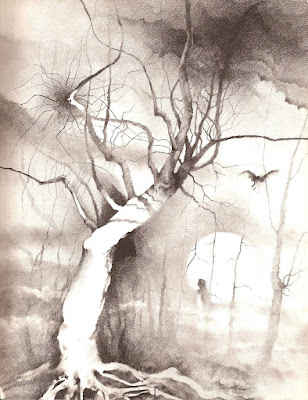
Thanks goes (again) to Kindertrauma for turning me in the right direction. The account, as it turns out, comes from the book Ghosts (1976, Seymour Simon, black and white illustrations by Stephen Grammell), part of "The Eerie Series" of supernatural non-fiction children's books. In nine chapters, Ghosts relays stories of real-life hauntings, as well as a few fictional tales from literature and legend.
It was in
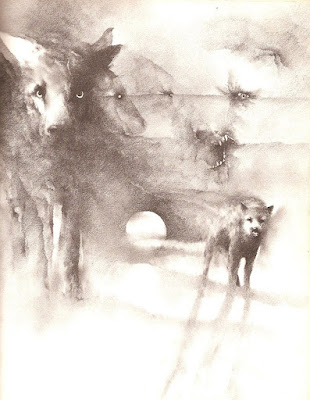
Chapter 8, The Hounds of Death, where I'd read about various encounters with ghostly dogs, including one that haunted a woman in Norfolk. Disturbed by the sound of scratching on her upper floor windowpane, the woman gets out of bed to find, "pressed against the glass...the huge form of a shaggy dog without a head."
Another chapter,
The Noisy Ghosts of Calvados Castle, is about a French castle where frightening screams, moans, and long shrieks have been heard as far back as 1875.
 The Nameless Horror of Berkeley Square
 is an "unspeakably horrible" ghost with many legs and tentacles and only a round hole for a mouth, that, in the late 1890s, came out of London's ancient sewers to haunt a townhouse.
 Chapter 3, A Long Island Spirit,
 is a more humorous than horrifying account from 1958 of a playful poltergeist that had been knocking over soda and perfume bottles in the Long Island home of James Herrmann.
The stories turn more disturbing in
The Restless Coffins, about a family crypt in Barbados where the coffins, several of them children's, are repeatedly found displaced and stacked in unaccountable ways.
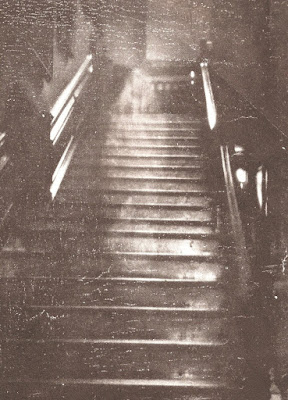
 The Brown Lady of Raynham Hall
 is about a ghost that had been haunting Raynham Hall in Norfolk, England, since 1835, and was allegedly captured on film by a photographer in 1936.
In
Chapter 6, The Ghostly Hitchhikers, we move into the realm of urban legend with two variations of the classic
hitchhiker campfire tale.
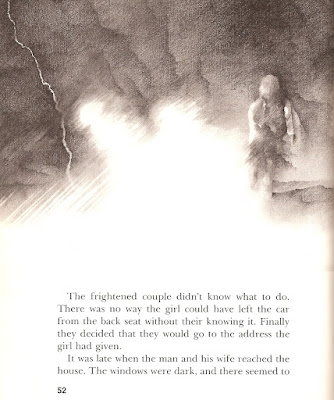
Ghost ships and sea haunts are covered in
Chapter 7, The S.S. Watertown Phantoms, while
Chapter 9, Haunted American History, takes us to the realm of early-American literature and legend, from White House hauntings to
The Legend of Sleepy Hollow.
 Ghosts-The Eerie Series
 can be
had cheap on the used market.