| Casting Jonbenet |
A Netflix original directed by young Australian auteur Kitty Green, CASTING JONBENET is a true story, on both levels: the back pages of making of a movie about a tragic event and the chronicle of how the telephone game distortion of memory+artistic recreation of that event can't help but distort, mythologize, and obfuscate. Rather than just recreate the infamous events of the JonBenet Ramsey case, Green lets the story come out via interviews and screen tests for the casting call of a "Lifetime"-style movie version that then we never see. The idea originally is that she is going to make a film on the case using the actual locations and casting only local actors from the Ramsey family's Colorado hometown, many of whom who knew the people involved, personally or indirectly. We're in a new weird zone for documentary. Bergman used a similar idea in Passion of Anna and Hour of the Wolf, by including interviews with the actors in between takes, but those were fiction films. Casting JonBenet, though technically a "making of" documentary, unfolds the details of a true crime story via interviews and some screen tests and never really makes the actual film they're testing for at all. The weird and original idea is perfect for the way we never which suspect's testimony is true. Is mom covering up for either her weird, possibly psychotic son or her weird, possible pedophilic husband? What about that three-page ransom note? Was it printed on the Ramsey's printer? What about JonnBenet herself? Was she abused by an archetypal stage mom (an ex-beauty queen), or was she just a brat? Was she really too good for this cruel world or vice versa? Recreating the testimony of real-life individuals who seemed to be 'acting' at their press conferences as a screen test is to rip the idea of consensual truth wide open.
Take for example the montage of auditions / screen tests of actresses re-enacting mom's initial (real-life, recorded) phone call to the police: A script in one hand, the phone in the other, several actresses carefully modulate the tremor of anxiety and desperation in their voice as they read from the script and feign possible feigning of real emotion. Are they judging the real life mom as guilty by playing up the feigning aspect? Or are they going for it--pouring on the grief and fear even though they know their limitations as actors might provide plenty of 'feigning' despite their best efforts? Green trusts us to unpack the massive electric charge inherent in watching an actor performing a real person's real but unconvincingly acted phone call to the police. How do you 'nail' a scene like that? Seeing more than one actress try reveals the mutability of truth at turns on its mythological axis. Even if we've never heard the actual Ramsey phone call (and we don't within the film, nor do we see any actual images of any of the actual participants) we know the 'type' from other crime shows. The child kidnapping/murder story is a tabloid boilerplate fastened with adamantine bolts to the mediated public consciousness, needing only new names to come fill the tray. Like jazz, the variations are endless yet iconic and unchangeable.
This is the source line of classic Brechtian theater - the refusal to let the audience drift too far away from the dialectic crux even while ever-lulling them with trinkets and shiny songs and whistles of narrative immersion. And man does Green stay Brechtian in her dialectic crux, bringing us back again and again to the impossibility of truth, only for the whodunnit aspect to lure our attention back to analytical mode (like we can solve it) and again back into conjecture and the dawning of myth. In this sense of the endless reenactment, Green's film becomes ceremonial. Events become mutable and abstracted by heightening their artificiality. We only gradually realize we'll never see the actual film she's casting.
This, whatever it is, is it.
But whatever it is, it's great: the cast interviewed cover not just their own hopes and dreams but their thoughts on the Ramseys--both speculation, personal observation from knowing them or living in the same town--and actor notes: their judgments are fairly evenly divided between suspecting the mother, the father, and the brother as either guilty or in collusion and not-- as some thought initially-- the mall Santa that mom tries to finger, or the skeevy pederast John Mark Karr, who confesses to the murder but who's proven to be nowhere near the scene. The actor cast in this role, Dixon White (below), gives the creepiest most memorable performance. Hearing how he prepares for a a character like this, entering this guy's mindset is to realize the true fearlessness of method acting. Few of us would dare delve that deep into the brain of someone so twisted, but thisacors plunges in and the film buckles a little bit under his intense stare once he goes into character.

By the time we get to Casting's weird, not entirely successful, all-in climax, we're left amazed that we ever had a concrete sense of reality at all. With so much acting and mask-wearing in our weird, kinky world, death's reality seems almost clown-like. Scenes of the actress cast as JonBenet enduring endless make-up prodding, painful hair extension inserts, flowers and a cowboy hat pinned to her scalp (all just to play a dead girl in a coffin) carry a morose but powerful charge that heightens the reality that only such double-artificiality can bring. When the back brush goes over her eye in one moment, the image is as clear as the last dissolve of Psycho from Norman to the grinning skull (top).

By contrast, the much-hyped NEON DEMON tried to deliver models playing dead but couldn't shake its overly familiar misogyny and dead-horse-beating message about vanity and youth worship. CASTING JONBENET, on the other hand, goes far deeper than cultural critique, it goes all the way into the eye of the image's eye of the image, so far it comes all the way back around, which is why it belongs more with Lynch's MULHOLLAND DRIVE.

Lynch's 21st century masterpiece was originally supposed to be a TV series, but the network passed on it, so the pilot was melded with new footage to 'close it.' There was a similar thing done with the pilot of TWIN PEAKS, for some international markets where it was shown theatrically (see here). If you can find this addition footage ending you can see a midnight hot tip call-in bring Cooper to a remote boiler room and a confrontation with Bob himself, here in a weird human form, hence killable --followed by a telling "25 Years Later" Black Lodge coda that's remarkably prescient to the new series. When MULHOLLAND DRIVE came out we figured it would be more of the same, and it kind of is, to a point. Scenes seem to promise to go somewhere, then trail off. Robert Forster's homicide detective gets only a single moment, as does (thankfully for I find him a most unsightly character), the dreamer in the Winkie's and the dirty hitman guy also seems like he was to have a more involved arc-- they all seem unfinished, arc for later episodes kept on more for their mood and their humor or scariness than story. But the deep rabbit hole the film ends up spiraling down, with the tiny elderly tourists trickling from the monster's paper bag and so forth, brings the events full circle and tightens the noose so fast we are left breathless.
| Kitty/ Kitty/ Kitty Green |
This, whatever it is, is it.
But whatever it is, it's great: the cast interviewed cover not just their own hopes and dreams but their thoughts on the Ramseys--both speculation, personal observation from knowing them or living in the same town--and actor notes: their judgments are fairly evenly divided between suspecting the mother, the father, and the brother as either guilty or in collusion and not-- as some thought initially-- the mall Santa that mom tries to finger, or the skeevy pederast John Mark Karr, who confesses to the murder but who's proven to be nowhere near the scene. The actor cast in this role, Dixon White (below), gives the creepiest most memorable performance. Hearing how he prepares for a a character like this, entering this guy's mindset is to realize the true fearlessness of method acting. Few of us would dare delve that deep into the brain of someone so twisted, but thisacors plunges in and the film buckles a little bit under his intense stare once he goes into character.
Lynch's 21st century masterpiece was originally supposed to be a TV series, but the network passed on it, so the pilot was melded with new footage to 'close it.' There was a similar thing done with the pilot of TWIN PEAKS, for some international markets where it was shown theatrically (see here). If you can find this addition footage ending you can see a midnight hot tip call-in bring Cooper to a remote boiler room and a confrontation with Bob himself, here in a weird human form, hence killable --followed by a telling "25 Years Later" Black Lodge coda that's remarkably prescient to the new series. When MULHOLLAND DRIVE came out we figured it would be more of the same, and it kind of is, to a point. Scenes seem to promise to go somewhere, then trail off. Robert Forster's homicide detective gets only a single moment, as does (thankfully for I find him a most unsightly character), the dreamer in the Winkie's and the dirty hitman guy also seems like he was to have a more involved arc-- they all seem unfinished, arc for later episodes kept on more for their mood and their humor or scariness than story. But the deep rabbit hole the film ends up spiraling down, with the tiny elderly tourists trickling from the monster's paper bag and so forth, brings the events full circle and tightens the noose so fast we are left breathless.
| The elderly exit the womb (Mulholland Dr.) |
At the time no one was quite ready for the reflexive meltdown critique of Hollywood and the psyche of the actress, this All About Aunt Acid Eve's Persona meta-miracle that we got with Mulholland Drive, but with each passing year it gets more relevant. It created a need for itself. In the recent BBC Culture poll of the 100 greatest films of the new century, it comes in at #1.
It's designed for repeat viewings-- only then does it begin to make "sense," like a mantra, or a magic spell --it's in the repeition that old walls are broken down to expose wider vistas. And now, well even more than before, Lynch's LA ain't yer mom's La-la Land - but the boulevard of actual dreams, good and bad-- the LA of literal dreams where once you get off that plane, you're never quire sure what reality is, or if it's even still there anymore. When someone says "Cut" while you're sitting in a restaurant do you automatically stop eating and look around for your director, only to slowly realize you really ARE just in a restaurant and whoever shouted it is probably shuffling cards? Maybe you could play a little solitaire, Raymond? (If you get that reference, you 'get' a star).
There are a lot of strange double negative truths to cinematic performance, the key one being that the more you let the seams show, the artsier (not sloppier!) you're being. If you are an actor playing a role and you do a good job 'you' disappear. But a bad one emerges, and if we like the actor as himself, we're kind of glad we didn't lose him to a character. No one wants to see Arnold Schwarzenegger disappear into a role like Sean Penn (or vice versa). BUT If you have a good actor playing an actor playing a role and they still disappear, they 'reappear' at the same time and in the process wind up achieving a level of truth that's impossible even in the relatively artifice-free realm of mundane daily life.
Brecht's withered corpse just slow-clapped in his crypt. Did you hear it?
If you're in the hands of an myopic visionary like Charlie Kaufman you may, on the other hand, overdo it--to the point even have an actor playing an actor playing an actor playing another actor and there accrues so many layers that the actor himself winds up trapped inside them and it becomes just that two-headed coin of narcissism and insecurity.
Kaufman's sexually frustrated self-conscious performer playing performer schtick has been a stone drag ever since we all felt that way as virgin teenagers. But for regular Joes like David Lynch, performance has a more fixed singular function. If there's sex to be had, it's had and then moved on past, and not all this '(literal) piece of shit at the center of the universe' moping or joyless smash-cut rutting. We know Lynch meditates-- and we can tell via his films that his ego is "right-sized." He doesn't even hide the sophisticated but out-dated type of woman characters he likes/writers-- with their strangely modern vintage clothing, shiny hair and fearless eyes, there as much of a type as Hithcock's blondes. For solipsistic loners like Kaufman, female characters fall into the duality of either being harpy/ lashing fury (a wife) or passive sex object (a fan!) as Freud would say "Ze boy is seeking a new mother whom he can zen reject." for Lynch, the pretty young ingenue is essentially a split character, not an object for self-laceration or fear/desire, but a dream anima - beyond duality. The dual lipstick pair-bond narcissistic amnesiac template in Mulholland of Betty and Rita adds a mythic ideal as old as western culture itself. ("No woman should have a memory," notes Lord Illingworth in An Ideal Husband. "Memory in a woman is the beginning of dowdiness.")
In Twin Peaks never see, for example, Laura Palmer doing charity work-- but we hear all the raves from the elderly lives she touched via Meals on Wheels, reading to the blind, etc. That and her romance with doe-eyed 'good' biker, James are the opposite of the bad girl side of Laura-- whose arc we follow with more interest. We see the aftermath of her drug use, her running with the bad dysfunctional crowd (wild-eyed Bobby, wife-beating Leo, fat-as-hell Jacques) and eventually the trauma that caused the split (her incestuous Bob-possessed father coming to her bed "since she was seven"), against which the saintly goodness of the daytime Laura scarcely registers. Lynch's druggy parties at remote cabins have a surreal prepubescent nightmare current to them, less a 'real' party and more a virgin child's wildest jealous imagination, infused as a result with hyper-surreal nightmarish quality, what McGowan calls Lynch's fantasmatic dimension.
To study the making of films in Hollywood (and the world) and the on-set drama that goes on, one is sometimes faced with tales of viewers/husbands/lovers fuming in the sidelines as their beloved gets it on in full nude scenes with some despicable actor she or he barely, knows while eight gaffers heavy breathe behind the kliegs. In Mulholland's torrid audition scene in Mason Adams' office (it made Watts a star!) we have the makings of a master thesis on the proximity between screen acting and prostitution. As I wrote in 03:, the prostitute and actress alike are judged on how well they can feign enjoyment of sex without making the john or their watching boyfriend, believe she actually enjoyed it--conveying being 'into it' without going so far into seeming to like it that the john thinks they shouldn't have to pay, or making their real life lover despondent. A prostitute or an actress may actually enjoy herself during the contracted sexual act as long as she pretends it's pretend enjoyment. Within her domain (the boudoir), the prostitute may be--more so than outside in the 'real' world-- completely "herself," - she may be experiencing that moment of complete subsumption into character which is at the heart of good acting. When "cut" rings out (or whatever the mutually agreed-upon safe word happens to be), she can resume the waking dream of societal expectations but until then she's free in the timelessness of the chthonic.
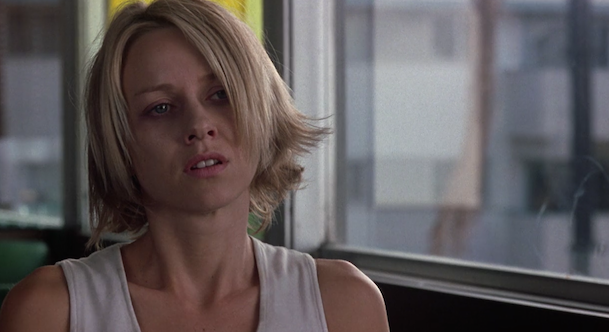
Of course that can lead to a kind of karmic celluloid looping (the actor who plays the same role onstage the same way, for a three-year Broadway run) that's escapable only if the script is deviated from, without warning, like Camilla's journey in the beginning of MD ("we don't stop here" - as if they've made the journey a thousand time-- and they have, more or less beginning and ending the film with it, yet they stop there--and she says they don't --every time). The crash forces us to wonder if it's the hit taken out by Diane against Camilla, or if there's a more sinister reason besides the treacherous curves and idiot teens combination of the titular drive. The deviation that sends Camilla down the hill to Aunty Em's house can be read as both the deal with the devil/mob (she's taken out of the car at gunpoint but then whatever was planned is interrupted by the crazy kids/concussion) and her own deal / deliverance - escape into a new identity (echoed in, for example, the presence of the same actress as Laura Palmer's cousin--but with dark hair this time, in Twin Peaks, or the prison cell switch from Bill Pullman to Balthazar Getty in Lost Highway; or the recent splitting up of Agent Cooper in Twin Peaks - the Return etc.)
We think we want to find out who we really are, to chase down the clues, but we don't, not really. For in finding out we also realize our entire life--this entire reality around us-- is an elaborate puppet show to distract us from panicking as we lay chained to the convey belt of sawmill Molloch. We're left with only a handful of decades, barely enough time to repeat the dirty trick on the next generation, and if we're artists, to maybe sew together some new puppets so they can forever dandle on the sawmill floor, free of splitting blades. The search for the meaning of the self always leads to the morgue, this Lynch and Green both know. In Drive. the trail of who post-accident Rita is always ends with the discovery of Diane Selwyn's dead body--a bit like Candice Hilligoss if she saw her own body being recovered from the river; or Jimmy the sax man finding his own body in the surf at the shocking conclusion of Jess Franco's VENUS IN FURS.

The mob, linked on some obscene fantasmatic level to the 'cowboy' (both a deep river 'big fish' childhood totem and Howard Hughes) have-long time Hollywood tentacles in the casting industry, ala THE GODFATHER's Tom getting godson Johnny Fontaine into Jack Woltz's FROM HERE TO ETERNITY-ish prestige pic (Theroux's frozen bank accounts = Khartoum's severed head). Camilla Rhodes' (alternately Laura Ann Haring and Melissa George) connection with them remains a mystery. It almost seems like they're doing it more for the benefit of some Kafka-esque attempt to drive the 'good' girl with the talent to insane frustration and cripple a director's project in the crib, to lay the groundwork for a deal with the devil (wherein 'wanting' to be famous eclipses actual talent or charisma as the guiding force - especially with state corruption [5] in the Arts Council). Or that famous line from Kafka's Before the Law: the gate was here solely for you, and now I'm going to close it.

One of the most sublime fusions of venue, screening time and film occurred for me seeing MD in a now long-gone family-owned cinema on 1st Ave UES, at the midnight showing opening weekend, the place was rundown but still clinging to the trappings of some long-since fallen into disrepair prefab maroon upgrade it got in the 80s. Operated by a large extended Indian family, the men in turbans and flowing saris mixed with jeans and sandals; the grandmother with her long braid of white hair ran the ticket booth; the children frolicking silently in the shadows around the snack bar, run by the mom, her long braid beaming black, the red dot in the center of hr forehead--gave the vibe an international vibe without going overboard. There was no Indian cooking smells or incense, just the usual popcorn but that was briefly overwhelmed by a stinking drunk homeless woman of enormous size who'd somehow gotten in and camped out a middle aisle seat. She was eventually loudly ejected by the older Indian lady no less, who shooed her out with a broom, to our muted cheers in the approx. time of the Winkie's episode; later, right around the time Betty and Rita were climbing into Diane Selwyn's apartment, I went to bathroom, which was right around one AM, and when the picture was starting to get super weird and somewhat boring for a first time viewer, at least enough to put me half asleep. I was sent by a series of signs on a long mystical journey underneath the theater, past various detours, piles of old chairs, puddles, and closed-off partitions until I came to the men's bathroom that looked like it belonged to a much older theater a block away, and old Indian man I can only assume was the grandfather was sweeping up, but making no noise. In my half-asleep, weirded out mind, his unexpected aura blazed like a whole different kind of lantern, yet he barely moved or made a sound
There was something quite reassuring about all this combined with the film; it made it seem like we were all sleeping over at this Indian family's surreal inn. With the film being what it was, it all made sense. I fell asleep around the time Betty climbs in Diane Selwyn's winodw; and yet was somehow I was still following events. Through some weird force I was dreaming while watching- third eye-open and trained on the screen-- like watching a movie in 3D and finally realizing I was wearing the glasses backwards, turning them around and--viola! The theater was one of the old type where the ceiling was low and the slope downwards small or almost nonexistent and the projector beam seemed to shoot right over heads so your head's silhouette blocked part of the screen if you stood up. Also we could hear the loud whirr of the projector in the quieter passages, or which there were a lot. Considering the post-modern meta-cinema qualities of the film, it fit is so perfectly. I know I myself was falling asleep to that soothing projector whirr, like white noise, and the blue light it streaming overhead matched the light of Club Silencio and when Rita O'Rio sings her a capella "Llorando" and the Betty and Diane cry from her passion, I could hear sobbing too in our own theater, as if our natural defenses had been lowered by the combination of being sleepy at a midnight show, the hour and the quiet nature of the film and the whirr of the projector all lowering our big city defenses so we had no ability to shut out the torrent of emotion the song + the response of these two women who--after their steamy hook-up--never do quite wake all the way up.
When we all were released after the film at 2 or 3 AM it felt like we'd all shared a marvelous weird dream together. We wordlessly bonded-- and outside in the late night air was this weird warm glowing mist. Everyone else on the NYC street was gone (we were around 89th St. and 1st). The streets were dead empty. And we all parted from each other hesitantly, almost like we would say goodbye to people we knew, though we hadn't said hello. We walked together as long as possible, barely speaking even to the friends we came with, the magic of the film following us home. As if to up the weirdness, I read a Village Voice piece (that I now can't find) mentioning the magic of their own screening and--from the description--I think it was at the same theater, maybe even the same showing.
I mention all this for a reason - to show the way meta can make the rest of the world--the world you're avoiding by seeing this film--the world you're escaping--come into deeper focus. The focus can in fact get so deep it resembles a dream and you realize reality is way more of an escape than you knew. Which is which becomes meaningless when you can no longer separate the two. That's when you know you're an artist, and it's time to go check in at the hospital. +++
It's designed for repeat viewings-- only then does it begin to make "sense," like a mantra, or a magic spell --it's in the repeition that old walls are broken down to expose wider vistas. And now, well even more than before, Lynch's LA ain't yer mom's La-la Land - but the boulevard of actual dreams, good and bad-- the LA of literal dreams where once you get off that plane, you're never quire sure what reality is, or if it's even still there anymore. When someone says "Cut" while you're sitting in a restaurant do you automatically stop eating and look around for your director, only to slowly realize you really ARE just in a restaurant and whoever shouted it is probably shuffling cards? Maybe you could play a little solitaire, Raymond? (If you get that reference, you 'get' a star).
There are a lot of strange double negative truths to cinematic performance, the key one being that the more you let the seams show, the artsier (not sloppier!) you're being. If you are an actor playing a role and you do a good job 'you' disappear. But a bad one emerges, and if we like the actor as himself, we're kind of glad we didn't lose him to a character. No one wants to see Arnold Schwarzenegger disappear into a role like Sean Penn (or vice versa). BUT If you have a good actor playing an actor playing a role and they still disappear, they 'reappear' at the same time and in the process wind up achieving a level of truth that's impossible even in the relatively artifice-free realm of mundane daily life.
Brecht's withered corpse just slow-clapped in his crypt. Did you hear it?
If you're in the hands of an myopic visionary like Charlie Kaufman you may, on the other hand, overdo it--to the point even have an actor playing an actor playing an actor playing another actor and there accrues so many layers that the actor himself winds up trapped inside them and it becomes just that two-headed coin of narcissism and insecurity.
(AS AN ASIDE WE'RE TALKING ABOUT CHARLIE KAUFMAN)
(WERE HE DEAD HE'D HAVE WANTED IT THAT WAY)
In Twin Peaks never see, for example, Laura Palmer doing charity work-- but we hear all the raves from the elderly lives she touched via Meals on Wheels, reading to the blind, etc. That and her romance with doe-eyed 'good' biker, James are the opposite of the bad girl side of Laura-- whose arc we follow with more interest. We see the aftermath of her drug use, her running with the bad dysfunctional crowd (wild-eyed Bobby, wife-beating Leo, fat-as-hell Jacques) and eventually the trauma that caused the split (her incestuous Bob-possessed father coming to her bed "since she was seven"), against which the saintly goodness of the daytime Laura scarcely registers. Lynch's druggy parties at remote cabins have a surreal prepubescent nightmare current to them, less a 'real' party and more a virgin child's wildest jealous imagination, infused as a result with hyper-surreal nightmarish quality, what McGowan calls Lynch's fantasmatic dimension.
To study the making of films in Hollywood (and the world) and the on-set drama that goes on, one is sometimes faced with tales of viewers/husbands/lovers fuming in the sidelines as their beloved gets it on in full nude scenes with some despicable actor she or he barely, knows while eight gaffers heavy breathe behind the kliegs. In Mulholland's torrid audition scene in Mason Adams' office (it made Watts a star!) we have the makings of a master thesis on the proximity between screen acting and prostitution. As I wrote in 03:, the prostitute and actress alike are judged on how well they can feign enjoyment of sex without making the john or their watching boyfriend, believe she actually enjoyed it--conveying being 'into it' without going so far into seeming to like it that the john thinks they shouldn't have to pay, or making their real life lover despondent. A prostitute or an actress may actually enjoy herself during the contracted sexual act as long as she pretends it's pretend enjoyment. Within her domain (the boudoir), the prostitute may be--more so than outside in the 'real' world-- completely "herself," - she may be experiencing that moment of complete subsumption into character which is at the heart of good acting. When "cut" rings out (or whatever the mutually agreed-upon safe word happens to be), she can resume the waking dream of societal expectations but until then she's free in the timelessness of the chthonic.
Of course that can lead to a kind of karmic celluloid looping (the actor who plays the same role onstage the same way, for a three-year Broadway run) that's escapable only if the script is deviated from, without warning, like Camilla's journey in the beginning of MD ("we don't stop here" - as if they've made the journey a thousand time-- and they have, more or less beginning and ending the film with it, yet they stop there--and she says they don't --every time). The crash forces us to wonder if it's the hit taken out by Diane against Camilla, or if there's a more sinister reason besides the treacherous curves and idiot teens combination of the titular drive. The deviation that sends Camilla down the hill to Aunty Em's house can be read as both the deal with the devil/mob (she's taken out of the car at gunpoint but then whatever was planned is interrupted by the crazy kids/concussion) and her own deal / deliverance - escape into a new identity (echoed in, for example, the presence of the same actress as Laura Palmer's cousin--but with dark hair this time, in Twin Peaks, or the prison cell switch from Bill Pullman to Balthazar Getty in Lost Highway; or the recent splitting up of Agent Cooper in Twin Peaks - the Return etc.)
We think we want to find out who we really are, to chase down the clues, but we don't, not really. For in finding out we also realize our entire life--this entire reality around us-- is an elaborate puppet show to distract us from panicking as we lay chained to the convey belt of sawmill Molloch. We're left with only a handful of decades, barely enough time to repeat the dirty trick on the next generation, and if we're artists, to maybe sew together some new puppets so they can forever dandle on the sawmill floor, free of splitting blades. The search for the meaning of the self always leads to the morgue, this Lynch and Green both know. In Drive. the trail of who post-accident Rita is always ends with the discovery of Diane Selwyn's dead body--a bit like Candice Hilligoss if she saw her own body being recovered from the river; or Jimmy the sax man finding his own body in the surf at the shocking conclusion of Jess Franco's VENUS IN FURS.
The Ingenue/Mistress to the Mob
Just as, in Lynch, the women are all the aspects of the same woman, who is in turn one aspect of a single psyche (the collective unconscious celluloid that runs through Lynch's Whole Self projector), so too the dark chthonic 'devouring father' is an aspect of that woman. If Betty/Diane is the unconscious anima to the male conscious ego (i.e. Lynch himself) then the unconscious's ego in turn has an inner male, a dark force of conspicuous enjoyment, the terrible father (ala Mr. Big in LOST HIGHWAY, and Frank Booth in BLUE VELVET), the one who separates the child from his mother, and who 'enjoys' all the women while the boys sulk and bide their time in the tall grasses, Moses and Monotheism-style; in MULHOLLAND he's a very shadowy nebulous figure in a wheelchair behind thick glass (the locked door to the ulterior basement of the unconscious mind, i.e the basement's basement) who sends his own agents and provocateurs out into the workaday world to inflict his seemingly trivial bidding (we're never permitted to learn why he is so insistent that Camilla Rhodes is "the girl" - is this payment for a separate 'deal'? Can Camilla really afford it? )
THE META LYNCH-IN
(A Sleepy Viewer is the Most Awake)
(A Sleepy Viewer is the Most Awake)
There was something quite reassuring about all this combined with the film; it made it seem like we were all sleeping over at this Indian family's surreal inn. With the film being what it was, it all made sense. I fell asleep around the time Betty climbs in Diane Selwyn's winodw; and yet was somehow I was still following events. Through some weird force I was dreaming while watching- third eye-open and trained on the screen-- like watching a movie in 3D and finally realizing I was wearing the glasses backwards, turning them around and--viola! The theater was one of the old type where the ceiling was low and the slope downwards small or almost nonexistent and the projector beam seemed to shoot right over heads so your head's silhouette blocked part of the screen if you stood up. Also we could hear the loud whirr of the projector in the quieter passages, or which there were a lot. Considering the post-modern meta-cinema qualities of the film, it fit is so perfectly. I know I myself was falling asleep to that soothing projector whirr, like white noise, and the blue light it streaming overhead matched the light of Club Silencio and when Rita O'Rio sings her a capella "Llorando" and the Betty and Diane cry from her passion, I could hear sobbing too in our own theater, as if our natural defenses had been lowered by the combination of being sleepy at a midnight show, the hour and the quiet nature of the film and the whirr of the projector all lowering our big city defenses so we had no ability to shut out the torrent of emotion the song + the response of these two women who--after their steamy hook-up--never do quite wake all the way up.
When we all were released after the film at 2 or 3 AM it felt like we'd all shared a marvelous weird dream together. We wordlessly bonded-- and outside in the late night air was this weird warm glowing mist. Everyone else on the NYC street was gone (we were around 89th St. and 1st). The streets were dead empty. And we all parted from each other hesitantly, almost like we would say goodbye to people we knew, though we hadn't said hello. We walked together as long as possible, barely speaking even to the friends we came with, the magic of the film following us home. As if to up the weirdness, I read a Village Voice piece (that I now can't find) mentioning the magic of their own screening and--from the description--I think it was at the same theater, maybe even the same showing.
| any similarities to a TV screen strictly sublime/accidental (my guess is a formative sexual-musical moment in Lynch's life occurred in front of a 50s-early 60s TV set, when some facsimile of this group came on Ed Sullivan or Bandstand or whatever NOTES: 1. I'd rather not go down this lane, as I'm as susceptible to hot button outrage and paranoia as the next man, and reading this stuff disturbs me. The result of getting too far into it is clear via the ridiculousness of armed civilians crashing the Bohemian Grove or Pizza Gate. Regardless of if it's true or not I personally can't believe it, for my own peace of mind, but the very hot button of it all is what fascinates me, the way our paranoid collective subconscious so mirrors the reports of actual programming that one can only assume it's intentional - either they imitate our dreams or our dreams imitate them. 2. Read the copious conspiracy theories Monarch 7 program's use of the Wizard of Oz as a hypnotic/programming tool (as seen in EYES WIDE SHUT) 4. Read my work-assigned synopsis/review here ("course description" at bottom) 5. According to my Argentine socialist ex-wife, talentless gangster progeny wanting to make movies are a problem in any country with corruption and a state-funded art council, like Argentina, Italy, Spain, etc.) In other words, the hack scribbling of the Great McGinty's nephew gets made word-for-word into a feature, not the talented visionary work of someone less connected - (since there's not even the public box office taste really relevant as a factor) Warning - Don't read the following ADDENDUM if you are not safely under a doctor's care. |
This audition scene is hot enough to wake the dead, but it's also very oddly sleepy for this same reason--Betty's performance could very easily plunge her down a rabbit hole of X-rated movies and then, who knows, bumming scabby cigarettes from gross scumbags before getting it on with them (presumably) in the back of a van in exchange for--presumably--money for crack and the promise to keep her eyes open for any new girls that might come staggering down from the Hills. And it seems like it will may have. But she reverts to Betty at the conclusion, safe amongst the small mostly female and neutered male (bald or elderly) assemblage as she would be at a post-church reception with her grandmother.
From a paranoid mind control Illuminati angle, we can also connect the Betty audition to the striptease (she calls it a 'job interview') Alice is forced to do at gunpoint for Mr. Eddy and his contingent in the LOST HIGHWAY flashback. The split subject then is explained through the elaborate mind control rituals, of which the connection between both HIGHWAY and DRIVE audition scenes connecting to conspiracy theories about Monarch 7 (1) or the collective subconscious and its tendency to arrange its repressed libidinal desires around pentagrams and black candles in some hidden room of one's parents' basement - with parents, grandparents, strange carnally-attuned neighbors with pointy glasses (like Nicki [Michele Hicks] below as the assistant to the casting director). Note the odd, knowing, carnal, paranoia-engendering gazes into camera below.
| Ready to bring you "over the rainbow" (2) |
Lynch knows, though. He's caught the big fishes.
------

------
PSYCHE FLOOR PLAN
Second (top) Floor
(Controlled by the Flow of "True" Events)
The Fishing Pier
Abstract thinking / super-ego / higher reasoning / artistic /: (FILMED) EVENT(Controlled by the Flow of "True" Events)
The Fishing Pier
Laundry chute to basement--> creative function / film (i.e. hearing voices flowing up from the depths and translating the narrative for the upper floors
steps - transitional - performance/ duty / expression, from effort to finished film.
First Floor
(Controlled by the Ego)
Waking Consciousness: (pay checks / paint brush cleaning / disclaimers / jail-time)-------------
POINT OF SEMI-CONSCIOUSNESS
(the fishing line)
steps down - transitional from awake to asleep'
THE BARRIER DOOR
--Water Surface--
BASEMENT
(controlled by the Anima)
Incestuous desire / childhood fantasy depository (glee that a different child than yourself is being beaten/ sexual desire for neighbors, fellow classmates, friends, etc.) - Little fish
Ulterior door/ barricade: Cover memory / split personality
crawlspace

For Lynch, a figure like the cowboy is a herald from one floor of consciousness to another, a sock puppet sent up from the lower basement, the agent of his own dark undersoul; the conveyer of actions dictated by the unseen monsters of power (seen here in big dark empty rooms --with nervous supplicants speaking to them from behind clear glass walls, a metaphor for the divider between unconscious and conscious, the way ideas and decisions are passed across a slot in the wall from the depths of psyche into action or art).
The levels of heavy power invested in these characters is impossible to understand until one translates their meaning across three spectrum - the meta outer spectrum (the blue-haired 'ultimate viewer / voyeur' at Club Silencio; the inner viewer (Camera POV) and innermost (character 'identification'). That a childhood icon (a popular plastic toy) like a cowboy to deliver these ultimatums is no accident: he's outmoded but recognizable, an ageless archetype as fitting in its proud anachronism as Sam Elliot in THE BIG LEBOWSKI.


Similarly JONBENET the film operates with multiple layers - with the innermost core being the mystery of 'whodunnit' the unknown story that no one could successfully descramble and so has fostered endless speculation; the outer--the narrative recreation; and the outermost - the casting and personal interviews - the telling difference which separates this from fiction of MULHOLLAND DRIVE is that the truth has a habit of doubling back around on itself while fiction tends to just reverberate out into the wilderness, i.e. the difference between bloating in a bathtub and dissolving in the ocean. So here the actors auditioning for the roles turn out to be friends and neighbors of the Ramseys, each with their own piece of the mosaic as precious yet macabre as a handkerchief with some of Dillinger's blood.
In Lynch's film, of course, there's no real blood, and all the handkerchief's have the same initials. The guy in the wheelchair is really one aspect of the same self that includes the cowboy, the mobsters, and both women; the fictive world of the film is as a universe exploded from the same ball of psyche. On the other hand, saying it's all one man's psyche doesn't mean its cast of voices is smaller than the Ramsey case's 'real' people cast. Events are rooted in time, relationships of cause and effect mutable only in the varying vantage points from which they are witnessed and remembered or performed, as if some endlessly variable mythic template (the way, say Pagans perform the roles of sun and moon during solstice). The world soul and the individual psyche are linked in ways that are beyond limitless. The brain might look like a ball of gray oatmeal but it's bigger than all the oceans combined and, if you try and get too close, will take a broken shard of mirror and fuck you up real pretty. But in the end, you will understand the most important truth--that there was nothing to understand at all. You can comb through that gray oatmeal for a thousand years and you will never find a thing, anymore than you can find George Jefferson's little shoes inside you TV set.

Ulterior door/ barricade: Cover memory / split personality
crawlspace
SECOND BARRIER
Laundry Chute 2
(Whatever lies beyond our conscious/unconscious' control/will)
Medium Fish
Medium Fish
Ulterior basement
(where Cronos is Chained)
(controlled by the Anima's Animus OR Illuminati/Reptillians)
(where Cronos is Chained)
(controlled by the Anima's Animus OR Illuminati/Reptillians)
Any actual (real physical space-time) incest / abuse
-TRUTH OF (Traumatic) EVENT
(repression depository for memories of actual incest, satanic abduction)
By the above Lynchian hierarchy of consciousness we can pinpoint the problem with False Memory Syndrome or SFS. Actual horrors endured are hidden below the sub basement level of merely repressed libidinal desires and fears, colored through lenses upon lenses warps upon warps etc. The traumatic real event from the basement (Mrs. Bates' actual withered skeleton in the dress) reaches up like a hand through the sock pocket of repressed unconscious desires (the frock and wig and Norman's mind), the hand reaching up through the laundry chute to kill women who arouse him (there's no lock on any of the doors between the floors of the psychotic, schizophrenic). The falseness of some recovered memories under hypnosis involves reverse-direction sock puppeteering that doesn't go far enough down, mistaking the sub/libidinal fantasy basement for the ulterior basement of actual truth. During the 80s Satanic panic it took the feds actually going down there and physically digging where all the bodies were supposed to be, under the foundation to where the ulterior rooms are, to realize there was nothing there - not ever (not yet anyway); the police were believing in empty sock puppets, because the puppets were covered in the sediment of their own deep wells, the collective subconscious hot button issues igniting us all to mob-style violence and outrage.
BIG FISH
---
For Lynch, a figure like the cowboy is a herald from one floor of consciousness to another, a sock puppet sent up from the lower basement, the agent of his own dark undersoul; the conveyer of actions dictated by the unseen monsters of power (seen here in big dark empty rooms --with nervous supplicants speaking to them from behind clear glass walls, a metaphor for the divider between unconscious and conscious, the way ideas and decisions are passed across a slot in the wall from the depths of psyche into action or art).
The levels of heavy power invested in these characters is impossible to understand until one translates their meaning across three spectrum - the meta outer spectrum (the blue-haired 'ultimate viewer / voyeur' at Club Silencio; the inner viewer (Camera POV) and innermost (character 'identification'). That a childhood icon (a popular plastic toy) like a cowboy to deliver these ultimatums is no accident: he's outmoded but recognizable, an ageless archetype as fitting in its proud anachronism as Sam Elliot in THE BIG LEBOWSKI.
Similarly JONBENET the film operates with multiple layers - with the innermost core being the mystery of 'whodunnit' the unknown story that no one could successfully descramble and so has fostered endless speculation; the outer--the narrative recreation; and the outermost - the casting and personal interviews - the telling difference which separates this from fiction of MULHOLLAND DRIVE is that the truth has a habit of doubling back around on itself while fiction tends to just reverberate out into the wilderness, i.e. the difference between bloating in a bathtub and dissolving in the ocean. So here the actors auditioning for the roles turn out to be friends and neighbors of the Ramseys, each with their own piece of the mosaic as precious yet macabre as a handkerchief with some of Dillinger's blood.
In Lynch's film, of course, there's no real blood, and all the handkerchief's have the same initials. The guy in the wheelchair is really one aspect of the same self that includes the cowboy, the mobsters, and both women; the fictive world of the film is as a universe exploded from the same ball of psyche. On the other hand, saying it's all one man's psyche doesn't mean its cast of voices is smaller than the Ramsey case's 'real' people cast. Events are rooted in time, relationships of cause and effect mutable only in the varying vantage points from which they are witnessed and remembered or performed, as if some endlessly variable mythic template (the way, say Pagans perform the roles of sun and moon during solstice). The world soul and the individual psyche are linked in ways that are beyond limitless. The brain might look like a ball of gray oatmeal but it's bigger than all the oceans combined and, if you try and get too close, will take a broken shard of mirror and fuck you up real pretty. But in the end, you will understand the most important truth--that there was nothing to understand at all. You can comb through that gray oatmeal for a thousand years and you will never find a thing, anymore than you can find George Jefferson's little shoes inside you TV set.
FURTHER: