Showing posts with label old school art. Show all posts

07 December 2025

Fight On! Issue 17 now available

As noted months ago here, the Old School Renaissance fanzine Fight On! has experienced its own renaissance. After spending a decade in a magically induced slumber, it awoke with an impressive new issue, number 15, during spring 2024.

Thankfully, that was not a one-off event. Since them, issue 16 has been published. And just this past Friday, issue 17 was unleashed onto the world.

Issue 17 features a rather nice cover illustration by the talented Peter Mullen:

Like every issue, issue 17 is available in PDF and print formats.

17 June 2025

Reflections on Middle-earth Roleplaying, Rolemaster, Against the Darkmaster, and Art

Back when I was a young lad and able to devote much of my time to role-playing games (late middle-school and high-school), I tried out a wide variety of different systems. Naturally, Dungeons and Dragons – and especially first edition AD&D – was a primary focus, given that it was the great colossus in the hobby during the 1980s, and everyone was familiar with it. But my friends and I also explored other games. We used our allowance money to try out alternatives like Dragonquest, Runequest, Thieves’ Guild, Traveller, Star Frontiers, and others. But our focus remained AD&D; it was the game with which we actually tried to play proper “campaigns” – usually failing for one reason or another, often with “total party kills” consciously or subconsciously engineered by tired or frustrated DMs. In contrast, we typically drifted away from the other systems after a couple of sessions. 

About halfway through high-school, though, my group – and especially me in my capacity as Game Master – shifted to Middle-earth Roleplaying (“MERP”). We still played other games – such as Call of Cthulhu and GURPS – but MERP became our main focus. My first “proper” campaign was one that I ran over a summer using MERP. The characters successfully completed a major quest and did some interesting things before my immaturity sadly led me to make some bad decisions that eventually caused the end of the campaign. Nonetheless, I remember it fondly, and parts of it vividly, even after all these years (almost four decades!).

Eventually we tried out Rolemaster as well. And although there were things about it that we liked, it proved less easy to use in play than the comparatively streamlined MERP. Sometimes we ‘mixed-and-matched’ things from the two systems, which was easy to do since MERP was a simplified “Tolkien-ized” version of Rolemaster (the relation between the two systems resembled that of Basic/Expert D&D and AD&D). In particular, the players used the individual weapon charts from Arms Law and spell charts from Spell Law, whereas I relied on the more general charts from MERP as GM. 

I continued to occasionally buy MERP and Rolemaster books even when I went to university and stopped playing RPGs regularly for a while. The Shadow World setting, by the highly creative Terry Amthor, especially intrigued me, although I never ran a campaign set in it. I bought the Rolemaster Companions as they were published and spent many hours daydreaming about the numerous options they provided (many of which, I recognized even at the time, were ill-conceived). However, the Middle-earth material remained my favourite. 

Given my longstanding interest in Rolemaster, I had known for many years that a new edition was in the works. This new version was ambitiously entitled “Rolemaster Unified” (“RMU”). It promised to “unite” elements of second edition Rolemaster (“RM2e”), the version that was dominant throughout the 1980s and into the early 1990s (later fixed up slightly and republished as Rolemaster Classic [“RMC”] around 2007) and Rolemaster the Standard System (“RMSS”), the even-more-complicated version that was published in the 1990s (a truncated version of which was later published in a single hardcover book, Rolemaster Fantasy Role-playing, with expansion books to cover the rest of system). I won’t delve into the edition differences here, most of which I have forgotten over the years. My perception is the RM2e/RMC remained more popular overall, but that RMSS had (and perhaps still has) strong advocates. Personally, after trying to GM some RMSS sessions about 25 years ago, I concluded that I preferred RM2e/RMC, and preferred MERP to both. 

In any case, given my gaming history, I was curious to see what the new version of Rolemaster – RMU – looked like. So, I recently checked out the products at DrivethruRPG. Alas, my curiosity was quickly extinguished. One reason was the price. Four PDFs are needed for the complete game, each of which is quite expensive. Given that I currently am quite happy with Against the Darkmaster (“VsD”) for this kind of game, and was simply curious about the new edition, my reaction was “no thanks.” (The complete rulebook for VsD in PDF is only one quarter the price of the four PDFs needed to play RMU.)

But just as much of a turn off as the price for RMU was the cover art. I would much prefer blank covers than ones graced with those pictures. I sincerely hope that the artist never reads this post, since I may come across as a bit mean here, but those covers are not ones that I would want to have to look at on a regular basis while playing a game every week.  

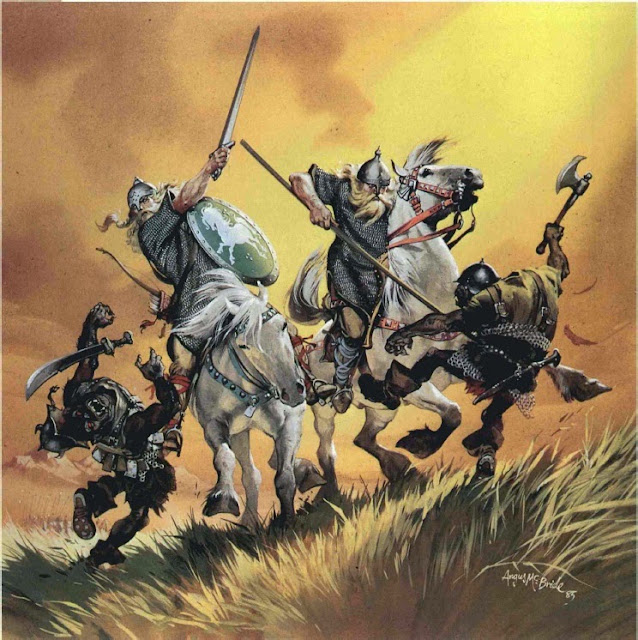
This made me reflect on the high quality of the art that characterized the main ICE (Iron Crown Enterprises) fantasy role-playing games – MERP and Rolemaster – during the company’s heyday from the mid-1980s to the early 1990s. That quality, for the most part, was due to the singular work of Angus McBride, whom I’ve praised many times at this blog in the past, including ranking him as one of the all-time greatest FRPG artists. 


That’s not to say that only McBride’s covers were excellent. The cover for the early UK edition of MERP was by Chris Achilleos and expressed a “metal” vision of Middle-earth better than anything else I’ve ever seen. (I remember seeing this cover in an advertisement in the UK gaming magazine White Dwarf back in the day and being bitter that I couldn’t purchase that version of the game in Canada.)

Also with respect to ICE’s Middle-earth line, the map artwork of Peter Fenlon was very important to me (and Fenlon is another artist whom I’ve praised here). Indeed, I spent hours just looking at Fenlon’s maps, thinking about how to detail the various locations on them (at least those that were not already described in the relevant Middle-earth setting books). I continue to cherish and use them to this day.


I actually started playing MERP before McBride started providing the covers for the line – although not before Fenlon started making the maps, as he was with the company from the start – so I don’t think my fondness for MERP was entirely due to the art. But I remember seeing McBride’s covers gracing the new MERP books and I can’t deny that they motivated me to buy a few more over the years than I would’ve otherwise. Certainly Middle-earth in my mind’s eye became infused with McBride’s vision of the world – and remains so even to this day.

I’ve mentioned before at this blog that I regard Against the Darkmaster (VsD) to be a worthy successor to MERP. It is not a “clone” – it changes too many things for it to be classified as such. But it is close enough to be readily compatible with MERP. I have had no difficulty in using elements of my MERP collection in both of my current VsD campaigns. 

In addition to its rules, VsD is also a worthy successor to MERP with respect to its art. The cover art for the core rulebook by Andrea Piparo is beautiful. 

The interior art for VsD is also of a very high quality. And I noticed an homage to one of my favourite McBride covers. (Unfortunately, I do not know which artist is responsible for the black and white picture below. The artists credited for the interior art are: Francesco Saverio Ferrara, Tommaso Galmacci, Rich Longmore, Heraldo Mussolini, Andrea Piparo, and Marcin Ściolny. The McBride picture was originally used for the Lost Realm of Cardolan module, and later used for the large Arnor book, which combined material from several earlier modules, including Cardolan.)


Well, this has been something of a rambling post. I guess that if I were to try to summarize my “key points” they would be:

  1. I liked MERP and Rolemaster (2nd edition) back in the day.
  2. Both MERP and Rolemaster, at least after the early days of ICE, benefitted from excellent cover art (primarily by Angus McBride). MERP also benefitted from amazing maps by Peter Fenlon. (The official RM setting, Shadow World, unfortunately did not enjoy as impressive cover or map art.)
  3. The cover art for the new version of Rolemaster (RMU) is not that great, in my view. The core rules also are quite expensive (even as PDFs). So I’m passing on RMU, at least for the time being.
  4. The rules for VsD are inspired heavily by MERP – and hence rock. The art for VsD is excellent as well. So I’m quite happy with the game overall – mechanically and aesthetically. 

Namárië!

09 October 2024

The Tome of Worldbuilding from Mythmere Games

I thought I’d mention that Mythmere Games is running another kickstarter. This one is for a volume entitled The Tome of Worldbuilding. The title pretty much sums up what the book is about: “The Tome of World Building is written by ENNIE-award winning author Matt Finch, author of the critically-acclaimed Tome of Adventure Design. Using the Tome of World Building, you can create fantasy worlds quickly and fill them out with a wealth of detail from the random-generation tables in this book.”

While Mythmere Games is known primarily for its Swords & Wizardry retro-clone – my favourite game of the “Old School Renaissance” and the one that motivated me to start this blog over fifteen years ago – The Tome of Worldbuilding is system-neutral. This also is the case for the other book that is part of this kickstarter, The Nomicon, which provides “new tables for name generation.”

More information about the kickstarter is available here.

The art samples look really great. I’m especially impressed by the pictures by Kennon James, which evoke the style of the late great Dave Trampier, while still being original.

Mythmere Games does great work. Check it out!

07 October 2024

Sale on issues 1-14 of Fight On!


As recently announced here, the Old School Renaissance fanzine Fight On! has returned to publication after a long sabbatical.

If you are missing PDF versions of the first run, issues 1-14, they currently are available in a bundle at Drivethru RPG for 50 percent off (34.99 USD). The sale will run until this Saturday (12 October 2024).

It’s great to have Fight On! back with us … and fighting on! 


30 July 2024

Fight On! Is Back

In the early days of this blog, when the “Old School Renaissance” scene was full of vim and vigour, a major player was the fanzine Fight On! It was a wonderful, eclectic, and somewhat chaotic journal, filled with fun scenarios, monsters, optional rules, and the like. I happily contributed a couple of articles back in the day (“Background Professions” to #5 and “The Duchy of Briz” to #7).

After a decade of enchanted sleep, Fight On! is back with issue #15. Here’s the blurb from the editor Ignatius Umlaut:

Ten years later, we are back from the dead to Fight On once more! These revenant runes are just as jam-packed as you remember with classes, monsters, spells, magic items, rules mods, homebrews, and awesome adventures in the spirit of the eldritch era of fantasy roleplaying! Dedicated to seventies D&D legend J. Eric Holmes, this issue brings together old and new stalwarts alike to celebrate our 15th issue and new beginning! With art and articles by J. Eric and Christopher Holmes, Tom Gordon, Calithena, Gabor Lux, Jeff Rients, James Maliszewski, Kesher, Pete Mullen, Cameron Hawkey, Zach Howard, Alex Schroder, Richard Rittenhouse, Settembrini, Patrick Farley, Jason Sholtis, Robert Conley, Kelvin Green, Philipp H., Attronarch, Mitzi!, and many more, this is the first of our new forays into fanzine fame and glory! Ride that wyvern while the sun is shining, and keep Fighting On!

My life with roleplaying games started with Dr. J. Eric Holmes’s Basic Dungeons & Dragons set back in 1980 (the one with chits instead of dice). So I’m especially keen to check out this issue!


[Picture by Peter Mullen from FO! 15]


10 July 2024

Trampier and Amthor inducted into the Gaming Hall of Fame

There is something called “The Academy of Adventure Gaming Arts and Design Hall of Fame.” It has existed since 1974 and includes many important game designers and artists. 

Since the Hall of Fame encompasses contributors to wargames, card games, and boardgames, as well as role-playing games, a lot of the people listed at the AAGAD Hall of Fame website are unfamiliar to me. But within the RPG world, there are many true legends.

In 2024, two people who have had a lot of influence on me during the many decades I’ve been involved in RPGs were inducted.

David Trampier – my favourite FRPG artist of all time (rivalled only by Angus McBride) – is now a member of the AAGAD Hall of Fame.

 
And Terry Amthor – a key contributor to the Middle-earth Roleplaying, Rolemaster, and Shadow World lines of Iron Crown Enterprises (Amthor was the primary author and creative force behind Shadow World, to which he contributed until his death) – also is now a member. (My current Ukrasia campaign draws heavily upon an early work of his, The Court of Ardor.)


Sadly, both Trampier and Amthor have passed away. But their contributions live on, and I am profoundly grateful to both of them for what they accomplished. 

10 January 2024

Jennell Jaquays RIP

It was announced over at the RPG Pub that the legendary adventure designer Jennell Jaquays has passed away.

Perhaps I'm somewhat unusual in this respect within the online ‘grognard’ community, but while I missed her early classic adventures (Caverns of Thracia, Griffin Mountain, Dark Tower, etc.), I was quite familiar with Jaquay’s illustrations for Iron Crown Enterprise’s old Shadow World (Rolemaster) products (as well as the ‘Nehwon Mythos’ pictures in the 1st edition AD&D Deities and Demigods). Indeed, I associate her artwork with my favourite book in the Shadow World series, Terry Amthor’s epic Jaiman: Land of Twilight. (Amthor is another recently deceased RPG legend.)

Here's the picture of the creepy "darklord" of Jaiman: “Lorgalis ‘the White’” (any resemblance to a certain Melnibonéan sorcerer-emperor is purely coincidental, I’m sure):


The Throne of the Dragon Lord:


And one of the ‘good guys’ – a rather unusual Loremaster:


Later (during 2000s) I picked up Thracia (the 3e version, and the PDF of the original) and some other classic things by Jaquays. I should be getting Goodman Games’ revamped version of Dark Tower (to which Jaquays contributed some new material, I believe) sometime later this year.

RIP.

26 November 2023

Erol Otus cover of Dragon Magazine now on my wall

I'm thrilled that I now have a framed print of the cover illustration by Erol Otus of the very first Dragon magazine that I ever owned (issue # 55) hanging on my wall:

The print is number 99 (out of 200) and signed Otus.

The original magazine cover:

The corner of my study:


06 July 2023

Old School Dungeons and Dragons Action Figures

These beautiful "action figures" recently arrived in my mail: 

I really shouldn't spend money on things like this, as they have no real "game utility" and will just sit on my bookshelf.

But, as the title of the blog indicates, I'm pretty akratic at times.

17 May 2023

Russ Nicholson RIP

Some sad news: the amazing artist Russ Nicholson has passed away. 


Nicholson probably is best known for his art in the Fiend Folio (1e AD&D), as well as his work in many of the classic “Fighting Fantasy” gamebooks, including the first one, The Warlock of Firetop Mountain


Fellow fans of Mythras may recognize his work from Monster Isle
One brilliantly disturbing example:


Back in 2011, I identified Nicholson as my 5th favourite FRPG artist of all time – and Nicholson was kind enough to post a “thank you” comment.

Many great works by Nicholson can found at his blog, The Gallery: Art of Russ Nicholson. (All of the illustrations in this post, except for the one of the Githyanki [which is from my PDF of the Fiend Folio], were taken from Nicholson's blog.)


RIP.


28 March 2023

Swords and Wizardry revised now live on kickstarter


First unleashed onto an unsuspecting world in 2008, Swords & Wizardry has been revised and cleaned up. Coming out via kickstarter, it promises to wreak even more havoc in the future! Its rules will now available under the Creative Commons License (rather than the Open Game License). Kudos to Mythmere Game for doing this!


As mentioned recently here, this blog started out as a way for me to share my house rules for S&W. Many of those house rules were later incorporated into the Crypts and Things FRPG. So, to put it mildly, this game has a special place in my desiccated undead heart!


The kickstarter is now “live” here. Unsurprisingly, it’s already exceeded its official goal. I encourage you to check it out!

18 February 2023

Preview of the new Erol Otus cover for Swords and Wizardry

Here's a preview of the new cover illustration by the legendary Erol Otus for the forthcoming version of Swords and Wizardry

I think it's meant to evoke Gandalf's famous stand-off with the balrog -- but this confrontation is outside, involves a weird insect behemoth (instead of a balrog), and the wizard is guarding his tower (I think).

I like the colours and the alien (almost Lovecraftian) look of the monster. 


31 May 2021

The Court of Ardor

One of my favourite campaign modules of all time is The Court of Ardor by Terry K. Amthor.


Ardor is set in southern Middle-earth. But the region – and especially the malevolent Court itself – does not fit well in that world. The background to the Court does refer to the roles of Morgoth and Ungoliant in poisoning the Two Trees of Valinor, Laurelin and Telperion, and the subsequent creation of the sun and moon by the Valar. These connections, though, fail to overcome the stark differences in tone between the module’s setting and Tolkien’s Middle-earth. The Court is a secret society of powerful magic-users (astrologers, sorcerers, mentalists, and the like); even the non-spell-casting members of the Court have access to powerful magic items. The magic system of Rolemaster simply does not work well for Middle-earth. Moreover, Amthor’s treatment of elves in this book is quite “un-Tolkien” in nature. (The themes of the setting, I think, anticipate Amthor’s later creation, Shadow World, with its secretive organizations of extremely powerful immortals.)


Its “non-Middle-earth” character aside, though, The Court of Ardor is a great fantasy setting. Indeed, it has been a wish of mine to use this module for a campaign for over three decades now. I would relocate it to a different world if I were to do so – specifically, I would embed it in a ‘homebrew’ fantasy setting inspired more by Michael Moorcock and Jack Vance than Tolkien. I probably also would change certain elements of the setting, in particular, the overarching aim of the Court, as well as aspects of some of the cultures and peoples.


The module focuses on the activities of the shadowy Court of Ardor, an organization of extremely powerful elves who are plotting something … both terrible and awesome. (I won’t say what here. What I’m about to write is mildly spoiler-ish, so skip down past the rest of this paragraph if you don’t want that.) The members of the Court all possess a magical deck of cards that portray their compatriots, and which enable them to communicate with each other. (Amthor confirmed in an interview decades later that this was inspired by the cards in Roger Zelazny’s “Amber” novels.) The deck of magical communication cards is quite cool – but, as I mentioned above, not exactly “Tolkien-esque” in nature.


Charles Peale’s illustrations of some of the members of the Court are – appropriately – in the style of cards:


There is only one illustration in the module that does not depict a member of the Court. It is of the bard “Klaen” – one of the few “good guys” in the region described in the module. It also is the only illustration not by Peale, but rather by Amthor:


Finally, like most of ICE’s Middle-earth modules, there is an amazing map by Peter Fenlon:


Hmmm… Perhaps I should use (a heavily modified version of) The Court of Ardor for a future Against the Darkmaster campaign…


(I had planned to write up this post weeks ago, shortly after my initial post on Peale’s artwork for ICE, but alas the end of the spring term overwhelmed me. Hopefully my blogging will pick up somewhat over the next few months.)

26 April 2021

Charles Peale – the fantasy artist

This is a post about the artist Charles Peale – no, not this guy! Rather, the artist who did a lot of the early interior black-and-white illustrations for Iron Crown Enterprises (ICE).


During its heyday of the 1980s and early 1990s, ICE boasted some excellent art. I’ve praised the amazing maps by Peter Fenlon here before, as well as the inspiring colour covers by Angus McBride.


Reading through the new fantasy role-playing game (a kind-of-but-not-exactly-MERP-clone) Against the Darkmaster (VsD), I felt compelled to look through some of my old MERP campaign and adventure modules. (Yes, despite having loads of work to do, I wasted some time daydreaming about someday running a VsD campaign employing these classic works.)  


Looking through these old books I was reminded of my fondness for Peale’s work. I really loved his line work, the ‘clean’ aesthetics of his pictures, and always wondered why ICE stopped using his material. ICE eventually switched to Liz Danforth for most of their interior art. While I like Danforth’s work well enough, I prefer Peale’s overall – there is, in my view, something ‘artificial’ or ‘stiff’ about the poses of Dansforth’s figures.


Anyhow, since I suspect that many people who occasionally visit this blog might be unfamiliar with Peale’s work, I thought that I would post some of his pictures here. It would be great if his work could be appreciated by a wider audience.


Here are some pictures from the Middle-earth modules Mirkwood, Isengard, Bree, and Cirith Ungol:


[Astrith -- a.k.a. the "Green Asp" -- of Calenhardon]
 

[Treachery in Cirith Ungol]
 

[Beorn in Southern Mirkwood]  


[Caline Halfelven of Cirith Ungol]


[Dwarves hiding from a giant spider in Northern Mirkwood]


[An orc follower of the Necromancer in Southern Mirkwood]


[Townsfolk of Bree]


[Saruman and Wormtongue in Isengard]


I will post some art that Peale did for the amazing campaign module The Court of Ardor later this week.

24 November 2020

The Monsters of Trampier

I’ve mentioned before here how much I adore the art of Dave Trampier (“DAT”). His work very much shaped the way in which I visualize fantasy adventuring—especially the more “gritty” kind characteristic of early AD&D and the World of Greyhawk

Of course, I’m not alone in my admiration! Today I stumbled upon a rather nice tribute to Trampier’s art in the Monster Manual at Heavy Metal (which I was surprised to learn still existed—I have distant memories of the magazine from my adolescence, but had assumed that it had gone the way of the Dinosaurs). 

The article mentions Trampier’s final year, including his interest in reengaging with the fantasy role-playing community, but which was thwarted tragically by his death in 2014. I find Trampier’s tale to be a mysterious and melancholic one. I can't help but wonder what amazing works he might have produced had he not walked away from it all in the late 1980s. But I am profoundly grateful for the invaluable contributions that he did make to our hobby.

Here are two of my favourite DAT illustrations: the Lizard Man and the Rakshasa. 

Blog Archive

About Me

My photo
I'm a Canadian political philosopher who lives primarily in Toronto but teaches in Milwaukee (sometimes in person, sometimes online).