You signed in with another tab or window. Reload to refresh your session.You signed out in another tab or window. Reload to refresh your session.You switched accounts on another tab or window. Reload to refresh your session.Dismiss alert
Historically some, practically zero in modern Korean language. A lot of modern texts are using form Hanja (Hangul) or vice versa. Ruby is not a part of Korean orthography standard.
Edit: Although ruby text are used in some publishing (especially for those uses Hanja extensively), for web there is not so much need for it.
bottom right seems to potentially be another case of inter-character which isn't covered by the current inter-character ruby design. Also ruby-align may need to add new value for it.
There are other things going on in the second of those, with dots and sometime double dots, sometimes to the side, sometimes between characters. Could you shed some light on that?
There are other things going on in the second of those, with dots and sometime double dots, sometimes to the side, sometimes between characters. Could you shed some light on that?
Contrary to the original description, dots placed aside characters are meant to mark tones, which was used in 15. century Korean. Dots placed under the character stands for a vowel Arae-A (아래아), which was used in old Korean language but its modern usage is limited.
I've seen a lot of examples of the ruby rendered inline, in a smaller font, as well. This should be using <ruby> markup ideally. I remember it was trivial to find examples of this in the bookstore, but I can't remember where I put those photos...
Example of Korean ruby, taken by me at Sungkyunkwan(성균관/成均館) in Seoul, Korea in September 27, 2019. 전통(傳統, reads “JeonTong” in Korean) 관례(冠禮, reads “GwanRye” in Korean) 계례(笄禮, reads “GyeRye” in Korean)
Activity
peremen commentedon Nov 18, 2017
topbottom, for vertical right or bottom right. (https://commons.wikimedia.org/wiki/File:Hunmin_Jeongeum.svg and http://kmug.co.kr/bbs/board.php?bo_table=job&wr_id=64982 )Edit: Although ruby text are used in some publishing (especially for those uses Hanja extensively), for web there is not so much need for it.
upsuper commentedon Nov 21, 2017
bottom right seems to potentially be another case of
inter-characterwhich isn't covered by the current inter-character ruby design. Alsoruby-alignmay need to add new value for it.r12a commentedon Nov 21, 2017
Bear in mind that we want to support digital publishing on the Web, not just ordinary web pages.
r12a commentedon Nov 21, 2017
@peremen Thanks for the comments and example. I added the pictures to the type-samples repo at w3c/type-samples#65 and w3c/type-samples#66.
There are other things going on in the second of those, with dots and sometime double dots, sometimes to the side, sometimes between characters. Could you shed some light on that?
peremen commentedon Nov 21, 2017
Contrary to the original description, dots placed aside characters are meant to mark tones, which was used in 15. century Korean. Dots placed under the character stands for a vowel Arae-A (아래아), which was used in old Korean language but its modern usage is limited.
r12a commentedon Nov 21, 2017
Great. Thanks!
r12a commentedon Jan 16, 2018
Reopening this, since i think we need to summarise it in klreq.
Also, the issue of intercharacter ruby raised by Xidorn needs to be taken into account for any gap analysis done for Korean.
fantasai commentedon Oct 4, 2018
I've seen a lot of examples of the ruby rendered inline, in a smaller font, as well. This should be using
<ruby>markup ideally. I remember it was trivial to find examples of this in the bookstore, but I can't remember where I put those photos...soon-bum commentedon Oct 7, 2018
ruby in Korean.docx
I've found four example photos (file attached)
studioego commentedon Oct 2, 2019
Example of Korean Ruby on Tex
KTUG's link: 루비
tex ksruby package pdf file from my git repo.
studioego commentedon Oct 2, 2019
Example of Korean ruby, taken by me at Sungkyunkwan(성균관/成均館) in Seoul, Korea in September 27, 2019.
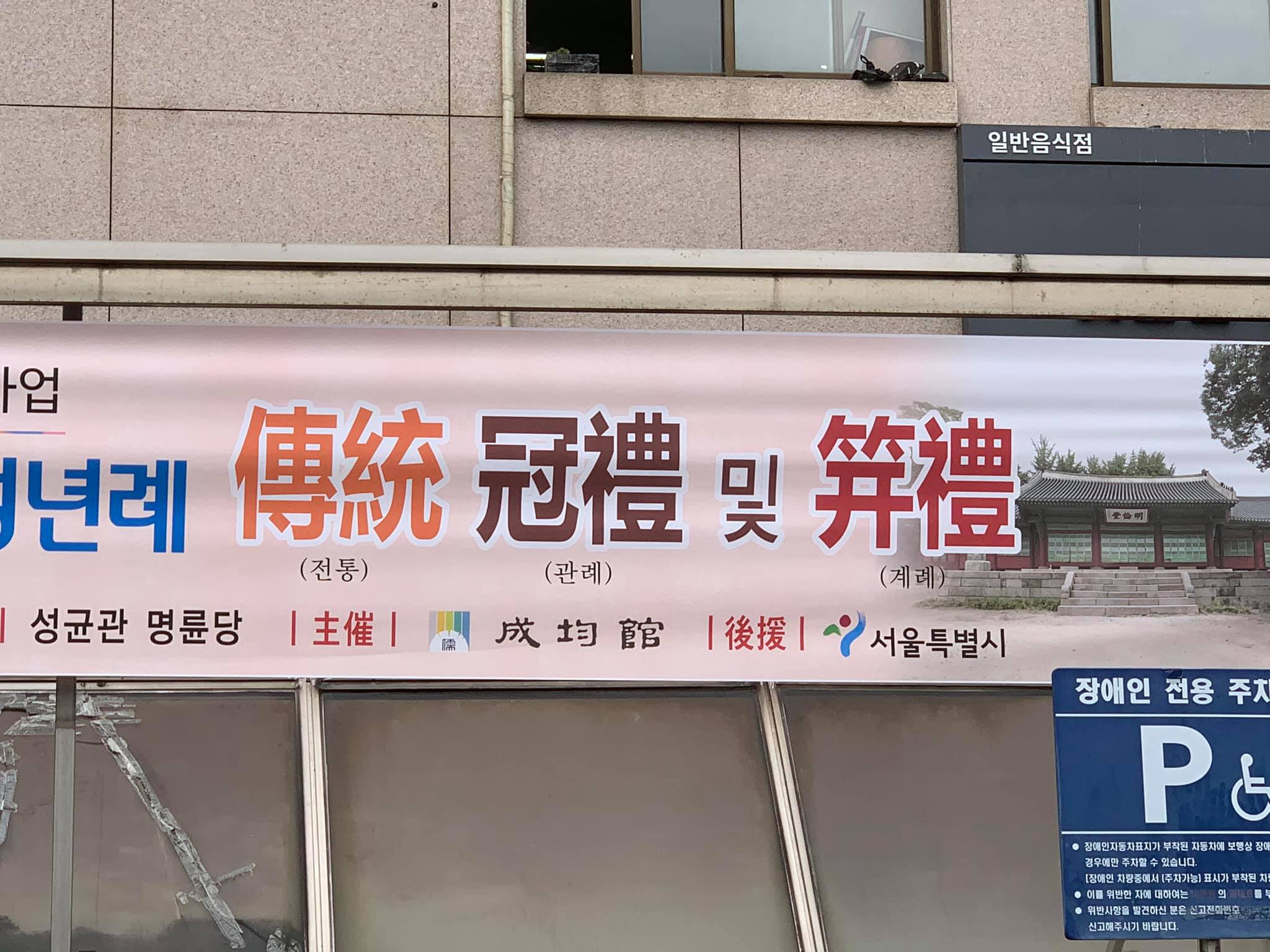
전통(傳統, reads “JeonTong” in Korean)관례(冠禮, reads “GwanRye” in Korean)계례(笄禮, reads “GyeRye” in Korean)